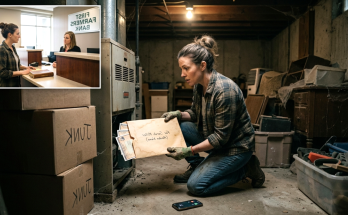
The first thing Dale said after Grandpa’s funeral was, “You can make three hundred dollars this weekend if you’ll do the basement.”
He said it casually, almost generously, while everyone else stood around Grandpa’s kitchen pretending not to notice how quickly the house had become an inventory. The refrigerator hummed behind us. Someone had left a casserole on the counter with its foil half peeled back. Outside, rain tapped against the windows, and Dale was already talking about what should be kept, what should be donated, and what could be sold.
I looked at him. “Three hundred for cleaning?”
“Just the basement,” he said. “Boxes, old tools, whatever’s down there. Most of it is junk.”
Pam, his sister, nodded from beside the sink. “Grandpa kept everything. Newspapers, broken lamps, old jars. It’ll take forever unless somebody just gets in there and works.”
Alan, my brother, was standing near the back door. He didn’t say anything.
That bothered me more than Dale’s offer.
Grandpa Henry had been dead for six weeks, and somehow Dale had already become the person who knew what everything was worth. He had arranged the estate paperwork. He had spoken with the realtor about the house. He had a folder on the kitchen table with handwritten lists clipped to it.
I had not wanted any of that.
I had wanted another month in which the house could remain untouched, with Grandpa’s coffee mug beside the sink and his old work jacket hanging behind the pantry door.
But grief does not stop other people from making plans.
“Why me?” I asked.
Dale gave a short laugh. “Because you’re family.”
That answer was almost insulting.
I was family when there was a basement to clean, apparently. Family when there were boxes nobody wanted to sort. Family when three hundred dollars needed to be saved from paying someone else.
I looked toward Alan.
He shrugged.
“You could use the money,” Dale said.
I almost asked him what he meant.
Instead, I said, “Fine.”
The basement door was at the end of the kitchen, beneath a narrow staircase where Grandpa had kept an old calendar with the year 1998 still hanging on it. I had seen that calendar every time I visited him during my divorce. Somehow he had never bothered to replace it.
I carried a cardboard box downstairs and turned on the single ceiling bulb.
The basement smelled of dust, concrete, and the faint mineral dampness that always clung to the walls after rain. Grandpa’s workbench occupied one corner. Rusted coffee cans held nails, washers, screws, and things whose purpose I had never understood.
I started with the shelves.
For the first hour, it was exactly what Dale had promised: junk.
Broken Christmas lights. A cracked fan. Three coffee tins full of bolts. A typewriter missing two keys. A box of magazines from the eighties. An electric heater that looked as if it had been dangerous when it was new.
I began filling boxes.
Every so often I found something worth keeping.
A pocketknife.
An old photograph.
A wooden bird Grandpa had carved for one of my sons.
I put those aside.
Around noon, I heard footsteps overhead.
Dale appeared at the top of the stairs.
“How’s it going?”
“Slow.”
He looked around.
“You find anything?”
“Mostly garbage.”
His eyes moved toward the far wall.
“Anything in the old storage area?”
“What old storage area?”
He pointed.
“Behind the furnace.”
I looked at the furnace.
There was a section of thin wood paneling behind it, partly hidden by a stack of paint cans.
“I haven’t gotten there.”
Dale’s expression changed so quickly I almost missed it.
“Don’t worry about that.”
I turned toward him.
“You just told me to clean the basement.”
“Yeah, but that part is mostly electrical stuff.”
He came down three steps.
“Leave the panel alone.”
I smiled faintly. “All right.”
He stood there for another moment.
Then he went back upstairs.
I listened to his footsteps cross the kitchen.
The back door opened.
Closed.
Then silence.
I stared at the panel.
People do not usually tell you not to look at something unless they have already imagined you looking.
I waited ten minutes.
Then I moved the paint cans.
The paneling was loose.
Not damaged.
Not rotten.
Loose.
I slid my fingers into a narrow gap and pulled.
The wood shifted with a soft scrape.
Behind it was a shallow space between the wall studs.
There was a brown envelope inside.
My first thought was that it contained photographs.
My second was that Dale had known it was there.
I pulled it out.
Dust coated the top, but someone had written a name across the front years ago.
NANCY LEE HARPER.
I stopped breathing for a moment.
That was my maiden name.
I had not used it in decades.
I turned the envelope over.
The flap had been sealed and reopened at some point.
Inside was a stack of savings bonds.
I counted them once.
Then again.
Seventeen.
The oldest was dated 1984.
The newest was several years later.
My name appeared on the registrations.
Not always alone.
Some read Henry Harper or Nancy Lee Harper.
Others carried names I recognized from Grandpa’s records.
I sat down on the basement floor.
The concrete was cold through my jeans.
I looked at the bonds again.
They were real.
At least, they looked real.
There was no reason for me to have seventeen savings bonds hidden behind a furnace.
And there was even less reason for Dale to have warned me away from that exact place.
I reached for my phone.
Before I called anyone, I noticed a smaller piece of paper folded inside the envelope.
It was a sticky note.
The handwriting belonged to Pam.
I knew it immediately.
Ask Dale if N.L.H. can be excluded if unclaimed.
I read the sentence three times.
N.L.H.
Nancy Lee Harper.
My name.
I folded the note and slipped it into my pocket.
Then I photographed every bond.
Front.
Back.
Serial number.
Registration.
Everything.
I had just finished when my phone rang.
Dale.
I watched his name flash across the screen.
I answered.
“You still at the house?”
“Yes.”
“How’s the basement?”
“Messy.”
He laughed.
“You find anything important?”
I looked down at the envelope.
“Maybe.”
There was a pause.
“What did you find?”
I could hear traffic behind him.
“Some savings bonds.”
His voice changed.
“Where?”
“Behind the furnace.”
Another pause.
Then, much more sharply, “Did you open them?”
“Yes.”
“What names are on them?”
I leaned against the wall.
“Why?”
“Nancy.”
“Why do you care?”
“I’m telling you, they’re probably worthless.”
“Then you won’t mind if I take them to the bank.”
Silence.
Then he said, “Burn them.”
I thought I had misheard him.
“What?”
“Burn them. They’re old paper. They aren’t worth anything.”
“You just asked me where they were.”
“I was asking because Grandpa had a lot of worthless junk down there.”
“Then why burn them?”
He exhaled.
“Because they’re not yours.”
I looked at the bonds in my hand.
“My name is on them.”
“That doesn’t mean anything.”
The line went quiet.
I could hear the refrigerator upstairs cycling on.
Then Dale said, “Nancy, just leave this alone.”
I ended the call.
For several minutes I sat there without moving.
Then I put the bonds back into the envelope.
I did not burn them.
I did not leave them in the basement.
I put them in my purse and carried them upstairs.
When I reached the kitchen, Pam was standing at the counter.
She looked at my purse.
Then at me.
“You done for today?”
“Almost.”
Her gaze stayed on my face.
“Find anything?”
I remembered her handwriting.
Ask Dale if N.L.H. can be excluded if unclaimed.
“No,” I said.
She nodded too quickly.
“Good.”
That one word stayed with me all the way home.
I drove straight to the bank.
The branch was small, old-fashioned, and nearly empty. A clock above the teller windows ticked loudly enough to make me aware of every second.
The woman who greeted me introduced herself as Mrs. Whitaker.
I placed the envelope on the counter.
“I found these in my grandfather’s house.”
She looked at the first bond.
Then at me.
“Henry Harper?”
“Yes.”
She examined the registration.
Then she looked at the next one.
And the next.
Her expression became more serious.
“Where exactly did you find these?”
“In his basement.”
“Did anyone ask you to destroy them?”
The question stopped me.
I looked down at the envelope.
Then back at her.
“Yes.”
Mrs. Whitaker’s hand froze over the bond.
“Who?”
“My cousin Dale.”
Her face changed.
“Exactly what did he tell you?”
I swallowed.
“He told me to burn them.”
She slowly placed the bond back on the counter.
Then she reached for the telephone.
“I’m going to ask someone else to look at these.”
I suddenly understood that the three hundred dollars had never been the point.
The money had been bait.
The basement had been the target.
And whatever Grandpa had hidden behind that furnace had survived six weeks after his death only because nobody expected me to look closely.
Click here to continue reading: PART 2: The Bank Found a Note Written About Me, and Before I Could Understand It, Someone Had Already Used My Name Inside Grandpa’s Missing Safe-Deposit Box
The Three Hundred Dollars Was Supposed to Buy My Silence, but the First Envelope Beneath Grandpa’s Furnace Made That Plan Impossible
Part 1 of 12