The email was short.
That made it worse.
There was no dramatic confession.
No elaborate scheme.
Just a few sentences from Oliver asking the attorney whether marriage to me would provide him with “any managerial authority” over the assets connected to the children.
The attorney had responded that he would have no automatic authority.
Oliver had replied with a simple thank-you.
That was it.
But dates have a way of changing memories.
I knew exactly where I had been five months before the wedding.
I had been working late.
Oliver had brought dinner to my office.
He had waited outside in the rain because visitors weren't allowed upstairs after eight.
When I finally came down, he was holding two containers of pasta and complaining that the sauce had gone cold.
I remembered laughing.
I remembered kissing him.
I remembered thinking I was lucky.
Now I knew that sometime around then, he had been asking a lawyer how much control marriage might give him over my family's assets.
I couldn't sleep.
At six in the morning, I made coffee and sat at the kitchen table.
Harry came downstairs.
“You're awake early.”
“Couldn't sleep.”
He poured cereal.
“Bad dream?”
“No.”
He looked at me.
“You sure?”
“Yes.”
He nodded and sat.
Children know when adults are lying.
They simply don't always know why.
After breakfast, I took him to school.
Then I drove straight to Denise's office.
The attorney who had handled Rachel's estate joined us by video.
His name was Michael Grant.
He had represented Rachel before her death and had helped establish the children's trust.
He looked uncomfortable.
“I wish I'd called you earlier.”
“You didn't know Oliver was planning anything.”
“No.”
“But you knew he asked questions.”
“Yes.”
“Why didn't you tell me?”
“Because he asked general legal questions. I couldn't disclose private conversations without a reason.”
I understood.
I didn't like it.
But I understood.
“What exactly did he ask?”
Michael pulled up the email.
“He asked whether a spouse could become a trustee.”
“And you said?”
“That it would require a formal change.”
“Could he have changed it?”
“Not without your consent.”
I looked at Denise.
“So the trust was never in danger.”
“The trust wasn't,” Michael said. “Your understanding of what he wanted may be more important.”
I frowned.
“What do you mean?”
Michael hesitated.
“He asked about control.”
“Control of what?”
“Everything.”
The word sat between us.
He explained that Oliver had asked about the house, investment accounts, insurance proceeds, and the children's trust.
Not all in one email.
Over several conversations.
Different questions.
Different dates.
Individually, they sounded ordinary.
Together, they formed a pattern.
I felt sick.
“How long?”
Michael looked down.
“Approximately eight months before the wedding.”
Eight months.
I had thought his interest in my finances had started after the engagement.
It hadn't.
The engagement had come after his research.
I drove home without music.
The road seemed strangely familiar.
A gas station.
A grocery store.
A coffee shop.
The school.
All ordinary.
I wondered how many times I had driven those roads while believing I knew what my life was.
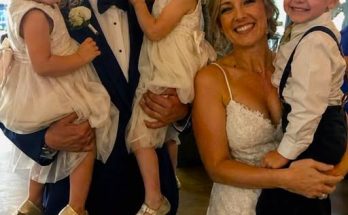
That afternoon, I found an old photograph.
It was from the day Oliver proposed.
We were standing outside the restaurant.
He was kneeling.
I was crying.
Rachel's daughters were behind us, laughing.
Harry was holding a small bouquet.
The picture had once been my favorite.
I looked at it for a long time.
Then I noticed something I had never noticed before.
Oliver wasn't looking at me.
He was looking past me.
Toward the children.
Toward the house key hanging from my handbag.
Maybe it meant nothing.
Maybe it meant everything.
I put the photograph down.
That evening, Sarah called.
I almost ignored it.
Instead, I answered.
“Hello?”
“Sharon.”
Her voice sounded tired.
“I need to talk to you.”
“I don't think that's a good idea.”
“Please.”
I said nothing.
“I didn't know how far Oliver had taken things.”
“You knew enough.”
“I knew he was interested in your finances.”
“Before he proposed?”
Silence.
That was an answer.
“You knew.”
“Yes.”
“Why didn't you stop him?”
She began crying.
“Because I thought I could control him.”
I closed my eyes.
“You couldn't.”
“No.”
“What did you think he would do?”
“I thought he would marry you and settle down.”
I almost laughed.
“Settle down?”
“He was desperate.”
“For what?”
“Money.”
The honesty stunned me.
“Why?”
Sarah took a breath.
“His business was failing.”
I sat down.
“What business?”
“He never told you?”
“No.”
She explained that Oliver had accumulated debt.
Credit cards.
Loans.
A failed investment.
A business partner who had disappeared.
Nothing sounded impossible.
But she said the debts had become serious.
“He thought marriage would solve it.”
“With my money.”
“Yes.”
“And you supported that?”
“I told myself it was temporary.”
I looked at the clock.
“What happened to the money he already had?”
“He lost most of it.”
I was silent.
Then I asked the question I had been avoiding.
“Did he ever love me?”
Sarah didn't answer immediately.
“I think he did.”
That wasn't enough.
“Did he love me enough to choose me without the money?”
“I don't know.”
Neither did I.
After the call, I sat alone in the kitchen.
The room was dark except for the light above the stove.
I thought about the recording.
About his words.
About the altered document.
About the email.
About the debts.
The pieces fit.
But there was one piece I couldn't place.
Why had he been so confident?
Why had he believed I would sign?
Why had he thought he could take control of the house?
Then I remembered something.
Three weeks before the wedding, Oliver had asked me whether I had ever considered moving the trust assets into one account.
I had laughed.
“Absolutely not.”
He had smiled.
“Just asking.”
At the time, I had dismissed it.
Now I wondered whether that had been a test.
Perhaps he had been measuring how much I understood.
How carefully I read things.
How easily I could be persuaded.
I called Denise.
“I want to know everything.”
“Everything about what?”
“Oliver's questions.”
She understood.
“I'll request the records.”
The following week was filled with paperwork.
Bank statements.
Attorney correspondence.
Old emails.
Dates.
Names.
Amounts.
Nothing was dramatic by itself.
But together, the pattern became impossible to ignore.
Oliver had known about the children's trust.
He had known about Rachel's insurance.
He had known the house was protected.
He had known that marriage alone would not give him control.
And yet he had proceeded.
That meant the altered agreement wasn't an accident.
It was an attempt to change the rules.
One afternoon, Michael called.
“There is another issue.”
“What?”
“The insurance proceeds were never entirely placed into the trust.”
I sat upright.
“What?”
“A portion was distributed directly to you.”
“How much?”
He told me.
It was significantly more than Oliver had ever been told.
I felt my stomach tighten.
“Who knew?”
“Your financial adviser.”
“Anyone else?”
“Not unless you told them.”
I thought back.
I had told Oliver once.
Not the amount.
Only that there was a distribution.
“Did Sarah know?”
“I don't know.”
That night, I checked my old emails.
I searched Sarah's name.
Nothing.
Then I searched Oliver's.
I found an email from nearly a year earlier.
He had written:
We should probably review the life insurance situation before we finalize everything.
I stared at the sentence.
Before we finalize everything.
There had been no engagement then.
No wedding.
No “we.”
Yet he had already written as if my finances were something he would eventually manage.
I forwarded it to Denise.
She called within minutes.
“Don't contact him.”
“I wasn't going to.”
“Good.”
“What happens now?”
“That depends on what he does next.”
I looked at the email.
For the first time, I realized something important.
The danger wasn't gone simply because the wedding was over.
Oliver had lost his easiest route into my life.
That didn't mean he had stopped looking for another one.
Two days later, a new envelope arrived at the house.
It wasn't from his attorney.
There was no return address.
Inside was a photocopy of a bank statement.
My bank statement.
Not current.
Old.
But private.
Someone had highlighted one transaction.
A large transfer from the insurance proceeds.
On the back of the page, someone had written six words.
You don't know what he already has.
I read the sentence twice.
Then I locked the doors.
For the first time since the wedding, I felt genuinely afraid.
Not of Oliver standing outside.
Not of another phone call.
Of the possibility that someone had been watching much more closely than I realized.
Click here to continue reading: PART 7: The Anonymous Warning Forced Me to Reopen Every Financial Record Until One Missing Detail Pointed Straight Back to Oliver
Two Days Before the Wedding, One Forgotten Phone Call Revealed the Man I Thought I Was About to Marry
Part 6 of 12