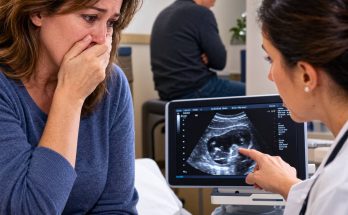
My heart began pounding before Dr. Evans finished reading the report. She had been studying the screen for several minutes, occasionally scrolling backward, then forward again, as if the same information might look different the second time. Finally, she folded her hands over the file and looked at me. “Susan, I need to ask you something about 2008.” The date alone made my stomach tighten. I had spent eighteen years trying not to think about that year.
“I was hospitalized in 2008,” I said. “After I overdosed.” Dr. Evans nodded. “That’s what your current medical history says.” She paused. “Were you ever told that you had surgery?” I almost laughed. “No. My husband told me they pumped my stomach and kept me for observation.” Her expression changed slightly. “Are you certain?” “As certain as anyone can be about something that happened eighteen years ago.”
She turned the monitor toward herself again. “Have you ever had pelvic surgery?” “No.” “Any gynecological procedure?” “No.” “Pregnancy?” My fingers tightened around the edge of the examination table. “No.” She looked up. “Never?” “Not that I know of.” She didn't immediately respond. Instead, she asked whether I had ever miscarried. I said no. Whether I had been pregnant after my son, Jake. Again, no. Then she looked back at the images.
“There are changes here that suggest you may have undergone a procedure,” she said carefully. “I don't want to draw conclusions from an old record that may be incomplete, but I think you should obtain your hospital records from 2008.” I felt the room become strangely quiet. “Why?” “Because something in your history doesn't match what I'm seeing.” Her voice softened. “And because if someone performed a procedure you don't remember, you deserve to know what it was.”
I drove home without music, without the radio, without even the usual habit of calling Jake during my commute. Every red light gave me another few seconds to remember the hospital. White ceiling tiles. The chemical smell of disinfectant. A dull ache in my abdomen. Michael sitting beside my bed and telling me everything was fine. I remembered his hand around mine. I remembered being terribly weak. What I didn't remember was surgery. Yet somewhere inside me, a fragment of memory stirred.
A nurse had stood beside the bed. She had looked at me, then at Michael. There had been uncertainty in her expression. Michael had spoken before she could say much. “She's still confused. The medication hasn't worn off.” At the time, I had accepted that explanation. I had been frightened and ashamed. I had overdosed after an affair that had already shattered my marriage. I hadn't wanted questions. I hadn't wanted anyone to look too closely at me.
When I reached our driveway, Michael's truck was already parked beside the garage. He was sitting on the back porch with a cup of coffee balanced between his hands. At seventy-one, he had become thinner than I remembered him being in our younger years. His hair was almost entirely white. His wedding ring hung loosely on his finger. Whenever he was nervous, he rubbed his thumb across it. I had known that habit for three decades. I knew the movement before I even stepped onto the porch.
“You're late,” he said.
“I had an appointment.”
“With Dr. Evans?”
I stopped halfway through removing my coat. “How did you know?”
“You mentioned it last night.”
Maybe I had. I couldn't remember. I set my purse on the kitchen counter and watched him through the doorway. “She found something.”
His hand went still against the wedding ring. “What?”
“She thinks I may have had surgery.”
For just a moment, Michael's face emptied of expression. It lasted barely two seconds, but I noticed. After eighteen years of living beside someone who rarely spoke, I had learned to read small movements. His eyes shifted away. His shoulders stiffened. Then he reached for the refrigerator door.
“What kind of surgery?”
“I don't know.”
“Then don't worry about it.”
I stared at him. “That's all you're going to say?”
“If the doctor isn't sure, there's no point panicking.”
“She asked me specifically about 2008.”
Michael's fingers tightened around the refrigerator handle. “Why?”
“That is what I'm trying to find out.”
He opened the refrigerator and looked inside as though chicken breasts and leftover vegetables were suddenly more important than the conversation. “We should eat.”
“Michael.”
He shut the door.
“What happened to me in 2008?”
His eyes met mine. Something passed across his face that I had never seen there before.
Fear.
Not irritation. Not the cold disappointment I had come to expect from him. Fear.
“I don't know what you're talking about,” he said.
“Yes, you do.”
“Susan—”
“She told me to ask you.”
“Who?”
“Dr. Evans.”
His jaw tightened. He looked toward the window. Then, almost too quietly for me to hear, he whispered, “Why now?”
I felt a chill run through me.
“Why now?” I repeated.
He closed his eyes.
For eighteen years, I had believed Michael's silence was punishment. I had cheated on him. I had lied to him. I had become pregnant by another man and then, overwhelmed by guilt and despair, nearly destroyed myself. Afterward, Michael had never touched me again. We remained married, raised Jake under the same roof, attended family events together, paid bills together, and lived as though we were roommates who happened to share a history.
I had assumed he hated me.
Now I wondered whether hatred had ever been the whole explanation.
That night, I lay awake beside the empty half of our bed. Michael had slept in the guest room for years. At 2:13 in the morning, I finally got up. The hallway was dark. His study door stood at the far end, just as it had for years. He had kept it locked since 2009. I had never asked why. Perhaps I had been afraid of the answer.
I stood in front of it with my hand resting against the brass knob.
Then I remembered the filing cabinet.
Before 2008, Michael and I had kept our important papers there together. Tax records. Insurance policies. Medical documents. Property papers. Afterward, he had taken over everything. I had never challenged him. I had stopped asking questions long before I stopped hoping for answers.
The knob turned.
Unlocked.
I pushed the door open.
The room smelled of old paper and dust. Moonlight cut through the blinds in thin gray lines. I switched on the desk lamp. Nothing had changed. The same wooden desk. The same old computer. The same metal filing cabinet against the wall.
On the bottom shelf sat a cardboard box.
My hands were shaking before I even pulled it forward.
I found tax documents from 2007 first. Then insurance statements. Bank records. Property papers. Beneath them was a folder marked in black ink:
2008 — MEDICAL.
I opened it.
The first page was a hospital discharge summary.
Patient: Susan Miller.
Admission date: March 14, 2008.
Discharge date: March 19, 2008.
I stared at the dates.
Five days.
I had always believed I'd spent two nights in the hospital.
I turned the page.
Medication records. Blood tests. Anesthesia notes.
Then I saw a line that made my breath catch.
Procedure: Exploratory laparoscopic surgery.
I read it twice.
Then again.
“No,” I whispered.
The next document was a surgical consent form.
My name was printed at the top.
But the signature at the bottom wasn't mine.
I knew my signature. I had signed mortgage documents, tax returns, school forms for Jake, and countless ordinary pieces of paper. This wasn't my handwriting.
Beneath it was another signature.
Michael Miller — Spouse.
I dropped the page onto the desk.
My knees weakened.
He had signed permission for surgery on my body while I was unconscious.
And then I saw a handwritten note attached to the final page.
Procedure completed without complication.
Patient's husband informed.
Patient should not be told until medically stable.
I heard footsteps behind me.
I froze.
Michael stood in the doorway.
For several seconds, neither of us spoke. His eyes moved from my face to the documents scattered across his desk. I lifted the consent form with trembling fingers.
“You told me they pumped my stomach.”
He closed his eyes.
“I know.”
“You lied to me.”
“Yes.”
My voice became quieter.
“What did you do to me?”
He didn't answer.
I stepped toward him.
“What happened in that hospital, Michael?”
His face seemed suddenly older than it had that afternoon.
“I didn't do it.”
“Then who did?”
He looked down.
“The doctor.”
“What doctor?”
He swallowed.
“Dr. Harris.”
I remembered the name immediately.
My physician in 2008.
The man who had treated me after the overdose.
“What did he do?”
Michael looked directly at me.
“He told me you were dying.”
“I wasn't dying.”
“You were.”
“I woke up.”
“Because they saved you.”
“Saved me from what?”
He hesitated.
I grabbed his sleeve.
“Michael, tell me.”
He pulled away, then stared at the floor.
“I thought I was protecting you.”
“From what?”
His voice dropped to almost nothing.
“The baby.”
Click here to continue reading: PART 2: The Medical File Proved My Husband Had Lied, but the Secret Behind That Lie Was Far More Terrifying Than I Had Imagined
After Eighteen Silent Years, One Question From My Doctor Made Me Realize My Husband Had Been Hiding More Than Resentment
Part 1 of 12