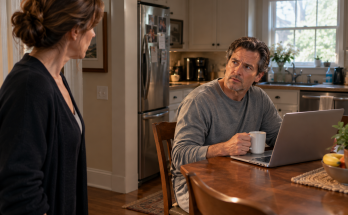
Three months passed after Evan brought home the bicycle.
The first few weeks were almost strange in their normality. I had gotten used to watching him come through the front door with a guarded expression, as if he were carrying some invisible list of everyone who needed something. Now he came home with mud on his sneakers from riding, complained about sore legs, and left his helmet beside the kitchen table.
His Saturdays changed too. He still worked at Sal’s diner, but his paycheck no longer disappeared into envelopes. Every Saturday evening, we deposited it into the savings account we had opened together. Evan kept the receipt in his wallet and checked the balance sometimes, not obsessively, but with the quiet satisfaction of someone learning that money could be saved without becoming a secret.
The Saturday Table had become part of the diner itself. The wooden cabinet near the entrance was always stocked with canned vegetables, cereal, soap, diapers, notebooks, and grocery vouchers. People brought things in when they had extras and took things when they needed them.
Evan wore a small volunteer badge while he worked there.
Sal had made him the unofficial keeper of the notebook, which meant Evan tracked what came in and what went out. He took the job seriously. He even complained when someone put canned tomatoes in the wrong section.
“You're becoming difficult,” Sal told him one Saturday.
Evan looked up from his notebook.
“You alphabetized the shelves.”
“Exactly.”
“That isn't difficult. That's organization.”
Sal pointed at him.
“That sentence is how it starts.”
I laughed from the counter.
Evan threw me a look, but he was smiling.
For the first time since Michael died, I heard my son's laughter every day.
Not the polite little laugh he used when adults tried too hard to cheer him up.
Real laughter.
The kind that escaped before he could stop it.
Sometimes he would tell me about something that happened at the diner. Sometimes he would come home excited because a family had left a box of school supplies. Once, he spent twenty minutes explaining why Sal's method of recording inventory made no mathematical sense.
I listened.
I let him talk.
I also made sure he understood that helping people did not make him responsible for them.
That lesson took time.
One Saturday, a woman arrived at the diner asking whether there was enough food left for her family. Evan immediately reached for his wallet.
I stopped him with one look.
He froze.
Then he slowly put his wallet away.
The woman received what she needed from the cabinet.
Later, Evan admitted that his first instinct had been to hand her cash.
“You didn't have to,” I told him.
“I know.”
“You remembered.”
He smiled.
“I'm learning.”
That was when I began to believe we had finally reached something close to peace.
Then, on a rainy Thursday afternoon, someone knocked on our door.
The rain had started before lunch and had turned the sidewalks dark by the time I heard the knock. I was sorting laundry in the living room when Evan called from the hallway.
“Mom?”
“What?”
“There's a letter for me.”
I walked toward him.
He was standing beside the front door holding a thick envelope.
It was not ordinary mail.
The paper was stiff and cream-colored. A red strip ran across the back. In the upper corner was the name of a law office I had never heard of.
My stomach tightened.
“Why is a lawyer writing to you?”
Evan looked at me.
“I don't know.”
He turned the envelope over.
His full name was printed on the front.
Evan Carter.
Not my name.
Not “parent or guardian.”
His.
“Did I do something?”
The question came so quickly that I almost smiled.
“No.”
“You're sure?”
“I don't know yet.”
He handed me the envelope.
I opened it carefully.
Inside was a single sheet.
I read the first line.
Then I stopped.
My fingers tightened around the paper.
Evan noticed immediately.
“What?”
I looked at him.
“The letter is about your father.”
His face changed.
Michael had been gone for three years.
Three years since the hospital hallway.
Three years since the phone call.
Three years since I had sat at a kitchen table surrounded by paperwork I barely understood and signed forms because somebody had told me they needed signatures.
I had handled the funeral.
The insurance.
The bills.
The bank accounts.
The probate process.
As far as I knew, everything connected to Michael had been settled.
Apparently, it hadn't.
The letter stated that the law firm represented the estate of Michael Carter and needed to speak with Evan regarding property still registered in his father's name.
I read that sentence twice.
“What property?” Evan asked.
“I don't know.”
“Is it money?”
“I don't know.”
“Did Dad leave something?”
“I don't know.”
His questions came faster.
I folded the letter.
“We're going to call them.”
“Now?”
“Yes.”
The attorney who answered sounded calm and professional. She explained that the firm had been contacted during an audit involving abandoned storage facilities.
A unit had been sitting for years under Michael's name.
The rental company had tried to locate him.
They had eventually discovered that he had died.
Because the unit had remained in his name and certain documents connected it to Evan, the attorney said the contents could not simply be disposed of.
My hand tightened around the phone.
“How long has it been there?”
“According to the records, more than three years.”
Three years.
The words sat heavily in my mind.
I asked whether it contained anything dangerous.
The attorney laughed softly.
“No. Nothing like that.”
“Then what is it?”
“We haven't inventoried everything yet.”
I looked at Evan.
“When can we see it?”
She gave us an appointment for Saturday morning.
After I hung up, Evan stood in the hallway staring at me.
“What do you think is inside?”
“I don't know.”
“Could it be Dad's stuff?”
“Probably.”
He swallowed.
“Do you think he knew?”
I didn't answer immediately.
Because that was the question I had been avoiding.
Michael had not known he was going to die.
At least, not as far as I knew.
He had left for work one ordinary morning and never come home.
There had been no farewell.
No final conversation.
No carefully arranged goodbye.
Just absence.
Maybe the storage unit held nothing important.
Maybe it held old furniture and Christmas decorations.
Maybe it held exactly the sort of forgotten junk people accumulate when they don't expect to leave their lives behind suddenly.
Or maybe there was something in there that Michael had intended for his son.
That possibility frightened me more.
Evan seemed to read something in my face.
“Mom?”
“Yes?”
“Whatever it is, we can handle it.”
I looked at him.
He had said the same kind of thing when he was thirteen and trying to solve everyone else's problems.
Only now his voice sounded different.
Older.
Not because he had become responsible for everything.
Because he had learned he didn't have to carry it alone.
“Together,” I said.
He nodded.
“Together.”
That night, I barely slept.
Rain tapped against the bedroom window.
At two in the morning, I found myself remembering Michael at twenty-seven, standing in our tiny first apartment with a broken lamp in one hand and a screwdriver in the other.
He had been terrible at fixing things.
He always insisted he could do it himself.
Then, after making the problem worse, he would finally admit he needed help.
I smiled in the darkness.
Evan had inherited that stubbornness.
But perhaps he had inherited something else too.
The ability to care deeply without making a performance of it.
Saturday morning arrived under a pale gray sky.
We drove across town in silence.
The storage facility sat behind an industrial strip, surrounded by chain-link fencing and rows of metal doors.
The manager met us at the gate.
He checked the paperwork twice.
Then he led us to the far end of the property.
“This is the unit,” he said.
He inserted a key.
The lock clicked.
The metal door rattled upward.
Dust drifted through the shaft of sunlight.
Evan stepped closer.
I felt his hand brush mine.
Inside were boxes.
Camping chairs.
Old fishing equipment.
Christmas decorations.
A cracked cooler.
A folding table.
Nothing immediately remarkable.
Then Evan saw something at the back.
“Mom.”
I followed his gaze.
A cedar chest sat against the wall.
Its lid was dark with age.
Two initials had been burned into the wood.
M.C.
My breath caught.
Michael Carter.
Evan walked toward it slowly.
He touched the initials with his fingertips.
“That's Dad's.”
“Yes.”
“How did he make this?”
“I don't know.”
We moved the boxes aside.
The chest was heavier than it looked.
The manager helped us drag it into the light.
There was a small brass latch.
It wasn't locked.
Evan looked at me.
“Can I?”
I nodded.
He lifted the lid.
The smell of cedar rose into the dusty air.
Inside were photographs.
Old journals.
A few pieces of clothing.
My wedding veil.
I touched it and felt my throat tighten.
Then Evan lifted a sealed envelope.
My name was written across the front.
The handwriting was unmistakable.
Michael's.
I couldn't breathe.
For three years, I had believed there were no words left from him that I hadn't already heard.
I had been wrong.
And suddenly the forgotten storage unit no longer felt like an accident.
It felt like a door Michael had closed long before we knew we would need to open it.
Click here to continue reading: PART 6: The Letter My Husband Left Behind Was Not About Wealth, but One Sentence Inside It Explained Why Evan Had Become the Boy He Was
The Money in My Son’s Backpack Was Missing, and His Boss Said I Needed to Come to the Diner Before It Was Too Late
Part 5 of 12