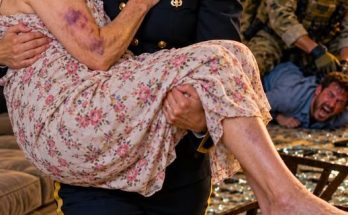
At 2:34 in the morning, my phone rang in the empty parking lot at Fort Belvoir, and the name on the screen made me stop walking.
Mom.
I had just finished a twenty-four-hour strategic planning assignment and was halfway to my car. My uniform felt stiff against my shoulders, my coffee had gone cold hours earlier, and my body was begging for sleep. My mother never called me at that hour. Corinne Ashford believed in schedules the way some people believed in commandments.
I answered immediately.
“Mom?”
For several seconds there was nothing but ragged breathing. Not ordinary crying. She sounded as if every breath had to be dragged through a narrow space.
Then she whispered, “Blair.”
The sound of my name in her voice changed everything.
“What happened?”
“Your husband came to my house.”
I tightened my grip on the phone.
“He hurt me,” she said. “Then he called the police and told them I attacked him.”
My keys slipped from my fingers and struck the asphalt.
I stared at them without seeing them.
“Nolan?”
“Yes.”
My husband’s name sounded absurd in that sentence. Nolan Vickers was the man who held doors for strangers, carried groceries for elderly neighbors, donated to charity dinners, and remembered the names of my coworkers’ children. For fifteen years, he had cultivated a reputation for being the safest, most reasonable man in every room.
“What did he do to you?”
“I don’t know how to explain it.”
“You don’t have to explain it right now. Tell me where you are.”
“The county police station.”
“Are you with an officer?”
“Yes.”
“Are you hurt?”
A pause.
“My shoulder. My face. My head.”
The parking lot seemed to tilt beneath me.
“Has anyone taken you to a hospital?”
“No. They keep asking questions.”
My voice became colder. Military training had taught me that panic was contagious and useless. Whatever I felt could wait.
“Listen to me, Mom. Do not sign anything. Do not agree to a psychiatric evaluation. Tell them you want medical treatment. I am on my way.”
She made a small sound that almost became a sob.
“I never wanted to interfere in your marriage.”
“You didn't.”
“I was trying to protect you.”
I closed my eyes.
“From what?”
She didn't answer.
The line went quiet for a moment.
Then she whispered, “Just come.”
I ran to my car.
The drive to Fairfax County was a blur of traffic lights and dark roads. My mind kept circling the same impossible question.
Why would Nolan attack my mother?
They had disagreed before. Corinne was blunt, analytical, and incapable of pretending not to notice something wrong. Nolan preferred smooth conversations and carefully chosen words. Their personalities had never fit naturally, but neither had ever crossed into open hostility.
At least, not where I could see it.
When I reached the precinct, red and blue lights flashed across the glass entrance.
An ambulance was pulling toward the side door.
I parked badly, left the vehicle running, and went inside.
Nolan was standing near the entrance.
He looked almost untouched.
He had a paper coffee cup in one hand and was speaking quietly with a young patrol officer. His expression was worried in exactly the right way: drawn around the eyes, concerned but controlled, the face of a husband shaken by a family crisis.
When he saw me, his shoulders sagged.
“Blair.”
I walked past him.
His hand moved toward my arm.
I stepped away.
“Where is my mother?”
“She's inside.”
“You can wait here.”
“Blair, listen—”
“I said wait.”
The words came out quietly enough that the officer looked between us.
I found the interview room and opened the door.
The woman sitting there barely resembled the mother I had left at her house two days earlier.
One lens was missing from her gold-rimmed glasses. The frame was twisted. Her blouse was torn at the shoulder, and a dark swelling had spread beneath one eye. An EMT was holding a cold pack against her upper arm.
Corinne looked up.
For one second, she tried to smile.
Then her face crumpled.
I knelt in front of her.
“You're going to the hospital.”
“But—”
“No arguments.”
I took her cold hands.
She squeezed them around mine.
Behind us, Sergeant Everett Sloan cleared his throat.
“Lieutenant Colonel Ashford, your husband has given us a statement.”
I looked at him.
“What statement?”
Sloan glanced toward the paperwork.
“He says he went to your mother's house around nine-thirty with an apple pie. He wanted to discuss some recent family tension.”
I looked at my mother.
She said nothing.
“He claims your mother became agitated,” Sloan continued. “He says she has been displaying signs of paranoia and confusion. According to him, she grabbed an iron fireplace poker and came after him.”
I looked back at the sergeant.
“My mother?”
“Yes.”
“She attacked him?”
“That is his account.”
I stood.
“And he was injured?”
Sloan hesitated.
“Not seriously.”
Of course.
My mother was the one going to the hospital.
Nolan was the one drinking coffee.
The ambulance crew arrived and began preparing Corinne for transport. I stayed beside her until the stretcher disappeared through the doors.
Only then did I return to the precinct lobby.
Nolan was waiting.
His expression softened when he saw me.
“Blair, I'm sorry.”
I stared at him.
“I didn't want this.”
“You went to my mother's house at nine-thirty at night.”
“I was trying to make peace.”
“With an apple pie.”
He swallowed.
“Yes.”
“Why?”
He spread his hands.
“Because she's been hostile toward me.”
“Since when?”
“You know how she can be.”
I did know how my mother could be. She asked uncomfortable questions. She remembered numbers. She noticed when statements didn't match.
But dementia?
No.
My mother was seventy-one, but her mind was sharper than most people's half her age. She had spent decades as a forensic accountant. She could look at a page of financial records and notice a missing digit from across a desk.
Nolan stepped closer.
“Blair, she attacked me. I pushed her away. That's all.”
I looked at the small scrape on his wrist.
Then at his perfectly clean shirt.
Then at his face.
“Why did she say you hurt her?”
“Because she's confused.”
“You keep saying that.”
“Because it's true.”
His voice remained gentle.
Too gentle.
He leaned toward me.
“Please don't let this destroy our family.”
I felt something inside me go very still.
“What do you mean?”
He glanced toward Sergeant Sloan, then lowered his voice.
“You have a promotion board coming up.”
There it was.
My career.
The thing I had spent half my life building.
“You're waiting for the security clearance upgrade,” he continued. “If this becomes a domestic scandal, if the military thinks your mother is unstable and you're covering for her—”
“Stop.”
He didn't.
“You could lose everything.”
He reached out and brushed an invisible speck from my uniform.
“Sign the psychiatric hold,” he whispered. “Let the doctors evaluate her. Let me handle the rest.”
I stared at his hand.
Then I looked into his eyes.
For the first time in fifteen years, I didn't see my husband.
I saw someone measuring how much I was willing to sacrifice.
He mistook my silence for hesitation.
That was his first mistake.
“I’m going to the hospital,” I said.
His face tightened.
“Blair—”
I walked away.
As I stepped outside, the night air felt heavy against my skin.
I still didn't know what my mother had discovered.
But I knew one thing.
Nolan was afraid of something.
And whatever it was, my mother had found it before I did.
Click here to continue reading: PART 2: The Fireplace Poker That Should Never Have Been Inside My Mother’s House Revealed the First Crack in Nolan’s Story
The Midnight Call That Turned My Husband’s Perfect Reputation Into the First Lie I Had to Prove
Part 1 of 20