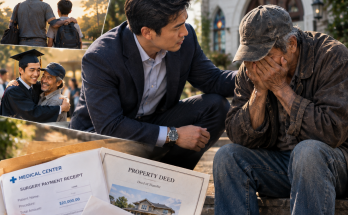
Arthur recovered slowly.
The first few days after surgery were harder than either of us expected. He tired easily and became irritated whenever a nurse caught him trying to do something without assistance.
One morning I found him attempting to reach the water pitcher.
“Dad.”
He froze.
The pitcher was inches beyond his fingertips.
“I was getting a drink.”
“You were supposed to call someone.”
“I've been getting my own drinks for sixty years.”
“And now you're not.”
He gave me a look.
“You sound like your mother.”
I smiled despite myself.
It was the first time he had mentioned her in weeks.
My mother had been dead for decades.
For most of my childhood, she existed in fragments: the smell of lavender soap, a photograph tucked inside a kitchen drawer, a faded blue dress hanging in an old closet long after she was gone.
I remembered her voice, but not always the words.
I remembered being ten years old at her funeral.
I remembered Arthur holding my shoulders while adults moved around us.
And I remembered asking him one question.
“Are you going to leave too?”
He had pulled me against his chest.
“No, son.”
His voice had been steady.
“I'm not going anywhere.”
At the time, I thought he was simply comforting a grieving child.
I didn't know he was making a promise that would shape the rest of his life.
After Arthur's surgery, I began spending nearly every evening at the hospital.
We talked about ordinary things.
The weather.
The neighbor's dog.
A baseball game.
The soup Emily sent that Arthur claimed needed more salt.
But there was something else between us now.
A silence that neither of us knew how to cross.
I knew Arthur had secrets.
I just didn't know how many.
One evening, rain tapped steadily against the hospital window.
Arthur was awake, staring into the darkness outside.
“Dad?”
He didn't answer immediately.
Then he said, “Your mother knew.”
I sat forward.
“Knew what?”
“That she was going to get sick.”
I felt something tighten beneath my ribs.
“You never told me that.”
“I know.”
“How long did she know?”
Arthur rubbed his thumb along the edge of the blanket.
“Long enough to be frightened. Long enough to make plans.”
“What kind of plans?”
He looked at me.
“The kind a mother makes when she doesn't know how much time she has left with her child.”
I stared at him.
Arthur took a slow breath.
“She asked me to promise something.”
“What?”
“That you would never believe you had been abandoned.”
The room seemed to become quieter.
“She knew your biological father wasn't going to raise you,” Arthur continued. “She knew your relatives weren't going to take responsibility for you. She knew you would eventually ask questions.”
I looked down at my hands.
“Why didn't anyone tell me?”
“Because your mother thought you needed a childhood more than you needed adult answers.”
“That doesn't explain everything.”
“No.”
Arthur's eyes remained fixed on the window.
“It doesn't.”
He told me that my mother had been frightened of what would happen to me after she was gone.
She had not wanted me passed between relatives.
She had not wanted me to grow up feeling like an obligation.
And she had looked at Arthur, a man who wasn't related to me by blood, and asked him to stay.
“She asked you to be my father?”
Arthur nodded.
“She said she didn't need you to have her blood or yours running through my veins. She needed you to love me.”
I looked away.
My eyes burned.
All my life, I had assumed Arthur became my father because circumstances forced him into the role.
Now I understood there had been a choice.
My mother had trusted him.
And Arthur had chosen me.
“She believed you could do it,” he said.
“Could do what?”
“Give you a home.”
I laughed softly, but there was no humor in it.
“You barely had enough money to take care of yourself.”
“I know.”
“You were poor.”
“I know.”
“You could have said no.”
Arthur looked at me.
“I almost did.”
That answer surprised me.
“Why?”
“Because I was scared.”
He told me he had been young, inexperienced, and barely making enough to survive.
He had no idea how to raise a grieving boy.
He had worried that love alone would not be enough.
“So what changed your mind?”
Arthur smiled faintly.
“Your mother.”
“What did she say?”
“She told me that children don't need someone perfect.”
He paused.
“They need someone who stays.”
I stared at him.
The words landed heavily because Arthur had done exactly that.
He stayed.
When I had nightmares, he stayed.
When I got sick, he stayed.
When I failed my first math exam, he stayed.
When I left for college, he stood in the doorway until my car disappeared.
When I graduated, he wore a shirt with a collar that was too tight because it was the best one he owned.
And when I became successful, he never once asked me for anything.
Not money.
Not recognition.
Not even gratitude.
“Why didn't you ever tell me this?” I asked.
“Because your mother asked me to let you decide what I was to you.”
I frowned.
“What does that mean?”
“She didn't want me forcing the word father on you.”
I felt tears gather in my eyes.
“She told me that if you ever called me Dad because you wanted to, that would mean more than any legal document.”
I looked at him.
“I've called you Dad my whole life.”
His smile widened.
“I know.”
There was a long silence.
Then I asked, “Did you ever regret it?”
Arthur looked genuinely confused.
“Regret what?”
“Taking me in.”
He shook his head.
“Not once.”
I leaned back.
The machines beside him continued their soft rhythm.
For years, I had believed Arthur sacrificed everything because he had no other choice.
Now I realized sacrifice had been the choice.
The following weeks changed the shape of our relationship.
Arthur came home from the hospital and slowly began regaining his strength.
Three months later, he moved into the house I had bought for him.
He protested every part of it.
The size.
The cost.
The new appliances.
The backyard.
He even complained about the front steps being too clean.
“You'll ruin them eventually,” I told him.
“That is the plan.”
The first morning he spent there, I found him kneeling in the backyard.
He had bought a young tree from a nursery.
“What are you doing?”
“Planting.”
“You've just recovered from heart surgery.”
“And?”
I stared at him.
Arthur pushed his shovel into the soil.
The ground was damp from rain, and dark earth clung to his knuckles.
“What kind of tree?”
“Something that will outlive me.”
I smiled.
“That's a little dramatic.”
“No. It's practical.”
He tamped the soil around the roots.
I watched him work.
“Why plant one now?”
Arthur leaned on the shovel.
“For whoever comes after me.”
“You don't have grandchildren.”
“Not yet.”
I laughed.
He pointed at the tree.
“One day, somebody will sit under this.”
I looked at the tiny branches trembling in the breeze.
“You really think it will get that big?”
“If somebody takes care of it.”
That sentence stayed with me.
Arthur watered the tree before he went inside.
He checked it every morning.
He adjusted the support stake when the wind pushed it sideways.
He complained when I forgot to water it.
And slowly, the tree became part of the yard.
Part of him.
Part of us.
I thought that was the end of the surprises.
I was wrong.
Six months after Arthur moved into his new home, my phone rang during a Monday afternoon meeting.
The number was unfamiliar.
I almost ignored it.
Then I answered.
“Mr. Carter?”
“Yes.”
“This is Robert Hale. I'm an attorney representing your father.”
I frowned.
“My father?”
“Yes. Arthur James Carter.”
I leaned back in my chair.
“Is there a problem?”
“No. Quite the opposite.”
His tone made me uneasy.
“I need to arrange a meeting with you concerning certain assets connected to your father.”
“What assets?”
There was a pause.
“An inheritance.”
I laughed once.
It was automatic.
“My father doesn't have an inheritance.”
The attorney was silent for just long enough to make my smile disappear.
Then he said, “That's what he wanted you to believe.”
I looked through the glass wall of my office.
Outside, people moved between desks, carrying coffee cups and folders, unaware that something had just shifted beneath my feet.
“What exactly are you talking about?”
“I'd rather explain in person.”
“Why?”
“Because there are documents involved.”
I tightened my grip on the phone.
“What kind of documents?”
“Property records. Financial records. And a set of personal papers that Arthur specifically instructed me not to release until you were ready.”
I stood.
“When did he arrange this?”
“Years ago.”
That answer frightened me more than the word inheritance.
“Years?”
“Yes.”
I stared at the city beyond my office window.
Arthur had always told me he had nothing.
He had lived modestly.
He counted grocery money.
He wore old clothes.
He had refused every expensive gift I tried to buy him.
So what could he possibly have hidden?
The attorney gave me an address and ended the call.
I remained standing long after the line went dead.
That evening I drove to Arthur's house.
He was in the backyard beneath the young tree.
His hands were dirty.
He looked up and smiled.
“You're early.”
I sat beside him.
“Dad, we need to talk.”
His smile faded.
He studied my face.
Then he looked at the tree.
“I suppose the time has come.”
I felt a chill.
“What time?”
Arthur stood slowly.
“The time when you finally learn what your mother left behind.”
Click here to continue reading: PART 3: The Old Box in My Father’s Closet Held My Mother’s Letter, a Fortune, and a Reason He Had Lived Poor While I Grew Rich
I Thought My Father Needed Money, Until I Saw the Look on His Face After I Told Him I Could Not Help
Part 2 of 20