The beautiful, sprawling house David and I lived in belonged 100% to me.
I had purchased it at 31 after a decade of aggressive saving and smart investments.
When David and I got engaged, we signed a bulletproof prenuptial agreement.
His 401(k) and premarital assets remained legally his.
My house remained my sole and separate property, explicitly including its existing equity and any future appreciation in value during the course of our marriage.
Anything we intentionally purchased together from a joint account would be treated as marital property.
David knew exactly what he was signing on that dotted line.
At first, it never seemed to bother his ego.
Then, about a year after our honeymoon, he started dropping casual comments.
“You should really add my name to the deed someday.”
I laughed it off the first time.
“Why?”
“Because we’re a married couple.”
“I know we are.”
“It’s our home.”
“It is our home to live in. But the asset is still legally mine.”
He clearly didn’t like that firm boundary.
Every few months, he found a way to bring it up again.
Sometimes he used the guise of “financial security.”
Sometimes he whined about “fairness.”
Sometimes he half-joked about feeling like a glorified tenant in my house.
I always gave him the exact same unwavering answer.
“I’m not changing the deed, David.”
I naively thought that was the end of the discussion.
Then, eight months prior to the fateful barbecue, I received a strange phone call at my office.
The woman cheerfully identified herself as a verification specialist for a major national lending company.
She stated she needed to verbally confirm some information on a pending home-equity loan application.
“I think you have the wrong number,” I told her politely. “I haven’t applied for any loans.”
There was a brief, awkward pause.
Then she asked me to verify the property address.
It was my house.
She asked whether David Mitchell was my legal spouse.
“Yes, he is.”
Her professional tone shifted.
The application requested a massive $74,000 home-equity line of credit (HELOC) leveraged against my house.
I was listed as the primary property owner and primary applicant.
David was listed as my spouse and the secondary contact.
The digital application contained what appeared to be my authorized electronic signature.
I had never seen the document.
I had absolutely never authorized anyone to sign it on my behalf.
I firmly informed the specialist right then and there that the application was highly fraudulent.
The lender immediately flagged and froze the file.
That very afternoon, I locked my credit with all three major bureaus and immediately retained a ruthless family law attorney named Jessica Hayes.
My initial, furious instinct was to confront David the second I walked through the front door.
Jessica strongly advised me against it.
“First, ensure your money and your identity are completely insulated. Then, we quietly preserve the evidence.”
So I followed her instructions to the letter.
I formally disputed the fraudulent application through the lender’s fraud investigation department.
After submitting proof of my identity and my status as the sole property owner, they legally released copies of the application records to me.
The IP address and email used during the application process belonged to David.
The secondary contact number was his cell phone.
The digital signature supposedly belonging to me was a blatant forgery.
I sat alone at my dining-room table, staring at the printed pages until the black ink blurred together.
Then I started digging much, much deeper.
I pulled credit reports.
I scoured joint bank statements.
I audited shared financial records.
I checked old devices linked to our Wi-Fi.
I discovered that David had racked up more than $30,000 in high-interest credit-card debt across three cards he had never once disclosed to me.
I found texts proving he had promised his older brother an $18,000 “investment” to bail out a failing landscaping franchise.
Then there was the car he had loudly promised Chloe for her upcoming 17th birthday.
For months, he had been boasting at family dinners about buying her something “really nice and safe.”
I had logically assumed he meant a reliable, modest used Honda.
Instead, I found a saved dealership quote for a brand-new SUV costing well over $20,000.
When I added all the staggering numbers together, the exact purpose of the $74,000 HELOC became sickeningly obvious.
David was desperately trying to consolidate his secret debt, bail out his brother, buy the expensive car he had promised his daughter, and float several other hidden bills.
He had arrogantly made financial promises to everyone around him that he simply couldn’t afford to keep.
And rather than admit to his family that he was drowning, he had apparently decided that stealing the equity in my hard-earned house would magically rescue his ego.
Then I hit the motherlode: a text conversation on an old iPad David had left synced to his iCloud account.
His brother had texted:
I thought Claire wasn’t comfortable taking a loan out against her house?
David casually replied:
She worries way too much about money. Once everything’s paid down and the monthly bills drop, she’ll see it made perfect sense.
His brother cautiously responded:
Just make sure she’s actually cool with it before you pull the trigger, man.
David wrote:
I’ll handle Claire.
I used my phone to photograph the entire thread.
Then I powered down the iPad and put it exactly where I found it.
That specific sentence burned itself into my brain.
I’ll handle Claire.
Not talk to Claire.
Not ask Claire for help.
Handle me. Like I was a nagging problem to be managed.
Jessica told me that if I wanted to pack my bags and leave him that night, I legally could.
Instead, I chose to quietly, methodically protect my kingdom.
I transferred all of my separate savings into a brand-new account at a completely different bank that David couldn’t access.
I changed every single password I owned.
I discreetly removed all my vital financial documents from our shared home office.
I monitored my locked credit reports weekly.
I preserved the lender’s fraud records, the IP logs, and the damning screenshots in a secure cloud drive.
I legally updated my estate plan and officially revoked any financial or medical power of attorney I had previously granted him.
Physical copies of everything went into a thick black folder hidden in my locked desk at work.
And then, I waited.
Not because I trusted him anymore.
Not because I was paralyzed by indecision.
I had already built my fortress.
I waited because some small, pathetic part of my heart still desperately hoped David would sit down and tell me the truth of his own free will.
People love to romanticize betrayal, imagining that discovering a lie instantly annihilates every ounce of love you ever felt for a person.
It doesn’t.
David was a liar, yes. But he was also the man who brought me fresh coffee in bed every Sunday morning.
He was the man who slept in an uncomfortable hospital chair for three days when my father had bypass surgery.
He remembered my exact, complicated coffee order and always knew which side of the hotel bed I preferred.
I spent sleepless nights wondering whether sheer financial panic had temporarily pushed a good man into one catastrophic decision.
I wondered whether his conscience would eventually win out.
Whether one random Tuesday evening, he would sit down across from me, take my hands, and say, “I did something terrible, and I need your help.”
Weeks bled into months.
He never confessed.
Instead, every few weeks, he would casually circle back to the same toxic subject.
“Have you given any more thought to putting my name on the deed?”
“No, David.”
“You seriously still don’t trust your own husband?”
I often wondered if he even grasped the sickening irony of that question.
Meanwhile, Chloe’s behavior became significantly more hostile and disrespectful.
At the time, I foolishly thought the massive financial deception with David and my deteriorating relationship with his daughter were two entirely separate issues.
I was dead wrong.
By the time I pulled my car into my driveway after the disastrous barbecue, I was officially done waiting for David to magically transform into the man I thought I married.
I marched upstairs and methodically packed a suitcase with the things I couldn’t easily replace.
My passport.
My birth certificate.
My work laptop.
A jewelry box containing pieces from my late grandmother.
A few essential files.
Then I drove to my office and retrieved the thick black folder.
Eight months of irrefutable evidence.
I dialed Jessica.
“I’m ready to pull the trigger.”
She was quiet for a brief second.
“Did something happen today?”
“Yes.”
“Are you physically safe?”
“Yes.”
“Then we file the papers first thing Monday morning.”
Next, I called an emergency locksmith.
I did not change the exterior locks on the house.
David and Chloe legally resided there, and I wasn’t interested in turning a clean emotional break into a messy illegal eviction dispute.
Instead, I had the locksmith install heavy-duty deadbolts on my private home office and the fireproof filing cabinet containing my remaining paperwork.
I also changed the digital access code on my detached garage workshop, where I stored expensive equipment and personal assets belonging solely to me.
Then I loaded my suitcases into the trunk of my car.
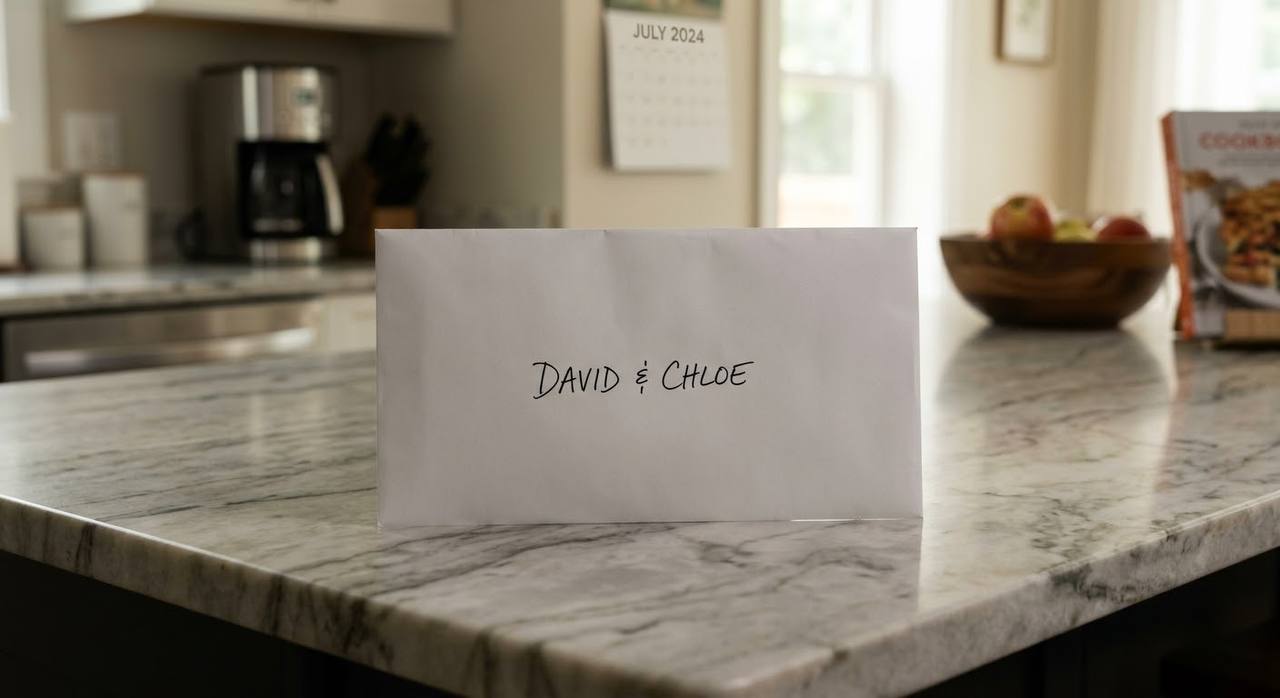
Before I walked out the front door for the last time, I placed a large, crisp white envelope dead center on the kitchen island.
Inside were high-quality copies of four specific things.
The first was a formal letter from Jessica’s firm confirming that I had instructed them to initiate divorce proceedings.
The second was the official notice from the lender confirming that the unauthorized $74,000 HELOC application had been permanently frozen and canceled due to a formal fraud dispute.
The third was a blown-up copy of the application signature page, highlighting the forged signature I had never written.
And the fourth was a crystal-clear printed screenshot of his damning iMessage.
I’ll handle Claire.
Underneath the screenshot, I wrote one single sentence in red ink:
You had 8 months to tell me the truth.
Then I drove straight to my sister’s house across town.
David called my cell at 8:12 that evening.
I silenced the ringer.
He called again.
Then again.
A text message popped up on my screen.
What the hell is this envelope?
Another one followed immediately.
Call me.
Then:
We need to talk right now. Please.
On his sixth frantic phone call, I finally answered.
“What the hell is this?!” he demanded, his voice shaking.
“You read the papers, David.”
“You’re actually filing for divorce?”
“Yes, I am.”
“Over what happened at Mom’s house today?!”
“No.”
Dead silence on the line.
Then his tone drastically changed from angry to terrified.
“This is about the loan.”
There was zero confusion in his voice.
Only sickening recognition.
“So you do remember it.”
“Claire, please listen to me—”
“You had eight entire months to confess, David.”
“I was going to explain everything!”
“When? After the money cleared?”
“I was desperately trying to fix things!”
“By fraudulently using the equity in my house to cover massive debts you deliberately hid from me?”
“It wasn’t just my debt!”
“I know exactly what it was for. There was your brother’s failing business. Chloe’s ridiculously expensive car. Maxed-out credit cards. I know exactly where every dime of that $74,000 was supposed to go.”
He went completely silent.
Then he muttered, “I was just trying to get everything under control for us.”
That was the exact moment his true motive became crystal clear to me.
David hadn’t wanted to admit to his family that he couldn’t afford to bankroll the lavish lifestyle he had promised them.
He had promised to bail his brother out.
He had promised his daughter a luxury car.
He had accumulated a mountain of consumer debt while strutting around pretending he was wildly successful.
Instead of facing the humiliation of disappointing them, he had unilaterally decided that the equity in my hard-earned house would magically absorb the consequences of his arrogance.
“You weren’t trying to fix our marriage,” I said coldly.
“You were just trying to keep every financial promise you made to your family without having to admit you couldn’t afford any of them.”
“We’re married, Claire! I thought we were supposed to be a team and help each other out!”
“Asking for help is something you actually do before you act. You stole my identity.”
“I knew you’d say no to the loan!”
“Exactly.”
He went quiet again.
“You knew my answer would be a firm no, so you criminally bypassed me to remove my ability to give one.”
“That’s not what I was trying to do, I swear!”
“You used my personal information and forged a signature I didn’t provide.”
“I was going to repay every single cent!”
“With what money, David? The money you don’t have?”
He had no answer for that.
Then, true to form, he aggressively changed tactics.
“So this is it, then? You’re just throwing away three years of marriage over paperwork?”
“No.”
I kept my voice terrifyingly calm.
“You threw away our marriage the exact second you decided my consent only mattered if I agreed with your spending habits.”
He let out a long, shaky exhale.
“And what about what happened today at the barbecue?”
“What about it?”