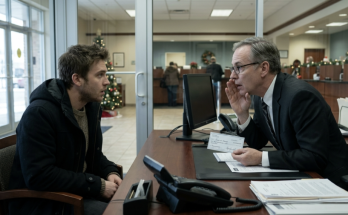
The independent investigator contacted us two days after the meeting.
His name was Daniel Mercer, a forensic accountant who had worked on several complex cases involving family trusts and corporate misconduct. He had been retained by the estate's attorneys to trace the payments Richard had identified and determine whether they were connected to the false hotel records or the interference with my correspondence.
Daniel requested that we meet at his office rather than at Sterling Enterprises. He explained that he wanted the discussion separated from the company's internal politics, and that he would not draw conclusions until he had reviewed the original documents.
I agreed to attend with David and Marcus.
Before the meeting, David called to ask whether I was comfortable sitting beside him. I told him I was willing to attend, but I did not want the arrangement mistaken for a reconciliation.
“I understand,” he said. “I'm not asking you to pretend anything has changed between us.”
“Good.”
“I want to know what happened. And I want to make sure nobody can use the children to hide it.”
That was the right reason to come, so I agreed.
Daniel's office was small and practical, with shelves of financial files and a long table covered in labeled folders. He had already reviewed the records Marcus provided, including the transfers to Vanessa's company, the hotel payment, and the correspondence recovered from Richard's files.
He began by explaining that the payments appeared to have been divided into several categories. Some were recorded as consulting fees, others as reimbursements, and a third group had been processed through a trust used for family-related expenses.
“The descriptions are inconsistent,” he said. “That doesn't prove wrongdoing on its own. But the timing is significant.”
He placed a timeline on the table.
The first payment to the company linked to Vanessa had been made several weeks before the hotel reservation. Another transfer followed shortly after the divorce petition was filed. The payments increased around the time I began sending letters about the pregnancy.
David studied the dates.
“So someone was paying her before the affair was exposed?”
“Yes,” Daniel replied. “The records suggest a financial relationship existed before the accusation. We need to establish what services, if any, were provided.”
Vanessa had already admitted that she was paid to remain silent. But Daniel was careful not to treat her statement as conclusive. He wanted emails, contracts, approval records, and testimony from anyone who had participated in the transactions.
I appreciated his caution. I had spent too many years watching people accept a convenient story because it was easier than asking for proof.
Daniel opened another folder.
“We also found a set of internal correspondence from the legal office. Some messages refer to a plan to isolate David from outside advice during the divorce.”
David's face tightened.
“Outside advice from whom?”
“Initially, the messages mention your wife's attorney. Later, they refer to any communication that might challenge the evidence against her.”
I felt a familiar chill.
“They wanted to stop me from reaching him.”
“That appears to have been one objective,” Daniel said. “But the correspondence suggests a broader concern about who controlled decisions within the family.”
He showed us an email exchange between Beatrice and a company lawyer. The language was formal, but one line stood out: the matter needed to be resolved before any future family obligations complicated the transfer of voting shares.
David read it twice.
“What family obligations?”
Daniel tapped the date.
“The message was sent shortly after your wife informed the legal office that she was pregnant. The original notice appears to have been received, although the copy sent to your personal office was never logged.”
David looked at me.
“You sent them the clinic confirmation?”
“Yes.”
“And they received it?”
“The delivery records show that someone signed for it.”
He stared at the email again.
“They knew.”
“They knew I was pregnant,” I said. “Whether they believed me or simply wanted to silence me is something they need to explain.”
Marcus leaned forward.
“Richard suspected the same thing. He found evidence that the family had been discussing succession and voting rights before the divorce. He believed the pregnancy had threatened a plan that was already underway.”
Daniel nodded.
“That is why we need the original trust documents. The payments are only one part of the picture.”
He explained that a trust established years earlier held a substantial portion of the family's controlling shares. The arrangement included provisions intended to protect the business from outside influence and keep voting power within a narrow group of relatives.
David had assumed that his future position in the company was secure. He had never examined the trust closely because his father had managed most of its administration, and Eleanor had always told him that the documents were routine.
The correspondence suggested otherwise.
Several proposed amendments would have shifted voting authority away from David and toward a committee controlled by Beatrice and two other family representatives. The changes had not all been completed, but the drafts indicated that someone had been preparing for a future in which David would have less control over the business.
“Did my father approve these changes?” David asked.
“Not the final versions,” Daniel replied. “Some drafts carry his objections. Others appear to have been prepared without his knowledge.”
David looked at Marcus.
“Why didn't he tell me?”
Marcus lowered his eyes.
“He may have believed he could resolve the problem quietly. Richard often tried to protect you from family disputes until he was certain he could offer a solution.”
“That sounds like him,” David said. “And it nearly cost me everything.”
No one contradicted him.
Daniel turned to the next set of records. One payment had been approved using Beatrice's initials, but the authorization code belonged to an office assistant who had left the company years earlier. The same code appeared on the hotel reimbursement and on a payment to a private investigator.
“Who was the investigator?” I asked.
Daniel gave us the name of a firm that had since dissolved. Its archived records showed that it had been hired to conduct surveillance on me during the months before the divorce.
David went pale.
“They were following her?”
“The invoices describe it as a personal matter,” Daniel said. “We haven't established who requested the work, but the timing overlaps with the photographs used to accuse her of an affair.”
I remembered looking over my shoulder on the walk home from the hospital, wondering whether the same car had passed me twice. At the time, I had attributed my unease to exhaustion and the shock of the divorce. I had never considered that someone might have been watching me to manufacture evidence.
“What did they find?” David asked.
“Nothing that substantiated the accusation,” Daniel replied. “The reports mostly document your wife's work schedule and movements between the hospital and her temporary residence.”
“So they watched her until they found something they could distort,” David said.
“That's one possible interpretation,” Daniel replied. “We need to locate the original surveillance reports and interview the people who handled them.”
The meeting continued for nearly two hours. Daniel outlined the steps required to obtain the missing trust documents, trace the payments through their final destinations, and establish whether the legal office had knowingly concealed the pregnancy notices.
When we finally stood to leave, David asked for a copy of the timeline.
“I want to read every entry.”
“You'll receive it,” Daniel said. “But I need you to understand that the investigation may uncover conduct involving people you care about. You cannot decide in advance what the records mean.”
David looked at me.
“I've done enough of that already.”
Outside the office, he offered to drive me home. I declined, explaining that Emily was waiting with the children.
He accepted the answer without argument.
Before we parted, he said, “I keep thinking about how many times you must have tried to tell me.”
“I stopped counting.”
“I don't know how to make up for it.”
“You don't make up for it by trying to undo the past. You make decisions now that don't repeat it.”
He nodded slowly.
“I want to do that.”
I believed that he meant it in that moment. Whether he could sustain it when the evidence threatened his position within the family remained to be seen.
Three days later, Daniel called with a discovery.
The trust's original authorization ledger had been stored in an off-site archive. A preliminary review revealed that one of the amendments had been prepared months before the false affair accusation. The amendment would have transferred temporary voting authority to Beatrice if David became unable to serve as the company's executive representative.
There was nothing inherently improper about a succession provision. The problem was the attached memorandum, which referred to the need to prevent personal circumstances from interfering with the transition.
The memorandum bore Eleanor's signature.
Beside it was a handwritten note from Beatrice.
If the marriage ends before the next review, the transfer can proceed without challenge.
David read the note in silence when Daniel sent us the scanned copy.
Then he called me.
“My mother and aunt were planning to change the voting structure before we separated.”
“What does that mean for the children?”
“It means they may have been afraid that any children I had with you would eventually become part of the succession question. The trust includes provisions for descendants, although we need a lawyer to determine how they apply.”
I sat down at the kitchen table.
“So they didn't just want you to divorce me. They wanted to make sure the divorce happened before anyone could challenge their control.”
“That is what the documents suggest.”
“And Vanessa?”
“She may have been involved because she wanted a place in the family, because she was being paid, or because she believed the arrangement would benefit her. We don't know yet.”
I looked toward the living room, where Liam was helping Noah with a school project. Ruby and Lily were arguing over colored pencils, and Chloe was lying on the rug with Barnaby beside her.
“They were children,” I said quietly. “They had nothing to do with the company.”
“I know.”
“They should never have been treated as a threat.”
“No,” David replied. “They shouldn't.”
The following morning, Daniel requested a formal interview with Beatrice. She refused, instead sending a letter through her attorney accusing the investigation of exceeding its mandate.
David responded by authorizing the release of additional corporate records and requesting an independent review of the trust's administration. The decision placed him in direct conflict with his aunt and several board members who had relied on Beatrice's assurances for years.
That afternoon, Marcus called me.
“There's another document,” he said. “Richard kept it separate from the other records. It appears to be a draft of a letter he intended to send David shortly before he became ill.”
“What does it say?”
“I haven't read the whole thing. But the first page refers to a conversation with Eleanor about the children and the company's voting rights.”
I gripped the phone.
“Does it name anyone else?”
“Yes.”
He paused.
“The name is Daniel Sterling.”
I knew the name. Daniel was David's cousin, a senior executive who had supported Beatrice's challenge to the investigation. He had remained quiet throughout the funeral, but I remembered seeing him near the cemetery gate, speaking to someone on his phone.
Marcus continued.
“Richard wrote that Daniel had been present when the original plan was discussed. He may have information about who ordered the false hotel evidence.”
The investigation had begun with one lie about a marriage. It was now uncovering a coordinated effort to control a business by controlling the people who might inherit it.
I looked at the copy of the hotel folio lying on the table.
For ten years, I had believed the worst thing the Sterling family had done was separate me from David.
Now I was beginning to understand that our separation had been only one part of a much larger plan.
And the person who might finally explain how it began was someone David had trusted since childhood.
Click here to continue reading: PART 9: David Confronted the Cousin Who Had Helped His Family Rewrite History, and the Answer Exposed the Last Reason They Feared My Children
Ten Years After Our Marriage Ended, I Returned to the Sterling Funeral With Five Children and a Secret No One Could Bury
Part 8 of 12