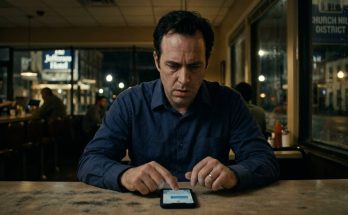
I waited until the clock on my phone showed 3:48 a.m. before getting up.
Lauren was asleep upstairs with Ethan. I stood at the bottom of the staircase for several seconds, listening to the quiet house, then returned to the living room and picked up my coat.
I didn't leave a note. I wasn't sure what I could write that wouldn't sound like another promise made before I understood what it required.
Before stepping outside, I looked once more toward the hallway. My son was only a few feet away, yet I had spent seven years living as though he had never existed. I would not allow the urgency of another mystery to make me forget what mattered most.
I locked the front door behind me and drove toward the outskirts of town.
Snow covered the roadside, turning the fields into pale, indistinct shapes beneath the winter sky. The heater blew lukewarm air against my hands. Every few minutes, I checked the message on my phone, hoping an additional explanation might appear.
Nothing did.
The old Keaton house stood at the end of a narrow road bordered by bare trees. My father had grown up there, and my uncle Robert had lived in it long after the rest of the family moved away. The property had been sold after Robert's death, but I remembered the porch, the low stone wall, and the loose brick beside the front steps.
I arrived at 4:36 a.m.
The house looked smaller than I remembered. Its windows were dark, and snow had collected along the porch railing. A faded wreath hung crookedly on the front door, as if whoever had placed it there had intended to return and never found the time.
I parked near the gate and approached the steps.
The brick was still loose.
I crouched, brushed away the snow, and found a small key beneath it. For a moment, I simply held it in my palm, wondering whether my uncle had left it there or whether someone had deliberately placed it where I would look.
The lock turned with a dry click.
Inside, the air smelled of dust, cold wood, and the faint metallic scent of an old heating system. Furniture stood beneath white sheets. A clock on the mantel had stopped at 11:42, and a folded artificial Christmas tree sat in a cardboard box near the fireplace.
I switched on the flashlight on my phone.
“Uncle Robert?”
My voice sounded too loud in the empty house.
No one answered.
I moved through the hallway, trying to remember the arrangement of the rooms. The kitchen was exactly where I expected it to be, with a small table beneath the window and a row of empty hooks beside the back door. The living room held an old armchair my father had once repaired himself.
Then I noticed a thin strip of light beneath the door to my uncle's study.
I stopped.
The electricity shouldn't have been working. The house had been empty for months, and I couldn't imagine why anyone would have left a lamp burning.
I pushed the door open.
A desk lamp illuminated a stack of envelopes and a photograph. The picture showed my father as a younger man, standing beside Uncle Robert and a woman I didn't recognize. My father was smiling, one hand resting on his brother's shoulder.
I picked up the photograph and turned it over.
There was no writing on the back.
Beneath it lay a handwritten letter addressed to me.
My fingers tightened around the paper as I unfolded it.
The first lines were written in my uncle's familiar, uneven script. I had seen his handwriting on birthday cards and the occasional Christmas envelope, but never in a letter like this.
He had written that if I was reading the message, the truth had finally reached me. He apologized for waiting so long and admitted that he had spent years convincing himself that silence was the only way to keep our family from falling apart.
Then I reached the next paragraph.
My father had not died simply because his heart failed him, Robert wrote. Three months before the accident, he had discovered that my mother had been concealing money from the small construction business he owned with his brother.
My breath caught.
The letter explained that my father had planned to confront her on the night he died. Robert had been present when the argument began. He remembered raised voices, accusations, and my mother insisting that she had done what she believed necessary.
My father had left the house furious.
He had driven away into the storm.
I lowered the page, unable to continue for several seconds. The story I had been given all my life had been simple: my father had suffered a heart attack during a winter storm, and nothing anyone could have done would have changed the outcome.
My uncle's account suggested that the hours before his death had been far more complicated.
I forced myself to keep reading.
Robert had followed my father after the argument. He found the car off the road, partially buried in snow. My father was still alive when he reached him.
I sat down heavily.
Alive.
The word seemed to fill the room.
According to the letter, my father had asked Robert to call for help. Robert did so, but before the ambulance arrived, my father made him promise something.
If he died, Robert was to protect me from the truth until I was old enough to understand what had happened.
My uncle had kept that promise for years. He had told himself that I was too young to bear the burden of knowing that my parents had been fighting shortly before my father's death.
But he admitted that he had eventually realized the silence had done more harm than good. He had watched my mother become increasingly determined to control the people around her, and he had seen how that need for control was affecting my life.
He should have told me, he wrote.
He was sorry he hadn't.
I pressed the heel of my hand against my forehead.
My father had been alive after the crash. Someone had been there with him. Someone had heard his final words.
And I had spent two decades believing there was nothing more to know.
The letter continued. At the bottom of the final page, my uncle had written that my father had left one last message for me. It was stored in a locked drawer beneath the desk.
A small brass key was taped to the back of the letter.
I turned it over and found the key secured beneath a strip of yellowing tape.
My hands shook as I crouched beside the desk. The drawer resisted at first, then slid open with a faint scrape.
Inside lay an old cassette recorder, a sealed envelope, and a small silver watch.
I recognized the watch immediately.
It had belonged to my father. I had searched for it after his funeral, and my mother had told me it must have been lost in the accident. I remembered being upset about it, although at sixteen I couldn't have explained why that small object mattered so much.
I lifted it carefully.
The metal was tarnished, but the hands still moved when I wound the crown.
Beneath the watch lay a cassette with a label attached to its side.
For Liam, when he's ready.
I stared at the words.
My uncle had been dead for six months. The house had been sold, and I had received no warning that anything had been left for me. Yet someone had known exactly where to send me, and the key had been waiting beneath the brick as though my arrival had been anticipated.
I placed the cassette into the recorder.
For a moment, nothing happened.
Then I pressed PLAY.
Static crackled through the small speaker. I leaned closer, barely breathing.
And then I heard my father's voice.
“Liam, if you're hearing this, your uncle has finally found the courage I couldn't ask him to find while I was alive.”
I covered my mouth.
I hadn't heard that voice in twenty years.
It sounded older than I remembered, rough around the edges, but unmistakably his. I could almost picture him sitting at the kitchen table, turning the silver watch over in his hands while he searched for the right words.
He spoke about my mother. He said she was frightened and had made mistakes, and that she would probably make more. He didn't ask me to excuse her. Instead, he asked me not to spend my life hating her.
The recording crackled, and I heard him take a breath.
He spoke about the danger of allowing fear to replace trust. He described how people could hurt the ones they loved while convincing themselves they were keeping everyone safe.
Then his voice grew softer.
“Your mother isn't a monster, Liam. But she can hurt people she loves. Never let someone else's fear become your responsibility to carry.”
The tape clicked off.
I remained in the chair, staring at the recorder.
My father had not accused my mother of causing the crash. He had not asked me to punish her. He had simply acknowledged something I had never been willing to see: love could be real, and the harm done in its name could be real, too.
I thought of Lauren, standing in the kitchen seven years earlier, asking me to listen. I thought of how quickly I had decided that her silence meant betrayal. I had been frightened and had treated that fear as proof that I was right.
I had inherited my mother's need to protect myself from uncertainty, though I had never understood where it came from.
But I had also made my own choices.
No lie my mother had told could erase the fact that I had walked out of my marriage without hearing the woman I loved. No forged note could give me back the years I had missed with Ethan.
I reached for the sealed envelope beneath the recorder.
Inside was a copy of an old bank statement from the construction business my father had owned with Robert. Several withdrawals had been marked in red ink. At the bottom, my uncle had added a final note.
My mother had repaid the money before the estate was settled. The money had never been the reason she kept the secret.
I read that line twice.
Then I understood that the argument had not been about money alone. My mother had been terrified that the last thing my father remembered about her was a bitter confrontation. After his death, she had tried to preserve the image of the family they had been by concealing the truth about the final hours of his life.
She had wanted to protect me from grief.
Instead, she had taught me that difficult questions were dangerous, that silence was safer than honesty, and that the people who loved me might be hiding things for my own good.
I gathered the letter, the bank statement, and the recorder into my bag. I took the silver watch with me, then switched off the desk lamp.
Outside, the first gray light of dawn was beginning to show above the trees.
I had come to the old house looking for an explanation of my father's death. I was leaving with something far more uncomfortable: evidence of how one person's fear had shaped the lives of everyone around her, including me.
When I returned to Lauren's house, the sky had begun to brighten over the snow-covered rooftops. I let myself in quietly and found her standing at the kitchen window with a mug of coffee between her hands.
She turned at the sound of the door.
“Where have you been, Liam?”
I placed the recorder and the papers on the table.
“I found out what happened to my father.”
Lauren set down her mug. Her eyes moved from the recorder to my face.
“Are you all right?”
I sat down and looked at the objects I had carried from my uncle's house.
“No,” I said honestly. “But I think I'm finally ready to find out what else I've been wrong about.”
Click here to continue reading: PART 5: Lauren Read My Father’s Final Letter, Then Asked the Question I Had Avoided for Seven Years: Would I Have Believed Her?
I Came to Her Door on Christmas Eve Expecting a Stranger, Until a Seven-Year-Old Boy Looked at Me With My Father’s Eyes
Part 4 of 16