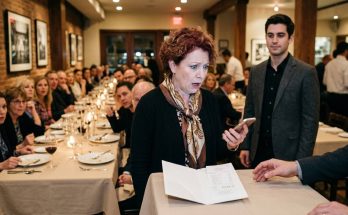
Eleanor drew the portfolio back toward herself, as though she might somehow make the documents more persuasive by reclaiming them.
“Claire, you are turning a simple matter into a spectacle,” she said. “Your husband has asked you to resolve this for weeks.”
“Then he can explain it to me himself.”
“He shouldn't have to beg his own wife for basic cooperation.”
“I'm not refusing to cooperate. I'm refusing to sign a document I haven't reviewed.”
Her lips tightened. She glanced around the table, checking whether her friends were watching. They were. The woman in red had stopped stirring her coffee. Another guest was pretending to read the dessert menu, although she had been holding it upside down for nearly a minute.
Eleanor hated losing control of a room.
“You have always been suspicious of Julian,” she said.
“That isn't true.”
“You make him feel as though he has to ask permission to participate in his own family.”
I looked at the documents again.
“His name is not on the restaurant's ownership records.”
“Because you have refused to put it there.”
“That's a decision I've made about my business. If Julian wants to discuss it, he knows where to find me.”
She sat back with an expression of wounded disbelief.
“Fine. Have it your way.”
I returned to my office, leaving the portfolio on the table. Marcus followed me a moment later.
“Do you want me to remove the documents from the dining room?”
“No. Let them stay where they are.”
He looked toward the guests. “And the bill?”
“Keep recording everything.”
For the next forty minutes, Eleanor and her friends continued their meal. They ordered coffee, more desserts, and two final bottles of wine. The legal documents remained beside Eleanor's plate, their bright yellow tabs visible whenever someone reached for a glass.
I tried to focus on the restaurant's daily reports, but my attention kept returning to the portfolio. Julian had been asking about ownership for months. His mother had arrived with documents already marked for signature. Whatever the paperwork contained, the timing was too deliberate to dismiss.
At 4:17 p.m., Marcus came into my office carrying a leather check presenter.
“The final total is ready.”
I opened it.
$14,812.64.
The figure was large enough to make me pause, but it was not an accident. Every dish, every bottle, every special request had been entered correctly. Eleanor had signed the agreement accepting responsibility for the entire party's bill.
“Print the itemized receipt,” I said.
Marcus did so, then handed it to me.
“You know she expects you to comp it.”
“I know.”
“She may never forgive you.”
I slipped the receipt into the presenter.
“That's her decision.”
I walked back into the dining room. Eleanor was telling a story that had several women laughing loudly. She had regained her composure and seemed to have decided that my refusal to sign the documents had been a temporary annoyance.
I placed the check beside her portfolio.
“There you are.”
She barely looked at it.
“Just take care of it, Claire.”
“You'll need to pay.”
Her laugh stopped.
She opened the presenter and stared at the total. Her eyebrows rose first, followed by a slow tightening around her mouth.
“What is this?”
“Your bill.”
“Fourteen thousand dollars?”
“Fourteen thousand, eight hundred and twelve dollars and sixty-four cents.”
She looked up at me as though I had deliberately insulted her.
“You cannot expect me to pay this.”
“You brought the party. You approved the orders. You signed the agreement.”
“I told everyone they could order freely because we're family.”
“And you said you were paying.”
Her voice dropped. “Don't be absurd. You've never charged me for a meal here.”
“Today is different.”
“You're humiliating me.”
“No, Eleanor. I'm asking you to settle the bill for the food and drinks your guests consumed.”
Several conversations around us faded. One woman put down her fork. Another began searching inside her handbag, looking uncomfortable.
Eleanor pushed the check presenter away.
“Comp it. Now.”
“No.”
She stared at me, her face flushing.
“You are my son's wife.”
“And this is my restaurant.”
The words hung between us. For once, Eleanor had no immediate response.
Then she snatched her phone from the table.
“Fine. I'll call Julian. He'll explain how this family operates.”
I had been waiting for that call.
She dialed his number and placed the phone on speaker in the middle of the table. The guests fell silent as the line rang.
Julian answered on the third ring.
“Mom?”
“Your wife has completely lost her mind,” Eleanor announced. “She has just handed me a bill for almost fifteen thousand dollars.”
There was a pause.
“Where are you?”
“At Oak & Vine, obviously. With all my friends.”
“Is Claire there?”
I stepped closer to the table.
“I'm right here.”
Julian exhaled audibly. “Claire, can we please discuss this later?”
His mother cut him off.
“No. You need to handle this now. She is trying to charge me for lunch at your own restaurant.”
The silence that followed was brief, but something in it made me straighten.
Then Julian spoke.
“Mom, stop talking.”
Eleanor blinked.
“What did you say?”
“Do not call it my restaurant.”
The women around her stopped moving. I could hear the faint hiss of the kitchen ventilation and the distant clatter of dishes being stacked behind the service doors.
Eleanor gave a bewildered laugh.
“Julian, what on earth are you talking about?”
“It's not mine.”
She stared at the phone.
“What do you mean, it's not yours?”
“I mean Oak & Vine belongs entirely to Claire.”
The color began to leave Eleanor's face.
For several seconds, she seemed unable to process the sentence. Then she looked from the phone to me, her mouth slightly open.
“But you told me you had an ownership stake,” she whispered. “You said Claire was refusing to put your name on the operating agreement.”
Julian said nothing.
Eleanor leaned closer to the phone.
“You told me you had invested in this business. You told me she was withholding something that legally belonged to you.”
Still nothing.
Her fingers curled around the edge of the table.
“Then why did you send me here with those papers?”
I reached for the portfolio.
Julian's voice changed instantly.
“Claire, don't sign anything. Please.”
I opened the folder and searched past the legal language until I found the relevant section.
Fifty percent.
The proposed agreement would transfer a controlling half-interest in Oak & Vine to Julian.
My hands went cold.
“You weren't asking me to tidy up our records,” I said into the phone. “You were trying to take half my company.”
“Claire, you don't understand the full situation.”
“I understand the number printed on this page.”
Eleanor looked down at the document, then back at the phone.
“You told me she was being unfair to you.”
Julian's breathing became shallow.
“Mom, please. Not here.”
“You told me she had agreed to this already.”
“I never said that.”
“You said she only needed to sign.”
I watched Eleanor's face change as the contradictions accumulated. Her anger was still there, but it had been joined by something more uncomfortable: the realization that she had helped her son pressure his wife into signing away a valuable business without understanding what the papers actually did.
I turned another page.
“Why do you need half of Oak & Vine, Julian?”
He hesitated long enough for the answer to begin forming in my mind.
“My firm has a serious cash-flow problem,” he finally admitted.
“How serious?”
“The bank won't renew our line of credit. I need additional assets to reassure the lender.”
I tapped the document.
“So you wanted to use my restaurant to secure your debts.”
“Not exactly.”
“Then explain exactly.”
He began talking about temporary financial pressure, a difficult quarter, and the need to stabilize his company. His words tumbled over one another, each explanation making the previous one sound less convincing.
I closed the folder.
“You should have come to me honestly.”
“I was trying to protect our future.”
“By hiding your company's problems and attempting to obtain half of my business without my informed consent?”
He had no answer.
Eleanor looked at him with growing disbelief.
“You told me Claire was the problem,” she said. “You told me she was being greedy.”
Julian's voice sharpened. “Because I knew you'd make this worse if you got involved.”
Her face reddened.
“You involved me! You gave me those papers and told me to make sure she signed them.”
I might once have felt satisfaction watching Eleanor turn on her son. Instead, I felt a deeper, colder dread.
The restaurant's ownership documents were one problem. The unexplained financial transfers were another.
I moved the phone closer to me.
“Julian, Sarah is auditing the operating accounts. She's found transfers I never approved.”
The line went silent.
“What transfers?” he asked.
“Money sent to your company. Payments that don't match our books. Expenses that have been recorded under descriptions that make no sense.”
“Those were temporary business advances.”
“From my company?”
“They were going to be replaced.”
I stared at the phone.
“How much money did you take?”
He didn't answer.
Behind me, the dining room remained utterly quiet. Eleanor had lowered her head, staring at the portfolio she had carried into my restaurant believing she was delivering a routine family document.
I had called the afternoon a business problem when I first saw the unusual charges.
Now I understood that I might be looking at something much worse.
Click here to continue reading: PART 4: His Mother Finally Heard the Truth, and the Missing Money Turned a Family Dispute Into a Financial Investigation
Thirty-Eight Guests Arrived Expecting a Free Feast, and My Mother-in-Law Made One Remark That Changed Everything
Part 3 of 12