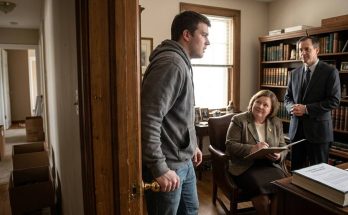
Evelyn asked me to sit down before she continued.
I was already sitting at the kitchen table, my fingers resting against the edge of the phone.
She explained that my parents had reviewed the available documentation with their attorneys.
The records of Grandpa's estate planning had become central to the dispute.
The trust had been established years before his final illness.
His decisions had been documented with independent legal advice.
There was no simple way to turn his carefully recorded wishes into something else just because my parents disliked the result.
"What happens now?" I asked.
"Your parents have to decide whether they intend to continue pursuing their challenge."
I stared at the wood grain beneath my hand.
"And if they do?"
"We'll continue responding through the proper legal process."
I appreciated that Evelyn never offered promises she couldn't keep.
She didn't tell me there was nothing to worry about.
She told me what was happening, what remained uncertain, and what we could do about it.
For someone who had spent years trying to guess what her parents wanted, that kind of honesty meant more than she probably knew.
After we finished talking, I remained at the table.
The refrigerator hummed.
Rain tapped against the kitchen window.
Grandpa's mug sat in the cupboard above the sink, exactly where I'd put it after washing it the week he'd died.
I wondered how many more months I would spend measuring my life by legal letters.
I didn't want to become someone who checked every envelope with dread.
I didn't want my parents to have that much control over me, even from a distance.
But I was still afraid.
That evening, I went into Grandpa's study.
His chair stood beside the window.
The mahogany desk was covered with the ordinary things I'd begun using again: a notebook, a pen, and a small stack of bills.
For months, I'd treated the room as though it belonged to a past I couldn't touch without hurting myself.
Now I sat down and opened the notebook.
I made a list of everything I wanted to do that had nothing to do with the dispute.
Finish the book on my bedside table.
Visit the foundation's office.
Call a friend I'd been neglecting.
Spend an afternoon in the garden without thinking about what might happen to the house.
The list wasn't ambitious.
That was the point.
I needed to remember that my life was larger than the fight my parents had started.
The next morning, I went to work as usual.
I answered emails, attended meetings, and completed the tasks I'd put off.
At lunch, a coworker asked how I was doing.
I almost gave the usual answer.
Fine.
Instead, I said I was dealing with a difficult family matter.
She didn't ask for details.
She simply told me she hoped things would settle soon.
It was a small kindness.
I carried it with me for the rest of the afternoon.
A few days later, Chloe called.
She sounded hesitant.
"Have you heard anything?"
"Not yet."
"I've spoken to Dad again."
I stopped sorting the papers on my desk.
"What did he say?"
"He still thinks Grandpa should have left the house to him."
I closed my eyes briefly.
"Even after everything?"
"Yes."
She sighed.
"I told him that being Grandpa's son didn't mean he could ignore what Grandpa wanted."
I appreciated her telling me.
But I also knew that I couldn't build my peace around whether Chloe managed to change our father's mind.
"Thank you for standing up for what's right," I said.
She was quiet.
"I should have done that earlier."
"Yes," I replied. "You should have."
I didn't say it to hurt her.
I said it because I was tired of pretending that every painful truth needed to be softened for someone else's comfort.
Chloe accepted the answer.
We spoke for another few minutes before ending the call.
That was becoming our pattern.
Small conversations.
Honest answers.
No promises that we would suddenly become the sisters we might have been if our childhoods had gone differently.
I found that I preferred it.
A week passed.
Then another.
I continued working with Evelyn and Robert, providing documents when requested and following their advice.
I tried not to imagine every possible outcome.
Some nights, I managed.
Other nights, I lay awake listening to the wind move through the trees outside my bedroom window.
When that happened, I reminded myself that fear was not evidence.
The letter from California was a claim.
It was not a verdict.
And Grandpa had not left me with nothing but memories and a hope that everyone would behave fairly.
He had prepared.
Eventually, Evelyn called again.
This time, she sounded more settled.
"Your parents have decided to withdraw their challenge."
I didn't answer immediately.
I had spent months imagining the moment I might hear those words.
In my mind, I'd pictured myself crying with relief or laughing because the ordeal was finally over.
Instead, I sat very still.
"They're withdrawing it?"
"Yes. After reviewing the documentation and receiving legal advice, they've decided not to continue."
I looked toward the study.
Sunlight lay across the floorboards.
For a moment, I couldn't connect the words she'd spoken with the fear I'd been carrying.
"What does that mean for the house?"
"The challenge will no longer be pursued. We'll continue with the remaining administration of the estate, but the legal dispute you've been facing is coming to an end."
I pressed my palm against the table.
"Thank you."
"You don't need to thank me for doing my job, Maya."
"I know. I just wanted to say it."
After the call, I walked down the hall.
I opened the study door and stood in the doorway.
The room looked exactly as it had that morning.
Grandpa's books.
His chair.
The desk where he'd kept every important document in its proper place.
Nothing had changed.
But something inside me had finally loosened.
I went to the desk and sat down.
Then I cried.
Not because I'd beaten my parents.
Not because the house was worth fighting over.
I cried because I was tired.
I cried because Grandpa wasn't there to tell me the hard part was over.
I cried because the five-year-old inside me had spent so long believing that other people could take everything away whenever they wanted.
And I cried because, this time, they hadn't.
When I finally stopped, I wiped my face with my sleeve.
I looked at the notebook I'd left on the desk.
My list was still there.
Finish the book.
Visit the foundation.
Call my friend.
Spend time in the garden.
I picked up the pen and crossed off the first item.
That evening, I made dinner.
Nothing special.
I used the old pan Grandpa had always preferred and set the table for one.
For the first time in months, I didn't keep checking my phone.
I ate slowly.
Afterward, I washed the dishes and put them away.
Then I stepped onto the porch.
The air was cool, and the sky above the trees had begun to darken.
The porch light was still off.
I stood there for a moment, looking at the driveway.
For years, I'd thought of home as the place where someone might return.
Now I was beginning to understand that home could also be the place where I was allowed to remain.
I went back inside and closed the door.
The house was mine to care for.
The future was mine to shape.
And for the first time since Grandpa's funeral, I could imagine tomorrow without wondering whether someone would arrive to take it away.
Click here to continue reading: PART 10: I Finally Opened Grandpa’s Bedroom to the Future, and the Small Change I Made There Helped Me Understand What He Had Been Teaching Me All Along
The Morning After I Buried Grandpa, My Parents Returned With a Truck and Treated My Childhood Home Like Their Property
Part 9 of 12