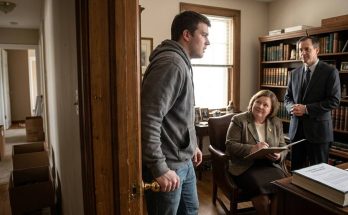
Nearly six months had passed since my parents arrived with the moving truck.
By then, the legal dispute had ended.
I had settled into a routine.
Work.
The house.
The foundation.
Occasional coffee with Chloe.
My life was not perfect, but it belonged to me.
My parents remained distant.
I heard little about them directly.
Sometimes Chloe mentioned that Dad was still angry about the estate.
Other times, she said Mom had been unusually quiet.
I didn't ask for details.
I had spent enough of my life trying to understand what happened inside their home.
I no longer believed it was my responsibility to solve their problems.
Then, one afternoon, I found a handwritten envelope in the mailbox.
My mother's handwriting was unmistakable.
I stood on the porch holding it.
The paper was plain.
There was no return address beyond the one I already knew.
For a moment, I considered taking it straight inside and putting it in a drawer.
I wasn't ready for another demand.
I wasn't ready to read another explanation about why they had done what they did.
But the envelope was addressed to me.
So I opened it.
The first few lines were difficult to read because my hands had begun to shake.
Mom wrote that she had spent a long time thinking about the years when I lived with Grandpa.
She said she knew I might not want to hear from her.
She said she had no right to expect a response.
I sat down on the porch bench.
Then I continued reading.
She admitted that she had been overwhelmed by the responsibility of raising two children during a troubled marriage.
When Dad suggested leaving me with Grandpa, she had agreed.
It had made their new life in Orange County easier.
She had told herself that Grandpa could give me stability while she and Dad sorted out their problems.
She had convinced herself that I would be better off.
I read that paragraph several times.
There it was.
Not a misunderstanding.
Not an accident.
A choice.
She had made it when I was five.
Then she had continued making it every year she stayed away.
She wrote that returning had become harder as time passed.
The longer she waited, the more ashamed she felt.
Rather than face what she'd done, she had allowed the distance to grow.
Birthdays passed.
School years passed.
My graduation came and went.
She had known there would be a price for returning.
She had simply avoided paying it.
I stopped reading for a moment.
The sky was pale above the trees.
Somewhere down the street, a child called to a friend.
I thought about all the birthdays Grandpa had celebrated with me.
He had always made pancakes in the morning.
Sometimes they came out too dark on one side.
Sometimes the first batch was too thick.
He never minded.
He would place the plate in front of me and ask what I wanted to do that year.
I had once asked whether my parents would remember my birthday.
Grandpa had looked at me for a long moment.
Then he had said that he hoped they would.
He hadn't lied.
He hadn't told me they loved me when he couldn't know what they felt.
He had simply stayed beside me while I waited.
I returned to the letter.
Mom acknowledged the day she came back to the house.
She admitted that she and Dad had arrived expecting to receive something they had not earned.
Even after watching Grandpa's recording, she had blamed me instead of confronting her own choices.
She had accused me of turning him against them.
She had treated the house as though my seventeen years there meant nothing.
She wrote that she was ashamed of it.
Near the end, she admitted that an apology could not give me back my childhood.
She didn't ask me to forgive her.
She didn't ask for money.
She didn't suggest that I should let her into the house.
She wrote that she understood I might never want a relationship with her.
Then she signed her name.
I sat with the letter in my lap.
I had imagined receiving an apology for years.
When I was younger, I'd pictured my mother arriving at Grandpa's house with tears in her eyes.
I'd imagined her telling me that leaving me had been a terrible mistake.
I'd imagined throwing my arms around her and feeling that everything had finally become right.
But the real letter didn't feel like that.
It didn't erase the years.
It didn't bring back the birthdays.
It didn't change the fact that she had known where I was and chosen not to return.
It did something smaller.
For the first time, she had told the truth without asking me to carry the blame.
I folded the letter carefully.
Then I went inside.
I placed it on the desk in Grandpa's study.
For a while, I stood beside the window, looking out toward the garden.
I wanted to know what I was supposed to feel.
Relief, perhaps.
Anger.
Sadness.
Some part of me was glad she'd finally admitted what happened.
Another part was furious that it had taken seventeen years and a fight over an inheritance to get there.
Both feelings were real.
I didn't need to choose between them.
That evening, I called Chloe.
"Mom wrote to me."
She was quiet.
"What did she say?"
I told her the main points.
Chloe listened without interrupting.
When I finished, she let out a slow breath.
"I'm glad she finally admitted it."
"So am I."
"Are you going to answer her?"
"I don't know."
Chloe didn't tell me what I should do.
That was new.
A year earlier, she might have tried to convince me to forgive Mom for the sake of the family.
Now she simply said that I could take my time.
We talked for a little longer.
Then we said goodbye.
I returned to the study and picked up the letter again.
I read it once more.
There were no hidden demands between the lines that I could identify.
No request to share the inheritance.
No suggestion that I should forget what had happened.
I was grateful for that.
But gratitude wasn't forgiveness.
I had to remind myself of that.
Sometimes, people talked about forgiveness as though it were a debt the injured person owed.
As though an apology automatically created an obligation.
I had spent my childhood trying to be good enough to bring my parents back.
I wasn't going to spend the rest of my life trying to be generous enough to make them feel better about leaving.
I could acknowledge Mom's honesty without pretending the damage had disappeared.
I could hope she learned something without inviting her back into my life before I was ready.
I could leave the door closed without turning my heart into something hard.
That night, I placed her letter in a drawer in the study.
I didn't throw it away.
I didn't display it.
I simply put it somewhere safe.
Then I went into the library and chose a book from the shelf.
I settled into Grandpa's chair and began to read.
The house was quiet.
The past was still there.
But it no longer had to decide what I did next.
Click here to continue reading: PART 12: One Year After Grandpa’s Funeral, I Turned On the Porch Light for Myself and Finally Understood Why He Had Never Let Me Believe I Was Unwanted
The Morning After I Buried Grandpa, My Parents Returned With a Truck and Treated My Childhood Home Like Their Property
Part 11 of 12