Landon called the following morning.
I watched his name appear on my screen.
For a moment, I considered letting it ring until it stopped.
Then I answered.
“Harper.”
He sounded impatient.
Not frightened.
Not apologetic.
Impatient.
“What happened with the card?”
I sat down at the kitchen table.
“Good morning to you, too.”
“Don't do that.”
“Do what?”
“Make this difficult.”
I closed my eyes.
There it was.
We had been speaking for less than a minute, and somehow I was already the person creating a problem.
“I haven't made anything difficult,” I said. “I secured my accounts.”
“You changed the access.”
“Yes.”
“You knew I was using that card.”
“I knew you had access to it while we were married.”
He went quiet for a moment.
Then he sighed.
“Harper, we need to be reasonable.”
I looked at the notebook beside my coffee.
I had written down the questions I needed answered.
The transaction.
The authorization.
The membership.
The remaining access.
I was not going to abandon those questions because Landon had chosen a familiar tone.
“Tell me what happened at the club.”
“I was making a purchase.”
“For the necklace?”
“Yes.”
“Did you expect to pay with my card?”
He paused.
“I expected the card to work.”
That answer told me more than he probably intended.
He did not say he had misunderstood the arrangement.
He did not say he had forgotten whose account it was.
He said he expected it to work.
I pressed my fingertips against the edge of the table.
“Why?”
“Because I've used it before.”
“While we were married.”
“We were married yesterday morning, Harper.”
“And we were divorced yesterday afternoon.”
He made a frustrated sound.
“You're acting as if I'm some stranger who walked in off the street.”
“No. I'm acting as if you no longer have permission to use my account.”
He did not answer immediately.
I could hear faint background noise on his end.
A door closed.
Someone spoke, too far away for me to understand.
Then Landon lowered his voice.
“Do you have any idea how embarrassing this is?”
I stared at the coffee cup.
I had expected him to be angry.
I had expected him to accuse me of being petty.
But hearing him complain about his embarrassment still hurt.
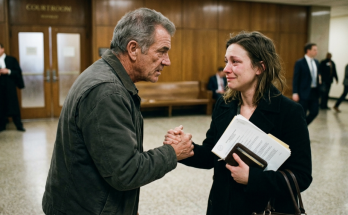
He had spent the previous day parading Tessa through the courthouse hallway.
He had worn the watch I bought him for our anniversary.
He had taken her to a private club under my membership and presented my card for a necklace that cost six hundred and forty thousand dollars.
Yet somehow, his embarrassment was the part I was supposed to care about.
“What exactly happened?” I asked.
“I don't want to discuss every detail over the phone.”
“Then tell me what you're willing to discuss.”
He exhaled sharply.
“Harper, the club knows me. I've been going there for years.”
“Through my membership.”
“Our membership.”
I felt the old argument rising between us.
Everything was ours when Landon wanted access.
When I needed him to share responsibility, the conversation changed.
“Who paid for the membership?” I asked.
“That isn't the point.”
“It is part of the point.”
He went silent.
I could almost picture him standing somewhere with his jaw tight, trying to decide which version of himself would work best.
The charming husband.
The offended man.
The reasonable businessman who had been unfairly inconvenienced.
I had seen all three.
“Look,” he said finally, “I don't want to fight with you. The divorce was difficult enough.”
I almost laughed.
He had made the divorce difficult for months.
He had made the courthouse hallway difficult with his remarks.
He had made the previous evening difficult by using a card that I had spent years allowing him to access.
Now he wanted the discussion to become difficult only when I asked him to explain himself.
“I'm not trying to fight,” I said. “I'm asking what happened.”
“I gave them the card. That's what happened.”
“And did you authorize the purchase?”
“I was buying a gift.”
“That wasn't my question.”
He was quiet again.
I waited.
Finally, he said, “I thought it would be handled.”
“By whom?”
“Harper.”
“By whom, Landon?”
He did not answer.
I looked at my father's notebook.
The blank lines seemed to offer more honesty than my husband had offered me in years.
“I've asked the club to verify the transaction,” I said. “I have also made it clear that you no longer have authorization to use my account.”
“You didn't have to do that without telling me.”
“I didn't need your permission.”
The silence that followed was different.
For the first time, I had said something he could not turn into a discussion about whether I was being kind enough.
He had no say in whether I could secure my own money.
I felt my heart beating hard, but I did not take the words back.
Landon spoke again.
“You've changed.”
“No,” I said quietly. “I'm finally making a decision for myself.”
He ended the call soon afterward.
I held the phone in my hand.
I had expected to feel triumphant.
Instead, I felt the familiar ache that came whenever I stopped doing what Landon wanted.
Part of me still feared that I had been cruel.
Part of me still wanted to call him back and soften what I had said.
That was how deeply the habit had settled into me.
I had spent so long managing his reactions that I sometimes mistook his displeasure for evidence that I had done something wrong.
Dad entered the kitchen carrying a folder.
He took one look at my face.
“You spoke to him.”
“Yes.”
“How did it go?”
“He wanted to know why I changed the card.”
“And what did you tell him?”
“The truth.”
Dad set the folder down.
“Then you did what you needed to do.”
I looked at the phone.
“He says the club situation is embarrassing.”
Dad did not comment on Landon's character.
He did not need to.
He simply asked, “Did he explain the authorization?”
“No.”
“Did he tell you what happened to the transaction?”
“No.”
“Then you still need the records.”
I nodded.
The conversation had not given me the answers I wanted.
It had given me something else.
I had heard Landon speak without immediately rushing to make him comfortable.
I had asked questions he did not want to answer.
And when he became frustrated, I had let him be frustrated.
Nothing terrible had happened.
The world had not collapsed.
I was still sitting at the same kitchen table, with the same cold coffee and the same notebook.
But I felt different.
Not strong in the way people described strength after a breakup.
I felt uncomfortable.
I felt sad.
I felt as if I had stepped out of a familiar room and discovered that I had been standing in the wrong place for years.
Later that day, I received a response from the club concerning the review of the account.
It contained information about the verification process and the status of the details they had been able to confirm.
I read it carefully.
I saved the message with my other records.
I did not send it to Landon.
I did not post it online.
I did not use it to embarrass him in return.
I wanted the matter resolved, not turned into another performance.
That evening, I finally removed the gold watch from the photograph I kept on my phone.
It had been a picture from our tenth anniversary.
Landon was smiling at the restaurant table, his wrist resting beside mine.
I had taken the photograph because I wanted to remember how happy he looked when he opened the gift.
I had not noticed that the watch was the first thing I had looked at in the picture every time I returned to it.
I deleted the image from my favorites.
I did not erase every photograph of our marriage.
I was not ready to do that.
I simply stopped keeping that one where I would see it every day.
Then I put my phone away.
I went to bed before midnight.
For the first time since the courthouse, I did not check whether Landon had sent another message.
I slept for several hours without waking.
It was not peace.
But it was a beginning.
Click here to continue reading: PART 7: The More I Examined the Life We Had Shared, the Harder It Became to Pretend That Access and Love Were the Same Thing
My Marriage Was Over, but My Father Saw a Problem I Was Too Heartbroken to Notice
Part 6 of 8