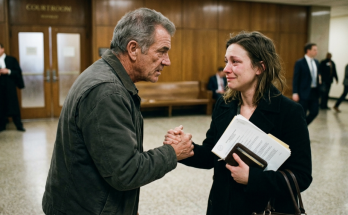
The weeks after the divorce were quieter than I expected.
There were still things to resolve.
The membership arrangements needed to be finalized, and the account review had to follow its course.
I kept the records.
I answered the questions put to me.
I did not allow Landon's impatience to determine how quickly I acted.
For the first time in our relationship, I was not trying to protect him from the discomfort of a decision he had made.
I was protecting myself from the consequences of choices I had not agreed to.
The difference changed more than I expected.
I had thought the end of the marriage would leave me with nothing but empty rooms and memories.
Instead, it left me with decisions.
Small ones at first.
Which accounts to keep.
Which arrangements to end.
Which messages required an answer.
Which things I could leave alone.
I discovered that I could make those decisions while still feeling sad.
I did not have to wait until I was completely healed to take care of myself.
One morning, I sat at my father's table with the final set of records I had received about the account arrangements.
I read each page carefully.
The documents did not explain every moment of my marriage.
They did not tell me what Landon had felt when he offered my card for the necklace.
They did not tell me whether he had understood the consequences of what he was doing.
They could not answer those questions.
What they could do was establish the information connected to the accounts and the steps taken to secure them.
That was enough for the work in front of me.
I put the papers in a folder.
Then I closed it.
Dad watched from the other side of the table.
“Are you finished?”
“With the things I can finish right now.”
He nodded.
“That counts.”
I looked at the folder.
For days, I had treated every unresolved detail as proof that I was still trapped in the marriage.
Now I understood that some matters simply took time.
I could not force an answer out of a financial institution.
I could not make Landon admit something he did not want to admit.
I could not change the way he had behaved in the courthouse hallway.
But I could keep my accounts secure.
I could preserve the records.
I could refuse to give him access again.
Those were things I could do.
And I had done them.
My phone rang later that day.
Landon's name appeared on the screen.
I answered after a moment.
“Harper.”
His voice sounded tired.
Not the carefully controlled voice he used in the courthouse.
Not the impatient voice he had used when he called about the card.
Just tired.
“I wanted to know whether everything with the club has been settled.”
I looked at the folder on the table.
“The account review is being handled through the appropriate channels.”
“So you still won't tell me anything?”
“I've told you what I know.”
“You could make this easier.”
I almost smiled at the familiar words.
For years, making things easier had been my responsibility.
If Landon was uncomfortable, I softened the conversation.
If he was embarrassed, I tried to protect him.
If he had made a mistake, I helped him explain it.
I had believed those things were part of being a good wife.
Now I understood that a relationship could not survive if one person was always expected to absorb the discomfort created by the other.
“I've secured my accounts,” I said. “The rest will be handled through the proper process.”
He exhaled.
“You're really going to leave things like this?”
“I am going to let the facts speak for themselves.”
He did not answer.
For a moment, I thought he might apologize.
I imagined him acknowledging that he had expected to use my card after our marriage ended.
I imagined him admitting that he had treated access as a right instead of a privilege.
I imagined him asking how I had been sleeping.
None of those things happened.
Instead, he said, “I never thought you'd turn on me like this.”
I felt the old urge to explain myself.
To tell him that I had not turned on him.
That I had simply stopped allowing him to use my financial access.
That protecting myself was not the same as punishing him.
The explanation rose to my lips.
Then I let it go.
He knew what I had told him.
Repeating it would not make him agree.
“I hope you take care of yourself, Landon,” I said.
He was silent.
Then the call ended.
I put the phone down.
There was no dramatic feeling of victory.
I did not stand up and announce that I was finally free.
I sat at the table and let the sadness come.
I had loved that man.
I had built plans around him.
I had imagined growing older beside him, remembering the places we had visited and the things we had accomplished together.
I had believed that if I remained patient enough, generous enough, and understanding enough, we would eventually reach a place where neither of us needed to defend our position.
I had been wrong.
That did not make every year a lie.
It meant that the future I had imagined was no longer the future I could live.
I cried for a while.
Dad did not interrupt me.
When I was ready, he set a glass of water beside me.
I drank it.
Then I wiped my face with a paper napkin and looked at the folder again.
The documents were ordinary.
The black card was inside, separated from my wallet.
There was nothing special about its surface.
No magic.
No promise.
It had never been proof that Landon was successful.
It had never been proof that I was a good wife.
It had only been a card connected to an account I was responsible for.
I had given him access because I trusted him.
When that trust was no longer justified, I had the right to withdraw it.
That was the whole truth.
It did not need a speech.
A few days later, I returned to my own home.
The rooms looked familiar, but I noticed things I had stopped seeing during the final year of my marriage.
The lamp beside the sofa had a crooked shade.
A small scratch marked the dining table.
The kitchen window needed cleaning.
These were ordinary details, and I found comfort in them.
I walked through the rooms slowly.
I did not look for signs of Landon everywhere.
I did not try to erase him from the house in a single afternoon.
I opened the windows.
I put fresh sheets on the bed.
I made coffee and drank it while standing by the kitchen counter.
The silence was different from the silence at my father's apartment.
This silence belonged to me.
I could leave a cup in the sink without wondering whether it would start an argument.
I could read at the table without being interrupted by someone demanding my attention.
I could decide what to do with an evening without measuring the decision against another person's expectations.
At first, the freedom felt uncomfortable.
I had spent so long adjusting myself around Landon that making a decision without considering his reaction seemed almost selfish.
Then I remembered the necklace.
Six hundred and forty thousand dollars.
I remembered the way he had placed my card on the tray.
I remembered how little hesitation there had been.
And I remembered my father's hand on my wrist outside the courtroom.
Change the access.
Protect what is yours.
At the time, I had thought he was asking me to handle a few practical details while I was heartbroken.
He had been doing something more important.
He had been reminding me that heartbreak did not cancel my responsibilities to myself.
I could grieve for my marriage and still protect my future.
I could miss Landon and still refuse to let him use my accounts.
I could remember the good parts without pretending the bad parts had not happened.
That evening, I placed the folder in a drawer.
I put the black card beside it.
Then I closed the drawer and went back to the kitchen.
I cooked a simple dinner.
I ate at the table.
I washed the plate and dried my hands.
Nothing about the evening would have looked important to anyone else.
That was what made it feel like mine.
Before bed, I checked my phone.
There was no message from Landon.
I no longer needed one.
I did not need him to apologize before I could move forward.
I did not need him to admit that I had been right.
I did not need him to understand why I had changed the PINs.
I had spent years waiting for him to recognize the things I did for him.
I would not spend the rest of my life waiting for him to recognize what he had done to me.
I turned off the light.
The next morning, I woke up and made coffee.
I stood by the window with the warm cup in both hands.
The city was beginning its day.
People were going to work, opening shops, hurrying toward appointments, and making plans that had nothing to do with me.
For the first time in a long while, I did not feel as if I had been left behind.
My marriage had ended.
The years behind it were still mine, even the ones I regretted.
I could not recover the time I had spent trusting the wrong things.
I could not make Landon become the person I had once believed he was.
But I could decide what I would allow from that day forward.
I would not confuse generosity with obligation.
I would not mistake confidence for character.
And I would never again believe that loving someone meant giving them unrestricted access to everything I had worked to build.
My father had not asked whether I was okay outside the courthouse.
At first, I had thought that was the cruelest part of the day.
Now I understood why he had reached for my wrist before he reached for comforting words.
He had seen that I was hurting.
He had also seen that I was vulnerable to someone who knew exactly where my trust had left the doors open.
He could not make the divorce painless.
He could not give me back the marriage I thought I had.
But he could remind me to protect what remained.
And this time, I listened.
The End
Read more original stories on Feel Every Story.
My Marriage Was Over, but My Father Saw a Problem I Was Too Heartbroken to Notice
Part 8 of 8