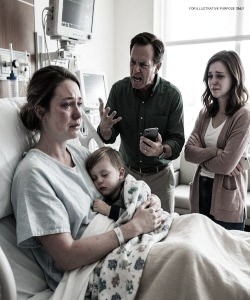
PART 3: THE ROOM THEY HAD ALREADY GIVEN AWAY
I almost laughed.
Not because anything was funny, but because my mother had just offered my home to four people while standing beside the granddaughter she still hadn’t bothered to greet.
“Until they get back on their feet,” I repeated. “And who decides when that is?”
Mom adjusted the strap of her handbag.
“There’s no need to put a deadline on helping family.”
“Then there’s no need to call it temporary.”
Her mouth tightened.
Beside me, Ben sat very still.
I knew that stillness. He was trying to give me space to handle my own family, even though every word coming out of my mother’s mouth was costing him effort.
“We have a newborn too,” he said.
Mom glanced at Eleanor’s bassinet.
“Yes, Ben. We’re aware.”
It was the first time she had acknowledged my daughter since entering the room.
Something inside me cooled.
“Are you?” I asked.
“Odalie.”
“You’ve been two doors away all day. You haven’t asked how much she weighs. You haven’t asked whether she’s feeding. You haven’t even said her name.”
My mother looked toward the hallway.
“Please don’t turn this into a competition between babies.”
“I’m asking you to look at mine.”
For a moment, nobody spoke.
Then Eleanor stirred, making a small, restless sound.
I reached for her, but the movement pulled painfully through my exhausted body. Ben stood immediately and lifted her into my arms.
Mom watched him settle the blanket around her.
“You see?” she said. “You have help.”
I looked up slowly.
“And that means I don’t need a mother?”
Her expression flickered.
For one brief second, I thought she might hear me.
Then she sighed.
“Your sister is overwhelmed.”
“So am I.”
“You’ve always handled things better.”
“Maybe because nobody gave me another choice.”
Ben lowered his head, rubbing a hand over his mouth.
My mother’s phone buzzed.
She glanced at the screen and turned it facedown so quickly that I noticed.
“Who is that?”
“Your father.”
“Tell him to come here.”
“He’s busy.”
“Doing what?”
“Odalie, you’re exhausted. This conversation would be more productive tomorrow.”
“No,” I said. “Tomorrow is apparently when I discover people living in my house.”
Her silence answered more than she intended.
Ben straightened.
“When were they planning to move in?”
Mom smoothed the front of her blouse.
“There are a few practical things to sort out first.”
“When?”
She looked at him with irritation.
“This evening.”
The room seemed to contract around us.
I could hear the air vent above the door. The squeak of shoes in the hallway. Eleanor’s little breaths against my chest.
“This evening,” I repeated.
“It’s only their belongings for now.”
“And who is letting them in?”
Another pause.
Ben took out his phone.
Mom immediately stepped toward him.
“Let’s not make calls before we’ve had a proper discussion.”
He looked at her.
“That would have been good advice before you gave away our spare rooms.”
He opened the app connected to our front-door camera.
I watched his face.
First concentration.
Then disbelief.
Then something colder.
“What?” I asked.
He turned the screen toward me.
A white moving van stood in our driveway.
Our driveway.
The one we had swept on Sunday because Ben wanted everything clean when we brought Eleanor home.
Its rear doors were open.
Two men were carrying a dark gray sofa toward our front porch.
I recognized that sofa.
Medelli had sent me a link to it eight months earlier and complained that Mom wouldn’t buy it for her.
Our front door was propped open with a cardboard box.
Dad stood beside it, pointing.
For several seconds, I couldn’t find my voice.
Then I looked at my mother.
“You said this evening.”
She didn’t look at the screen.
“It is this evening.”
The calmness of her answer hurt more than shouting would have.
They weren’t considering it.
They weren’t waiting for an answer.
They had already started.
Ben tapped the microphone on the camera.
“Stop unloading.”
On the screen, one of the movers looked up.
Dad turned toward the doorbell.
“Ben?”
“Tell them to stop. Nobody has permission to move anything into our house.”
Dad stepped closer to the camera.
“We’re getting things ready. We’ll talk when you get back.”
“We’re talking now.”
Mom reached toward Ben’s phone.
He moved it out of her reach without taking his eyes off the screen.
“Call Kyle,” Dad said. “He’ll explain.”
“I don’t need an explanation. I need you to stop.”
One of the movers lowered his end of the sofa.
Dad turned away from the camera and spoke to him.
We couldn’t hear every word.
But we heard enough.
“My daughter’s place. Family arrangement.”
Ben’s jaw tightened.
He spoke clearly into the phone.
“I am one of the homeowners. There is no arrangement. Please put the furniture back in the van.”
The mover looked at Dad, then at the camera.
“Sir, we were told—”
“I understand. You were given incorrect information.”
Mom folded her arms.
“Do you realize they’ve paid for those movers?”
I stared at her.
“Do you realize I’m watching strangers carry furniture into my house?”
“They aren’t strangers. They’re professionals.”
I couldn’t believe we were having this conversation.
Ben stepped toward the window and called our neighbor, Mrs. Alvarez, who had been feeding our cat while we were at the hospital.
I heard him ask whether she could watch from her porch and confirm when the van left.
Then he called a locksmith.
My mother’s eyes widened.
“You’re changing the locks?”
“Yes,” he said.
“Against your own family?”
“Against anyone who uses an emergency key this way.”
She turned to me.
“You’re going to let him speak to me like that?”
I shifted Eleanor higher against my chest.
“He’s saying exactly what I would say.”
Mom stared at me as though I had suddenly begun speaking a language she didn’t recognize.
Perhaps I had.
For most of my life, my answer had been some version of yes.
Yes, I could transfer money.
Yes, I could postpone my plans.
Yes, Medelli could have the bigger room, the better date, the last chance.
Even my objections usually ended with an apology.
This time, I didn’t offer one.
“Now explain the hospital questions,” I said.
Mom looked away.
“We were trying to make the discharge easier.”
“For whom?”
“For everybody.”
“Who was supposed to take Eleanor home?”
“Odalie, nobody was trying to take your baby.”
“Then tell me what you asked.”
She exhaled sharply.
“I asked whether a grandparent could collect a baby if the mother needed to remain in the hospital longer.”
Ben ended his call.
He turned toward us.
“Why?”
“Because we didn’t know when Odalie would be released.”
“You could have asked me,” I said.
“You were resting.”
“I called you.”
Her face tightened again.
I could still hear Dad’s voice from that call.
WE’RE EXHAUSTED.
They had been too tired to walk down the hallway.
But somehow, they had found the energy to arrange movers, discuss my daughter’s discharge, and distribute the rooms in my house.
“Where did you intend to take her?”
Mom hesitated.
“To our place, if necessary. Just for a little while.”
I felt Ben move closer.
“And where would I have gone?”
“With her, of course.”
I looked down at Eleanor.
Her tiny hand had escaped the blanket and rested against my hospital gown.
“Why would I go to your house when I have my own?”
Mom’s gaze went briefly to Ben.
“Because yours would be busy.”
There it was.
Not a complete confession.
Just one careless word.
Busy.
With my sister’s furniture.
With her husband.
With the baby my parents had celebrated all day.
My home would be busy, so my daughter and I were supposed to go somewhere else.
“How many rooms did you promise her?”
“Odalie—”
“How many?”
“The two spare rooms.”
“One is Ben’s office.”
“He can work downstairs.”
“And the other?”
“The guest room.”
I watched her carefully.
“What about Eleanor’s nursery?”
She said nothing.
Ben reached for his phone again.
Mom’s voice sharpened.
“That nursery is the only room upstairs that doesn’t share a wall with the bathroom. Medelli’s baby is a very light sleeper.”
I felt my heartbeat in my throat.
“He’s been alive for a few hours.”
“She needs to establish a routine.”
“And Eleanor doesn’t?”
“Your baby will be sleeping beside you anyway.”
For months, Ben and I had worked on that room.
He had painted the walls a soft green after I changed my mind three times.
I had spent evenings sitting in the rocking chair, one hand on my stomach, imagining the little person who would sleep there.
Above the crib, we had hung wooden letters.
ELEANOR.
My mother had looked at that room and seen something available for someone else.
I heard my own voice before I realized I was speaking.
“Get out.”
Mom blinked.
“What?”
“Leave my room.”
“You’re upset.”
“Yes.”
“Then this isn’t the time to make decisions.”
“It’s the perfect time to make this one.”
She stared at me.
I didn’t raise my voice.
I didn’t need to.
“You can come back when we invite you. Until then, you don’t visit me, you don’t ask staff questions about my baby, and you don’t go near our house.”
Her eyes filled.
Under other circumstances, that would have undone me.
I would have rushed to comfort her before she had to sit with even a moment of discomfort.
But Eleanor moved against me, and I stayed still.
“We raised you better than this.”
“No,” I said quietly. “You raised me to make this easy for you.”
The door opened before she could answer.
Denise stood there.
She took in my face, Ben’s expression, and my mother standing between us.
“Everything all right?”
“My mother is leaving,” I said.
Denise stepped aside and held the door.
Mom picked up her handbag.
At the threshold, she turned.
“Your sister has nowhere to take her baby.”
The words landed heavily.
For the first time, the situation beneath all her excuses showed itself.
I looked at her.
“What happened to their apartment?”
She pressed her lips together.
“Ask Medelli.”
Then she walked out.
For a few seconds, I stared at the empty doorway.
Denise closed it gently.
“Would you like us to limit visitors?”
“Yes,” I said.
The word felt unfamiliar.
Then easier.
“Yes. Please.”
She explained that she would let the team know and asked whether I needed anything else.
“Water,” I whispered.
“And maybe a minute.”
“You can have both.”
After she left, Ben sat beside me.
I had expected anger to keep me upright.
Instead, I started shaking.
Not dramatically.
Just a tremor in my hands that I couldn’t stop.
“I gave them that key,” I said.
“For emergencies.”
“I told them the code.”
“Because you trusted them.”
“I should have—”
“No.”
Ben’s voice was gentle, but firm.
“Don’t finish that sentence.”
I looked at him.
“You did not cause this by trusting your parents.”
That was when I cried.
I cried for the nine hours.
For the flowers I had watched pass my doorway.
For the little girl in my arms who had entered the world and already been assigned less space in it.
Ben held the water cup while I drank.
Then he kissed Eleanor’s head.
“She’s coming home to her own room,” he said. “With us.”
His phone buzzed.
Mrs. Alvarez.
The movers were putting the sofa back in the van.
Dad was standing on the lawn, arguing on his phone.
The locksmith could meet Ben at the house in forty minutes.
“I hate leaving you,” he said.
“Go.”
“I can ask someone else to—”
“Ben. Please go make sure our home is still ours.”
He glanced at the door.
“I’ll ask Denise to check on you.”
Before leaving, he plugged my phone into its charger and placed the call button where I could easily reach it.
Small things.
Thoughtful things.
The kind of care my parents kept telling me I didn’t need.
When the door closed behind him, the room became quiet.
I touched Eleanor’s cheek.
“I wanted them to love you immediately,” I whispered.
She made a soft sound in her sleep.
“I’m sorry.”
Then my phone began vibrating.
Dad.
I let it ring.
A message followed.
You humiliated me in front of working men.
Then another.
Your sister is crying. I hope you’re pleased with yourself.
I put the phone facedown.
A minute later, it vibrated again.
This time, it was Medelli.
For a moment, I considered ignoring her too.
Then I remembered Mom’s final words.
Nowhere to take her baby.
I answered.
“Did you know?”
There was no greeting.
No question about Eleanor.
Just those three words.
I sat straighter.
“Did I know what?”
“That Dad took the movers over already?”
“Yes. Did you?”
“I knew they were going this afternoon.”
“Without asking me?”
Silence.
Then she said, “Mom said you knew.”
I closed my eyes.
“What exactly did she tell you?”
“That you and Ben offered to let us stay.”
The anger in my chest shifted.
It didn’t disappear.
But it found a new shape.
“When?”
“A few weeks ago.”
“A few weeks?”
“She said you wanted to talk about the details after the babies came.”
I looked toward the door.
My mother had made it sound like a suggestion that developed during a long day at the hospital.
A spontaneous family solution.
But this had been waiting for me before my labor even began.
“Medelli, we never offered.”
I heard a baby crying in the background.
Her voice became smaller.
“I asked why you hadn’t mentioned it.”
“What did she say?”
“That you were stressed about the birth. That I shouldn’t make you feel like I was rushing you.”
I rubbed my forehead.
“Why didn’t you call me anyway?”
“I should have.”
It was such a simple answer that I didn’t know what to do with it.
Medelli rarely admitted she should have done anything differently.
“Why do you need somewhere to stay?”
She took a shaky breath.
“Our lease ended yesterday.”
“Why didn’t you renew it?”
“Because Mom said we didn’t need to.”
I stared at the wall.
“We gave notice last month,” she continued. “Kyle put most of our things in storage. We stayed with his brother for the last three nights.”
“Medelli…”
“I thought you knew.”
I could hear the fear now.
Not outrage.
Fear.
Whatever part she had played, my parents had also put her in a position where a promise from them was the only thing waiting outside the hospital.
But knowing that did not make my house theirs to give.
“I’m sorry they told you that,” I said. “But you can’t move into our home.”
Her breath caught.
“Where are we supposed to go?”
“You need to discuss that with Kyle. And with Mom and Dad.”
“You have four bedrooms.”
There it was again.
The familiar arithmetic.
Whatever I had, minus whatever she needed, equaled whatever I was permitted to keep.
“We have a home,” I said. “We just had a baby. We didn’t agree to this.”
For several seconds, all I heard was her son crying.
Then she asked a question I wasn’t expecting.
“What about the money?”
My fingers tightened around the phone.
“What money?”
“The money you gave Mom.”
“I send Mom money every month.”
“No. The other money.”
I stopped moving.
“Medelli, be specific.”
“The money for us to stay there. Mom said she needed it before the movers came.”
A strange pressure gathered behind my ribs.
“Who gave her money?”
“Kyle did.”
“How much?”
She hesitated.
“Six thousand dollars.”
I looked at Eleanor.
Then at the phone in my hand.
“What was it for?”
“Three months upfront. Mom said you and Ben didn’t want to make it awkward by collecting it yourselves.”
I couldn’t speak.
“Odalie?”
“Did you get anything in writing?”
“Yes.”
“Send it to me.”
“Why?”
“Please, Medelli. Send it.”
The call ended.
I waited, watching the screen.
One minute.
Then two.
A photograph arrived.
It showed a printed page lying on Medelli’s hospital blanket.
At the top was our address.
Beneath it were her name and Kyle’s.
Three months.
Two bedrooms.
Shared use of the kitchen and living areas.
A deposit marked PAID.
And at the bottom, above the words PROPERTY OWNER, was a signature.
My signature.
Or someone’s careful attempt at it.
I enlarged the image.
The O was wrong.
Too narrow.
The last letters were separated instead of joined.
I knew every stroke because it was the signature I had put on my graduation paperwork, my marriage certificate, and the documents for the house Ben and I had bought.
I had never signed this page.
A second message appeared from Medelli.
Mom sent us this yesterday. She said you signed it before you went to the hospital.
Then Ben called.
I answered without taking my eyes off the photograph.
“Odalie,” he said, “I’m at the house.”
His voice sounded strange.
“What happened?”
“The furniture is gone. Your dad left before I arrived.”
I waited.
“But there’s something on the kitchen counter.”
“What?”
“A folder. He must have forgotten it.”
I heard paper moving.
Then Ben took a slow breath.
“There’s an agreement in here with your signature.”
“I know,” I whispered.
“No.” His voice dropped. “There’s another page underneath it.”
My mouth went dry.
“What page?”
“It says we’ve agreed to sell them a share of the house.”
Before I could answer, someone knocked on my hospital-room door.
Three quick taps.
Then my mother’s voice.
“Odalie? Open up.”
I looked down at my sleeping daughter.
My phone was still pressed to my ear.
Through the door, Mom spoke again, lower this time.
“We need to talk before Ben reads anything.”
END OF PART 2….
PART 3: THE PRICE OF MY SILENCE
My mother wanted me to open the door.
My husband wanted me to stay on the phone.
For the first time in my life, choosing between them wasn’t difficult.
“Ben,” I whispered, “take pictures of every page.”
“I already am.”
“Don’t let Dad take the folder.”
“I’m alone here. The locksmith just arrived.”
Outside my room, Mom knocked again.
“Odalie, I know you can hear me.”
I stared at the door.
For nine hours, I had wanted her to walk through it.
Now I wanted a lock between us.
“Did you hear that?” I asked Ben.
“Yes.”
“She knows what’s in the folder.”
“I heard.”
Eleanor stirred against my chest, pressing her mouth against the edge of her blanket.
I looked down at her little face.
She was hungry.
That ordinary need steadied me more than anything else could have.
Whatever my parents had done, my daughter still needed to eat. She needed clean clothes and gentle hands and a mother who could breathe.
“I need to feed her,” I said.
“Then feed her. You don’t have to solve this right now.”
“But the papers—”
“Are here with me. They’re not going anywhere.”
Another knock.
“Odalie, please. Your father is very upset.”
I pressed the call button beside my bed.
When Denise came in, Mom was immediately behind her.
“There you are,” Mom said, as though she had merely been waiting for me to finish getting dressed. “I only need a moment.”
Denise stayed beside the door.
“Odalie, would you like this visitor to remain?”
My mother’s expression sharpened.
“I’m her mother.”
Denise didn’t look away from me.
“Would you like her to remain?”
I looked at Mom.
Her handbag was still on her shoulder. Her phone was clenched in one hand.
She had rushed back for a folder.
She hadn’t rushed over for her granddaughter.
“No,” I said.
“Odalie—”
“Not now.”
Denise stepped slightly aside, leaving a clear path into the hallway.
“We can give her some time.”
Mom looked past her.
“Don’t let your husband turn this into something it isn’t.”
I brought the phone closer to my mouth.
“Ben?”
“I’m here.”
“Did you get that?”
“Yes.”
Mom’s face changed.
“You have him listening?”
“He’s my husband.”
“This is a private family matter.”
I looked down at Eleanor, then back at her.
“He is my family.”
Denise didn’t touch my mother. She didn’t need to.
She simply stood there until Mom stepped backward into the hall.
Before the door closed, my mother said something I would remember long after the sound of her voice stopped.
“If you make this official, you can’t take it back.”
Then she was gone.
I sat very still.
Ben spoke softly into my ear.
“Odalie?”
“I heard her.”
“So did I.”
For a moment, neither of us said anything.
Then I swallowed.
“Come back when you can.”
“I will.”
After we ended the call, Denise helped me adjust the pillows.
My hands were clumsy. I kept tugging the blanket in the wrong direction.
“You don’t need to hurry,” she said.
“I’m sorry.”
“For what?”
I opened my mouth.
Then closed it.
I didn’t know.
For needing help.
For taking up time.
For making a room uncomfortable when I had spent my life trying to keep everyone else comfortable.
Denise waited while I settled Eleanor.
When my daughter finally began feeding, I felt a small part of the room return to normal.
“Would it help to have someone from our support team check in tomorrow?” Denise asked. “You’ve had a difficult day.”
I nodded.
“And no visitors unless you or Ben approve?”
“Yes.”
She wrote something down.
“Then that’s what we’ll do.”
After she left, I watched Eleanor’s tiny fingers uncurl against my skin.
My mother had told me I couldn’t take it back.
But she hadn’t sounded worried about a misunderstanding.
She had sounded worried about a record.
My phone lit up.
Three photographs from Ben.
I opened the first.
The rental agreement Medelli had sent me was on top.
Underneath it was a second document.
AGREEMENT FOR FUTURE TRANSFER OF OWNERSHIP INTEREST.
I read the heading twice before moving down the page.
The language was awkward and uneven, as if someone had copied pieces from different forms and tried to make them fit.
It named Ben and me as the owners.
It named Medelli and Kyle as the proposed buyers.
And beside a line labeled INITIAL CONTRIBUTION was the amount my sister had mentioned.
Six thousand dollars.
My stomach tightened.
The same money had been described to Medelli as three months of rent.
Here it was being described as the first payment toward a share of our home.
Near the bottom was another imitation of my signature.
Beside it was Ben’s.
His was worse.
Whoever had written it had spelled his middle name incorrectly.
I stared at that mistake.
A tiny detail.
Almost ridiculous.
And yet it made the whole thing feel more real.
Someone had sat down with a pen and tried to become us.
Not in an argument.
Not in a heated moment.
At a table.
With time to think.
My phone vibrated again.
Medelli.
I answered.
“Did you read it?”
“Yes.”
“Mom says you’re confused.”
I shut my eyes.
“Of course she does.”
“She said you agreed months ago and now Ben is making you change your mind.”
“Medelli, listen carefully. I did not sign either of those documents.”
A pause.
“Either?”
“There’s another one.”
“What other one?”
“An agreement saying you and Kyle are buying a share of our house.”
The silence on the other end was immediate.
Then she said, “No.”
“I’m looking at it.”
“No, Odalie. We weren’t buying anything.”
I heard movement, then Kyle’s voice in the background.
“What is she saying?”
Medelli repeated it.
A second later, he was on the phone.
“Odalie?”
“Yes.”
“We paid for somewhere to live. That’s all.”
“Who did you pay?”
“Your dad.”
“Mom said it went through her.”
“He gave me an account number. Her name was on it.”
“When?”
“Monday.”
I looked at the date on the agreement.
Monday.
“What did he tell you?”
Kyle exhaled.
“He said you’d offered the rooms, but Ben wanted the first few months paid before we moved in. He said he was handling it so nobody felt awkward asking family for money.”
I stared at the wall.
Ben had spent the past three months buying used nursery furniture and fixing it himself so we could keep more savings for my leave.
Now my father had turned him into the person demanding six thousand dollars from a couple about to have a baby.
“Did you speak to Ben?”
“No.”
“Why not?”
“Your dad said Ben was embarrassed about needing the money.”
I almost laughed again.
That same sharp, disbelieving sound.
My parents had given everyone a different reason not to speak directly.
I was stressed.
Ben was embarrassed.
Medelli was overwhelmed.
And in the space between those excuses, they had built an entire arrangement.
“Send me the messages,” I said.
“All of them?”
“Anything about our house. The money. Moving in.”
Kyle hesitated.
Then he said, “Okay.”
Before he handed the phone back, I heard Medelli ask him something quietly.
His answer was too muffled to understand.
When she returned, her voice had changed.
“Odalie?”
“What?”
“Mom told me you wanted Eleanor to stay with her for the first week.”
I went cold.
“Why would she tell you that?”
“She said you were worried about coping.”
I looked at the baby in my arms.
“She said you’d been crying a lot. That you and Ben had been arguing.”
Neither of those things was true.
I had cried once over a car-seat buckle I couldn’t loosen.
Ben had held me while I laughed at myself afterward.
That was the extent of the crisis my mother had apparently used to explain why my newborn would be living somewhere else.
“Did she tell you that before today?”
“Yes.”
“How long before?”
“Last weekend.”
I stopped asking questions.
Not because I had enough answers.
Because I suddenly needed air.
“Send the messages,” I said. “I need to go.”
“Odalie, wait.”
I waited.
“I really thought you knew.”
I looked at the empty chair beside my bed.
Maybe she had.
Maybe she had believed the arrangement because it benefited her, and believing it was easier than calling me.
I wasn’t ready to decide which.
“I wanted you to ask me,” I said.
Then I ended the call.
Ben returned less than an hour later.
He carried the folder under one arm and a paper bag in the other.
“I brought soup,” he said.
I looked at the bag, and for some reason that nearly broke me.
Not because I was hungry.
Because he had remembered.
Somewhere between strangers moving into our home, a locksmith replacing our locks, and finding his name on a document he had never seen, he had remembered I still hadn’t eaten dinner.
He set the folder on the windowsill.
Then he washed his hands and came to us.
“How is she?”
“Perfect.”
“How are you?”
I tried to answer.
My face crumpled instead.
He sat on the edge of the bed and put his arm around me.
For a while, neither of us spoke.
When I could finally breathe without shaking, he opened the soup.
“The locks are changed. The garage code too. Your dad’s key won’t work.”
“Did he come back?”
“He called six times.”
“What did you say?”
“That any conversation about the documents needs to be in writing.”
I looked toward the folder.
“Do those papers mean anything?”
“They mean somebody used our names without asking. Beyond that, I’m not guessing.”
He took a spoon from the bag.
“I called the attorney who handled our closing. Her office is closed, but I left a message asking her to contact us tomorrow.”
I nodded.
A small, practical step.
Tomorrow.
Not a dramatic confrontation.
Not a promise that everything would be fixed before midnight.
Just someone qualified to read what we were too frightened and exhausted to understand.
Ben fed me a spoonful of soup while Eleanor slept against me.
Then he said, “There’s something else in the folder.”
I stopped swallowing.
“What?”
“A handwritten expense sheet.”
He took it out and placed it on the tray.
At the top, in my mother’s unmistakable handwriting, were three words.
FAMILY HOUSING PLAN.
Below them were names and amounts.
Kyle and Medelli — $6,000 received.
Moving company — $480.
Storage balance — $210.
Then a line that made the back of my neck tighten.
Odalie monthly — $1,200 continuing.
I stared at it.
My monthly payment.
The money I had been sending to help my parents with their mortgage.
“What does continuing mean?”
“I don’t know,” Ben said.
But we both knew what it suggested.
They had planned my money as carefully as they had planned my rooms.
I picked up the page.
There was another note in the margin.
Discuss after delivery. She will calm down.
I read it three times.
Not ask after delivery.
Not explain.
Discuss.
As though the difficult part was getting me through my reaction.
As though my anger was weather they merely had to wait out.
I handed the page back.
“I’m stopping the transfer.”
Ben looked at me.
“Are you sure?”
“Yes.”
He didn’t celebrate.
He didn’t say he had been waiting years for me to do it.
He simply handed me my phone.
I opened my banking app.
The next scheduled payment was due in two days.
For nearly four years, that number had felt like a responsibility.
Proof I was a good daughter.
Proof that being independent hadn’t made me selfish.
My finger hovered over the screen.
Then I canceled the scheduled transfer.
Nothing dramatic happened.
No alarm.
No door slammed.
Just a brief confirmation.
And the quiet realization that a boundary could begin with something as small as one tap.
“I’ll tell them in writing tomorrow,” I said.
Ben nodded.
“Tomorrow.”
A few minutes later, Kyle’s screenshots arrived.
There were seventeen.
I opened them one by one.
Dad telling Kyle not to bother Ben at work.
Mom assuring Medelli the nursery would be ready.
A message saying the furniture could be moved while I was still in the hospital.
Then one from Dad that made me sit straighter.
Don’t mention the ownership page to Odalie yet. We’ll explain the structure once everyone is settled.
I turned the phone toward Ben.
He read it without speaking.
Below that was Kyle’s reply.
I thought this was rent?
Dad had answered:
It is for now. This just protects your contribution. Nothing for you to worry about.
I felt a slow, sick anger spread through me.
My father hadn’t merely misunderstood what my mother promised.
He knew there were two versions of the arrangement.
He had helped keep them apart.
Then another message arrived.
This one was from Dad.
I suppose you’ve had enough time to upset everyone. Your mother and I are downstairs. Come to your senses before this gets worse.
I looked at the words.
Then I typed.
I did not authorize anyone to move into our home. I did not sign either agreement. Do not return to our property. Any further discussion must be in writing.
I showed Ben.
He read it.
“Do you want to send it?”
“Yes.”
So I did.
The three little dots appeared almost immediately.
They vanished.
Appeared again.
Then my phone rang.
Dad.
I declined it.
He called again.
I silenced the phone.
For several minutes, nothing happened.
Then Denise came in to check my blood pressure and ask about my pain.
I answered her questions.
Ben changed Eleanor’s diaper for the first time without needing help with the tabs.
Our daughter objected loudly.
We both laughed.
A tired, fragile laugh.
But ours.
For a few minutes, my parents were outside the room in every possible way.
Then a new message appeared.
From Medelli.
It was an old photograph.
Not of the hospital.
Not of paperwork.
My parents’ kitchen.
I recognized the yellow curtains, the chipped corner of the counter, the little calendar Mom always kept beside the refrigerator.
Across the island were boxes.
Packed boxes.
I frowned.
A second photograph followed.
Their living room, almost empty.
The armchair Dad had owned since I was twelve was gone.
So was the cabinet full of Mom’s good dishes.
Under the pictures, Medelli wrote:
Kyle says I need to show you these. Mom sent them last month when I asked if we could stay with them instead.
I stared at the screen.
Then I called her.
She answered immediately.
“Why is their house packed?”
“Odalie…”
“Why?”
A pause.
Then, carefully, “Because they sold it.”
The room seemed to tilt.
I gripped the edge of the tray.
“No.”
“I thought you knew that part.”
“When?”
“The sale finished in June.”
June.
Four months earlier.
Four months of transfers.
Four months of Mom telling me how much the mortgage payment frightened her.
I could hear her voice as clearly as if she were beside the bed.
You’re the reason we still have a roof over our heads.
“Odalie?”
I looked at Ben.
He had stopped folding Eleanor’s clean blanket.
“Where are they living?” I asked.
“In a furnished rental. Their agreement ends Sunday.”
Sunday.
Three days away.
I looked toward the folder on the windowsill.
The strange urgency.
The moving van.
The pages nobody wanted Ben to read.
This wasn’t only about my sister having somewhere to take her baby.
“Medelli,” I said slowly, “who else was supposed to move into our house?”
She didn’t answer.
I could hear her breathing.
“Who else?”
Finally, she whispered, “Mom said you’d probably be upset about the downstairs bedroom.”
Our downstairs bedroom.
The small guest room beside the kitchen.
The room my mother had somehow left out when she told me they only needed two.
I turned toward Ben.
“My parents sold their house.”
His expression changed.
“What?”
“In June.”
He looked down at the expense sheet.
Then back at me.
“They were moving in too?”
On the phone, Medelli began crying.
“I thought this was something all of you had worked out.”
I couldn’t comfort her.
I could barely hear her.
June.
July.
August.
September.
Money sent for a mortgage that was no longer theirs.
I opened my messages with Mom and scrolled back.
There it was.
Three weeks earlier.
Sweetheart, could you send the payment a day early? The bank is giving your father trouble again.
Underneath was my reply.
Of course. Is everything okay?
And hers.
It will be once the money comes through. Thank goodness we have you.
I stared at those words until they blurred.
Then a message from an unfamiliar number appeared at the top of my screen.
Hello, Odalie. This is Martin Hale. Your father gave me your number regarding repayment of the private loan. Please confirm whether the $18,000 balance will be settled Sunday as promised.
I read it once.
Then again.
Ben reached for my hand.
“What is it?”
Before I could answer, a second message arrived.
He said the money from the house arrangement would cover it.
PART 4: THE VOICE HE DIDN’T KNOW WAS LISTENING
The stranger wanted eighteen thousand dollars by Sunday.
My daughter wasn’t even a day old.
And somehow, my father had decided those two facts belonged in the same conversation.
I handed Ben the phone.
He read both messages, then looked at me.
“You’ve never heard of this man?”
“Never.”
“Have you signed anything for your dad recently?”
“No.”
The answer came quickly.
Then the old instinct arrived behind it.
Search harder. Remember better. Find the part where this might somehow be your fault.
Ben must have seen it on my face.
“Helping them with bills doesn’t mean you agreed to pay every debt they have.”
On the other phone line, Medelli was still saying my name.
I had forgotten she was there.
“I need to go,” I told her.
“What happened?”
“Someone is asking me to repay Dad’s loan.”
Silence.
Then she whispered, “How much?”
“Eighteen thousand.”
I heard a sharp intake of breath.
“What?” I asked.
“Nothing.”
“Medelli.”
“Kyle said Dad asked him whether he could get another loan.”
“When?”
“Last week.”
“For how much?”
“Twelve thousand.”
I looked at the folder on the windowsill.
Six thousand from Kyle.
Twelve thousand more.
Eighteen thousand.
The numbers fit so neatly that I felt sick.
“What did Kyle say?”
“He said no. The six thousand was almost everything we had saved.”
I closed my eyes.
My parents hadn’t been arranging a generous family rescue.
They had been trying to assemble a payment.
And my house was the thing they had offered to make people hand over the money.
“Please don’t send them anything else,” I said.
“We can’t.”
For once, my sister’s voice contained no accusation.
Just the plain exhaustion of someone discovering the floor beneath her wasn’t solid.
After I ended the call, Ben pulled his chair closer.
“We don’t need to answer this tonight.”
“I know.”
But I kept looking at the unfamiliar number.
Martin Hale.
A real name attached to a problem my father had apparently been hiding for months.
“I want to know what Dad told him.”
“Then ask for the documents. We don’t have to explain anything.”
Together, we wrote a short reply.
I have not agreed to repay any loan for my father. Please send the documents or messages that led you to contact me.
I pressed send.
Then I set the phone down.
For nearly a minute, I watched Eleanor sleep.
Her lips moved slightly, as though she were practicing dreams.
I tried to imagine telling her this story one day.
Not the betrayal.
The smaller part.
That on the night she was born, I finally understood how much of my life I had spent being afraid to disappoint people who rarely worried about disappointing me.
The phone buzzed.
Mr. Hale had replied.
I’m sorry. Your father told me you were coordinating the repayment. I’ll forward what I have.
A photograph followed.
It showed a handwritten loan acknowledgment.
My father’s name.
My father’s signature.
Eighteen thousand dollars borrowed in July.
There was no mention of me.
Then came a screenshot of their conversation from that morning.
Dad had written:
The family housing arrangement is finalized. Six received, twelve coming. Odalie will handle the remaining transfer. Contact her if I’m tied up with the babies.
I stared at the time.
10:42 a.m.
At 10:42, I had been holding Eleanor for the first time.
Ben had taken a picture of us.
My hair was plastered to my forehead. My face was swollen with exhaustion. I had looked at the camera with an expression I barely recognized.
Wonder.
Relief.
A happiness so complete that for a few minutes, nothing else had existed.
Two doors away, my father had been giving a creditor my phone number.
Another message arrived from Mr. Hale.
I’ll take this up with him directly. Congratulations on your baby. I’m sorry to have disturbed you.
That last sentence nearly brought me to tears.
A stranger had learned I had given birth and offered congratulations.
My father had learned I had given birth and found a convenient reason to be unavailable.
Ben saved the photographs with the others.
Then he put both our phones facedown.
“Ten minutes,” he said.
“What?”
“For ten minutes, nobody else gets this room.”
He lifted Eleanor carefully from her bassinet and settled into the chair beside me.
I watched him study her.
The curve of her nose.
The crease in one ear.
The tiny scratch she had somehow managed to give herself near her chin.
“She looks like you,” he whispered.
“She looks like a very annoyed potato.”
He laughed.
So did I.
And for ten minutes, we were simply two tired people with a new baby.
Then my father called the hospital room phone.
The sound startled all three of us.
Eleanor jerked in Ben’s arms and began to cry.
I stared at the receiver.
Nobody had used that phone all day.
Ben reached for it, but I picked it up first.
“Hello?”
“Finally.”
Dad’s voice.
Hard. Impatient.
As though I had been late for an appointment.
“Do you understand what you’ve done?”
I watched Ben stand and begin rocking Eleanor.
“What have I done?”
“Hale called me.”
“I’m sure he did.”
“You had no reason to involve yourself.”
I looked at the messages still glowing on my own phone.
“You gave him my number.”
“I told him you might help organize things.”
“You told him I would pay him.”
“That’s not what I meant.”
“It’s what you wrote.”
There was a pause.
Then his tone changed.
Softer.
The voice he used when he wanted a favor he knew was too large to ask directly.
“Odalie, I’ve had a difficult few months.”
I said nothing.
“There are things you don’t understand.”
“Then explain them.”
“Not over the phone.”
“Put them in writing.”
He exhaled sharply.
“Is that Ben talking?”
“No, Dad. You’re talking to me.”
For a moment, I heard only distant traffic.
He was outside.
Somewhere beyond the hospital windows, my father was standing under the same dark sky, trying to find a version of this conversation that ended with me giving him what he wanted.
“The money is due Sunday,” he said.
“I saw.”
“I wouldn’t ask if there were another way.”
“You haven’t asked.”
“What?”
“You’ve promised my house. Used my name. Told someone I would repay your loan. You still haven’t actually asked me for help.”
He went quiet.
Then he said, “Will you help me?”
There it was.
The sentence I had spent years waiting for him to say honestly.
No criticism.
No claim that I owed him.
Just a question.
For one dangerous second, I felt the old pull.
I pictured him younger, carrying me inside after I fell asleep in the car.
His hand wrapped around mine when I learned to cross a street.
The man I kept searching for whenever the man in front of me hurt me.
Then Eleanor cried again.
Ben kissed her forehead and murmured, “I’ve got you.”
I looked at them.
“No,” I said.
The word came out quietly.
Dad didn’t answer.
“I will not give you eighteen thousand dollars.”
“You have savings.”
“We have a baby.”
“And we’re your parents.”
“Yes,” I said. “You are.”
He waited for more.
I let the silence remain.
Finally, he said, “Your mother was right.”
“About what?”
“You’ve let money change you.”
I looked at the expense sheet beside my bed.
My monthly transfer written into their plan.
My rooms divided up.
My signature copied.
“No, Dad,” I said. “I’m finally asking where it went.”
Then I hung up.
My hand shook as I put the receiver down.
Ben didn’t tell me I had done the right thing.
He didn’t turn it into a lesson.
He came closer and let me rest my forehead against his arm while he held our daughter.
Later, Denise arranged for calls to be screened through the desk.
The hallway quieted.
The lights dimmed.
And somehow, between feeding Eleanor and checking that she was still breathing, I slept.
Not for long.
But enough that when morning came, the world had edges again.
At eight fifteen, the attorney who had handled our closing called Ben.
Her name was Rachel Mercer.
I remembered her because, on the day we bought our house, she had waited patiently while I read every page before signing.
Dad had teased me afterward.
Still checking everybody’s homework?
That memory hurt now.
Ben put Rachel on speaker after asking whether I was comfortable with it.
We explained what had happened.
She asked short, precise questions.
Had we signed either agreement?
No.
Had we authorized my parents to negotiate on our behalf?
No.
Had anyone moved in or received keys from us?
No.
Had money been paid directly to us?
No.
She asked us to send clear copies of everything.
Then she said something that helped me take a full breath.
“A document your father leaves on a kitchen counter does not, by itself, give anyone ownership of your home.”
I closed my eyes.
“But,” she continued, “I want to review the full papers and check whether anything has been submitted elsewhere. Preserve the originals. Keep the messages. Don’t agree to revised paperwork just to make this go away.”
“Should we speak to him?” Ben asked.
“Only if you want to. You don’t need to negotiate this from a maternity room.”
After the call, I looked toward the window.
Morning sunlight had reached the opposite building.
Somewhere below, people were buying coffee and complaining about traffic.
Ordinary life was continuing.
I wanted mine back.
At nine thirty, Denise appeared at the door.
“Your sister is asking to see you.”
I looked at Ben.
He waited for my answer.
“Is she alone?”
“Her husband is with her. Your parents aren’t.”
I thought about the six thousand dollars.
The lease they had given up.
The words she had said without thinking.
You have four bedrooms.
“Just Medelli,” I said. “For now.”
A few minutes later, my sister came in wearing a pale blue robe over her hospital gown.
She moved slowly.
Her face was washed out, her hair twisted into a loose knot.
Without Mom beside her, without flowers and attention surrounding her, she looked younger than I expected.
She stopped just inside the door.
For the first time since we had both given birth, she looked at Eleanor.
“Oh,” she whispered.
I said nothing.
“She has your mouth.”
Medelli stepped closer, then paused.
“Can I?”
I nodded toward the chair.
“Sit down first.”
Ben lifted Eleanor and placed her carefully in my sister’s arms.
Medelli looked down.
Her face crumpled.
“I’m sorry I didn’t come.”
I watched her fingers settle around the blanket.
“Why didn’t you?”
She swallowed.
“Mom said you were sleeping.”
“For nine hours?”
“No.”
Her eyes stayed on Eleanor.
“After a while, I stopped asking.”
That answer hurt.
But it was the first answer anyone had given me that didn’t try to erase what happened.
“I knew you were nearby,” she said. “I could have sent Kyle to check. I could have called.”
“Yes.”
“I kept thinking you’d come when you felt better.”
I looked at her.
“I had just given birth too.”
“I know.”
She wiped one cheek with the back of her hand.
“I know that sounds awful.”
I didn’t rescue her from it.
She sat with the silence.
Then she said, “Kyle’s brother says we can stay another week. His wife is clearing space.”
Relief moved through me.
Not because the problem was solved.
Because there was finally a solution that didn’t begin by taking something from us.
“What happens after that?”
“We find somewhere we can afford.”
She looked up.
“We should have done that before giving notice.”
I nodded.
Medelli studied Eleanor again.
Then she said, “There’s something I need to show you.”
My shoulders tightened.
“More messages?”
“Not exactly.”
She handed Eleanor back to Ben and reached into the pocket of her robe.
Her phone screen was cracked in one corner.
I had never noticed before.
“I argued with Mom this morning.”
“About the money?”
“And the papers.”
She opened a voice-message thread.
“I asked how you could have signed something you’d never seen.”
I stared at the screen.
“She sent you an answer?”
“She thought she did.”
Medelli pressed play.
Mom’s voice filled the room.
“Your sister knew we were trying to help everybody. She’s being very selective about what she remembers.”
I felt my jaw tighten.
Then there was a rustle.
A pause.
I assumed the recording had ended.
It hadn’t.
Mom spoke again, farther from the microphone.
“Did that send?”
Dad’s voice answered.
“I don’t know. Put it down.”
My sister looked at me.
Her face was pale.
On the recording, something clinked against a hard surface.
Then Dad said, “We need to get that folder back.”
Mom replied, “She’s already seen it.”
“She’s seen photographs. Ben has the originals.”
“What difference does that make?”
“Just get them.”
I gripped the edge of the blanket.
The recording continued.
Mom sounded angry now.
“I told you not to put the ownership page in with the rental.”
“And I told you we needed something to show Hale.”
The room went completely still.
Ben stopped moving.
Medelli’s eyes filled again.
Mom said, “You should never have signed Ben’s name.”
Dad answered immediately.
“You did Odalie’s.”
I couldn’t feel my fingertips.
For a few seconds, there was no sound except breathing and the faint scrape of something being moved.
Then Mom said, lower, “That was different.”
“How?”
“She would have agreed to help if he hadn’t interfered.”
I stared at my sister’s phone.
There it was.
Not a misunderstanding.
Not a misplaced page.
Not a memory I had lost in childbirth.
My mother had copied my signature because she believed agreeing was the only answer I was entitled to give.
The recording ended with Mom muttering, “Why is this still counting?”
Medelli lowered the phone.
“I don’t think she knew it was recording after the first part.”
Nobody spoke.
Then Ben said quietly, “Can you send us the original message?”
She nodded.
Her hands shook as she did it.
I looked at my sister.
“Why are you showing me this?”
She blinked.
For a moment, I thought she would say because it was right.
Because we were sisters.
Because she loved me.
Instead, she looked at Eleanor.
“Because I was about to bring my son into your house,” she whispered. “And they would have let me believe you changed your mind after taking our money.”
I waited.
“They were going to make me hate you.”
Her voice broke.
“And I was ready to.”
That was the part that finally undid me.
Not the signatures.
Not the money.
The ease with which my parents had arranged for us to stand on opposite sides of a lie.
Medelli cried quietly.
I didn’t hug her.
I wasn’t ready.
But when she reached for a tissue and couldn’t find one, I pushed the box toward her.
It was the most I could offer.
For that morning, it was enough.
After she left, Ben sent the message to Rachel with a brief explanation.
Then he sat beside me while I stared at the wall.
“I keep remembering things,” I said.
“What things?”
“Times Mom said Medelli needed something. Times she told me not to bring it up because my sister would be embarrassed.”
He waited.
“I don’t know how many conversations I never had.”
“You don’t have to figure all of them out today.”
I nodded.
But one question remained.
A question bigger than eighteen thousand dollars.
Bigger than a moving van.
My parents had sold their house in June.
They had borrowed money in July.
They had taken six thousand dollars from Kyle this week.
And through all of it, I had kept sending twelve hundred dollars every month.
Where had it gone?
At eleven seventeen, Dad sent me a message.
I know your sister visited. Don’t let her confuse you. Your mother and I have sacrificed more for you than you realize.
I read it without answering.
Then a second message arrived.
There are things about your house you don’t know.
I felt Ben’s hand settle on my shoulder.
A photograph followed.
An old envelope.
Cream-colored.
My name written across the front in familiar, slanting handwriting.
Not Mom’s.
Not Dad’s.
My grandmother’s.
She had died six years earlier.
Before Ben and I bought our house.
Before my parents began asking for monthly help.
I touched the screen.
I knew those letters.
The long sweep of the O.
The little upward flick at the end of my name.
Grandma had written every birthday card that way.
On the envelope, beneath my name, were five words.
For your first home, sweetheart.
My breath stopped.
Dad’s next message appeared.
Before you accuse us of stealing, you should hear the whole story.
END OF PART 4
PART 5: THE LETTER THAT ARRIVED SIX YEARS LATE
My grandmother had been dead for six years.
Somehow, my father had waited until I threatened to stop paying his bills to deliver her message.
I enlarged the photograph until the cream-colored envelope filled my screen.
For your first home, sweetheart.
The words blurred.
I remembered those hands.
Thin fingers. A gold wedding band worn smooth. A little crookedness in the knuckles that made opening jars difficult.
Those hands had taught me to braid dough.
Held the back of my bicycle seat.
Slipped twenty-dollar bills into my coat pocket when I left for college, even though I knew she couldn’t easily spare them.
And apparently, they had written me one more letter.
A letter everyone else had decided I didn’t need to see.
Ben leaned closer.
“Is that really her handwriting?”
“Yes.”
“Have you seen the envelope before?”
“No.”
My phone vibrated.
Dad again.
Call me. This needs explaining.
I typed slowly.
Send photographs of the letter and everything inside the envelope.
His reply came almost immediately.
I’m not doing this through messages.
I looked at the hospital bassinet.
Eleanor was asleep with one arm raised beside her head, her fingers curled.
I had spent the entire night answering problems I hadn’t created.
Now my father was holding my grandmother’s words just out of reach.
I put the phone down.
“What if he destroys it?”
Ben looked at the screen.
“He’s already sent proof that he has it.”
“That won’t give me her letter.”
“No,” he said gently. “It won’t.”
I appreciated that he didn’t pretend otherwise.
A few minutes later, I sent the photograph and Dad’s messages to Rachel.
She called shortly afterward.
“Do you know what your grandmother left in her estate?”
I looked at Ben.
“Dad handled everything.”
“Was he the executor?”
“I think so. He said she named him.”
“Did you receive any documents?”
“No.”
“What were you told?”
I could hear my father’s voice before I repeated it.
“That her care had used up most of her savings. That the house needed work before it could be sold. There wasn’t much left.”
Rachel paused.
“Was there an attorney involved?”
“I don’t remember a name.”
“That’s all right. Start by writing down what you do remember. We’ll work out what records we can obtain.”
I stared at the photograph.
“Does the envelope mean she left me money?”
“It means she wrote you something about your first home. We need to see the contents before drawing conclusions.”
Her careful answer steadied me.
All morning, my mind had been trying to jump from one frightening possibility to another.
Rachel kept returning me to the things we actually knew.
The documents were unsigned by us.
My mother had admitted copying my signature in the voice message.
My father had my grandmother’s letter.
The rest still needed answers.
“Your father can deliver the envelope to my office,” Rachel said. “You don’t need to meet him to receive it.”
I thanked her.
Then I sent Dad the address and asked him to leave the envelope there.
For eleven minutes, he didn’t respond.
When he did, his message contained no mention of Grandma.
We will be at the hospital at one. Your mother deserves the chance to speak.
I showed Ben.
He sighed.
“Do you want me to tell the desk?”
“Yes.”
Then I added, “But I want the letter.”
“I know.”
The doctor came while I was still staring at the phone.
She checked on me, asked about the pain, the bleeding, the dizziness.
I answered carefully.
I wanted to go home.
More than anything, I wanted to take Eleanor through our front door, sit in the rocking chair we had chosen, and hear nothing but the ordinary sounds of our house.
But Eleanor still had her newborn checks ahead of her, and my blood pressure needed another look.
So we stayed.
I ate toast.
Ben found clean socks in the overnight bag.
A nurse helped us with feeding.
Life continued in small, necessary pieces.
At twelve forty, Medelli sent a message.
Mom asked me to tell you to meet them.
I waited.
Then another appeared.
I told her no.
I read that one twice.
A third followed.
Kyle is asking for our money back. Dad says he doesn’t have it anymore.
I closed my eyes.
Of course he didn’t.
But before I could reply, Medelli sent something else.
Mom says you’re about to ruin Dad over money Grandma never meant for you to have alone.
I sat up.
The movement hurt.
Ben was beside me immediately.
“What?”
I held out the phone.
He read it.
Then he looked at me.
“She’s talking about money.”
“Yes.”
For the first time, the envelope was more than a painful mystery.
There had been money.
Enough that my mother was already explaining why I shouldn’t have had it.
I called Medelli.
She answered quietly.
“Is she with you?”
“No. She left.”
“What exactly did she say about Grandma?”
Medelli exhaled.
“That you always thought being close to her made you special.”
I looked at the window.
Grandma had lived twenty minutes from my college.
On Sunday afternoons, I used to take the bus to her house with a bag of groceries and whatever laundry I couldn’t afford to wash that week.
She cooked.
I changed the sheets she could no longer lift.
We watched old movies with the volume too high.
When her hands began to shake, I wrote out the addresses on her Christmas cards.
I hadn’t thought it made me special.
I had thought she was lonely.
“What else?” I asked.
“She said Grandma wasn’t thinking about the whole family.”
I pressed my lips together.
Then Medelli said, “Odalie, did Grandma leave you something?”
“I don’t know.”
“Mom wouldn’t tell me.”
“Did she mention an amount?”
“No.”
There was a pause.
Then my sister spoke more softly.
“I remember an envelope.”
My hand tightened around the phone.
“What?”
“After the funeral. At Grandma’s house.”
I could see that day immediately.
The kitchen crowded with people.
Foil-covered dishes on every counter.
Dad standing beside the back door with a stack of folders.
Mom telling me to take leftover food home because I looked tired.
“Where?”
“In the little drawer beside her chair,” Medelli said. “Mom was clearing it out. There were envelopes with names on them.”
“Names?”
“Yours. Mine. I think Aunt Caroline’s.”
“Did you get yours?”
“Yes.”
The room seemed to become very quiet.
“What was inside?”
“A letter. And her pearl earrings.”
I stared at the wall.
Medelli’s voice changed.
“You didn’t get yours.”
It wasn’t a question.
“No.”
“Oh, Odalie.”
For six years, I had believed there had been nothing.
Not because I expected jewelry or money.
Because when I asked Dad whether Grandma had left any letters, he had said she hadn’t been well enough near the end.
I remembered thanking him for checking.
I remembered going home and crying because I was beginning to forget the exact sound of her voice.
And my sister had been holding a letter the whole time.
“Did Mom tell you not to mention it?”
“Yes.”
“Why?”
“She said everybody received different things. That comparing would cause hurt feelings.”
I rested my hand over my eyes.
There it was again.
Another conversation we had been persuaded not to have.
At one twelve, Denise came to the door.
“Your parents are here.”
Ben stood.
“They’ve been told—”
“I know.” She looked at me. “They aren’t coming in. Your father says he has something to give you.”
“The envelope?”
“He says so.”
I swallowed.
“Can he leave it with you?”
“I asked. He wants to speak to you.”
Ben looked at my face.
I knew what he was about to say.
I also knew I couldn’t spend the afternoon imagining my father walking away with Grandma’s last words.
“I’ll speak to him,” I said.
“Odalie.”
“With you here. And only if he hands over the envelope first.”
Denise nodded.
“I’ll explain that.”
I settled Eleanor in her bassinet.
Then I pulled the blanket over my knees and waited.
My parents entered together.
Dad came first, carrying the envelope.
Mom followed with a small pink gift bag.
The bag was so bright against her dark coat that I couldn’t stop looking at it.
She placed it on the tray.
“For Eleanor.”
Yesterday, I would have been grateful.
Today, it looked like something she had bought on the way to a difficult meeting.
Dad held the envelope beside his leg.
“We need to clear the air.”
Ben extended his hand.
“The letter first.”
Dad looked at him.
“This is between me and my daughter.”
“I’m asking for my letter,” I said.
For a moment, he didn’t move.
Then he passed it to Ben.
Ben placed it in my hands.
The paper was real.
That was the first thing I noticed.
Not a photograph.
Not something trapped behind a screen.
The envelope was soft at the corners, with a faint brown mark along one edge.
And it had already been opened.
I ran my finger beneath the torn flap.
Mom sat down without being invited.
“Before you read that, you need to understand the circumstances.”
“No.”
She blinked.
I looked at her.
“I’m going to read what Grandma wrote.”
I unfolded the first page.
My dearest Odalie,
I had to stop.
Just my name.
That was all it took.
Not because I hadn’t seen it written before.
Because for six years, I had believed she hadn’t left me any words.
Ben sat beside me.
He didn’t look over my shoulder until I tilted the page toward him.
My dearest Odalie,
You have spent so much time helping me that I worry you think I don’t notice what it costs you.
I notice the late bus you take home. I notice when you say you’ve eaten, then finish every bit of supper. I notice that your winter coat has the same loose button it had last year because you use your spare hours fixing things for me.
I pressed my lips together.
Grandma had noticed the coat.
I hadn’t known.
You always tell me you’re managing. I believe you. But I would like you to have something more than managing.
Below that, her handwriting grew smaller.
I have arranged a gift of seventy-five thousand dollars for you from my estate. It is separate from what I am leaving your father.
The room disappeared for a moment.
Seventy-five thousand.
I read the number again.
Then the sentence after it.
It is separate from what I am leaving your father.
Ben’s hand closed around mine.
Across the room, Mom shifted in her chair.
I kept reading.
Use it toward a home, if that is still your dream. Somewhere warm, with a kitchen big enough for people to sit while you cook. You used to tell me you wanted a window over the sink. I hope you find one.
I began to cry.
We had a window over the sink.
A small one looking into the backyard.
I had stood beneath it on the day we moved in and thought about calling her.
Six months after she died, I had still reached for my phone before remembering.
You do not need to buy anything grand. I only want you to have a little less worry. Promise me you won’t work every day of your life without leaving time to enjoy it.
And when you have your own family, tell them I loved them before I met them.
I lowered the letter.
Eleanor made a tiny sound in her sleep.
I looked at my daughter.
Then at my father.
“Where is it?”
Dad drew a breath.
“The situation was complicated.”
“Where is the seventy-five thousand dollars?”
Mom leaned forward.
“Odalie, your grandmother didn’t know how much pressure we were under.”
I looked back at the page.
“It says this was separate from Dad’s inheritance.”
“She had more confidence in you,” Mom said. “She knew you’d be all right.”
I stared at her.
Even now.
Even with Grandma’s words in my lap.
They were trying to turn being capable into a reason I didn’t deserve what someone had chosen to give me.
“Where did it go?”
Dad rubbed his palms over his knees.
“We used some of it to keep things stable.”
“What things?”
“The house.”
“Your house?”
“Yes.”
“The house you sold in June?”
His face tightened.
“Yes.”
“And after you sold it, you kept taking mortgage money from me.”
Mom opened her mouth.
I turned to her.
“Please don’t.”
She closed it.
For the first time since they arrived, neither of them had an answer ready.
Ben spoke.
“How much of Odalie’s money did you use?”
Dad looked at him.
“We’re talking as a family.”
“How much?”
“All right,” Dad snapped. “All of it.”
The words seemed to remain in the room after he stopped speaking.
All of it.
I thought of our down payment.
The extra shifts.
The holiday we canceled.
Ben selling the old motorcycle he had restored with his brother because we needed to cover closing costs.
I thought of Dad at our housewarming, standing in our kitchen with a drink in his hand.
Proud of you, kiddo. You did this all yourselves.
He had known.
Standing beneath the window Grandma wanted me to have, he had known.
“Why didn’t you tell me?”
My voice was so quiet that Dad leaned forward.
“We intended to put it back.”
“When?”
“As soon as we could.”
“Six years?”
He looked away.
“What did you think would happen?”
Mom answered this time.
“We thought you’d understand once you had children.”
I looked at Eleanor.
Then back at her.
“I understand less.”
Her face crumpled.
But I was still holding the letter.
There was something else inside the envelope.
I could feel it when I moved.
A folded document.
I pulled it out.
Dad’s eyes followed my hands.
“What is that?” Ben asked.
“I don’t know.”
I unfolded it.
A printed page.
My name near the top.
The amount.
Seventy-five thousand dollars.
And at the bottom, a signature.
Mine.
I stopped breathing.
It was an acknowledgment of receipt.
Dated five months after Grandma died.
A statement saying I had received the gift described in the estate paperwork.
I had been at work that day.
I knew because it was my birthday.
My manager had brought a supermarket cake to the break room, and I had stayed late to finish a project.
I had not received seventy-five thousand dollars.
I had not signed this page.
Ben read it once.
Then he looked at my parents.
“Who signed this?”
Mom stared at the gift bag.
Dad said nothing.
I looked from one to the other.
“You did it before.”
Neither moved.
The signatures on the house papers hadn’t been a desperate idea invented this week.
They had done this to me years earlier.
And because I hadn’t discovered it, they had tried again.
“Who signed it?” I asked.
Mom began crying.
Dad leaned forward.
“Your mother thought she was protecting the family.”
I looked at her hands.
The same hands that had adjusted my veil on my wedding day.
The same hands that had touched my stomach when I told her I was pregnant.
The same hands that had written my name beneath a lie.
“You let me send you money,” I whispered.
“Odalie—”
“You watched me work weekends.”
“We never asked you to work weekends.”
“No. You just told me you might lose the house.”
Dad stood.
“This is why I wanted to explain before you read everything.”
Ben rose too.
“Sit down or leave.”
For a second, I thought Dad might shout.
Instead, he looked at the papers in my lap.
“We need those back.”
I folded Grandma’s letter carefully.
“No.”
“The estate documents aren’t yours to keep.”
“They have my name on them.”
Mom wiped her face.
“There’s another copy. We brought that so you could understand what happened.”
I looked at her.
“What I understand is that someone else may have been told I received money.”
Dad glanced toward the door.
That tiny movement told me more than his explanations had.
“Who has the other copy?”
“Odalie, don’t start calling people.”
“Who?”
He picked up Mom’s handbag and handed it to her.
“We should go. You need rest.”
Now he wanted to leave.
Now that the questions had become specific.
Ben opened the door.
Neither of us stopped them.
At the threshold, Mom turned toward the bassinet.
“Can I at least hold Eleanor?”
I looked at my sleeping daughter.
“Not today.”
She stood there a moment longer.
Then she left.
After the door closed, I sat without moving.
Ben photographed the new documents and sent them to Rachel.
Then he asked if I wanted him to put the letter somewhere safe.
“Not yet.”
I needed it in my hands.
Needed proof that Grandma had thought of me.
That someone had looked at my life and wanted it to be easier.
Near the bottom of her letter, beneath her signature, there was a postscript I hadn’t read.
P.S. Caroline knows about this. I made her promise to help if the paperwork becomes a nuisance. You know how your father is about putting things off.
Aunt Caroline.
Grandma’s younger daughter.
Dad’s sister.
I hadn’t spoken to her properly in years.
Mom said she had become bitter after the funeral.
Dad said she had accused him of things that weren’t true.
When I stopped receiving birthday calls, I assumed she had decided staying close to me wasn’t worth staying connected to him.
I showed Ben the line.
“Do you have her number?”
“I think so.”
I found it buried in my contacts.
For a long moment, I stared at her name.
Then I called.
She answered on the fourth ring.
“Hello?”
“Aunt Caroline?”
A pause.
“Odalie?”
“It’s me.”
“Oh, sweetheart.”
Her voice broke on the second word.
I hadn’t expected that.
“I’m sorry to call without warning.”
“You never need to apologize for calling me.”
I pressed the letter against my chest.
“I had a baby yesterday.”
A little gasp.
“A baby?”
“A girl. Her name is Eleanor.”
“Your grandmother’s middle name.”
“Yes.”
Caroline began crying.
So did I.
For a moment, we could barely speak.
Then she asked if we were both all right.
I looked at the documents beside me.
“Physically, yes.”
“What happened?”
I took a breath.
“Dad brought me a letter from Grandma.”
Silence.
Then Caroline spoke carefully.
“Which letter?”
“The one about helping me buy a home.”
Her breath caught.
“He brought it today?”
“Yes.”
Another silence.
Longer this time.
Finally, she said, “Odalie, did you ever receive the money?”
“No.”
I heard something being set down.
Then footsteps.
When Caroline spoke again, her voice was firmer.
“Did you sign an acknowledgment saying you did?”
“No.”
“Oh, God.”
I closed my eyes.
“You knew about the paper?”
“Yes.”
“Why didn’t you ask me?”
“I tried.”
I frowned.
“When?”
“Six years ago. Several times. Your father said you didn’t want to discuss money with me. Then I received a message from you.”
“What message?”
“I kept it.”
I looked at Ben.
“What did it say?”
Caroline’s voice trembled.
“That you had received everything. That I was upsetting you by questioning your parents. That you wanted me to stay away.”
My mouth went dry.
“I never sent that.”
“I know that now.”
A moment later, my phone chimed.
Caroline had sent a screenshot.
The message was long.
Cold.
Cruel in a way that made my stomach turn.
It ended with a sentence I would never have written.
Grandma is gone. Please stop using her as an excuse to interfere in our family.
Above it was my name.
And beneath that, an old phone number.
My old number.
The one I had used until my parents asked to borrow that phone after theirs broke.
I stared at it.
Across the room, Eleanor began to wake.
Ben lifted her gently.
On the phone, Caroline whispered, “Sweetheart, there’s something else.”
I couldn’t take my eyes off the message.
“What?”
“Your grandmother gave me a sealed copy of her instructions.”
“About the money?”
“Yes. And about a small house she still owned.”
I looked up.
“What house?”
“The one on Briar Lane.”
I knew that address.
I had written it into my banking app nearly four years earlier.
It was my parents’ house.
PART 6: THE HOUSE ON BRIAR LANE
For nearly four years, I had sent twelve hundred dollars a month to save my parents’ house.
Now my aunt was telling me it had belonged to my grandmother.
I gripped the phone.
“What do you mean, she owned it?”
“Your grandmother bought Briar Lane after your grandfather died. Your parents moved in when your father’s business struggled.”
I looked at Ben.
He could hear enough of the conversation to know something was wrong.
“But they had a mortgage.”
Caroline was quiet.
“At least,” I said, “that’s what they told me.”
“Your grandmother owned it outright when she died.”
I stared at the wall.
All those messages.
The bank is giving your father trouble.
Could you send it a day early?
We wouldn’t ask if we had another choice.
“Did she leave it to Dad?”
“No, sweetheart.”
The way she said it made my stomach tighten.
“Then who?”
“To you and Medelli. Equally.”
I looked at the cream-colored envelope in my lap.
For a moment, the words stopped making sense.
The house.
The money.
My sister’s name.
Mine.
There was too much to hold at once.
Caroline spoke again.
“I need to show you the documents. I don’t want you trying to understand this from memory over the phone.”
“Why didn’t we know?”
“I thought you did.”
Her voice broke.
“Your father sent me copies of signed statements. Then that message came from your number. I believed you wanted me to leave it alone.”
I closed my eyes.
Another door my parents had shut between two people.
Another silence they had filled for us.
“What statements?”
“One said you and Medelli wanted to sell Briar Lane to your parents under a payment arrangement. Your father said it allowed them to stay without forcing you girls to wait for your inheritance.”
I swallowed.
“I never agreed to that.”
“I understand.”
“Did Medelli?”
“I don’t know.”
My daughter began crying in Ben’s arms.
I turned toward her automatically.
Caroline heard.
“Take care of your baby. Send me the name of your attorney. I’ll bring everything I have.”
“You’d come?”
“Odalie.”
She paused.
“When your grandmother made me promise to look after you, she didn’t put an expiration date on it.”
I pressed my hand over my mouth.
For six years, I had thought she didn’t want me.
Now she was asking which road would bring her to me fastest.
After we ended the call, I sat without moving.
Ben settled Eleanor against my chest.
Her little forehead was warm.
“She needs you here,” he said gently.
I nodded.
I fed my daughter while he contacted Rachel.
He kept his voice low.
I heard pieces.
Briar Lane.
Grandmother’s estate.
Documents coming from her aunt.
Then he listened for a long time.
When he ended the call, he pulled his chair close.
“Rachel wants us to avoid drawing conclusions until she sees the records.”
I looked up.
“Caroline said the house was ours.”
“She said that was what your grandmother intended. Rachel needs to establish what actually happened afterward.”
I hated the distinction.
I also knew we needed it.
The truth was already frightening enough.
We couldn’t afford to build the next part out of guesses.
My phone buzzed.
Medelli.
Are you okay? Mom won’t answer me.
I stared at the message.
Then I called.
She answered immediately.
“What happened?”
“Have you ever signed anything about the house on Briar Lane?”
“What?”
“An agreement letting Mom and Dad buy it from us.”
For a moment, I heard nothing.
Then she said, “Why would they buy their own house from us?”
I looked at Ben.
He closed his eyes.
“Grandma owned it,” I said.
“No.”
“That’s what Caroline told me.”
“Aunt Caroline?”
“Yes.”
“Mom said she—”
“I know what Mom said.”
My voice came out sharper than I intended.
I took a breath.
“Medelli, I need you to think. After Grandma died, did Dad ask you to sign paperwork?”
“Probably.”
“What kind?”
“I don’t know. Estate things.”
“Did you read them?”
A pause.
“No.”
I stared at the blanket over my knees.
“Why not?”
“Because Dad said they were routine.”
The answer was so familiar that I couldn’t even be angry.
I had trusted that same voice.
I had simply been given fewer pages to sign.
“Do you remember signing anything with my name on it?”
“I don’t remember.”
“Please try.”
“I am trying, Odalie.”
Her voice shook.
Then she said, “There was something about letting them stay.”
I sat straighter.
“What?”
“Dad said Grandma wanted them to be able to keep living there. He said signing would prevent problems.”
“Did he mention payments?”
“No.”
“
Did he mention buying our shares?”
“No.”
“Did he tell you the house had been left to us?”
Silence.
Then a small, stunned answer.
“No.”
I looked toward the window.
Another version.
Another carefully selected piece.
They had told Medelli enough to get a signature.
They had apparently decided they didn’t need to ask me at all.
“What do I do?” she whispered.
“Keep every message. Don’t sign anything else.”
“Are you saying they stole the house?”
“I’m saying we need the papers.”
For the first time all day, I heard my own voice sound like Rachel’s.
Careful.
Specific.
Unwilling to be pushed further than the facts.
Caroline arrived that afternoon.
Denise announced her, and something inside me tightened.
I hadn’t seen my aunt in years.
I remembered her at Grandma’s kitchen table, sleeves pushed up, arguing cheerfully over whether the pie needed more cinnamon.
I remembered her at the funeral, standing alone near the church steps.
Mom had guided me in the opposite direction.
Leave her be, sweetheart. She’s looking for an argument.
Now Caroline appeared in my doorway holding a worn leather folder and a paper bag.
Her hair was grayer.
There were deeper lines around her mouth.
But when she saw me, her expression was exactly the same as it had been when I was a little girl running toward her at Christmas.
“Oh, Odalie.”
She stopped beside the bed.
“Can I hug you?”
I nodded.
She bent carefully, avoiding the baby, and wrapped her arms around me.
I tried to say I was sorry.
She shook her head against mine.
“Later. We have time for all of that later.”
Then she looked down.
“And this must be Eleanor.”
She said my daughter’s name like it was something precious.
Not an interruption.
Not a detail to be dealt with after the important conversation.
I watched her face soften.
“Hello, little one.”
That was when I began crying again.
Caroline brushed a tear from my cheek.
“I brought you something to eat. Your grandmother’s chicken soup.”
A laugh escaped me through the tears.
“You still make it?”
“Badly. She never wrote down how much pepper.”
Ben took the bag.
For a few minutes, nobody mentioned money.
Caroline held Eleanor.
She asked about the birth.
She asked how I was feeling.
She listened to the answers.
I had forgotten that a family visit could feel like this.
Eventually, she set the leather folder on the tray.
“I sent scans to Rachel before I left.”
“What’s in it?”
“My copy of your grandmother’s will. Her letter to me. The documents your father sent afterward.”
She opened it.
The pages were organized inside clear sleeves.
On the first, Grandma’s name appeared above a block of formal language.
Caroline turned to a page marked with a narrow strip of blue paper.
“There.”
I read the paragraph.
Briar Lane.
My name.
Medelli’s.
Equal shares.
It was written so plainly that for a moment, I felt foolish for never knowing.
Then I remembered all the times I had asked Dad whether there was anything I needed to do.
I’ve handled it.
Don’t worry about the paperwork.
Your grandmother wouldn’t want us fighting over things.
Caroline turned another page.
“This is what your father sent me months later.”
An agreement.
According to it, Medelli and I had agreed to sell the property to our parents for one hundred and eighty thousand dollars.
They would make monthly payments to us.
The amount was six hundred dollars each.
I stared at the figures.
Six hundred to Medelli.
Six hundred to me.
Twelve hundred.
Exactly what I had been sending them.
The room seemed to narrow.
Ben took the page and read it carefully.
“Did they ever pay you anything?”
I shook my head.
“Medelli?”
“I don’t know.”
Caroline’s face tightened.
“Your father told me the payments were arranged.”
At the bottom were four names.
Mom.
Dad.
Medelli.
Me.
I leaned closer.
Medelli’s signature looked like hers.
Mine did not.
Again.
I pressed my palms flat against the blanket.
For years, my parents had treated my name as something they could borrow whenever the answer they wanted wasn’t available.
“Did you believe this was real?” I asked Caroline.
She didn’t look away.
“Yes.”
My throat tightened.
“Why?”
“Because I saw both your names. Because your father said the arrangement was your idea. And because when I tried to speak to you, I received that message.”
She swallowed.
“I should have come to your door.”
I looked at her.
“I should have asked you face-to-face instead of deciding you were angry with me.”
For a moment, neither of us spoke.
Then I said, “I wish you had.”
Tears filled her eyes.
“So do I.”
It wasn’t forgiveness.
Not completely.
But it was the first apology anyone had offered that didn’t ask me to make them feel better.
Rachel called while Caroline was still there.
Ben put her on speaker.
“I’ve started reviewing the documents,” she said. “There are serious inconsistencies. I’m also arranging to obtain the estate and property records.”
“Was the house ours?” I asked.
“The will names you and your sister as beneficiaries of that property. I still need to trace how the title was handled and what was represented to the estate.”
“And the signatures?”
“We’ll preserve the originals and address each document separately. Please don’t confront your parents with every detail we find.”
I glanced at the door.
“Why?”
“Because I don’t want the next thing we discover to be another missing folder.”
Nobody spoke.
Then Rachel added, “You should also ask your sister to seek her own advice. Her signature appears on at least one document, and she may have been told something different from what the document says.”
I thought of Medelli in her blue robe.
The way she had said, Because Dad said they were routine.
“I’ll tell her.”
After the call, Caroline stayed while Ben went to find coffee.
She sat beside the bassinet, watching Eleanor sleep.
Finally, she said, “Your grandmother worried about this.”
I looked at her.
“About them taking money?”
“No. About you always being the one who could manage.”
I felt a sharp ache in my chest.
“She used to say your parents confused not complaining with not needing.”
I looked down at Grandma’s letter.
I would like you to have something more than managing.
“She knew,” I whispered.
Caroline nodded.
“She tried to leave you a little room to breathe.”
I thought of the nursery.
My mother deciding my daughter could sleep somewhere else because my sister’s baby needed the quiet room.
My father dividing the bedrooms.
The expense sheet counting on my monthly payment.
Grandma had tried to give me space.
My parents had spent years finding ways to use it themselves.
A little later, Medelli asked if she could come over.
This time, I said Kyle could come too.
He wheeled her slowly into the room, their son resting in the hospital bassinet beside them, guided by a nurse.
For a moment, the two babies lay a few feet apart.
Born on the same day.
Unaware that the adults around them were trying to untangle six years of lies.
Medelli saw Caroline and stopped speaking.
Caroline stood.
“Hello, sweetheart.”
My sister looked at her.
Then she began crying.
“I signed something,” she said.
Caroline reached for a chair.
“Sit down. Tell us what you remember.”
Medelli looked at the agreement.
Her face drained.
“That’s my signature.”
I watched her read.
Her lips moved slightly.
Then she shook her head.
“No. Dad said this meant they could keep living there.”
Kyle leaned over her shoulder.
“Did he give you a copy?”
“No.”
“Did you know about the payments?”
“No.”
She looked at me.
“I never got any money.”
Neither had I.
Ben placed the expense sheet beside the old agreement.
One document said my parents were supposed to send money to us.
The other assumed I would keep sending money to them.
Medelli stared at both.
Then she looked up.
“You were paying their mortgage?”
“Twelve hundred a month.”
Her expression changed.
“No.”
I frowned.
“What?”
“Mom told me you’d stopped helping years ago.”
The room fell silent.
“She said they didn’t want to pressure you because you were saving for your house.”
I looked at Caroline.
She had lowered herself slowly into a chair.
Medelli reached for Kyle’s hand.
“Every time Dad asked us for money, he said you’d already said no.”
I tried to answer.
Nothing came out.
For years, I had been sending money believing I was the only one who could help.
My sister had been handing over what she had believing I wouldn’t.
They hadn’t simply kept us from comparing gifts.
They had kept us from comparing sacrifices.
Kyle took out his phone.
“We need to add this up.”
“Not now,” Medelli whispered.
He looked at her.
“I don’t mean all of it. Just what we can see.”
He opened his banking app and scrolled.
A repair payment.
A medical bill.
Money for a car.
Some had been small.
Some hadn’t.
He stopped on one transfer and stared.
“What?” Medelli asked.
He turned the screen toward her.
“Your dad asked for this the week they sold Briar Lane.”
“How much?”
“Twenty-eight hundred.”
“For what?”
“He said the house payment was overdue.”
I looked at the ceiling.
I had sent mine early that month too.
Caroline stood abruptly and walked to the window.
Her shoulders shook once.
Then she folded her arms and remained there until she could turn around without crying.
My phone rang.
Dad.
Everyone looked at it.
I let it stop.
A message appeared.
Your mother is not well. We need to stop this before someone gets hurt.
I stared at the words.
Then another.
Ask Caroline what her interference did to this family last time.
I turned the screen toward my aunt.
She read it.
Her face changed.
“What happened last time?” I asked.
Caroline looked at the leather folder.
Then at me.
“I questioned a bank withdrawal after your grandmother became ill.”
“How much?”
“Enough that I wanted an explanation.”
“What did Dad say?”
“That it was for her care.”
“Was it?”
“I couldn’t prove otherwise.”
I waited.
Caroline looked down at her hands.
“Your grandmother stopped answering my calls for a while. When I finally saw her, she asked why I’d told your father I wanted her put in a home.”
The room was silent.
“I never said that.”
I felt cold.
Different people.
Different years.
The same method.
A private message.
An explanation delivered through someone else.
A relationship broken before either person knew what had happened.
My phone buzzed again.
This time, it was Rachel.
Can you and Ben take a brief call privately?
I showed Ben.
He looked at Caroline, who immediately stood.
“We’ll take the babies over to the sitting area with the nurse. Only for a few minutes.”
I hesitated.
Caroline noticed.
“Or we can all step out and leave Eleanor here.”
“Leave her here,” I said.
She nodded without offense.
Nobody argued.
Nobody told me I was being difficult.
Within a minute, Ben and I were alone with our daughter.
I answered Rachel’s call.
“I have a preliminary result from the property records,” she said. “We still need the supporting filings, but I wanted you to hear this directly.”
I held Ben’s hand.
“Okay.”
“The June sale is recorded.”
“We knew that.”
“Yes. But there’s a detail you didn’t know.”
I watched Eleanor’s chest rise and fall.
“What detail?”
“Your parents weren’t listed as the sellers.”
I stopped breathing.
“Who was?”
“You and Medelli.”
Ben sat forward.
“That’s impossible.”
Rachel’s voice stayed calm.
“The transaction was signed on your behalf by your father.”
I looked at Grandma’s letter.
At the agreement.
At the pile of pages that kept growing beside my hospital bed.
“How?”
“A power of attorney was used.”
“I never gave him one.”
“I understand.”
“No, Rachel. I have never signed anything giving him permission to sell a house.”
“We’ll obtain the document. For now, there’s one question I need you to answer.”
I gripped Ben’s hand harder.
“What?”
“Did you receive a transfer of one hundred and forty-two thousand six hundred dollars in June?”
My eyes filled.
“No.”
“That amount is listed as your share of the proceeds.”
For a moment, I couldn’t hear anything except my daughter breathing.
Then my phone lit up with another message from Dad.
I know what Rachel is looking at.
I stared at it.
A second message followed.
Before you say you never received the money, ask your husband about the account ending in 4817.
I turned toward Ben.
He was looking at the screen.
And for the first time since this began, he didn’t immediately speak.
END OF PART 6
PART 7: THE FAMILY WE BROUGHT HOME — FINAL PART
My father had spent my entire life knowing exactly where to press.
This time, he pressed on the one person who had never let me fall.
Ask your husband about the account ending in 4817.
I looked at Ben.
He was staring at the message.
“Do you recognize it?”
“Yes.”
The word landed hard.
On speakerphone, Rachel went quiet.
I pulled my hand away before I could stop myself.
Ben noticed.
Pain crossed his face, but he didn’t reach for me.
“That was our old down-payment account.”
I blinked.
“What?”
“The one we closed after buying the house.”
I remembered it slowly.
A separate savings account.
Every extra shift.
Every canceled trip.
The money from his motorcycle.
“But Dad knows the last four digits.”
“He helped us print the statements when our printer broke. Remember? The lender needed them.”
I remembered standing in my parents’ dining room, gathering warm pages from Dad’s printer.
Mom had made coffee.
Dad had teased us about the stack.
Buying a house or adopting a government department?
Such an ordinary afternoon.
Now I wondered how many ordinary afternoons had become opportunities.
Rachel spoke.
“Ben, can you obtain the account records and closure confirmation?”
“Yes.”
“Do that first. Odalie, your father’s text is a claim. We need to compare it with the actual payment records.”
Ben took out his phone.
His hands shook as he searched his archived email.
I watched him and felt ashamed.
“I’m sorry.”
He looked up.
“You asked me a question.”
“I thought—”
“I know.”
His voice was gentle.
“He knew you would.”
Within minutes, Ben found the bank’s confirmation.
The account had been closed almost three years before the sale of Briar Lane.
He forwarded it to Rachel.
Then he placed the phone beside me.
There it was.
A date.
A balance of zero.
An account closure.
Something solid beneath the fear.
My father had used a number he knew we would recognize.
He hadn’t explained where my money went.
He had simply handed me a new person to doubt.
I took Ben’s hand again.
“I should have waited.”
“You’ve had people you trusted lie to you for two days.”
He rubbed his thumb over my knuckles.
“We’ll check things together.”
On the phone, Rachel said, “I’ll request the disbursement records from the closing company. Please save your father’s message.”
I looked at it one last time.
Then I saved it.
I didn’t reply.
For once, my father had thrown something into the room and nobody ran after it.
That evening, the doctor cleared me to go home.
Eleanor’s checks were complete.
Denise brought the paperwork, explained what we needed to watch for, and patiently repeated the instructions my exhausted mind couldn’t hold the first time.
Ben packed our bags.
Caroline folded the extra blanket.
My sister stood near the door with Kyle.
Their son was sleeping against his father’s chest.
Nobody knew quite how to say goodbye.
Finally, Medelli stepped forward.
“I know saying sorry doesn’t fix it.”
“No,” I said.
She nodded.
“I won’t ask you to pretend it does.”
I looked at her.
For most of our lives, someone else had translated every difficult feeling between us.
Mom explained what Medelli meant.
Dad explained what I should tolerate.
Now we stood a few feet apart with nobody speaking for either of us.
“If you want to know something about me,” I said, “ask me.”
“I will.”
“And if Mom tells you I said something—”
“I’ll call you.”
I nodded.
It wasn’t a promise that everything would be easy.
It was a place to begin.
Ben carried Eleanor out in her car seat.
I followed slowly, one hand resting against my stomach.
At the elevator, I looked back.
Denise stood at the nurses’ station.
“Take care of yourself too,” she said.
I tried to thank her.
My voice broke.
She smiled and gave a small wave.
Then the doors closed.
My parents weren’t in the lobby.
For the first time, their absence didn’t feel like something I had to repair.
Outside, the evening air was cool.
Ben helped me into the car, then checked Eleanor’s seat one more time.
Before he started the engine, he looked at us in the rearview mirror.
“Ready?”
I looked at my daughter.
“Yes.”
Our front porch light was on when we arrived.
Mrs. Alvarez had left a covered dish beside the door with a note.
Welcome home, Eleanor. Your parents can return the dish whenever they sleep again.
I laughed.
A real laugh.
Ben unlocked the new lock.
We stepped inside.
The house smelled faintly of lemon cleaner and the wood shelves he had installed in the nursery.
No boxes.
No unfamiliar furniture.
No one telling me where I ought to sleep.
Ben had returned everything the movers had shifted to its place.
Upstairs, the nursery door stood open.
The green walls glowed softly in the lamplight.
The rocking chair waited beside the crib.
And above it, every wooden letter was still there.
ELEANOR.
I stood in the doorway and cried.
Ben came up behind me.
“What is it?”
“Nothing.”
I shook my head.
“Everything.”
He placed our daughter in my arms.
I sat in the chair we had chosen together.
For months, I had imagined this moment.
I had never imagined how hard I would have to fight to keep it.
That night, we ordered sandwiches.
We took turns sleeping.
We changed diapers badly, then slightly better.
At three in the morning, Eleanor cried while Ben searched for a clean onesie that was directly in front of him.
I laughed until my stitches hurt.
There was no grand feeling of victory.
Just a baby.
A tired husband.
A quiet house.
And the knowledge that nobody else was coming through our door without an invitation.
The truth about the money took longer.
It did not arrive in one dramatic confession.
It came in records.
Bank statements.
Emails.
Copies of documents with my name written by someone else.
The power of attorney used in the Briar Lane sale was dated while I had been attending a work conference in another state.
My employer’s travel records helped establish that.
The signature wasn’t mine.
Neither was the account receiving my supposed share of the proceeds.
The closing instructions directed both our portions into an account our father controlled.
The old account number he had sent me wasn’t on those instructions at all.
Rachel explained the findings in her office while Ben sat beside me.
I listened without crying.
Then she placed a copy of the payment record in front of me, and I touched the amount with my fingertip.
One hundred and forty-two thousand six hundred dollars.
For months after receiving it, Dad had continued asking me to send my mortgage contribution early.
“Where did it go?” I asked.
Some of that answer came from the records.
Some came later, through the formal investigation.
Business debts.
Overdue taxes.
Credit cards.
A failed venture Dad had never told us about.
Money moved from one problem to another until there was nothing left but another promise and another person to ask.
My parents had received their own inheritance from Grandma too.
They had spent that.
Then the seventy-five thousand dollars she left me.
Then the proceeds from Briar Lane.
By the time my sister and I went into labor, they were living in a rental they could no longer afford, owing Martin Hale eighteen thousand dollars, and preparing to move into our home.
Medelli’s six thousand had already gone toward other overdue obligations.
Dad’s solution had been to borrow twelve thousand more from Kyle.
When Kyle refused, Dad had given Mr. Hale my number.
My father had counted my savings without ever seeing the balance.
He had counted my rooms without asking whether they were free.
Most of all, he had counted on my fear of being a bad daughter.
When Rachel asked whether I wanted to make a formal report about the forged documents, I thought about Mom’s warning in the hospital.
If you make this official, you can’t take it back.
I asked Rachel to explain the process.
I asked what decisions would remain mine and which would belong to the authorities.
Then I went home and slept on it.
The next morning, I called her.
“I’m ready.”
Medelli made her own report with her own attorney.
For once, nobody signed for either of us.
My parents tried nearly every approach before they accepted that we were serious.
Dad sent angry messages.
Mom sent photographs of us as children.
An aunt I hadn’t spoken to in years called to say families should settle things privately.
I asked whether she knew my signature had been copied.
She said she didn’t want to get involved in the details.
“Then please don’t get involved in the decision,” I told her.
My voice shook.
I said it anyway.
Caroline came every Wednesday.
Sometimes she brought food.
Sometimes she held Eleanor while I showered.
Once, she sat on the kitchen floor with me because I started crying while putting away a pot and couldn’t explain why.
She didn’t ask me to move on.
She didn’t remind me my parents loved me in their own way.
She handed me a towel and stayed.
One afternoon, she brought a photograph of Grandma standing outside Briar Lane.
The roses behind her were in bloom.
“She’d be furious,” Caroline said.
I smiled weakly.
“At them?”
“Yes.”
Then she looked at me.
“And she’d want you to have lunch.”
I laughed through my tears.
That sounded exactly right.
My sister’s life changed too.
She and Kyle moved into a small apartment with a narrow kitchen and no room for the sofa they had tried to bring into my house.
They sold it.
Medelli sent me a photograph of the empty space where it had stood.
Starting smaller, she wrote.
For once, she didn’t add a request.
She found part-time work when she was ready.
Kyle took over their budget.
They made mistakes.
They argued.
They learned.
We didn’t suddenly become the sisters I had always wished we were.
There were years between us that couldn’t be fixed by discovering a common enemy.
But she began asking about me.
And listening.
When she visited Eleanor, she brought diapers in the right size because she had checked first.
When she needed something, she asked directly.
Sometimes I said yes.
Sometimes I said no.
She kept calling.
That mattered more than any speech she could have made.
Months passed before my mother asked for a meeting through Rachel.
She said she wanted to apologize.
I almost agreed to meet at our house.
The habit was still there.
Make it comfortable.
Put the kettle on.
Protect her from embarrassment.
Then I looked at Eleanor playing on a blanket in the living room.
I chose a quiet meeting room at Rachel’s office instead.
Ben came with me.
My mother arrived alone.
She looked older.
I hated that I noticed.
I hated that part of me wanted to cross the room and ask whether she was eating properly.
She sat down and folded her hands.
“How is Eleanor?”
“Growing.”
“Does she sleep?”
“Sometimes.”
Mom smiled faintly.
I didn’t fill the silence.
Finally, she said, “I shouldn’t have signed your name.”
I watched her.
“No.”
“Your father was desperate.”
“Mom.”
She stopped.
“That’s an explanation of how he felt. I’m asking you to talk about what you did.”
Her eyes filled.
She looked at her hands.
“I signed the receipt for your grandmother’s gift.”
I waited.
“And the agreement about the house.”
“The old house or our house?”
She closed her eyes.
“Both.”
My chest tightened.
For months, I had read those facts on paper.
Hearing her say them was different.
“I told myself we would make it right,” she whispered.
“Why did you keep taking my money?”
She shook her head.
“I don’t have an answer that will make it better.”
For the first time, she didn’t try to give me one.
I sat back.
Mom wiped her cheek.
“I miss you.”
“I miss the mother I thought I had.”
She flinched.
I hadn’t said it to hurt her.
That made it harder.
“I don’t know whether I can be what you need now,” she said.
“I don’t know either.”
“Will I ever hold Eleanor?”
I looked at Ben.
Then back at her.
“I’m not making that decision today.”
She began to speak.
Stopped.
Then nodded.
It was a small thing, accepting an answer she didn’t like.
It didn’t repair what she had done.
But I noticed.
Dad took longer to stop blaming everyone else.
Even after the records were clear, he insisted the money would have been restored if people had given him more time.
But time had been the one thing he had already taken plenty of.
Years of it.
Along with the chance for me to read Grandma’s letter when her death was still new.
Along with years of friendship with Caroline.
Along with the version of my sister I might have known if we had ever been allowed to compare the truth.
The legal case moved slowly.
The false ownership papers involving our home were addressed.
Our property remained ours.
The estate and sale transactions were examined.
Both parents eventually admitted their roles in the forged documents as part of the proceedings.
There were legal penalties, repayment orders, and money recovered from assets that remained.
There was no sudden check that restored every dollar.
Some money was gone.
Some would be repaid over years.
Rachel was honest about that.
So was I.
I stopped measuring justice by whether my life could be returned to exactly what it had been.
I wanted the truth recorded.
I wanted the false papers corrected.
I wanted them unable to keep doing this in my name.
And I wanted to raise my daughter without teaching her that love required her to ignore what she could see.
On Eleanor’s first birthday, our kitchen was full.
Caroline stood at the counter arguing with Ben about the amount of pepper in the soup.
Mrs. Alvarez brought a cake.
Medelli arrived with Kyle and their little boy, who immediately tried to eat a paper decoration.
We had celebrated his birthday that morning.
Separate cakes.
Separate candles.
Both children allowed to have a day without one disappearing into the other.
My sister handed me a small package.
Inside was a framed photograph from the hospital.
Not one from the first day.
A picture Caroline had taken just before we left.
Ben beside my bed.
Eleanor in my arms.
My hair a mess.
My face tired.
All three of us looking at each other.
On the back, Medelli had written:
I’m glad you said no.
I read it twice.
Then I hugged her.
The embrace was awkward at first.
Then it wasn’t.
That evening, after everyone left, I carried Eleanor upstairs.
She was heavy with sleep, one sticky hand resting against my shoulder.
Ben followed with the last clean bottle.
The nursery was still green.
The rocking chair had a worn patch now.
A basket of toys stood where the moving boxes might have been.
Beside the window, we had framed a copy of Grandma’s letter.
The original was safely put away.
I sat down and looked at the line I had come to know by heart.
And when you have your own family, tell them I loved them before I met them.
I touched Eleanor’s hair.
“She did,” I whispered.
Ben knelt beside the chair.
“What?”
“Loved her before she met her.”
He looked at the letter.
Then at our daughter.
“I believe that.”
For a while, we sat without speaking.
Downstairs, there were dishes in the sink.
We had bills to pay.
There were still legal updates I dreaded opening and days when an old memory would return with a new, painful meaning.
I still missed my parents sometimes.
Not the way they had treated me.
The ordinary things.
My father laughing at a terrible joke.
My mother humming while she cooked.
I had learned I could miss them without handing them a key.
Eleanor stirred.
Her eyes opened just enough to find my face.
Then she smiled sleepily and settled against me.
A year earlier, I had waited nine hours for someone to walk two doors down and tell me my daughter mattered.
Now I looked around her room.
Her father beside us.
Her name above the crib.
The blanket her great-aunt had sewn.
The photograph of her cousin tucked on the shelf.
There was nothing here she would ever have to earn by being useful.
I kissed her forehead.
Downstairs, Ben would turn off the lights.
He would check the lock.
Tomorrow, we would wake up tired and do all the small things again.
Feed her.
Hold her.
Listen when she cried.
Celebrate what she learned.
And someday, when she grew old enough to call herself independent, I would be proud.
Then I would ask whether she needed anything.
Because my daughter would never have to become helpless to deserve her mother.
I held her a little closer as she fell asleep.
“You don’t have to be the easy one,” I whispered. “I’ll come when you call.”
THE END