The Sheriff Had No Idea He Had Arrested a Federal Judge
PART 2 — The Badge That Changed Everything
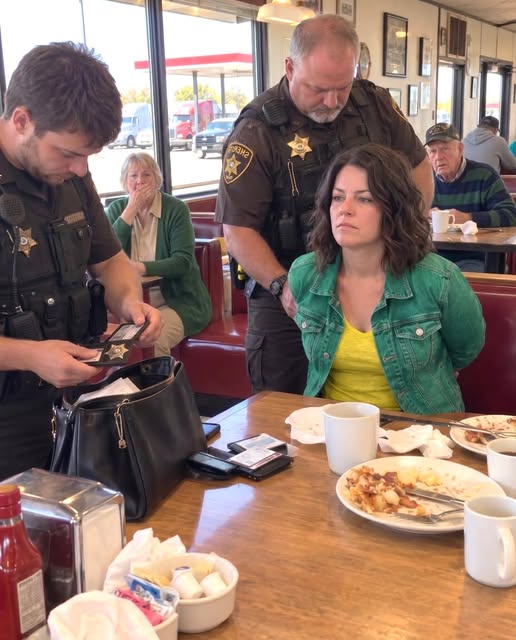
The ride to the sheriff’s station took twelve minutes.
Sheriff Dalton Voss spent most of that time bragging about how he handled troublemakers in his county.
I sat in the back seat, my wrists aching from the handcuffs.
I said nothing.
Every word he spoke was another detail I intended to remember.
When we arrived, Voss dragged me through the front entrance.
Three deputies looked up from their desks.
“Got ourselves a troublemaker,” he announced.
One deputy laughed.
Another barely glanced at me.
But the youngest officer, a man who appeared to be in his late twenties, frowned.
His nameplate read ELI CARTER.
“What’s the charge, Sheriff?” he asked.
Voss threw my purse onto the counter.
“Suspicion of armed robbery. Resisting arrest. Disorderly conduct. Whatever else fits.”
I looked directly at Deputy Carter.
“Officer, I would like to know whether I’m being formally charged or detained for questioning.”
Voss slammed his palm against the counter.
“You don’t get to ask questions!”
Carter’s eyes moved from my face to the handcuffs.
“Sir, did she actually resist?”
Voss turned slowly.
“You questioning me, son?”
“No, Sheriff. Just completing the report.”
“Then complete it.”
He pushed me into a metal chair.
“Search her belongings.”
Carter hesitated.
Then he carefully opened my purse.
He removed my keys, notebook, and wallet.
When he unfolded the wallet, something changed.
His hands stopped moving.
He stared at the identification card tucked inside.
Then he looked at me.
Then back at the card.
His face drained of color.
“Ma’am,” he whispered, “is this identification genuine?”
I held his gaze.
“Yes, Deputy.”
He swallowed.
The card identified me as Honorable Amara Whitlock, United States District Judge.
Carter stood so quickly that his chair scraped against the floor.
“Sheriff?”
Voss was pouring himself a cup of coffee.
“What now?”
“Sir, I think you need to come here.”
“Why?”
“Because this woman is a federal judge.”
The room went completely silent.
Voss laughed.
“Sure she is.”
Carter placed the identification on the counter.
“Sir, I’ve seen federal judicial credentials before. This appears authentic.”
Voss marched over and snatched the wallet.
His smile disappeared.
He examined the card.
Then he looked at me.
I could see him trying to decide whether he was frightened or furious.
“Where’d you steal this?”
I answered calmly.
“I didn’t.”
“You’re impersonating a federal official.”
“Then I suggest you verify my identity.”
Carter immediately reached for the station telephone.
Voss caught his wrist.
“Nobody makes a call without my permission.”
I leaned forward.
“Sheriff Voss, I strongly recommend that you remove these handcuffs and preserve every recording of my arrest.”
His eyes narrowed.
“Are you threatening me?”
“No. I’m giving you an opportunity to stop making the situation worse.”
He leaned close enough that I could smell his coffee.
“You think some fancy identification makes you untouchable?”
“Not at all,” I replied. “The law applies to me, too.”
I paused.
“But it also applies to you.”
For the first time since entering that diner, he had nothing to say.
Then my phone began ringing again.
Carter glanced at the screen.
The caller identification read:
CHIEF JUDGE ELEANOR HAYES — FEDERAL DISTRICT COURT
Voss stared at the name.
His face hardened.
“Don’t answer it.”
Carter looked at me.
I nodded.
“Deputy, please tell the caller where I am.”
Before he could move, Voss grabbed the phone and ended the call.
“Nobody is contacting anybody!”
That was when I knew this situation had become more dangerous than I originally anticipated.
Voss wasn’t simply arrogant.
He was desperate to maintain control.
And desperate men often make reckless decisions.
PART 3 — The Call the Sheriff Couldn’t Stop
Ten minutes later, Deputy Carter quietly approached the room where Voss had ordered me held.
He carried a bottle of water.
“Judge Whitlock,” he whispered, “I’m sorry.”
I looked at him.
“Sorry for what, Deputy?”
“For what happened at the diner. And for what he’s doing now.”
“Did you witness my arrest?”
“No, ma’am.”
“Then don’t apologize for something you didn’t do.”
He hesitated.
“Sir—Sheriff Voss has been doing things like this for years.”
I studied his expression.
“Tell me what you mean.”
Carter glanced toward the doorway.
“People get arrested without proper cause. Charges disappear if someone pays certain fees. Sometimes people sit in holding cells for days before anyone files paperwork.”
I felt a familiar heaviness settle in my chest.
The anonymous complaints had described precisely those patterns.
“Do you have records?”
He nodded.
“Some.”
“Have you reported this?”
“I tried once.”
“What happened?”
“My supervisor told me I’d lose my badge if I kept asking questions.”
I leaned forward.
“Deputy Carter, you need to understand something. My position doesn’t give me authority to personally investigate every crime or order an arrest. But I can report what I’ve witnessed to the proper authorities.”
He looked down.
“Would they actually listen?”
“Evidence gives them a reason to.”
I paused.
“And your testimony could matter.”
A door slammed outside.
Carter stepped back.
Voss appeared.
“What are you two whispering about?”
“Just giving her water, Sheriff.”
Voss snatched the bottle.
“She doesn’t need special treatment.”
He turned toward me.
“You know, lady, I’ve been thinking. Maybe we can forget this whole misunderstanding.”
I said nothing.
“All you have to do is sign something saying you were mistaken about what happened.”
He placed a sheet of paper on the table.
It was a handwritten statement claiming that I’d behaved aggressively, refused lawful instructions, and consented to my detention.
I read it carefully.
Then I pushed it back.
“I won’t sign a false statement.”
Voss’s jaw tightened.
“You’re making this difficult.”
“No, Sheriff. I’m refusing to lie.”
He slapped the table.
“You have no idea who you’re dealing with!”
I looked him directly in the eyes.
“I believe I’m beginning to understand.”
Before he could answer, a telephone rang in the main office.
Then another.
Then a third.
Voss stormed out.
Through the open doorway, I heard a dispatcher speaking urgently.
“Sheriff, there’s a federal official on the line asking about Judge Whitlock.”
“Tell them she’s not here!”
The dispatcher hesitated.
“Sir, they already know she’s here.”
A long silence followed.
Then she added something that made my stomach tighten.
“They say they’re contacting the U.S. Attorney’s Office.”
Voss cursed.
For the first time, I heard fear in his voice.
PART 4 — The Evidence Nobody Was Supposed to See
The next person to enter the room wasn’t Sheriff Voss.
It was Deputy Carter.
He had my phone in his hand.
“Judge Whitlock, Chief Judge Hayes wants to speak with you.”
Voss had apparently stepped outside to make a call of his own.
I nodded.
Carter put the call on speaker.
“Amara?”
“Eleanor. I’m safe.”
“Thank God. We’ve been trying to contact you for nearly an hour.”
“I’m being detained at the county sheriff’s station.”
“We know. What happened?”
I explained the arrest, the fabricated accusation, and Voss’s attempt to force me to sign a false statement.
Chief Judge Hayes listened without interrupting.
When I finished, her voice became firm.
“Amara, representatives from the U.S. Attorney’s Office have been notified. Federal law enforcement has also been contacted. Do not make any further statements without counsel.”
“Understood.”
Then she asked a question I hadn’t expected.
“Are there any witnesses willing to preserve evidence?”
I looked toward Carter.
He took a breath.
“Ma’am, I’m Deputy Eli Carter. I may have something important.”
“What is it, Deputy?”
“Security footage. Booking records. And copies of reports that don’t match what actually happened.”
Chief Judge Hayes was silent for a moment.
“Deputy, do not destroy, alter, or improperly remove anything. Preserve the evidence and make it available through lawful channels.”
“Yes, ma’am.”
The door suddenly flew open.
Voss stood in the doorway.
His eyes moved from the phone to Carter.
“What the hell are you doing?”
Carter straightened.
“Speaking to a federal judicial official, sir.”
Voss lunged toward the phone.
But Chief Judge Hayes spoke before he could disconnect it.
“Sheriff Voss, this is Chief Judge Eleanor Hayes. I strongly advise you to obtain legal counsel and ensure that Judge Whitlock is treated lawfully.”
Voss froze.
His mouth opened.
Nothing came out.
Then he finally managed to say:
“This is all a misunderstanding.”
I spoke quietly.
“Then you should have no objection to preserving the evidence.”
He looked at me with an expression I would never forget.
It wasn’t remorse.
It was calculation.
He was already searching for someone else to blame.
PART 5 — The Deputy Who Finally Spoke
The first federal agents arrived later that afternoon.
They didn’t burst through the doors or announce that everyone was under arrest.
Two agents entered, identified themselves, and began establishing what had happened.
One spoke privately with Deputy Carter.
The other reviewed the circumstances of my detention.
Voss attempted to greet them with a smile.
“Glad you boys are here. We had a little mix-up.”
Special Agent Marcus Reed didn’t smile back.
“We’re here to collect information, Sheriff.”
“Of course. Anything you need.”
“Then we’d like the incident report, booking records, dispatch communications, and all available body-camera and surveillance footage.”
Voss’s expression shifted.
“Some of our cameras have been malfunctioning.”
Reed wrote something in his notebook.
“Which cameras?”
“Well, I’d have to check.”
“Please do.”
I watched from a chair near the front office.
My handcuffs had finally been removed after the county attorney reviewed the situation and directed that I be released.
The red marks around my wrists remained.
But those marks weren’t the reason I’d come to this county.
I wanted to understand what happened to people who didn’t possess federal credentials.
People who couldn’t call a chief judge.
People who had no reason to believe anyone outside that building would care.
Carter approached Agent Reed.
“Sir, there’s something I need to tell you.”
Voss turned sharply.
“Deputy, back to your desk.”
Carter didn’t move.
“Sir, I have records of other questionable arrests.”
Voss’s face turned red.
“That’s confidential department material!”
Reed stepped between them.
“Deputy Carter, would you be willing to speak with us privately?”
Carter looked at his sheriff.
For a moment, fear flickered across his face.
Then he nodded.
“Yes, sir.”
Voss slammed his fist against the counter.
“You’re finished in this department!”
Reed turned toward him.
“Sheriff, you need to stop interfering with this interview.”
The room fell silent.
And for the first time, Voss obeyed someone else.
PART 6 — The Truth Beneath the Uniform
The investigation didn’t end that afternoon.
It began there.
Over the following weeks, investigators interviewed residents, reviewed records, and examined financial transactions connected to the sheriff’s department.
Several former employees agreed to speak.
Then more witnesses came forward.
A mechanic described being detained after refusing to repair a patrol vehicle without payment.
A single mother said she’d been threatened with arrest after questioning a mysterious administrative fee.
An elderly veteran described losing two days in jail because he’d complained publicly about the sheriff.
Their accounts were allegations that required investigation, not automatic proof of guilt.
But documents began to corroborate several of them.
Records revealed detention entries that conflicted with dispatch logs.
Financial documents raised questions about payments that had never been properly accounted for.
And one internal recording captured Voss instructing a subordinate to change the wording of an incident report.
Deputy Carter had preserved that recording through the department’s authorized evidence system before investigators secured it.
When Agent Reed later interviewed me, he placed a photograph on the table.
It showed a woman standing outside the county courthouse with two young children.
“Her name is Denise Parker,” he said.
I recognized the name.
It had appeared in one of the anonymous complaints.
“She reported that Voss threatened to take her children if she testified against one of his deputies.”
I looked at the photograph.
The children couldn’t have been older than eight and ten.
“Has she spoken with investigators?”
“Yes. Her testimony is consistent with records we’ve recovered.”
I sat quietly for a moment.
Then I asked:
“Is she safe?”
“We’re taking appropriate steps to protect witnesses.”
I nodded.
The more I learned, the clearer the picture became.
My arrest hadn’t been an isolated mistake.
It appeared to be part of a much larger pattern of intimidation.
And now that pattern was finally being examined.
PART 7 — The Day the Sheriff Lost His Power
Three months after my arrest, a federal grand jury returned an indictment against Sheriff Dalton Voss.
He faced charges arising from alleged civil-rights violations, falsification of records, and obstruction-related conduct.
Two other department employees were also charged.
The allegations were serious.
But an indictment wasn’t a conviction.
Voss remained entitled to counsel, a fair trial, and the presumption of innocence.
I understood that better than most.
Because I was the complainant and a potential witness, I took no judicial role in the proceedings.
I neither presided over the case nor influenced which judge would hear it.
Still, I attended one hearing as a private observer.
Voss entered the courtroom wearing a dark suit.
There was no sheriff’s badge on his chest.
No gun at his hip.
No deputies following his commands.
He looked smaller than I remembered.
When he noticed me seated in the public gallery, his eyes narrowed.
For a brief moment, our gazes met.
I didn’t smile.
I didn’t celebrate.
I simply watched.
During the proceedings, his attorney argued that the government’s interpretation of the evidence was unfair.
The prosecutors presented their position.
The judge listened to both sides.
That was how the justice system was supposed to work.
Not through one man’s intimidation.
Not through threats delivered in a diner.
And not through charges invented to punish someone for asking questions.
Several months later, after a trial in which numerous witnesses testified, a jury convicted Voss on multiple counts.
The evidence included records, testimony, and recordings.
My own testimony concerned what I had personally witnessed.
I didn’t exaggerate.
I didn’t speculate.
I described the handcuffs, the false accusations, the fabricated statement, and his efforts to prevent communication.
The jury made its decision.
At sentencing, the court imposed a substantial prison term.
Voss would no longer command the department he’d controlled for so many years.
But the outcome mattered for reasons far beyond my arrest.
It meant that people who had once been afraid to speak had finally been heard.
PART 8 — The Badge That Truly Mattered
Nearly a year after that morning in the diner, I returned to the same small town.
This time, I wasn’t conducting an informal visit.
I’d been invited to speak at a community forum about civil rights, public trust, and accountability.
The diner was still there.
Same faded sign.
Same vinyl booths.
Same narrow counter.
I stopped for breakfast before the event.
When I walked inside, the waitress who had served me on the day of my arrest recognized me immediately.
Her name was Ruth.
She put a hand over her mouth.
“Judge Whitlock?”
I smiled.
“Hello, Ruth.”
Her eyes filled with tears.
“I’ve wanted to apologize for so long.”
“For what?”
“For standing there and doing nothing while he took you away.”
I looked at her carefully.
“You were frightened.”
She nodded.
“We all were.”
I pulled out a chair.
“Would you sit with me for a minute?”
She did.
I told her something I’d spent months thinking about.
“People shouldn’t have to be unusually brave just to expect lawful treatment from public officials.”
Ruth wiped her eyes.
“Things have changed around here.”
“How so?”
“People ask questions now. They go to town meetings. They don’t whisper every time a patrol car drives past.”
I felt something inside me settle.
“That’s good to hear.”
Just then, the diner door opened.
A familiar young man stepped inside.
Deputy Eli Carter.
Except he was no longer a deputy.
He wore a plain button-down shirt and carried a folder under one arm.
“Judge Whitlock.”
“Eli.”
He shook my hand.
After cooperating with investigators, Carter had left the sheriff’s department.
He’d enrolled in a law enforcement leadership program and accepted a position with a neighboring agency that was rebuilding its community-policing practices.
He seemed more confident now.
“I heard you were in town,” he said.
“I was hoping to see you.”
He smiled.
“There’s something I wanted to tell you.”
“Go ahead.”
He pulled a photograph from his folder.
It showed a group of newly trained officers standing outside a classroom.
“We’ve started teaching a course on constitutional policing,” he explained. “Fourth Amendment protections, lawful detention, report integrity, and what officers should do when a supervisor gives an unlawful order.”
I examined the photograph.
“That’s important work.”
“There’s one thing I tell every class.”
I raised an eyebrow.
“What’s that?”
He looked toward the booth where I’d been arrested.
“That the person you’re dealing with shouldn’t need to be a federal judge for you to respect their rights.”
I stared at him.
For a moment, I couldn’t speak.
Then I nodded.
“That’s exactly right, Eli.”
FINAL PART — Justice Doesn’t Depend on Who You Are
That evening, I stood before an audience of nearly two hundred residents.
Some were business owners.
Some were teachers.
Some were parents.
Several were people who had testified during the investigation.
Deputy Carter sat near the front.
Ruth was there, too.
When I stepped to the microphone, the room became quiet.
I didn’t begin by discussing my federal judgeship.
I began with a simple question.
“What if I hadn’t carried that identification?”
Nobody answered.
I looked across the audience.
“What if I had been an ordinary visitor with no influential contacts? What if I couldn’t afford an attorney? What if nobody believed me?”
A woman in the second row lowered her head.
I continued.
“The Constitution does not reserve its protections for judges, wealthy people, public officials, or anyone with an important title.”
I paused.
“It protects the person working a night shift. The grandmother buying groceries. The teenager walking home. The mother trying to keep her family together.”
Several people nodded.
“My credentials helped others recognize the seriousness of what happened to me. But those credentials didn’t create my rights.”
I glanced toward Eli.
“Those rights existed before anyone opened my wallet.”
The room remained completely still.
“Authority is not a license to humiliate. A badge is not permission to invent accusations. And public office is not ownership of the people you serve.”
I thought about Sheriff Voss.
About the fear in the diner.
About the metal chair at the station.
About the people who had endured far worse without anyone knowing their names.
Then I said the words I most wanted the community to remember.
“The true test of justice is not how the powerful are treated. It’s how the powerless are protected.”
The audience rose to its feet.
I didn’t feel victorious.
I felt grateful that people had finally found the courage to speak.
After the event, I walked alone to my car.
The evening air was cool.
I placed my handbag on the passenger seat.
Inside was the same wallet that Deputy Carter had opened almost a year earlier.
I took out my judicial identification and looked at it for a moment.
Then I returned it to its place.
That card had helped expose one sheriff’s abuse of power.
But it was never supposed to be the difference between being respected and being mistreated.
I started the engine.
As I drove away, I thought about something Eli had said.
That every person deserved the same respect he’d shown me once he learned who I was.
And I realized that was the most important lesson of all.
I hadn’t remained calm in that diner because I believed I was above the law.
I had remained calm because I believed the law should stand above all of us.
Even a sheriff.
Even a federal judge.
Even the most powerful person in the room.
Because a badge may give someone authority.
But only integrity makes that authority worthy of respect.
THE END