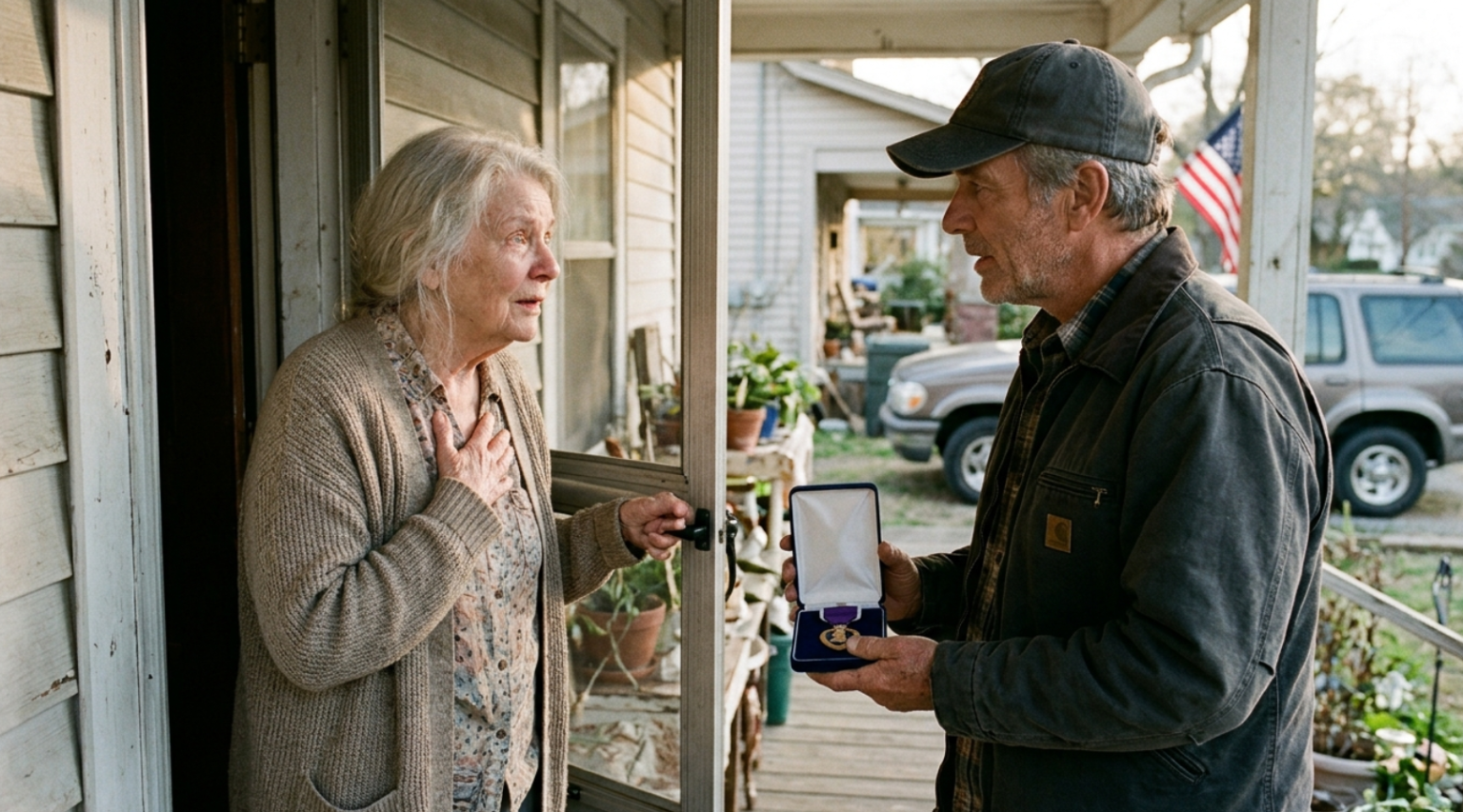
Dennis held out the photograph, but his hands were trembling.
“Mrs. Marlow, before I give you this, I need to ask you something.”
I looked at the faded picture between his fingers.
“What is it?”
“Did your husband ever tell you why he refused to accept a second medal?”
I stared at him.
“A second medal?”
Dennis nodded.
“My father spent the last twenty years of his life trying to find your husband. He wanted to tell him that what happened in that jungle wasn’t his fault.”
Behind me, Tyler slowly lowered himself onto the stairs.
I felt the blood drain from my face.
“What wasn’t Frank’s fault?”
Dennis turned the photograph toward me.
It showed three young soldiers standing beside a military helicopter. One was Frank. I recognized his crooked smile immediately, the same smile he’d worn in our wedding photograph.
The second was a young man with dark hair and a bandage wrapped around his arm.
“The man beside Frank is my father, Ray,” Dennis explained.
Then he pointed to the third soldier.
A boy, barely old enough to shave, stood with his arm around Frank’s shoulders.
“His name was Daniel Mercer. He was nineteen.”
I looked closer.
There was something familiar about that face.
Dennis swallowed.
“Daniel was the reason your husband received the Purple Heart. But he was also the reason your husband never wanted anyone to talk about it.”
I pulled the door open wider.
“Please come inside.”
Dennis followed me into the living room.
Tyler stood quickly.
“I’m Tyler. Frank was my grandfather.”
Dennis shook his hand.
“Then there’s something you need to hear, too.”
We sat around the dining table where Frank used to drink his morning coffee.
Dennis placed the blue velvet case in front of me.
“My father told me this story when I was twelve. He made me promise that if I ever found Frank Marlow, I’d tell him the truth.”
He unfolded a second piece of paper.
It was a letter.
The handwriting was uneven, and the paper had turned yellow.
“On the morning of October 17, 1968, my father’s patrol was caught in an ambush. Three men were wounded. One of them was my father.”
I held my breath.
“Frank was hit in the leg, but he refused to leave. He carried my father through the jungle for nearly two miles. Every time my father begged him to put him down, Frank kept saying the same thing.”
Dennis looked directly at me.
“‘I promised somebody I’d bring you home.'”
My eyes filled.
Frank had said those exact words to me once.
It was the night our first child was born.
I had asked him why he always checked the doors twice before bed.
He had kissed my forehead and whispered, “Because I promised somebody I’d bring everyone home.”
I never knew what he meant.
Dennis continued.
“Daniel Mercer was the youngest man in the patrol. When the shooting started, Daniel went back to help another wounded soldier.”
His voice grew quieter.
“He never made it out.”
I covered my mouth.
“Frank blamed himself,” Dennis said. “He believed he should have gone back for Daniel instead of carrying my father.”
For the first time, I understood the nightmares.
The nights Frank woke shouting a name.
The way he avoided fireworks.
The way he’d sit in the garage on certain October mornings, holding a cup of coffee that went cold in his hands.
“Daniel,” I whispered.
Dennis nodded.
“That’s the name my father heard Frank calling after they reached safety.”
I looked down at the photograph.
Then Dennis said something that made my heart nearly stop.
“Mrs. Marlow, Daniel Mercer wasn’t just another soldier to your husband.”
I raised my eyes.
“He was Frank’s younger brother.”
I shook my head.
“No. Frank never had a brother.”
Dennis looked at me with such sadness that I knew he wasn’t lying.
“His half brother. They had different mothers. They met for the first time after being assigned to the same unit. My father said Frank was determined to bring Daniel home so they could get to know each other properly.”
For several moments, nobody spoke.
I had been married to Frank for fifty-four years.
I had washed his clothes, raised his children, held his hand through surgeries, and sat beside his hospital bed when he took his last breath.
Yet there had been a whole part of his life I had never known.
“Why didn’t he tell me?” I whispered.
Dennis folded his hands.
“My father believed Frank thought he’d failed his brother. Frank asked that his name be left out of the account describing how my father was rescued. He didn’t want anyone calling him a hero.”
Then he slid the letter toward me.
“This is what my father wrote to Frank before he died. I found it among his papers. He never knew where to send it.”
I unfolded the letter.
Dear Frank,
You carried me out of that jungle when you could barely walk yourself.
For the rest of my life, I have lived because you refused to leave me.
I know you think you failed Daniel.
But I need you to understand something.
Daniel knew exactly what he was doing when he went back. He made his choice because he loved the men beside him.
And Frank, he loved you.
The last thing Daniel said to me before he ran back was, “Tell my brother I finally got to fight beside him. Tell him I’m proud.”
You didn’t fail your brother.
You gave me a life.
I married the woman I loved. I raised three children. I held seven grandchildren. I watched the sunrise thousands of times.
Every one of those days was a gift you gave me.
Please stop carrying the blame for a man who would have wanted you to live.
Your brother in arms,
Ray Hale.
By the time I finished reading, tears were falling onto the paper.
Tyler was crying, too.
He hadn’t made a sound.
He just sat there with his elbows on his knees and his face buried in his hands.
For the first time since Frank died, I felt as though my husband were sitting beside me again.
Not the old man who needed a cane.
Not the quiet grandfather who fixed broken bicycles and slipped five-dollar bills into birthday cards.
But the twenty-three-year-old boy who had carried another soldier through a jungle while his own leg was bleeding.
The boy who had spent the next fifty-two years believing he had failed someone he loved.
Dennis gently closed the velvet case.
“My father died in 2011,” he said. “He asked me to keep looking for Frank. I tried for years, but there were too many dead ends.”
He looked at the medal.
“Then eleven days ago, I saw this Purple Heart listed online. The seller included a photograph of the name on the old box. I knew immediately.”
I stared at him.
“You paid three hundred and forty dollars?”
“Yes, ma’am.”
“And then drove seven hundred miles to return it?”
He smiled faintly.
“Your husband carried my father two miles when he couldn’t walk. Seven hundred miles in an air-conditioned car seemed like a pretty small favor.”
I started crying again.
That’s when the front door opened.
Kayla came in carrying two grocery bags.
She stopped when she saw us sitting at the table.
“What’s going on?”
Nobody answered immediately.
Then her eyes landed on the blue velvet case.
“Oh,” she said. “Is that the old medal?”
Tyler stood up.
“Kayla, sit down.”
She frowned.
“Why?”
“Because you need to hear what you sold.”
She rolled her eyes.
“Tyler, seriously? We’re still talking about that?”
Dennis stood.
“Ma’am, my father lived forty-three more years because of the man who earned that medal.”
Kayla looked confused.
Dennis continued.
“He got to meet his grandchildren. He got to grow old with his wife. He got to die in his own bed surrounded by people who loved him.”
He pointed gently toward the case.
“That medal was never just something sitting in a drawer.”
Kayla put the grocery bags on the counter.
“I didn’t know any of that.”
I looked at her.
“You didn’t ask.”
She opened her mouth, then closed it.
“You knew it belonged to Frank,” I said. “You knew it was the one thing I kept exactly where he left it. You knew I was in the hospital.”
My voice trembled, but I didn’t look away.
“And you took it anyway.”
Tyler stepped beside me.
“Grandma’s right.”
Kayla turned toward him.
“Seriously? You’re taking her side?”
“Yes.”
It was one word.
But after two years of watching my grandson stay silent, it sounded like a door finally opening.
“You sold something that wasn’t yours,” Tyler said. “And when Grandma came home, you acted like she was foolish for being upset.”
“We needed the car fixed.”
“We could have figured something else out.”
Kayla crossed her arms.
“So what do you want me to do?”
Tyler looked at the medal.
“First, apologize. Then pay Dennis back.”
Dennis raised a hand.
“That’s not necessary.”
“It is to me,” Tyler said.
Kayla looked at me.
For a moment, I thought she would argue again.
Instead, her eyes filled.
“I’m sorry, Grandma Jean.”
I nodded.
But I didn’t tell her everything was fine.
Because it wasn’t.
Some things can’t be repaired with a quick apology.
Over the next several weeks, Tyler changed.
He helped me move my belongings into the downstairs bedroom so I wouldn’t have to climb the stairs with my bad knee.
He put a lock on my bedroom door, at my request.
He took on more of the household expenses and made sure I had access to my own money and belongings without anyone interfering.
And he repaid Dennis the full three hundred and forty dollars from his own savings.
Kayla eventually wrote me a letter.
She admitted she’d started seeing my possessions as clutter instead of pieces of my life.
She said she’d been so focused on making extra money that she had stopped considering what those things meant to me.
I appreciated the letter.
Trust, however, took longer.
Dennis and I stayed in touch.
He sent me copies of military records, more photographs, and a picture of his father holding his first grandchild.
In return, I sent him the photograph of Frank that had always sat beside my bed.
The two families that had been connected by one terrible day in 1968 were finally getting to know each other.
And then, in June, Dennis called me with one final surprise.
“Mrs. Marlow,” he said, “I found Daniel’s daughter.”
I sat down.
“Daniel had a daughter?”
“His girlfriend was pregnant when he left for Vietnam. Daniel never knew. His daughter is fifty-seven now.”
I pressed my hand against my chest.
Dennis told me her name was Rebecca.
She had spent her whole life knowing her father only through a few photographs and letters.
When Dennis contacted her, she cried after hearing about Frank.
She said she’d always wondered whether anyone had been with her father in his final days.
I asked Dennis to give her my number.
The next Sunday, Rebecca called.
We spoke for nearly three hours.
She told me about her children.
I told her about Frank.
And for the first time in fifty-eight years, Daniel Mercer’s daughter heard stories about the brother her father had loved.
Two months later, Rebecca came to visit.
We stood together in front of Frank’s grave.
She placed a small photograph of Daniel beside the headstone.
“I wish they could have known each other longer,” she whispered.
“So do I,” I said.
Then she took my hand.
“But at least they found each other.”
That evening, I brought out Frank’s Purple Heart.
It no longer lived in a dresser drawer.
Tyler had purchased a wooden display case with a glass front.
Inside, we placed the medal, the photograph of the three soldiers, and a copy of Ray Hale’s letter.
Beneath them, on a small brass plate, Tyler had engraved:
FRANK MARLOW
Beloved Husband, Father, and Grandfather.
He Carried Others Home, Even When He Carried Pain of His Own.
I cried when I saw it.
Not because it was sad.
But because Frank’s story was finally being told.
A few weeks later, Kayla asked whether she could help me dust the display case.
I handed her a soft cloth.
She cleaned the glass carefully.
Then she stood looking at the photograph.
“Grandma Jean,” she said quietly, “I really didn’t understand.”
“I know.”
“I wish I’d met him.”
I looked at Frank’s young face in the photograph.
“You would have liked him,” I said. “He was a good man.”
She nodded.
“And I’m sorry I treated something he earned like it was worthless.”
I reached for her hand.
“Remember this, Kayla. Something doesn’t have to be worth a lot of money to be worth everything to somebody.”
Today, the medal sits on the mantel where everyone can see it.
Sometimes Tyler’s little boy, my great-grandson, points at the glass case and asks about the man in the picture.
And I tell him.
I tell him about the young soldier who carried a wounded man through the jungle.
I tell him about the brother he loved.
I tell him about the man who came home, built a family, and spent the rest of his life quietly helping other people.
And then I tell him something Frank never lived long enough to hear.
“Your great-grandpa was a hero.”
Last month, Dennis visited again.
This time, he brought his children and grandchildren.
We all sat around the dining table, sharing photographs and telling stories.
At one point, Dennis looked toward the mantel and grew quiet.
“There’s something I’ve been meaning to tell you, Jean.”
“What is it?”
He smiled.
“My father used to say that someday he’d find a way to thank Frank properly.”
He looked around at our families gathered together.
“I think we finally did.”
I looked at the people sitting around my table.
Two families.
Three generations.
Connected by a brave young man who had never asked to be remembered.
And I realized something.
For years, I’d believed that Frank had taken the story of his war to the grave.
But the truth hadn’t disappeared.
It had been living in another family’s prayers.
Every night, for forty years.
And all it took to bring that story home was a stranger who recognized a name, drove seven hundred miles, and refused to let a hero’s medal become somebody else’s forgotten purchase.
My grandson’s wife sold my husband’s Purple Heart for $340. She thought it was just an old medal.
But that $340 sale brought back a piece of my husband I never knew existed.
And at eighty-one years old, I finally learned that sometimes the most precious inheritance isn’t the object someone leaves behind.
It’s the truth about the life they lived.
THE END