FINAL PART: THE FENCE THAT COST HIM EVERYTHING
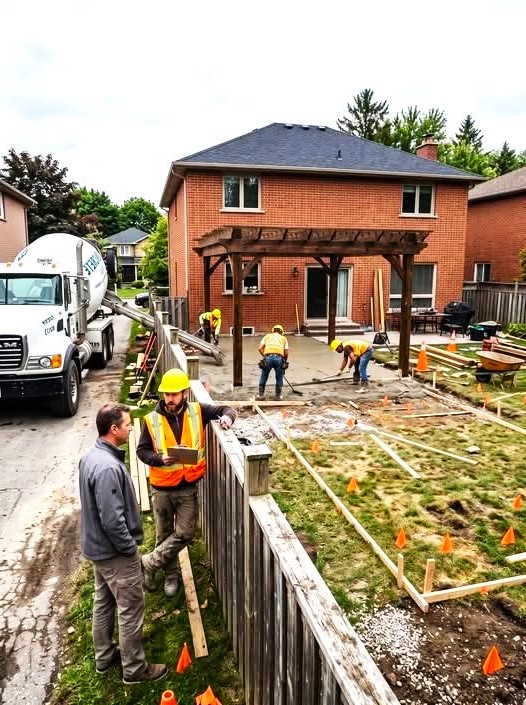
The concrete truck was still backing into Tyler’s driveway when Rachel told me to put down my phone.
“Jason, listen carefully. Do not confront him. Do not threaten the contractors. And whatever you do, don’t try to stop that truck yourself.”
I watched through my kitchen window.
The driver climbed down and began speaking to a man wearing a yellow safety vest.
Tyler stood beside them, smiling like a man who had just won something.
“What should I do?”
“Send me pictures of everything. I’m calling the county inspections office.”
“Will they stop him?”
“If the work doesn’t match his approved plans, they have a reason to investigate. But we need an inspector to establish that.”
I took twelve photographs.
Then I went to work.
That was the hardest part.
Spending an entire morning pulling wire through a commercial building while knowing my neighbor might be pouring concrete over land I had spent eleven years paying for.
At 11:43, Rachel called.
“An inspector is on his way.”
I nearly dropped my screwdriver.
“What happened?”
“I submitted the certified survey, his original permit drawing, and photographs showing the actual construction. The county wants to see the site before the pour continues.”
I drove home during lunch.
When I turned onto my street, I saw a white county vehicle parked outside Tyler’s house.
The concrete truck was still there.
But its drum was turning slowly, and nobody was pouring anything.
A man in a blue polo shirt stood near the fence, holding Carl’s survey.
Tyler was talking with both hands.
Even from across the street, I could tell he was furious.
I parked in my driveway.
The inspector introduced himself as David Harris.
“Mr. Miller?”
“Yes, sir.”
“I’m reviewing a reported discrepancy between the approved plans and the property boundary.”
Tyler immediately stepped forward.
“He’s been harassing us for weeks. This is ridiculous.”
David didn’t look at him.
“Mr. Bennett, I’m going to need you to give me a moment.”
I handed David the certified survey Rachel had told me to keep in my truck.
He compared it to the site plan.
Then he walked toward the orange flags.
The same flags Tyler had kicked over.
One was still lying in the grass.
David studied the fence, the excavated pool area, and the concrete forms.
He measured twice.
Then he turned toward Tyler.
“Who established the property line for this project?”
Tyler folded his arms.
“My contractor.”
“Did your contractor use a licensed survey?”
“We went off the existing yard.”
David pointed toward the cedar fence.
“This fence was installed recently.”
“So?”
“So I’m asking what information you used to determine where the property line actually is.”
Tyler said nothing.
David looked at the stamped survey again.
Then he asked one more question.
“Mr. Bennett, are you aware that your submitted site drawing shows a boundary approximately eight feet farther into your yard than the fence you installed?”
For the first time since this began, Tyler stopped smiling.
“That drawing was preliminary.”
David turned the page.
“It appears in your approved application.”
“My builder handled that.”
“Your name is on the certification.”
Tyler’s face reddened.
Ashley came outside carrying her phone.
“What’s going on?”
Tyler snapped at her.
“Go inside.”
She didn’t.
David finished his measurements.
Then he walked over to the contractor.
“Work covered by this permit needs to stop until these discrepancies are resolved.”
The contractor stared at him.
“We’ve got concrete scheduled.”
“I understand.”
“That’s going to cost somebody a lot of money.”
David looked back toward Tyler.
“Then the property line should have been verified before construction.”
Nobody spoke.
The contractor picked up his phone.
And the concrete truck eventually pulled away.
With its load still aboard.
I watched it disappear down the street.
I didn’t smile.
I didn’t celebrate.
I simply went inside and made myself a sandwich.
Because the fence was still standing.
And my land was still trapped behind it.
Three days later, Rachel called me into her office.
She had received Tyler’s response to our latest demand.
I expected an apology.
Instead, she slid a letter across her desk.
Tyler’s attorney claimed that I had accepted the fence location by failing to object during construction.
I read that sentence three times.
“I was at work when they built it.”
Rachel nodded.
“And you contacted a surveyor almost immediately after discovering it.”
“They’re seriously arguing that?”
“They’re trying.”
I turned the page.
The letter also suggested Tyler might have acquired rights to the disputed strip through his use of the property.
I looked up.
“He moved in eight months ago.”
“I know.”
“He built the fence a few weeks ago.”
“I know that too.”
Rachel leaned back.
“Claims like that depend on specific legal requirements. An eight-month occupancy and a recent fence aren’t enough to establish adverse possession in North Carolina.”
I felt my shoulders relax.
Then she placed a second document on the desk.
“This is more interesting.”
It was an older recorded subdivision plat.
Dated twenty-six years earlier.
My property and Tyler’s had originally been part of the same development.
A narrow drainage easement ran behind both lots.
The easement wasn’t ownership.
But it placed restrictions on certain improvements.
And Tyler’s proposed pool equipment pad appeared to overlap that restricted area.
“Does that mean he can’t build the pool?”
“Not necessarily. It means the county and the easement holder may have additional questions.”
I studied the drawing.
Then Rachel pointed to the fence line.
“More importantly, his actual lot is smaller than the area he represented on his construction plan. He planned the entire backyard project around land he doesn’t own.”
“How bad is it?”
“Potentially expensive. But don’t count his losses yet. Our job is to restore your boundary, not punish him.”
I nodded.
That sounded right.
At least until the following Saturday.
Emma was visiting for the weekend.
She was seventeen by then, taller than her mother, with the same brown eyes she’d had when she was little.
She came outside while I was repairing the swing beneath the oak tree.
“Dad?”
“Yeah?”
“Why is that man taking pictures of our house?”
I looked toward Tyler’s property.
He stood beside his fence holding his phone directly toward us.
When he noticed me, he lowered it.
“Go inside for a minute, sweetheart.”
Emma hesitated.
“Is he the fence guy?”
“Unfortunately.”
She looked at the cedar boards.
“That’s where we used to throw the football, isn’t it?”
I glanced toward the missing strip.
“Yeah.”
She was quiet.
Then she said something that stayed with me.
“Dad, you always told me not to let somebody take something just because they’re louder than me.”
I looked at her.
She shrugged.
“So don’t.”
That evening, I emailed Rachel.
I told her I wanted to move forward with a civil action if Tyler refused to resolve the encroachment.
Not because I wanted a fight.
Because I’d already tried every reasonable way to avoid one.
Rachel prepared the filing.
The complaint sought a judicial determination of the boundary, removal of the encroaching fence and improvements, and appropriate relief for the interference with my property.
Tyler was served the following week.
That afternoon, he marched across his front lawn.
I was standing by my mailbox.
“You’re suing me?”
I looked at him.
“My attorney asked you to move the fence.”
“You’re going to ruin us over eight feet of grass?”
I glanced at the cedar boards behind his house.
“Then why was eight feet so important to you?”
His mouth opened.
Nothing came out.
Finally, he said, “You could’ve just been neighborly.”
I almost laughed.
Instead, I asked him one question.
“If I built a fence eight feet into your yard, would you let me keep it?”
He stared at me.
Then he walked away.
Two weeks later, something unexpected happened.
Ashley knocked on my door.
Alone.
I opened it halfway.
She looked exhausted.
Her hair was pulled into a messy ponytail, and she held a folder against her chest.
“Can we talk?”
I stepped onto the porch.
She glanced toward her house.
“I didn’t know.”
“Didn’t know what?”
“That the fence was on your property.”
I said nothing.
She swallowed.
“Tyler told me the old boundary was wrong. He said the previous owner of your house had been mowing part of our lot for years.”
I thought about the eleven summers I’d spent behind that mower.
“He told you that?”
She nodded.
“He said he’d checked everything.”
I looked at the folder.
“What’s that?”
She opened it.
Inside were printed estimates from the landscaping contractor.
One estimate was dated before the fence installation.
I recognized the diagram immediately.
The correct property boundary was marked in red.
A handwritten note beside the proposed fence read:
Shift fence approximately 8 ft west to gain usable space.
I stared at those words.
Ashley looked down.
“I found it in his desk.”
For several seconds, I couldn’t speak.
The fence had never been a measuring mistake.
It wasn’t a misunderstanding between neighbors.
It was a decision.
A deliberate one.
“Why are you showing me this?”
Ashley’s eyes filled with tears.
“Because he keeps telling me everything is your fault.”
She wiped her cheek.
“And because now he’s saying we might have to take out another loan to fix the backyard.”
I took a slow breath.
“Have you shown this to an attorney?”
“No.”
“You should. And I need you to give it to Rachel if you’re willing.”
She nodded.
Before leaving, Ashley said something else.
“I told him to move the fence after your first email.”
That surprised me.
“What did he say?”
Her expression changed.
“He said you’d never spend thousands of dollars fighting over a strip of grass.”
I watched her walk home.
Then I called Rachel.
By Monday morning, she had a copy of the document.
And Tyler’s attorney had received it through the proper legal process.
Everything changed after that.
The confident letters stopped.
The threats disappeared.
Then, six weeks after the concrete truck turned around, Rachel called with an offer.
Tyler was willing to relocate the fence.
At his expense.
I sat down at the kitchen table.
“That’s it?”
“Not quite.”
She continued.
“He also proposes restoring the disturbed ground, removing any improvements that cross the surveyed line, and reimbursing a portion of your survey and legal costs.”
I stared through the window.
The cedar fence stood exactly where he’d left it.
“What about the pool?”
“He’s working with the county on a revised design. That’s between him and the permitting authorities, provided it doesn’t encroach on your property or violate your rights.”
I nodded.
Rachel paused.
“Jason, there’s something I want you to understand.”
“What’s that?”
“Winning a property dispute isn’t about making the other person suffer. It’s about protecting what belongs to you.”
I looked at the old oak tree.
At Emma’s swing.
At the lawn that had suddenly felt smaller every time I walked outside.
“I understand.”
We negotiated a written settlement.
The agreement required Tyler to have the fence removed from my property, relocate it entirely within his boundary, restore the affected strip, and address the encroaching landscaping.
It also established deadlines, inspection requirements, and what would happen if he failed to comply.
I refused one provision.
Tyler wanted the agreement to say the original fence placement had been a mutual misunderstanding.
Rachel asked why I objected.
“Because it wasn’t.”
She looked at the contractor’s handwritten note.
Then she nodded.
The wording was changed.
Tyler signed.
So did I.
On a cool Tuesday morning in October, the fence crew returned.
I stood on my porch holding a cup of coffee.
The same crew that had built the cedar wall began taking it apart.
One board at a time.
The sound of drills carried across both yards.
Posts came out.
Concrete footings were broken apart.
Fresh sod was rolled back.
The two Japanese maples were moved.
The pergola frame was dismantled where it crossed my line.
And gradually, my missing lawn appeared again.
I hadn’t realized how much I’d missed that ordinary strip of grass.
Not until I could see it.
By noon, the old fence was gone.
By Friday, the replacement stood on Tyler’s side of the surveyed boundary.
Carl returned to verify the location.
He walked the line with his equipment.
Checked the corners.
Measured the setbacks.
Then he handed me his report.
“The new fence is clear of your parcel.”
I looked at the boards.
They were beautiful.
Straight.
Expensive.
And finally in the right place.
“How much did all this cost him?” I asked.
Carl shrugged.
“Only he knows.”
I later learned that Tyler had lost deposits, paid for demolition and reconstruction, and faced additional engineering and permit expenses for the pool.
Rachel told me the combination could easily reach tens of thousands of dollars.
But I never saw his final bills.
And I didn’t need to.
What mattered was that I wasn’t paying for his decision.
A month later, Tyler’s pool project resumed with a revised layout.
Smaller.
Farther from my property.
No longer designed around an extra eight feet he had never owned.
The hot tub pad had also been moved.
The backyard he’d imagined was gone.
But he still had a backyard.
Just the one he’d actually bought.
One Saturday, I was mowing the restored strip when Tyler appeared on his side of the new fence.
He stood there for a while.
Then he called my name.
“Jason.”
I shut off the mower.
He looked uncomfortable.
“I guess this got out of hand.”
I waited.
He rubbed his jaw.
“Cost me a lot of money.”
I rested one hand on the mower handle.
“You could’ve moved it when I sent the first email.”
He glanced away.
“I know.”
It was the closest thing to an apology I’d ever hear from him.
Then he said, almost quietly, “You really went through all that for eight feet?”
I looked down at the grass beneath my shoes.
The strip was narrow.
Nothing special.
A little uneven where the new sod met the old.
I thought about my divorce.
The years of overtime.
The mortgage payments.
The weekends Emma and I spent planting flowers and throwing a football across that lawn.
And the way Tyler had smiled when he told me I couldn’t afford to make him move.
Then I looked back at him.
“No, Tyler.”
He frowned.
“I went through all that because you thought you could decide what I was allowed to keep.”
He didn’t answer.
I restarted the mower.
And I finished cutting my yard.
Every inch of it.
That evening, Emma came over with takeout.
We sat on the back porch while the sun slipped behind the oak tree.
She looked across the grass.
“Wow. It looks bigger.”
I smiled.
“It looks like it used to.”
She laughed.
Then she got up, walked to the swing, and sat down.
The old wooden seat creaked beneath her.
“Remember when you used to push me on this?”
“Every weekend.”
“You always told me to hold on tight.”
“I did.”
She looked across the restored lawn.
“Guess you listened to your own advice.”
I didn’t say anything.
Because for the first time in months, there was nothing left to argue about.
The fence was where it belonged.
The survey markers were undisturbed.
And my daughter was swinging beneath the same oak tree she’d loved when she was six.
I watched the evening light stretch across the grass.
Then I thought about something Tyler had said the day he threatened to have me arrested.
“I built the fence. It’s my yard now.”
He’d been so certain that putting up a barrier could change who owned the ground beneath it.
But the fence had never transferred a single square foot.
It had only hidden my property from view.
And when the boards finally came down, the truth was exactly where it had always been.
Sometimes the most expensive mistake a person can make is assuming that someone else’s silence means they’ve surrendered.
I never raised my voice.
I never tore down his fence.
I never stepped onto his property to settle the score.
I simply kept the photographs, trusted the survey, followed the legal process, and refused to give away what was mine.
Tyler got the backyard he legally owned.
I got mine back.
And that was enough.
THE END.