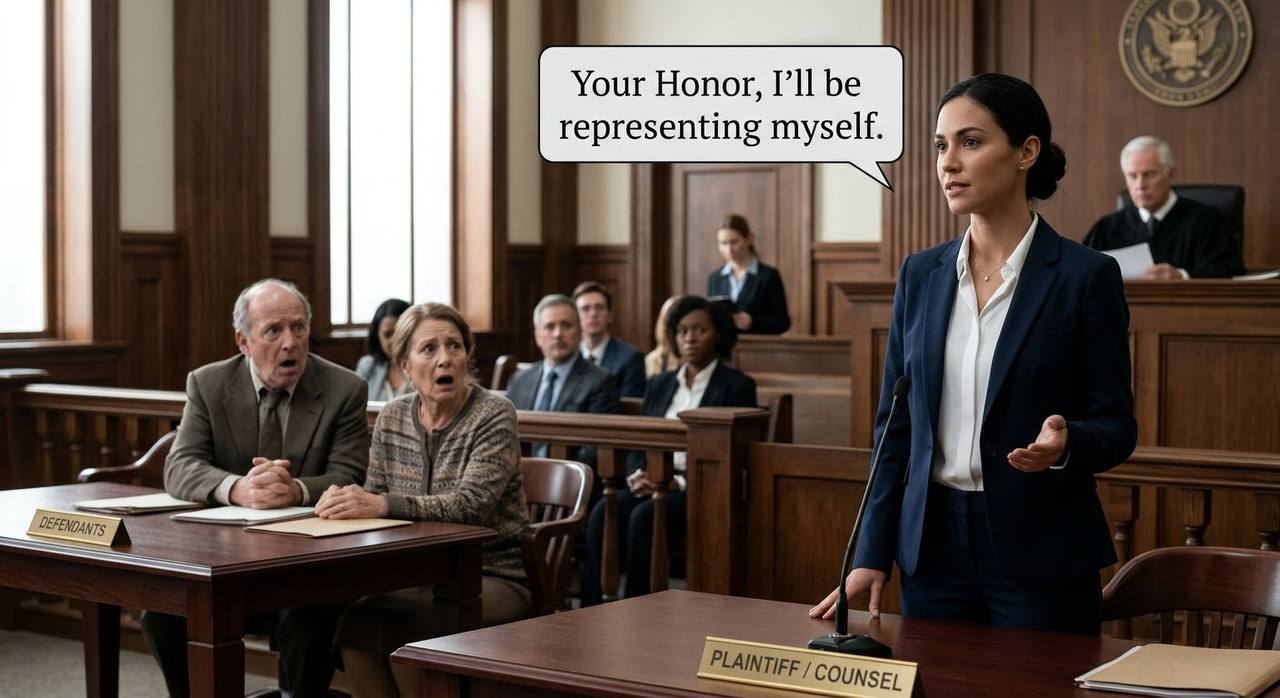
At eight years old, my parents left me on a wooden bench at a Greyhound station and never came back — twenty-two years later, after the stranger who raised me left me $3.8 million, they walked into court to take it… until I stood up and said, “Your Honor, I’ll be representing myself”
“From a storage unit registered under my father’s name, Your Honor. The private investigator I hired located it after reviewing several old financial records.”
Judge Patricia Wynn studied me over the rims of her glasses.
“And how was this storage unit accessed, Mr. Marsh?”
I had expected the question.
“With the written authorization of the facility’s current legal operator, following its lawful lien-sale process. The unit had been abandoned for more than three years. My investigator purchased its contents at a public auction. The original inventory records and chain-of-custody documentation are included in Exhibit Four.”
The judge nodded.
“Very well. But admission of the contents is a separate question. Counsel?”
My biological parents’ attorney, Richard Collins, rose immediately.
“Your Honor, we object to the introduction of this letter. Its authenticity has not been established, and its contents appear entirely unrelated to the question of inheritance.”
I looked toward him.
“Your Honor, the plaintiffs have based their claim on the assertion that they were wrongfully separated from their son and have maintained a genuine parental interest in him. This letter directly contradicts those allegations. I also have records and testimony supporting its authenticity.”
Judge Wynn considered the objection.
“I will hear the foundation before ruling on admissibility.”
I nodded.
“Thank you, Your Honor.”
Then I looked at Arthur.
The man who had left me on a wooden bench with a granola bar and a promise.
His face had gone gray.
For twenty-two years, I had imagined confronting him.
I had rehearsed speeches in my head.
Angry speeches.
Desperate speeches.
Speeches that ended with him crying and admitting he had made a terrible mistake.
But standing in that courtroom, I discovered something strange.
I no longer needed him to admit anything.
I only needed the truth to stand on its own.
I turned back toward the judge.
“Your Honor, I would like to call the first witness.”
Richard Collins frowned.
“Who?”
I glanced toward the courtroom doors.
“Mr. Thomas Avery.”
The bailiff opened the doors.
A thin, elderly man with silver hair and a walking cane entered slowly.
My father’s hands tightened around the edge of his chair.
Because he knew exactly who Thomas Avery was.
And he knew what Thomas had witnessed.
Thomas Avery had managed a small insurance agency in Dayton during the early 1990s.
He was seventy-eight now, retired, and living in a quiet apartment outside Cincinnati.
My investigator had found him after discovering his signature on an old insurance application.
When I first contacted him, he refused to talk.
Then I sent him a copy of the police report from February 1994.
He called me twenty minutes later.
And the first words out of his mouth were:
“Son, I’ve been waiting thirty-two years for someone to ask me about that.”
In court, Thomas took the witness stand and swore to tell the truth.
I approached carefully.
“Mr. Avery, do you recognize Arthur Marsh?”
Thomas looked toward my biological father.
“Yes.”
“How?”
“He was a client of mine.”
“Did you assist him with an insurance policy in 1992?”
“Yes.”
“What kind of policy?”
“A life insurance policy on his son.”
I felt the courtroom tighten around those words.
My mother stared straight ahead.
Wyatt stopped moving.
“Did anything about that application concern you?”
Thomas shifted in his chair.
“Yes.”
“Please explain.”
He looked at Arthur.
“Mr. Marsh asked several unusual questions about missing-person claims, death presumptions, and what happened if a child disappeared without a body being recovered.”
Richard Collins stood.
“Objection. Relevance.”
Judge Wynn looked at me.
“Mr. Marsh?”
“The testimony concerns the plaintiffs’ alleged good faith and their claim that the defendant’s separation from them was involuntary. It also provides context for the documentary evidence they dispute.”
The judge paused.
“I’ll allow limited testimony concerning the application and the witness’s direct observations. Proceed.”
I turned back toward Thomas.
“What did you tell Mr. Marsh?”
“I told him a missing person isn’t automatically considered dead. The law imposes requirements, and an insurer investigates claims. There is no simple disappearing-child payout.”
“And what was his reaction?”
Thomas swallowed.
“He became angry.”
“Did he say anything?”
“Yes.”
Thomas looked toward the judge.
“He said, ‘There must be some way to get paid if a kid vanishes.’”
A low murmur moved through the courtroom.
Judge Wynn raised her hand.
“Order.”
My mother closed her eyes.
I let the silence settle before asking the next question.
“Mr. Avery, did you write a letter to your agency supervisor about that conversation?”
“Yes.”
“Do you recognize this copy?”
I handed him the document.
He studied it.
“That’s my letter.”
“And did you retain the original in the agency’s archived records?”
“Yes.”
I submitted the archive certification and the witness’s identification of the document for the judge’s consideration.
Thomas leaned closer to the microphone.
“I should have done more,” he whispered.
I paused.
“What do you mean?”
His eyes filled with tears.
“When I heard a little boy had disappeared from a Greyhound station in 1994, I remembered that conversation. I called the insurance company. I told them about it.”
He stopped.
“I thought somebody would investigate.”
My throat tightened.
“Did anybody contact you afterward?”
“An investigator did. I gave him a statement. Then I never heard another word.”
I looked toward Arthur.
He was staring at the table.
“Thank you, Mr. Avery.”
I returned to my chair.
And for the first time since the lawsuit began, my father looked frightened.
Not angry.
Not offended.
Frightened.
The second document concerned the $62,000 insurance payment.
I had initially believed Arthur and Evelyn collected it simply by reporting me missing.
But the truth was more complicated.
And far uglier.
The payment had not been an ordinary death benefit.
It had been part of a disputed insurance settlement, issued after Arthur submitted documents claiming that I had disappeared under circumstances suggesting a fatal accident near a river outside Dayton.
The insurer’s archived records showed that the company had rejected the initial death claim because there was no legal declaration of death.
But it had later paid a settlement after receiving sworn statements and other supporting documents.
Those statements were signed by my parents.
And one of them contained a sentence that made my stomach twist.
Our son Matthew was last seen walking alone toward the riverbank after a severe family disagreement.
I was eight years old.
I had never been near that river.
I had been sitting on a wooden bench inside a bus station, waiting for my parents to return.
I had told the police exactly where they left me.
The child welfare agency had recorded it.
Yet my parents had submitted an entirely different story.
When I explained the conflict between the records, Richard Collins rose again.
“Your Honor, my clients deny any intentional misrepresentation. These documents are decades old, and there may have been confusion during an extremely traumatic period.”
I turned toward him.
“Confusion?”
Judge Wynn looked sharply at me.
“Mr. Marsh, direct your remarks to the court.”
I took a breath.
“Yes, Your Honor.”
Then I placed a certified copy of the original police report on the display screen.
February 14, 1994.
The date I was found.
The report listed the Greyhound terminal.
The wooden bench.
The time of the first police contact.
And the statement of the eight-year-old boy who had been left there.
I read my own words aloud.
“Mom said she was buying tickets. Dad said he’d come back. I waited because they told me not to move.”
My voice cracked on the last sentence.
I stopped.
For a moment, I was no longer thirty years old.
I was eight again.
Sitting in that awful station.
Watching buses leave without me.
Wondering whether I had done something wrong.
Then I heard a voice behind me.
“Take your time, Matthew.”
I turned.
Sitting in the third row was a woman in her seventies.
Her name was Margaret Ellis.
She had been the child welfare caseworker assigned to me in 1994.
And she had traveled from Indiana to be there.
I nodded to her.
Then faced the judge again.
“Your Honor, the agency records establish that I was found at the bus terminal and placed in protective custody. The plaintiffs’ insurance statements place me somewhere else entirely.”
Judge Wynn examined the dates.
“Mr. Collins, do your clients dispute the authenticity of the child welfare records?”
The attorney glanced toward Arthur.
Arthur whispered something fiercely.
Richard Collins stood.
“They do not dispute that the defendant was located at the bus terminal. They dispute the defendant’s characterization of their intentions.”
I nodded.
“Then I would like to address their intentions.”
I lifted the first binder again.
And finally returned to the letter dated January 12, 1994.
The letter was written on ordinary lined paper.
The kind sold in discount stores.
It had been folded into quarters and tucked inside an old bank envelope.
The first line read:
Evelyn, we cannot keep doing this.
When I first discovered it, I had thought it was about money.
The second paragraph mentioned unpaid bills and a failed business venture.
Then came a sentence that had stopped my heart.
The insurance people are getting suspicious, so we need to make sure the story stays exactly the same.
I looked toward my mother.
Her lips were pressed together so tightly they had nearly disappeared.
After the foundation testimony and handwriting evidence were presented, Judge Wynn permitted the letter for the limited purpose of evaluating the plaintiffs’ credibility and allegations.
I continued.
We have to make it look like Matthew ran away. If he tells people we left him, they’ll start asking questions.
My mother made a small sound.
Not quite a sob.
Not quite a gasp.
I read the next paragraph.
Wyatt is only three. He needs stability. We cannot afford to lose everything because of the older boy.
I stopped.
The older boy.
That was me.
Not Matthew.
Not our son.
Not our child.
Just the older boy.
I stared at the paper.
I had read those words dozens of times before coming to court.
But saying them aloud hurt differently.
Because for twenty-two years, I had wondered whether my parents loved me.
And now I was reading proof that, at the most important moment of my childhood, they had considered me a problem to be removed.
I turned the page.
Once the boy is gone, we can start over. Keep the application documents somewhere safe. Do not tell anyone about the policy questions.
I looked up.
“Your Honor, I would like to submit the handwriting comparison performed by a qualified forensic document examiner, along with several undisputed letters written by Arthur Marsh during the same period.”
Judge Wynn reviewed the supporting material.
Richard Collins objected to the examiner’s conclusions.
The judge made clear that the letter would be weighed alongside the other evidence rather than treated as conclusive proof by itself.
Then she asked a question.
“Mr. Collins, would your clients like to respond?”
Arthur was shaking his head.
My mother was staring at me with an expression I had never seen before.
Not love.
Not remorse.
Panic.
Richard Collins leaned toward them.
They whispered for almost a minute.
Then he stood.
“Your Honor, my clients would like a brief recess.”
Judge Wynn checked the clock.
“Fifteen minutes.”
The gavel came down.
And the moment the judge left, my mother turned toward me.
“Matthew.”
I froze.
It was the first time she had spoken my name in twenty-two years.
“Matthew, please.”
I did not move.
She stood.
Wyatt grabbed her elbow.
“Mom, sit down.”
She pulled away.
“Matthew, you don’t understand.”
I looked at her.
The woman who had carried me for nine months.
Who had once tucked me into bed.
Who had left me holding a granola bar on a freezing afternoon.
“What don’t I understand?”
Her eyes filled.
“We were desperate.”
I stared at her.
“Desperate?”
“Your father lost his business. We were drowning in debt.”
I felt something cold settle inside my chest.
“So you abandoned your son?”
She began crying.
“We thought the state would take care of you.”
I laughed.
One sharp, disbelieving laugh.
“You thought the state would take care of me?”
She reached toward my arm.
I stepped back.
“Did you know where I was?”
Her face crumpled.
“Matthew—”
“Did you know?”
She nodded.
Very slightly.
My chest tightened.
“When?”
She looked at the floor.
“About six months afterward.”
For a moment, I couldn’t breathe.
Six months.
I had spent six months wondering why nobody had come.
Six months waking from nightmares.
Six months crying silently in unfamiliar bedrooms.
Six months believing my parents were searching for me.
And they had known.
“You knew I was alive?”
She began sobbing.
“Yes.”
“And you never came?”
She shook her head.
I stared at her.
“Why?”
She covered her mouth.
Then whispered:
“Because by then, we’d already told too many lies.”
The bailiff approached and instructed everyone to return to their seats while the recess continued.
I walked into the hallway.
My hands were trembling.
I had prepared for every legal argument.
Every objection.
Every possible attempt to challenge Elijah’s will.
But I had not prepared for my mother admitting that she knew where I was and chose to leave me there.
I leaned against the wall.
And suddenly, I was crying.
Not quietly.
Not politely.
I was crying the way eight-year-old Matthew had wanted to cry at the bus station.
Only now there was no reason to hide it.
A hand rested on my shoulder.
I turned.
Margaret Ellis stood beside me.
Her eyes were wet.
“Oh, sweetheart.”
That was all she said.
And somehow those two words nearly broke me.
She had called me sweetheart when I was eight.
She had brought me a coloring book during my first week in protective custody.
She had been there when Elijah asked whether I wanted to live with him.
I wiped my face.
“Did you know?”
Her expression changed.
“Know what?”
“That my parents knew where I was?”
She shook her head.
“No, Matthew.”
I closed my eyes.
“If I had known,” she whispered, “I would have raised hell.”
I laughed through my tears.
She smiled sadly.
“Your father would have too.”
I knew she meant Elijah.
Not Arthur.
And something inside me loosened.
Because that was the difference between the two men.
Arthur had given me a name and walked away.
Elijah had found me sitting alone and spent the rest of his life making sure I never felt unwanted again.
When court resumed, Judge Wynn asked whether either party had additional witnesses.
I stood.
“Yes, Your Honor. I would like to call Margaret Ellis.”
Richard Collins sighed audibly.
Margaret took the witness stand.
I asked her to describe the circumstances of my placement in 1994.
She spoke clearly.
She explained that the police had contacted child protective services after locating an abandoned child at the bus terminal.
She described my condition.
Cold.
Exhausted.
Frightened.
She described how I refused to leave the waiting room because I believed my parents would return.
Then she said something I had never known.
“Matthew kept asking us not to throw away the granola bar.”
My throat tightened.
I turned toward her.
“What?”
She looked at me.
“You kept it in your coat pocket for weeks.”
I stared.
“I don’t remember that.”
Margaret nodded.
“You said your mother had given it to you, and you thought she might be upset if you lost it.”
The courtroom blurred.
I gripped the podium.
All those years.
I had forgotten that detail.
But somewhere in the records of my childhood, a little boy had been protecting a granola bar because it was the last thing his mother gave him.
Margaret continued.
“When Elijah Marsh began visiting Matthew, he noticed the boy kept checking the hallway whenever a door opened.”
She smiled faintly.
“Elijah started bringing his chess set because he realized Matthew needed something to focus on besides waiting.”
I wiped my eyes.
“What changed after Elijah became involved?”
“Matthew began talking again. He made friends. His grades improved. But more importantly, he began to believe adults could keep their promises.”
She paused.
“Elijah was the most consistent person in that child’s life.”
I nodded.
“Thank you.”
Then I asked my final question.
“Ms. Ellis, did Arthur or Evelyn ever petition to regain custody of me?”
“No.”
“Did they attend any court hearing related to my placement?”
“No.”
“Did they contact your office to request visitation?”
“Not to my knowledge, and there is no record of such a request in the file.”
“Did they oppose the termination of their parental rights?”
“No.”
I looked toward the judge.
“Thank you. No further questions.”
Richard Collins tried to challenge Margaret’s recollection.
He asked about the passage of time.
About missing documents.
About whether she could remember every case she had handled during a thirty-year career.
Margaret remained calm.
Then he asked, “Isn’t it possible that my clients were simply overwhelmed by circumstances?”
She looked directly at him.
“Mr. Collins, I’ve worked with overwhelmed parents.”
He paused.
“I’ve worked with families facing poverty, addiction, homelessness, illness, and terrible personal tragedies.”
Her voice grew firm.
“Many of those parents fought desperately to keep their children.”
She looked toward Arthur and Evelyn.
“These parents never came back.”
The courtroom was silent.
Richard Collins sat down.
The third binder contained Elijah’s estate documents.
His will.
His trust records.
His medical records demonstrating that he had been competent when he made his final estate plan.
And a signed statement explaining his intentions.
My biological parents had claimed Elijah manipulated me and that I had taken advantage of an elderly man.
But the documents told a different story.
Elijah had revised his will three years before his death.
He had done so with an independent attorney.
He had undergone a routine cognitive evaluation that found no impairment affecting his ability to make legal decisions.
And he had left a handwritten letter.
Not addressed to Arthur.
Not addressed to Evelyn.
Addressed to me.
I had not planned to read it aloud.
But after hearing my mother’s confession, I knew I needed to.
“Your Honor,” I said, “I would like to offer the statement Elijah Marsh left with his estate attorney.”
Judge Wynn nodded.
“Proceed.”
I unfolded the letter.
The paper was thick and cream-colored.
Elijah always bought good stationery.
Even when he wore shoes with holes in the soles.
I smiled despite myself.
Then I began.
My dear Matthew,
If you are reading this, I have finally lost the argument with time.
A small laugh escaped my throat.
That was Elijah.
Even in death, he had found a way to make me smile.
I have never been a particularly sentimental man. You know that. I believe in paying bills on time, keeping promises, and never moving your queen too early in a chess game.
I paused.
But there is something I want you to understand.
The day I met you, I thought I was teaching a frightened little boy how to play chess.
I did not know you were teaching me how to be a father.
My eyes filled.
Before you came into my life, I had money, property, and a quiet house.
People called me successful.
But success is a strange thing when nobody is waiting at home to hear about your day.
Then you arrived with your little suitcase, your serious face, and a hundred questions about everything.
You asked whether clouds could fall.
You asked why old people walked slowly.
You asked whether dogs understood English.
I laughed through my tears.
The judge’s expression softened.
And every night, before going to sleep, you asked whether I would still be there in the morning.
My voice broke.
I remembered that.
For years, I had asked Elijah the same question.
“Will you be here tomorrow?”
And every night, he answered:
“Where else would I go?”
I wiped my face and continued.
Matthew, I know you have spent your life wondering why your first parents left.
I wish I could give you an answer that would make the pain disappear.
But I cannot.
What I can tell you is this: their decision was never a measure of your worth.
I stopped.
The courtroom was completely silent.
Even Wyatt had lowered his head.
You were never unwanted by me.
Not for one day.
Not when you broke the kitchen window playing baseball.
Not when you failed your first driving test.
Not when you told me you wanted to become a lawyer instead of joining the family business.
You were my son.
Not because of blood.
Not because of a court order.
But because loving you was the easiest decision I ever made.
I could barely see the page.
The estate I leave behind is not a reward for being a good son.
It is not payment for taking care of me.
It is simply what remains of a life I was fortunate enough to share with you.
Use it wisely.
Help people when you can.
And please, for the love of heaven, replace that terrible old refrigerator in the kitchen.
The courtroom laughed softly.
I laughed too.
Then I read the final paragraph.
One last thing, Matthew.
If the people who abandoned you ever return, I hope you will remember that you do not owe them your peace.
You may forgive them if that helps you.
You may choose never to speak to them again.
Both decisions belong to you.
But never let anyone convince you that love is a debt that can be collected after twenty-two years of absence.
You are my son.
You always will be.
Love, Dad.
I lowered the letter.
For several seconds, nobody moved.
Then Judge Wynn looked at me.
“Mr. Marsh, would you like a moment?”
I shook my head.
“No, Your Honor.”
My voice was barely audible.
“I’m ready.”
The plaintiffs’ attorney attempted to recover during closing arguments.
He argued that Arthur and Evelyn had experienced financial hardship.
That families sometimes made tragic mistakes.
That the passage of time complicated the evidence.
But none of those arguments established a legal right to Elijah’s estate.
My biological parents were not his heirs under the will.
They were not beneficiaries of his trust.
They had no evidence that Elijah lacked capacity.
And their claims about my relationship with him were contradicted by years of documentation.
When my turn came, I stood without notes.
“Your Honor, I understand that this court cannot undo what happened to me in 1994.”
I looked at the judge.
“It cannot return my childhood. It cannot erase the years I spent wondering why my parents left me.”
I paused.
“And it cannot bring Elijah Marsh back.”
My voice steadied.
“But this case is not about whether I was a perfect son or whether the plaintiffs were imperfect parents.”
I turned slightly toward Arthur and Evelyn.
“It is about whether people who abandoned their child have a lawful claim to an estate left by a man who later adopted and raised that child.”
I faced the judge again.
“They do not.”
Richard Collins shifted in his chair.
I continued.
“The plaintiffs have presented no valid legal basis to inherit from Elijah Marsh. Their biological relationship to me does not create one.”
I placed my hands on the podium.
“And their allegations that Elijah manipulated me are contradicted by the will, the independent legal advice he received, his medical records, and his own written statement.”
I paused.
“Your Honor, I am not asking this court to punish my parents for abandoning me.”
I glanced at the insurance documents.
“Questions about whether crimes were committed belong to the appropriate investigative authorities, and I have already provided the relevant records to them.”
My mother lowered her head.
“But I am asking this court to protect the wishes of the man who became my father.”
My voice cracked.
“Elijah Marsh did not save me because I was worth $3.8 million.”
I looked at his photograph on the table.
“He saved me because I was eight years old and alone.”
Then I turned toward Judge Wynn.
“And that is the only kind of inheritance that ever truly mattered to me.”
I sat down.
My hands were shaking.
But for the first time since receiving the lawsuit, I felt calm.
Judge Wynn did not deliver a dramatic speech.
Real courtrooms rarely work that way.
She reviewed the evidence, questioned both sides about the legal basis for the claims, and explained that her written decision would address the remaining procedural issues.
But before adjourning, she made one observation.
“The court is concerned by the lack of a legally supported claim against this estate and by the serious discrepancies revealed in the plaintiffs’ own representations.”
She looked toward Richard Collins.
“Counsel, I strongly suggest you review the record carefully before making any further filings.”
Then she addressed me.
“Mr. Marsh, your submissions will be considered in accordance with the applicable rules of evidence and procedure.”
I nodded.
“Thank you, Your Honor.”
The hearing ended.
And suddenly, the courtroom was full of movement.
Chairs scraping.
Papers rustling.
Quiet conversations.
But I remained seated.
Staring at Elijah’s photograph.
The man in the brown corduroy jacket.
The man with the chess set.
The man who had been my father in every way that mattered.
The written decision arrived eleven days later.
Judge Wynn dismissed the claims against Elijah’s estate, finding that my biological parents had established no viable entitlement to the inheritance and had provided no sufficient basis to invalidate the estate plan.
Their attempt to claim the $3.8 million had failed.
The court also addressed their unsupported allegations and permitted further proceedings on certain litigation costs.
The insurance records were referred separately to the appropriate authorities.
I did not celebrate.
I did not call the newspapers.
I did not post a photograph of the decision online.
Instead, I drove to Centerville.
To Elijah’s old house.
The same cream-colored house with the cedarwood smell and the bookshelves that covered almost every wall.
I sat in his favorite armchair.
Then I placed the court decision beside his photograph.
“We won, Dad,” I whispered.
The house was silent.
I looked toward the chessboard on the coffee table.
Elijah had left our last game unfinished.
His black king stood near the corner.
My white queen was positioned three squares away.
I remembered how he’d teased me during our final match.
“Matthew, you spend too much time thinking about how to defeat your opponent.”
“What should I think about?”
He smiled.
“How to protect what matters.”
I picked up the white queen.
And began to cry.
Three weeks after the decision, my biological mother sent me a letter.
Not through an attorney.
Not by courier.
Just a plain envelope with my name written across the front.
I almost threw it away.
Instead, I opened it.
She wrote that she was sorry.
That she had been afraid.
That Arthur had pressured her.
That she thought about me every birthday.
That she wanted another chance.
I read the letter twice.
Then I folded it and placed it in a drawer.
I did not answer.
Not because I hated her.
But because I had spent twenty-two years learning how to live without waiting for her to come back.
I was not going to spend another twenty-two years waiting for an apology to become enough.
Arthur never contacted me.
Wyatt sent one furious message accusing me of destroying the family.
I deleted it.
The truth was, I had not destroyed anything.
Whatever family Arthur and Evelyn had chosen to build without me was theirs to maintain.
I was no longer responsible for protecting their version of the past.
Six months later, I established the Elijah Marsh Foundation.
I did not use all the inheritance.
I kept the house.
I preserved the investments Elijah had worked so carefully to build.
But I committed a substantial portion of the estate to helping children who had experienced abandonment, foster care instability, and the terrifying transition into adulthood without family support.
The foundation began modestly.
Emergency housing assistance.
College application fees.
Legal guidance.
Mentorship.
Small grants for young adults leaving foster care.
And one program that mattered more to me than all the others.
Chess lessons.
Every Saturday morning, I visited a local youth center with a small wooden chess set.
I sat across from children who had been told too many times that they were difficult.
Unwanted.
Broken.
One morning, a nine-year-old boy named Caleb sat across from me.
He barely spoke.
He kept staring at the door.
I recognized that look.
I had worn it myself.
I placed the pieces on the board.
“Do you know how to play chess?” I asked.
Caleb shook his head.
I smiled.
“That’s fine. I can teach you.”
He studied me suspiciously.
Then asked, “Are you coming back next week?”
My throat tightened.
For a moment, I was eight years old again.
Sitting beside a man in a brown corduroy jacket.
Waiting to discover whether adults could keep promises.
I looked Caleb straight in the eyes.
“Yes.”
He stared at me.
“Really?”
“Really.”
Then I said the words Elijah had said to me so many times.
“Where else would I go?”
And for the first time that morning, Caleb smiled.
I’m thirty-one now.
The lawsuit is over.
The money is secure.
The criminal questions surrounding my biological parents’ old insurance claim are matters for the authorities, not for me to settle through revenge.
But sometimes, late at night, I still think about that wooden bench.
I remember the cold.
The overhead lights.
The smell of diesel.
The crushed granola bar in my hand.
I remember staring at the doors.
Waiting.
And waiting.
And waiting.
For years, I believed the most important question of my life was why Arthur and Evelyn never returned.
Now I know it wasn’t.
The most important question was what happened after they left.
Because after they abandoned me, a stranger saw me.
He sat down.
He opened a chess set.
And he stayed.
He stayed through nightmares.
Through school failures.
Through teenage anger.
Through graduation.
Through every ordinary Tuesday when I needed someone to remind me that I belonged somewhere.
Elijah Marsh never gave me the childhood I was supposed to have.
He gave me the childhood I still had time to experience.
And when he died, he left me $3.8 million.
But the inheritance I treasure most never appeared in the will.
It was the knowledge that one person had looked at a frightened little boy and decided he was worth loving.
Not temporarily.
Not conditionally.
Not until something better came along.
Forever.
Last Sunday, I visited Elijah’s grave.
I brought fresh flowers.
And the little magnetic chess set he had carried into that waiting room twenty-three years earlier.
I sat beside his headstone for a long time.
Then I whispered:
“Dad, they came back.”
The wind moved softly through the trees.
“They came back for the money.”
I smiled through tears.
“But they couldn’t take what you gave me.”
I rested my hand against the stone.
“Because you taught me that family isn’t determined by who leaves you behind.”
My voice broke.
“It’s determined by who stays.”
Then I stood.
Brushed the grass from my trousers.
And walked toward my car.
I had children waiting for me at the youth center.
A chessboard to set up.
Promises to keep.
And a life to live.
For twenty-two years, my biological parents had been able to make the eight-year-old boy inside me feel abandoned.
But they would never again make the man I had become feel unwanted.
Because the day Elijah Marsh walked into that waiting room, he did not simply teach me how to play chess.
He taught me that being abandoned does not mean being unworthy of love.
And that was worth more than every dollar they tried to take.
THE END.