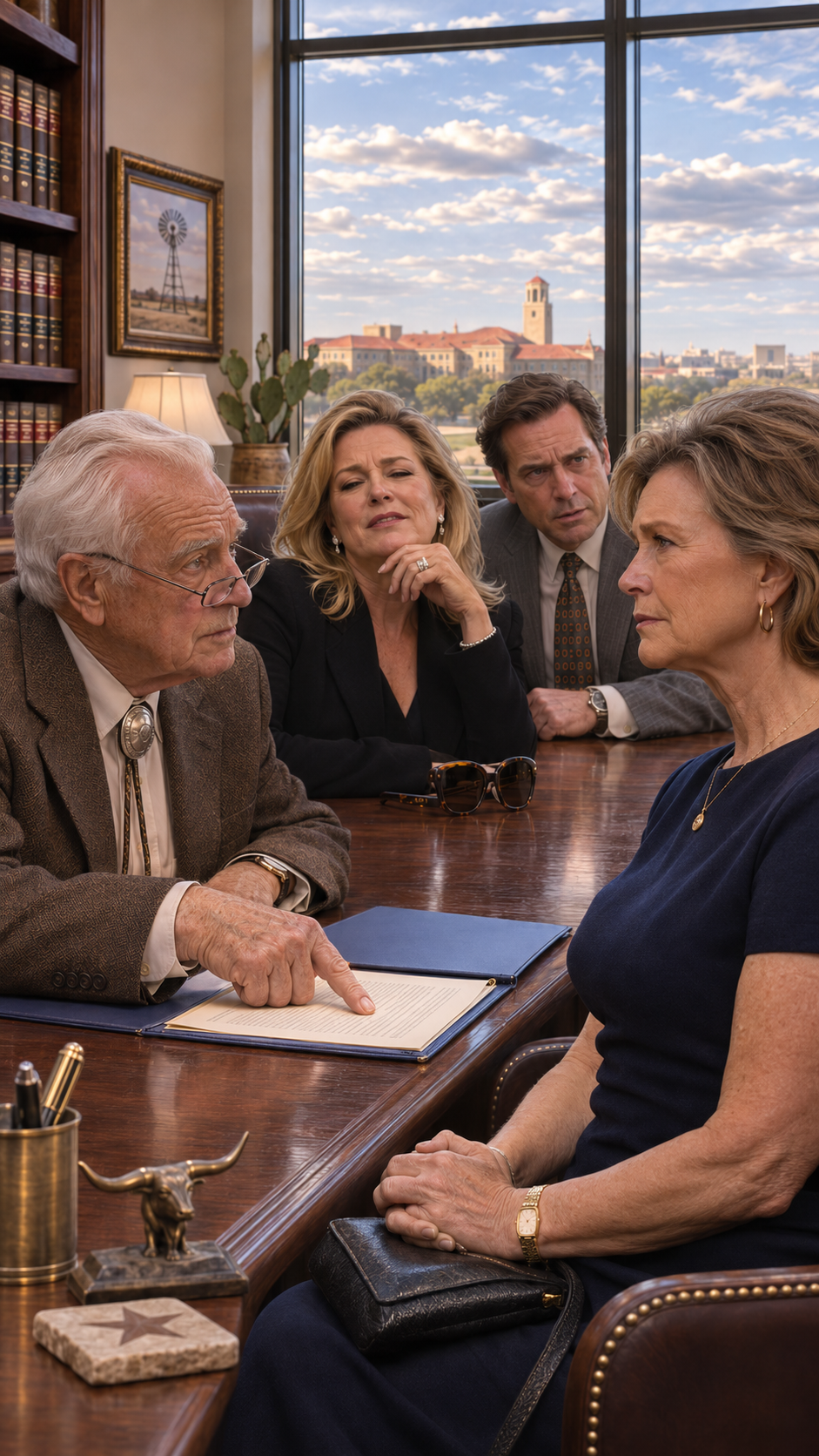
My sister married my ex-husband the minute his oil money came in, and she made sure I heard about it at church. Eleven months later Clay had a stroke on a hunting lease outside Snyder and never came home. At the attorney’s office in Lubbock, my sister crossed her legs, smiled at me, and said, “I’m his wife now, Marlene. The estate is mine. I don’t know why they even asked you here.” I let her talk. I sat there with my purse on my lap and waited while the attorney opened Clay’s will. Then he read the first line out loud, stopped, and set his finger right beside my name.
…..Mr. Haskins looked over the top of his reading glasses.
“Yes,” he said. “It was signed in my office, witnessed by two independent witnesses, and notarized. I personally supervised the execution.”
Tammy leaned back in her chair.
“Fine. Then read it.”
Mr. Haskins looked down at the document.
He cleared his throat.
Then he read the opening declaration.
“Before any distribution of my estate is made, I direct my executor to acknowledge and satisfy all outstanding obligations owed to Marlene Jean Dobbs, my former wife, arising from the property settlement agreement executed on August nineteenth, 2011.”
Tammy blinked.
“What obligations?”
Mr. Haskins continued.
“These obligations include her retained economic interest in the original Scurry County mineral holdings and any unpaid proceeds attributable to the subsequent sale of those assets.”
I felt my throat tighten.
Not because I didn’t know what the document meant.
I knew exactly what it meant.
I’d known there was an unresolved question about those mineral interests since the day Clay sold his company.
What I hadn’t known was whether he would ever admit it.
Mr. Haskins stopped reading.
Then he looked at Tammy.
“Mrs. Dobbs, before we discuss what your husband left you, we must first establish what was never entirely his to distribute.”
Tammy stared at him.
Her lawyer sat a little straighter.
“What exactly are you suggesting?”
Mr. Haskins removed another document from the folder.
“I’m not suggesting anything. I’m referring to an agreement executed by Clayton and Marlene during their divorce.”
Tammy laughed.
“Oh, please. She already got her settlement.”
I looked down at my purse.
The same brown leather purse I’d carried for nine years.
Inside was a small notebook with every monthly payment Clay had ever made.
I’d been a bookkeeper for thirty-eight years.
Some habits don’t leave you.
Mr. Haskins turned toward me.
“Marlene, would you like me to explain the agreement?”
I nodded.
“Yes, sir.”
He slid a copy across the table.
Then he said seven words that made Tammy’s smile disappear.
“Your sister never surrendered her original royalty interest.”
***
I was twenty-three when I married Clay Dobbs.
He was twenty-five.
We didn’t have a honeymoon.
We drove to Ruidoso for one night, spent forty-six dollars on a motel room, and came home because he had a shift starting at six the following morning.
Clay was a roughneck.
He worked twelve-hour shifts in the heat, came home smelling of diesel and drilling mud, and fell asleep halfway through supper.
We lived in a single-wide trailer outside Lubbock.
In winter, the pipes froze.
In summer, the air conditioner sounded like it was trying to climb out of the wall.
But we were young.
And we had plans.
Clay wanted to own oil leases.
I wanted a house with a real laundry room.
Neither dream seemed particularly extravagant.
Every Friday, I sat at our kitchen table with a calculator and a stack of envelopes.
Rent.
Groceries.
Electricity.
Truck payment.
Savings.
There wasn’t much left over.
But there was always enough for Clay to talk about buying the next opportunity.
He’d come home with maps, production estimates, and stories about old wells that might still have something worth extracting.
Most of those stories ended with somebody losing money.
A few didn’t.
I listened.
I asked questions.
And eventually, I learned enough about the business to recognize the difference.
In 1993, Clay came home talking about a mineral interest outside Snyder.
It wasn’t much.
A fractional interest connected to a property that several larger operators had passed over.
The seller needed cash.
Clay wanted to buy.
We didn’t have enough.
So I withdrew the money I’d saved from bookkeeping work and sold the little gold bracelet my grandmother had given me when I turned eighteen.
Together, we scraped up $18,600.
I remember the amount because I wrote it in red ink in our ledger.
Clay was embarrassed.
“I’ll pay you back,” he said.
I shook my head.
“We’re married, Clay. We’re building something.”
He hugged me so tightly I couldn’t breathe.
Then he said, “If this thing ever pays off, half the credit belongs to you.”
I believed him.
For years, he acted like he believed it too.
***
The Scurry County interest became part of the foundation of Clay’s early success.
By 1994, one of the associated wells began producing.
By 1999, additional interests and drilling projects had expanded the business.
Money started arriving in amounts that once would have seemed impossible.
We moved out of the single-wide.
Bought the house on 82nd Street.
Opened proper investment accounts.
And finally replaced Clay’s old truck.
But success did something to him.
At first, it was little things.
He stopped asking my opinion before signing contracts.
Started introducing me as his wife instead of his business partner.
Told people I’d been lucky to marry a man with ambition.
That last one always made me smile.
Because I could remember nights when he was too exhausted to read a lease agreement and I sat beside him highlighting the paragraphs he needed to review.
I knew which wells were producing.
Which ones were losing money.
Which leases were about to expire.
And which partners should never be trusted with a handshake.
Clay had the instincts.
I kept the records.
Together, we’d built something valuable.
Then he hired Krystal.
She was twenty-eight, pretty, and laughed at everything he said.
I was forty-nine and had spent years watching our money grow while my marriage slowly disappeared.
When I discovered the affair, Clay didn’t even have the decency to deny it.
He sat at our dining room table and told me he’d changed.
That he needed a different life.
That I should understand.
I remember looking at him and thinking how strange it was that a man could stand in a house we’d paid for together and describe abandoning his marriage as personal growth.
I hired an attorney.
And I made sure I understood every number before signing anything.
***
Our divorce was finalized in 2011.
I received the house, certain financial assets, and monthly payments under the settlement.
Clay retained control of the operating companies.
But one provision was different.
Because of my contribution to the original mineral acquisition and the way those interests had been documented, the settlement preserved a defined economic interest for me in certain original Scurry County assets and proceeds attributable to their eventual disposition.
It wasn’t ownership of all Clay’s wells.
It wasn’t half his company.
It was a limited but potentially valuable interest governed by a written agreement.
For years, it produced modest payments.
Clay’s accountants sent statements.
I recorded each one.
Most months, the money arrived on time.
Sometimes it didn’t.
I wrote letters.
They corrected the errors.
That was how things worked.
Until 2023.
When Clay sold the Permian acreage to a Houston company.
The newspaper reported an estimated four-hundred-million-dollar transaction.
I read the article over breakfast.
Then I opened my old settlement folder.
Because certain portions of the sold assets appeared to trace back to the interests covered by our agreement.
I called the accounting office.
They told me the final allocation was still being reconciled.
I asked for supporting statements.
They said they’d send them.
They never did.
Three months later, Tammy married Clay.
And I decided I wasn’t going to discuss my financial affairs with my younger sister in a church fellowship hall.
Instead, I hired an independent attorney to review the records.
Her name was Margaret Sloane.
She specialized in commercial property and mineral interests.
She took one look at the settlement and said, “Marlene, we need to establish exactly which assets were included in that sale.”
I agreed.
Then Clay died before the accounting was finished.
That was how I ended up in Mr. Haskins’s conference room.
With Tammy smiling at me as though she had already inherited everything.
***
Mr. Haskins turned another page.
“The transaction reported in the newspaper involved several operating entities and multiple investors,” he explained. “The public figure was the overall transaction value, not a personal check written to Clayton.”
Tammy frowned.
“So?”
“So we must distinguish what Clayton personally owned, what his companies owned, what remained subject to debt and taxes, and what contractual obligations survived the sale.”
She waved one hand.
“That’s lawyer talk.”
Her attorney gave her a sharp glance.
Mr. Haskins continued.
“At the time of his death, Clayton was involved in a review of the amounts attributable to Marlene’s retained interest.”
I sat quietly.
Tammy stared at me.
“You’ve been trying to take his money?”
I looked at her.
“No, Tammy.”
“Then what’s this?”
“It’s an agreement Clay signed when we divorced.”
She laughed bitterly.
“That was twelve years ago!”
“Yes.”
“And you’re still coming after him?”
I folded my hands.
“Tammy, a contract doesn’t stop existing because you don’t like who signed it.”
Her lawyer leaned forward.
“Mr. Haskins, has the amount been determined?”
“Not conclusively. An outside accounting review is underway.”
Tammy looked relieved.
“See? It’s probably nothing.”
Mr. Haskins opened the next file.
“The preliminary calculation identifies approximately nineteen million dollars in potentially attributable proceeds, subject to final tracing, adjustments, and any valid disputes.”
Tammy’s mouth fell open.
“Nineteen million?”
The room went completely silent.
I looked toward the window.
Texas Tech students were walking across the sidewalk below.
A young woman carried a backpack.
A man balanced two coffee cups.
The world looked ordinary.
But inside that conference room, my sister had just learned that the woman she’d mocked for losing Clay might have a claim worth more than anything Tammy had personally earned in her life.
***
Tammy recovered first.
“That’s ridiculous.”
Nobody answered.
She pointed at me.
“She didn’t do anything for that money.”
I looked at her.
I could have told her about the single-wide.
About the gold bracelet.
About the nights Clay came home too tired to eat.
About the ledger I’d kept through every dry hole and every late bill.
But she knew those stories.
She’d been there.
She’d borrowed money from me while I was living them.
So I said something simple.
“I was there when we bought the first interest, Tammy.”
She rolled her eyes.
“You were married to him. Congratulations.”
I nodded.
“Yes. I was.”
Then I looked directly at her.
“And the agreement was part of what we settled when that marriage ended.”
Tammy turned toward Mr. Haskins.
“I want this challenged.”
Her attorney raised one hand.
“We’ll review the documents before deciding whether there are grounds to dispute the claim.”
Mr. Haskins nodded.
“Of course.”
Tammy looked irritated.
“Why aren’t you fighting for me?”
Her lawyer spoke quietly.
“Because I need to know what the documents actually say.”
For the first time that morning, I almost smiled.
***
Then Mr. Haskins turned back to the will.
“There’s another matter.”
Tammy straightened.
“Finally.”
He looked at her.
“Clayton made specific provisions for you as his surviving spouse.”
Her shoulders relaxed.
I watched her smile return.
“Of course he did.”
Mr. Haskins continued.
“The provisions include certain personal property, a residence interest, and distributions from a trust established for your benefit.”
Tammy nodded.
“Good.”
He looked down.
“However, those provisions do not give you ownership of every asset associated with Clayton’s businesses.”
Her smile faded.
“What?”
The attorney continued.
“Clayton also directed that his remaining separate estate, after debts, taxes, and other obligations, be allocated among several beneficiaries and charitable purposes.”
Tammy stared.
“What beneficiaries?”
Mr. Haskins turned a page.
“A fund for the children of certain deceased and disabled oilfield workers.”
I looked up.
That surprised me.
He continued.
“An educational endowment at Texas Tech. And provisions for several long-serving employees.”
Tammy looked horrified.
“He’s leaving money to employees?”
“Yes.”
“What about me?”
Mr. Haskins glanced at her.
“Your provisions remain substantial.”
“How substantial?”
He began explaining the financial structure.
I won’t pretend the details were simple.
Texas marital property rules.
Separate property.
Community interests.
Trust distributions.
Business ownership.
Estate expenses.
It wasn’t the kind of thing that could be settled by somebody shouting, “I’m the wife.”
And even Clay’s will couldn’t automatically take away whatever legal rights Tammy had as his surviving spouse.
But what became clear was this:
Clay had not arranged for Tammy to receive outright control of his entire fortune.
He had provided for her.
He had also made sure other obligations were honored.
And he had kept substantial business assets under professional management.
Tammy leaned back.
“This isn’t what he promised me.”
Mr. Haskins looked at her.
“What did he promise?”
She opened her mouth.
Then closed it.
For a moment, nobody spoke.
And I began to suspect that my sister had been living inside a version of Clay’s wealth that existed mostly in her imagination.
***
The meeting ended after nearly two hours.
Outside, the West Texas wind was blowing hard enough to pull at my dress.
I walked toward my Buick.
Tammy followed me.
“Marlene!”
I stopped.
She crossed the parking lot, heels clicking against the pavement.
“You knew about this.”
I turned.
“I knew about my settlement.”
“You knew Clay was leaving you millions!”
“No. I knew there was an unresolved accounting issue.”
She stared at me.
“Same thing.”
“It isn’t.”
She folded her arms.
“You’ve always been jealous of me.”
I almost laughed.
“Tammy, I was fifty years old when Clay and I divorced. You were forty-one when you married him. I wasn’t competing with you.”
Her face reddened.
“You couldn’t stand that he chose me.”
I looked at her for a long moment.
Then said, “Clay chose plenty of women over the years.”
That stopped her.
I continued.
“You weren’t the first woman he disappointed me with.”
She looked away.
For a second, I thought I saw something like fear in her expression.
Then she whispered, “He loved me.”
I nodded.
“Maybe he did.”
She stared.
“Maybe?”
I took a breath.
“Tammy, I don’t know what Clay felt during your marriage. I’m not going to pretend I do.”
She looked down.
I continued.
“But I hope you married him because you wanted to spend your life with him.”
She didn’t answer.
So I got into my car.
And drove home.
***
I didn’t celebrate that evening.
I made a pot of beans.
Fed my little terrier, Biscuit.
And sat at the kitchen table with the folder Mr. Haskins had given me.
My house on 82nd Street was quiet.
The same house Clay and I had once imagined growing old in.
After the divorce, I’d repainted the bedroom.
Replaced the heavy leather furniture he liked.
And planted yellow roses beside the patio.
It had taken me years to stop thinking of it as the place where my marriage ended.
Now it was simply home.
At seven o’clock, my friend Doris called.
She’d known me since our bookkeeping classes in 1976.
“Well?” she asked.
I smiled.
“That’s a big question.”
“Did Tammy inherit the whole state of Texas?”
I laughed.
“No.”
“Did she faint?”
“No.”
“Did you?”
“Almost.”
Doris waited.
Then I told her about the preliminary accounting.
The retained interest.
The will.
The employee fund.
When I finished, she was quiet.
Then she said, “Marlene, you’ve been waiting twelve years for that man to admit how much you contributed.”
I looked down.
“I suppose I have.”
She sighed.
“Does it feel good?”
I thought about it.
Then answered honestly.
“Not the way I expected.”
Because I would have preferred an ordinary marriage.
A husband who came home.
A retirement spent sitting on the porch together.
Maybe a few grandchildren running across the yard.
I had wanted those things more than any oil money.
But Clay had made his choices.
And I’d made mine.
Now I wanted only what was legitimately owed.
Nothing more.
***
Three weeks later, Margaret Sloane called.
She’d received the preliminary accounting documents from the estate’s representatives.
“Marlene, I’ve reviewed the schedules.”
I sat up.
“And?”
“The amount may be substantial. But there are questions about which assets fall within the settlement provision and how the sale proceeds were allocated.”
I nodded.
“That’s what we expected.”
“Yes.”
She paused.
“There’s something else I want you to see.”
My stomach tightened.
“What?”
“A letter from Clay.”
I went still.
“To me?”
“Yes.”
I didn’t answer.
Margaret continued.
“It was provided to counsel with the estate records. Mr. Haskins says Clay wrote it shortly before he signed the new will.”
I looked toward the window.
“Did he know he was sick?”
“I can’t say. But the letter appears to have been prepared during his estate planning.”
I swallowed.
“What’s in it?”
Margaret hesitated.
“I think you should read it yourself.”
***
I drove to her office the next morning.
She handed me a sealed envelope.
My name was written across the front.
Clay’s handwriting.
I recognized it immediately.
After all those years, I still knew the way he wrote his capital M.
I sat down.
Opened the envelope.
And unfolded three pages.
“Marlene,
I don’t know if you’ll want to read this.
You’d have every reason not to.
I’ve spent years telling myself I built everything on my own.
The company.
The wells.
The money.
But when I went back through the old books, I saw your handwriting on almost every page.
I saw the first lease calculations.
The old bank statements.
The records you kept when we couldn’t afford an accountant.
And I remembered the night you sold your grandmother’s bracelet to help me buy that first interest.
I didn’t forget it because it was unimportant.
I forgot it because remembering would have meant admitting how much I owed you.
I wasn’t a good husband.
I know that.
I was proud.
Selfish.
And more interested in being admired than being faithful.
You deserved better.
When we divorced, you insisted on keeping the economic interest we agreed belonged to you.
I resented that.
I told people you were greedy.
But you weren’t asking for anything we hadn’t already built together.
The sale of the company forced me to face how complicated those old holdings had become.
I’ve instructed my attorneys and accountants to complete the reconciliation honestly.
Whatever is owed under our agreement should be paid.
I don’t expect forgiveness.
I don’t expect you to come to my funeral.
And I don’t expect this letter to change what happened.
But I want you to know something I should have said in 1985, when we were living in that miserable trailer and you were balancing our checkbook by the light over the stove.
I couldn’t have built that first business without you.
You were there when nobody else believed in me.
And I’m sorry I let money convince me I no longer needed you.
Clay.”
I lowered the letter.
Then I began crying.
Not loudly.
Not dramatically.
Just the quiet crying of a woman who had spent twelve years trying not to think about how much of her life she’d given to a man who walked away.
Margaret passed me a tissue.
I stared at the last sentence.
I couldn’t have built that first business without you.
For years, I’d wanted Clay to admit that.
And now he’d done it.
But he was gone.
There would be no conversation.
No chance to ask why.
No opportunity to tell him how badly he’d hurt me.
All I had were three pages.
And the knowledge that somewhere near the end of his life, he’d finally remembered who had helped him begin.
***
The estate accounting took months.
There were business valuations.
Tax records.
Asset schedules.
Old leases.
Amendments.
Distribution statements.
And more correspondence than I cared to read.
Tammy challenged portions of the financial arrangements.
Her attorneys questioned the scope of the settlement.
Our attorneys responded with the original agreement, supporting records, and additional documentation.
Nobody walked into a courtroom and instantly awarded me nineteen million dollars.
Real financial disputes don’t work that way.
There were negotiations.
Independent calculations.
And disagreements over expenses that had been deducted from the original sale proceeds.
But the underlying agreement was real.
The retained interest was documented.
And Clay’s final instructions made clear that he wanted the obligation addressed rather than ignored.
Eventually, the estate and my representatives reached a settlement.
The final amount was lower than the initial preliminary figure after accounting adjustments and negotiated terms.
Still, it was more money than I’d ever imagined personally controlling.
When Margaret told me the number, I stared at her.
Then asked her to repeat it.
She did.
I laughed.
Then cried.
Then laughed again.
Because I remembered the single-wide.
The frozen pipes.
The beans we’d eaten three nights in a row because we couldn’t afford meat.
The bracelet I’d sold.
And the husband who’d once promised that half the credit belonged to me.
I hadn’t received half his fortune.
I wasn’t entitled to it.
But I had finally received recognition for the interest we’d documented long ago.
And that was enough.
***
Tammy called the evening the settlement was finalized.
I was sitting on the patio with Biscuit asleep beside my chair.
Her name appeared on my phone.
For a moment, I considered letting it ring.
Then I answered.
“Hello, Tammy.”
She didn’t say hello.
“You got your money.”
I looked toward the roses.
“Yes.”
She laughed bitterly.
“Congratulations.”
I waited.
“You must be thrilled.”
I took a breath.
“Tammy, I don’t want to fight.”
She was quiet.
Then said, “You always win.”
I closed my eyes.
There it was.
The sentence that had followed us since childhood.
When I earned better grades, I was showing off.
When I got married first, I was lucky.
When I bought a house, I thought I was better than everyone.
When Clay left me, Tammy acted as though she’d finally won something.
And now, even with Clay dead, she was still keeping score.
I leaned back.
“Tammy, what exactly do you think I won?”
She didn’t answer.
I continued.
“My marriage ended. Clay died. And you lost your husband.”
Silence.
“Nobody won.”
Her voice changed.
“He left more to those employees than I expected.”
I nodded.
“He apparently wanted to take care of them.”
She sniffled.
“And all those restrictions on the trust…”
I looked down.
“That’s something you’ll need to discuss with your attorney.”
She was quiet.
Then whispered, “I thought we had more time.”
For the first time, she sounded like a widow instead of a disappointed investor.
I felt my anger soften.
Not disappear.
Just soften.
“Most people do,” I said.
She began crying.
I sat quietly while she did.
And for the first time since she’d married Clay, we had a conversation that wasn’t about who had more.
***
A few weeks later, I learned something else.
Tammy had been having money problems before Clay died.
Not because he hadn’t provided for her.
Because she’d been living as though a newspaper headline represented unlimited personal cash.
She’d bought expensive clothes.
Redecorated their house.
Traveled.
Purchased jewelry.
And promised friends extravagant gifts.
Clay had apparently warned her several times that the company sale involved taxes, obligations, and investments that couldn’t simply be spent.
She hadn’t listened.
I recognized the pattern.
Clay had once treated every successful well as though it would produce forever.
He’d learned caution eventually.
Tammy hadn’t.
Now she was discovering that wealth could be complicated even when the numbers looked enormous.
I didn’t offer advice.
She had lawyers.
Financial professionals.
And resources of her own.
What she didn’t have was the unlimited control she’d expected.
And I wasn’t responsible for changing that.
***
That summer, I visited Snyder for the first time in years.
Not because I wanted to see the hunting lease.
Not because I wanted to relive Clay’s final morning.
I went because there was something I needed to do.
Outside town stood a small cemetery.
Several generations of my mother’s family were buried there.
My grandparents.
Two uncles.
A cousin who died young.
I drove through the gates and parked beside the old iron fence.
Then I walked to my grandmother’s grave.
Her name was engraved beneath a small cross.
HATTIE JEAN MORGAN.
1908–1992.
I knelt and brushed dust from the stone.
“Well, Grandma,” I whispered, “your bracelet turned out to be a pretty good investment.”
Then I laughed.
And cried.
I remembered the day she’d given it to me.
My eighteenth birthday.
She’d told me it wasn’t expensive but that it had belonged to her mother.
I wore it on my wedding day.
Then sold it when Clay needed money for the first mineral purchase.
For years, I’d regretted losing it.
Not because of the gold.
Because it had been hers.
I touched the stone.
“I hope you understand why I did it.”
The wind moved through the dry grass.
I stayed for a while.
Then drove back toward Lubbock.
And somewhere along that highway, I began thinking about what I wanted to do with the money.
Not what Clay had wanted.
Not what Tammy thought I deserved.
What I wanted.
For the first time in a long time, that question felt important.
***
The first thing I did was meet with a financial adviser.
Then an estate attorney.
Then my accountant.
I wasn’t going to spend thirty-eight years keeping other people’s books and suddenly stop paying attention when the numbers belonged to me.
I arranged the money carefully.
Made plans for taxes.
Reviewed investments.
Updated my will.
And set aside enough that I could live comfortably without ever worrying about medical bills or losing my home.
I also paid off the remaining balance on the small office building where I’d run my bookkeeping practice.
Then I took a week off.
Doris nearly fainted.
“You? Taking a vacation?”
I laughed.
“Apparently.”
“Where are you going?”
I thought about it.
“Maybe Santa Fe.”
She stared at me.
“You’ve been saying that for twenty years.”
“I know.”
She smiled.
“Well, it’s about time.”
So we went.
Two old women driving west with too much luggage, stopping for coffee whenever we pleased.
We wandered through galleries.
Ate good food.
Bought scarves we didn’t need.
And sat on a hotel balcony watching the mountains turn purple at sunset.
I laughed more that week than I had in years.
One evening, Doris looked at me over dinner.
“You know, Marlene, you don’t look like a woman who just became rich.”
I smiled.
“What do I look like?”
She thought about it.
“Like somebody who finally stopped waiting for permission to enjoy her own life.”
I looked down.
And realized she was right.
***
The next decision came from a place I hadn’t expected.
I was cleaning out an old filing cabinet when I found a photograph of the first crew Clay had hired.
Six men standing beside a drilling rig.
Their faces dusty.
Their coveralls stained.
Clay in the middle, grinning like he’d just won the lottery.
I recognized three of them immediately.
Eddie Varela.
Tommy Rios.
And Billy Crane.
Eddie had died in a work-related accident years earlier.
Tommy had suffered a serious injury and never returned to the oilfield.
Billy had worked for Clay nearly twenty years before retiring.
I sat down with the photograph.
And remembered something.
Those men had helped build the company too.
Clay hadn’t done it alone.
Neither had I.
There had been crews working in heat that made the metal too hot to touch.
Mechanics repairing equipment at midnight.
Truck drivers hauling supplies across West Texas highways.
Office workers handling paperwork.
Families waiting at home.
And people who’d paid a much higher price than anything written on a balance sheet.
I thought about Clay’s will.
The fund for workers’ families.
Then I called Mr. Haskins.
***
He sounded surprised to hear from me.
“Marlene.”
“Hello, Mr. Haskins.”
“How are you?”
“Doing well, thank you.”
“What can I do for you?”
I took a breath.
“I’d like to know more about the fund Clay established for oilfield workers’ families.”
He was quiet.
Then said, “I’d be happy to arrange a meeting.”
A week later, I sat in the same conference room where Tammy had told me the estate belonged to her.
This time, she wasn’t there.
There were no arguments.
No Dallas attorney in a gray suit.
Just Mr. Haskins, two administrators involved with the charitable fund, and a folder of information.
They explained that the program was intended to provide educational and emergency support to eligible families affected by serious oilfield injuries and deaths.
It was still being organized.
There would be independent oversight.
Application criteria.
Financial reporting.
And proper administration.
I listened.
Asked questions.
Reviewed the numbers.
Then made a decision.
I would contribute some of my own money to the fund.
Not because Clay had asked me to.
Not because I felt guilty.
Because the people whose work helped create that wealth deserved to be remembered too.
Mr. Haskins looked at me.
“Are you certain?”
I nodded.
“Yes.”
He smiled.
“Clay would’ve appreciated that.”
I looked down at the photograph I’d brought.
“Maybe.”
Then I looked at him.
“But I’m doing it because I think it’s right.”
***
The first scholarship ceremony was held the following spring.
A small gathering at a community center outside Lubbock.
No expensive decorations.
No television crews.
Just folding chairs, coffee, cookies, and families.
One young woman received assistance toward nursing school.
Her father had worked in the oilfield before an injury forced him to retire.
A young man received support for a welding certification.
Another student was preparing to study mechanical engineering at Texas Tech.
I sat near the back.
I didn’t want attention.
But halfway through the ceremony, Mr. Haskins approached the microphone.
He spoke about the program.
The people who’d helped establish it.
And the importance of supporting families who had contributed so much to the region.
Then he said something I hadn’t expected.
“One of our founding supporters is here today. She helped keep the earliest records of Clayton Dobbs’s business long before anyone imagined how successful it might become.”
I felt my cheeks warm.
He looked toward me.
“Marlene, would you stand?”
I shook my head slightly.
Doris elbowed me.
“Get up, woman.”
I stood.
The room applauded.
And for a moment, I remembered every late night I’d spent balancing books at our kitchen table.
Every invoice.
Every lease.
Every check.
All those years when people saw Clay as the businessman and me as the wife standing beside him.
Now, in a room full of families who understood what hard work looked like, somebody had acknowledged what I’d done.
My eyes filled.
I sat back down.
And Doris squeezed my hand.
***
Tammy didn’t attend the ceremony.
I hadn’t expected her to.
We still spoke occasionally.
Mostly birthdays.
Holidays.
The occasional family matter.
She was more careful with her words now.
But our relationship remained fragile.
Too many years had passed with her treating my life like a contest.
One afternoon, she came to my house unexpectedly.
I was watering the roses.
She stood beside her car wearing a simple blue dress.
No expensive hat.
No sunglasses.
No diamonds large enough to blind a person.
“Hello, Marlene.”
I set down the hose.
“Tammy.”
She looked uncomfortable.
“Can I come in?”
I hesitated.
Then nodded.
We sat at the kitchen table.
I made coffee.
For a long moment, she stared at the mug in front of her.
Then she said, “I owe you an apology.”
I didn’t answer.
She looked up.
“For what I said at church.”
I felt my chest tighten.
Three years had passed since she’d stood in that fellowship hall holding lemon bars and told everyone she’d married Clay now that he was somebody.
I remembered every word.
Tammy continued.
“I wanted to embarrass you.”
I nodded.
“You did.”
She swallowed.
“I thought marrying Clay meant I’d finally done better than you.”
I stared at her.
Then asked a question.
“Why did you need to do better than me?”
She looked down.
“I don’t know.”
I waited.
After a moment, she whispered, “I think I always felt like you were the one everybody trusted.”
I frowned.
“Trusted?”
She nodded.
“Mom trusted you with money. Dad asked your advice. People came to you when something went wrong.”
I stared at her.
“Tammy, I worked hard to become someone people could depend on.”
She nodded.
“I know that now.”
Her eyes filled.
“I thought if I had more money, a better house, a richer husband, people would finally look at me that way.”
I looked down at my coffee.
For the first time, I understood something about my sister.
She hadn’t simply wanted what I had.
She’d wanted what she believed having it would make her feel.
Important.
Admired.
Secure.
But she’d never learned that none of those things could be guaranteed by marrying somebody else’s ex-husband.
***
Tammy began crying.
“I did love Clay.”
I nodded.
“I believe you.”
She looked surprised.
“Really?”
“Tammy, I don’t think your marriage was my business.”
Her expression softened.
I continued.
“But the way you treated me was.”
She lowered her head.
“I know.”
For a while, neither of us spoke.
Then she asked something that made me stop.
“Did he ever tell you he was sorry?”
I looked toward the drawer where I kept Clay’s letter.
“Yes.”
Her eyes widened.
“When?”
“Before he died.”
She stared.
“Did he write to you?”
I nodded.
Tammy looked down.
Then whispered, “He wrote me one too.”
I waited.
She took a breath.
“He told me he’d loved me. But he also told me he was worried I cared too much about what people thought of us.”
I looked at her.
She continued.
“He said I needed to find a life that didn’t depend on being Mrs. Clayton Dobbs.”
Her voice broke.
“I was so angry when I read it.”
I understood.
Clay had never been particularly gentle with uncomfortable truths.
But sometimes he’d been right.
Tammy wiped her eyes.
“I think he knew something was wrong before I did.”
I looked at my sister.
Then said quietly, “Maybe he finally started seeing some things clearly.”
We sat together for another hour.
There were no dramatic promises.
No instant reconciliation.
But before she left, Tammy hugged me.
A real hug.
Not the stiff little embrace she’d given me at family funerals.
And when she walked out, I felt something I hadn’t expected.
Not forgiveness all at once.
But the possibility of peace.
***
I’m seventy now.
I’ve reduced my bookkeeping business to a handful of longtime clients.
I still keep my own records.
Still balance my accounts.
Still save receipts.
And I still live in the house on 82nd Street.
The yellow roses have grown tall.
Biscuit is slower now.
Doris and I take a trip every spring.
And the little office where I spent so many years preparing other people’s tax records has become a place where I occasionally help younger women understand the basics of budgeting, business ownership, and financial planning.
I don’t charge most of them.
Some are newly divorced.
Some are widows.
Some are starting small businesses.
And some simply want to understand what happens to their money after they deposit it in the bank.
I tell them the same thing.
“Don’t be ashamed to ask questions.”
Then I hand them a notebook.
Because money can become complicated.
People can become dishonest.
And promises don’t mean much if nobody remembers what was agreed.
***
Last October, I went to church wearing my navy dress.
The same one I’d worn to Mr. Haskins’s office after Clay died.
I sat in the third pew.
Sang the hymns.
Listened to the sermon.
And afterward, went into the fellowship hall for coffee.
Mrs. Peabody was there.
She was ninety now.
Still sharp as a tack.
Still wearing the same enormous brooch she’d owned for years.
She saw me and smiled.
“Marlene Dobbs.”
“Morning, Mrs. Peabody.”
She took my hand.
“How are you, honey?”
“I’m doing well.”
She nodded.
“I hear you’re helping those oilfield families.”
I smiled.
“A little.”
She patted my arm.
“That’s good work.”
Then she leaned closer.
“Do you remember what I told you when Tammy embarrassed you in here?”
I laughed.
“Yes, ma’am.”
She grinned.
“I said that girl would get exactly what she’d earned.”
I looked toward the coffee table.
Tammy was standing beside the lemon bars.
For a moment, the memory was so vivid I could almost hear her old words.
You had him when he was nobody. I’ve got him now that he’s somebody.
Mrs. Peabody squeezed my hand.
“Funny how things work out.”
I looked back at her.
Then smiled.
“Yes, ma’am.”
But I wasn’t thinking about the money.
I was thinking about the years I’d spent believing that losing Clay meant I’d lost the best part of my life.
It hadn’t.
I’d lost a marriage that no longer respected me.
And eventually, I’d found a life that did.
***
That afternoon, I went home and opened the old cedar chest at the foot of my bed.
Inside were photographs.
Letters.
A few childhood keepsakes.
And the first bookkeeping ledger Clay and I had used after buying that mineral interest in 1993.
The cover was faded green.
The corners were bent.
I opened it carefully.
There, written in my handwriting, was the original entry.
August 17, 1993.
Mineral interest purchase.
$18,600.
I ran my finger across the numbers.
Then remembered the single-wide trailer.
The old coffee pot.
Clay standing in the doorway with his boots covered in mud.
The young woman I’d been, believing that if she worked hard enough and loved someone faithfully, everything would turn out the way she’d planned.
I wished I could speak to her.
I’d tell her that she would survive the affair.
The divorce.
The church humiliation.
The years of being treated like the woman who’d lost.
I’d tell her she would keep her dignity.
That she’d build a good life.
And that someday, someone would finally acknowledge the work she’d done.
Then I turned to the back page of the ledger.
There was a note.
Clay’s handwriting.
I’d forgotten it was there.
“Marlene kept us straight when I couldn’t see two feet ahead. If this thing ever makes money, she deserves her share.”
I sat very still.
Then I laughed.
Not bitterly.
Not triumphantly.
Just a small, surprised laugh.
Because Clay had written those words thirty years earlier.
Before the money.
Before the fourteen wells.
Before the office downtown.
Before Krystal.
Before Tammy.
Before the newspaper headline.
Before everything became complicated.
For one brief moment, he’d understood the truth.
He just hadn’t lived by it.
I closed the ledger.
And placed it beside his letter.
***
People sometimes ask whether I regret not fighting harder to keep Clay.
I don’t.
A marriage isn’t something one person can preserve by doing all the work.
And I wasn’t willing to spend the rest of my life competing with younger women for the attention of a man who’d forgotten what loyalty looked like.
They also ask whether I’m glad Tammy didn’t inherit everything.
That’s a more complicated question.
I don’t wish poverty on my sister.
I don’t wish her pain.
And I certainly didn’t wish for Clay to die.
But I’m glad the truth finally came out.
I’m glad the agreement was honored.
I’m glad the people who helped build the business weren’t forgotten.
And I’m glad I didn’t let Tammy’s cruel words convince me that my worth depended on which woman Clay chose.
Because the biggest mistake my sister made wasn’t marrying my ex-husband.
It was believing that his money made her more valuable than me.
And the biggest mistake Clay made wasn’t becoming wealthy.
It was forgetting that wealth doesn’t erase the people who helped you earn it.
***
Last Sunday, Tammy came over for supper.
She brought lemon bars.
I laughed when I saw the dish.
She looked confused.
“What’s funny?”
I shook my head.
“Nothing.”
Then I smiled.
“Just remembering something.”
We ate at my kitchen table.
Talked about our mother’s old recipes.
Argued over whether Aunt Louise had really put mayonnaise in her chocolate cake.
And laughed about the time Tammy tried to bleach my hair when we were teenagers.
For one evening, we were simply sisters again.
Not entirely healed.
Not free of old hurts.
But trying.
After she left, I washed the dishes and stood beside the window.
The roses moved gently in the evening breeze.
My house was quiet.
My accounts were in order.
And there was nobody in the world I needed to impress.
I looked toward the photograph of my younger self standing beside Clay outside our single-wide trailer.
We were smiling.
He had his arm around my waist.
I was wearing the little gold bracelet I’d later sell.
For years, looking at that picture hurt.
Now it didn’t.
I could remember the good without pretending the bad never happened.
I could appreciate what we built without wishing we were still married.
And I could accept the money I was owed without letting it become the most important thing about my life.
I turned off the kitchen light.
Picked up Biscuit.
And walked toward the bedroom.
On the dresser sat Clay’s letter.
Beside it, the old ledger.
Two pieces of paper written decades apart.
One from the beginning.
One near the end.
Both saying something I had spent years wishing he’d say while he was alive.
That I had mattered.
I looked at them for a moment.
Then smiled.
Because by then, I no longer needed Clay to tell me that.
I already knew.