PART 2 — What Was Left
They went right up to the same window.
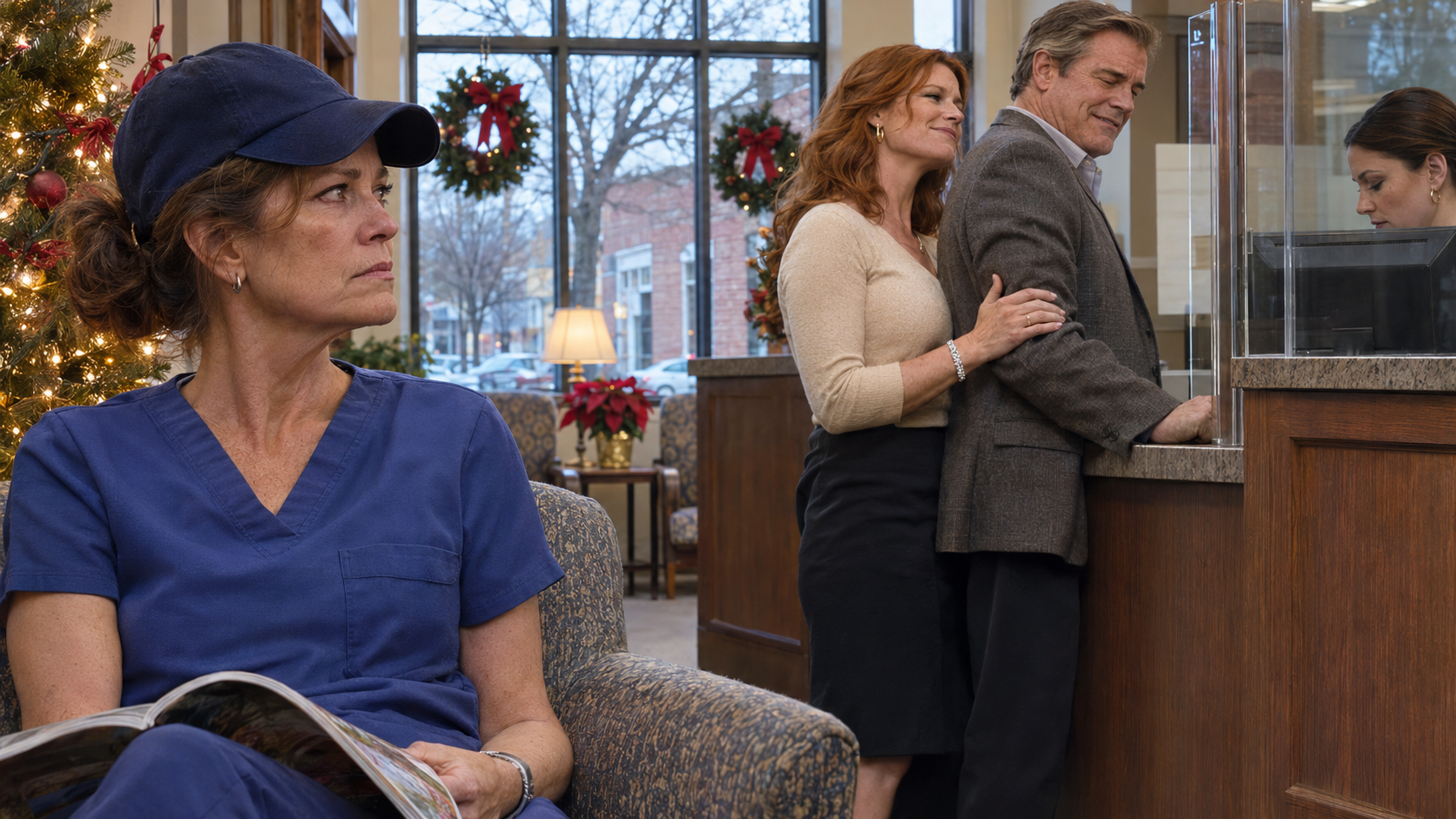
Stu put both hands on the counter. Ashlee kept hers in the bend of his elbow. Her bracelet slid out from under the cuff of her sweater and knocked against the wood.
The teller looked at her screen and said, “Mr. Spurlock, the balance in your joint savings is forty-eight thousand, three hundred sixteen dollars and twenty-two cents. Is that the amount you want to transfer?”
Stu took one hand off the counter.
“No,” he said. “You’ve got the wrong account.”
She asked him to confirm the last four digits. He said them so fast she had to ask him to repeat the last two.
“That’s the account I have open,” she said.
“There’s ninety-six thousand in it.”
Ashlee loosened her grip on his arm. Until then, I’d been wondering whether she knew where the money was coming from.
Her next words settled that for me.
“You said ninety-six, six thirty-two.”
She knew the number down to the dollar. I could have told you what was in the account, of course. I used to check it every payday after I made my deposit. But I wondered how long she had been carrying that figure around in her head, and what it had started to feel like to her.
Stu leaned closer to the opening in the glass.
“Show me where it went.”
“I can print the account activity for you.”
“Then print it.”
He looked back at Ashlee as if to make sure she’d seen him get things under control. She was looking at the counter.
I had my thumb stuck between two pages of a magazine. The paper cut me when I pulled it free. Just a little sting, then a red dot right in the fold of my knuckle.
A week earlier I’d been able to hold a deposit slip steady after hearing my husband say every dime. Now I couldn’t close a magazine without hurting myself.
The printer behind the counter made a noise like somebody clearing their throat.
The teller slid the page through.
Stu read it once. Then he bent over it, holding it flat with the heel of his hand.
“Cheri,” he said.
I don’t think he meant to call for me. I think he’d just got to my name and said it out loud.
“I’m right here.”
He turned.
For a second his face did the ordinary thing it did when we ran into each other somewhere unexpected. His eyebrows rose, and the corners of his mouth lifted a little. We’d been married long enough to have a whole set of expressions we could make without thinking.
Then he saw the ball cap. He looked down at my scrubs. I watched him work out that this was where I went on my lunch hour.
“How long have you been sitting there?”
“Since before you came in.”
Ashlee pulled her hand away. She folded it over the bracelet.
I put the magazine on the chair beside me, lined its edge up with the armrest, and stood. I didn’t take my purse. I expected to come back for it in a minute.
Stu held up the statement.
“What did you do?”
“I moved my half.”
“You took forty-eight thousand dollars without talking to me?”
“Forty-eight thousand, three hundred sixteen dollars and twenty-two cents.”
I could hear myself giving him the cents, and I knew how petty it might sound to the people in line. But I’d spent a good deal of my life being expected to round things in Stu’s favor. An extra Saturday at the office was just one shift. A winter without his paycheck was a rough patch. The money I’d earned during those months had gone into the same account as his, and it had looked so much like his by the time it got there that he’d thought he could walk away with it.
I wanted him to hear the cents.
Stu glanced over his shoulder. There were three people in line by then, including a man with a paper sack from the bakery. The man had begun examining the Christmas hours taped to the door.
“We need to talk somewhere private,” Stu said.
“I heard you here last week.”
Ashlee looked at him.
“Last week?”
“You were standing right where you are now,” I told her.
She glanced down at her shoes.
“Stu said you’d agreed to the transfer.”
“I’d like to hear when he told you that.”
“Cheri,” Stu said.
He used to say my name that way if I started to tell a story about him in company and he was afraid I’d get to the part where he looked foolish. Sometimes he’d put a hand on my knee. I used to take the hint.
I waited for Ashlee to answer.
“Before we came in the first time,” she said. “He said you knew he needed the money.”
Stu folded the statement in half. The edges were crooked, so he opened it and did it again.
“Can you give us a minute?” he asked her.
Ashlee looked at his hands. Her car keys were sitting on the counter by his wrist. She picked them up.
“I’ll be in the car.”
He nodded like they’d straightened out a small matter between them. Then she walked past me, and he watched her all the way to the door.
I watched him watch her.
I’d been keeping a little hope tucked away all week. It had survived the lie about Kingsport, the hand on his arm, and even the way he’d rubbed my shoulders on Tuesday when I knew there was something he wasn’t telling me. I could still imagine him looking at me on Friday and getting so ashamed he’d forget about everything else.
When Ashlee left, he looked worried she might keep going.
The teller cleared her throat.
“Mr. Spurlock, would you like to go ahead with the transfer for the balance shown?”
He said no.
He didn’t look at me when he said it. I had the feeling he was answering too fast for a man who had spent a whole week arranging to come back.
The branch manager came out from behind her desk. She’d known me since Bradley was five. When he was little, she’d hand him a lollipop and tell him to ask his mother before he opened it. He’d always wait until we got outside, then announce that he’d forgotten to ask while the woman was still in a position to hear me say yes.
She offered us her office.
“I’ve got to be back at work,” I said.
I picked up my purse. My hand shook so hard I slid the strap all the way to my elbow to keep it from falling.
Stu followed me out.
The air had that damp Tennessee cold that gets through a scrub top before you’ve had time to find the keys in your bag. Ashlee’s car was parked two spaces over from mine. The engine was running, and I could see her silhouette through the fog on the passenger window.
“Just listen to me for a second,” Stu said.
I turned so he could see I was listening.
“You had your paycheck going into that account this whole time,” he said. “You know I’ve always taken care of things.”
I thought of driving home from work in a freezing rain one year because Bradley had strep and Stu was out of town. The power had gone off. I’d sat with our boy on the kitchen floor in our coats and called around until I got one of the neighbors to lend us a camp stove. Stu had called the next night and asked if we were warm yet.
“I know what I put in,” I said.
“I was going to make it up.”
“After you took it?”
“After I got things going.”
“What things?”
The engine in Ashlee’s car changed pitch. Stu looked toward it.
“Come to the house tonight,” I said. “If you want to tell me something, tell me there.”
“What are you going to say to Bradley?”
Of all the things he could have asked me right then, there was the one he went for.
“I’m having lunch with him tomorrow.”
“Cheri, he’s getting married next Saturday.”
“I know when my son’s getting married.”
“He asked us for one day.”
“He asked me,” I said. “I don’t know what he asked you.”
Stu reached for my sleeve. I stepped back before I knew I’d decided to.
He let his hand hang in the air a second. Then he put it in his coat pocket.
I got into my car and drove to the office. At a light, I turned the heater up and felt warm air hit the cut on my finger. I put a bandage on it when I got to work. An hour later I looked down and saw the bandage had loosened inside my glove, and I made myself finish what I was doing before I stopped to fix it.
My last patient was an older woman whose husband had started forgetting which door to use when he came to pick her up. She asked if I minded leaving her in the chair a minute because she could see his truck out the window and knew he’d get turned around at the entrance.
I stayed with her. Her husband came to the right door on his own that afternoon. She smiled when she saw him and gave him a little wave through the glass.
I envied her so badly that I had to turn my face away.
Then he dropped one of her gloves on the way to the truck, and she called him a useless old thing, plain as day across the whole parking lot. He went back for the glove. She took his arm. They drove off together.
I sat at my station a few minutes after everybody left.
There was still a piece of me waiting for some woman older than I was to come in and tell me what to do. My mother would have been eighty-one. All the time I was growing up, I thought she had a rule for everything. I’d have given anything that afternoon to ask her how many of those rules she’d made up while standing in a grocery store or a church bathroom, with no idea whether she’d be able to follow them herself.
By the time I got home, I’d decided I wanted to know the truth in my own kitchen.
I’d also decided I wanted something to eat.
I heated a bowl of leftover pot roast. Some of the fat had gone white around the rim of the container. I scraped it off, cut the biggest piece of meat in half, and sat down at six o’clock with a fork and a napkin.
Stu got in at six-twenty. I knew because the microwave clock was right over his shoulder when he walked past the stove.
He hung his gray sport coat on the back of the empty chair.
“Is there any more of that?”
“In the refrigerator.”
He opened the door. I heard him shifting jars around, looking directly past the clear container I’d set on the front of the bottom shelf.
“Here it is,” he said to himself.
He brought the container to the counter and pulled out a bowl. He even got a spoon after opening the wrong drawer first. It was strange to see what little things I’d gotten out of the habit of letting him do.
We ate a few bites in silence before I asked him where he’d slept the night he called me from Kingsport.
He laid his spoon down.
“Ashlee’s.”
I pushed a carrot around in my bowl.
“Did you go to Kingsport at all?”
“I was there Tuesday and Wednesday. The meeting ran short.”
“And you called me Thursday and said it was still going.”
“Yes.”
He said it into his bowl. I felt a flash of anger at the bowl, of all things. I wanted to take it out of his hands and throw it against the wall. If we had been in somebody else’s house, I might have. But I’d bought that set of dishes with my employee Christmas bonus years ago. I knew what a replacement cost because I’d already broken one.
“How long?” I asked.
He drew his thumb along the edge of the table.
“Since the spring.”
Bradley had called me in April to say he was going to propose. I’d put him on speaker and got Stu out of the garage so he could hear about the ring. The three of us had talked for forty minutes. Stu had given Bradley advice about getting down on one knee without losing his balance.
I remembered the way our son had laughed.
“Were you with her before Bradley got engaged?”
“After.”
He said it like that settled some question of timing I would find comforting.
“Tell me about the money.”
His eyes went up to the ceiling over the stove. A brown mark the size of a saucer had appeared there after the last hard rain. I’d traced its edge in pencil to see if it was spreading. From where I sat I could see it had gone over the line.
“Ashlee’s cousin is selling his interest in a feed and farm supply store,” he said. “She put me in touch with him. I could get in as a partner if I came up with the money.”
“You were going to leave your job?”
“I was going to give notice after the first of the year.”
“Does anybody at work know?”
“No.”
I waited.
“Ashlee knows,” he said.
“Where’s the store?”
“Outside Crossville.”
He walked me through what he and Ashlee had discussed. First the store. Then a lease on a place close enough for him to go in early and open up. No bother with a long drive from Cookeville if he moved before he started. Every piece of it seemed to have been thought through, except what would happen to me when the bank statement came.
“Where were you going to tell me you’d gone?” I asked.
“I figured I’d tell you after Christmas.”
There was a potholder on the table between us. Bradley had sewn it in middle school. He’d put a loop on it that was too small to fit over a hook, and the whole thing sat crooked if you laid it out flat. I put one finger into the loop and pulled until an old stitch poked through.
“What about the wedding gift?”
“I’d have found the money for it.”
“Where?”
“Cheri, I don’t know where. I thought I could make it work.”
“What did you think I was going to do about the roof?”
He turned his head up again. He couldn’t even look at me steadily about the roof.
I stopped asking questions for a minute. He picked up his spoon and took a bite, then put it down as if he’d just realized where he was.
“Did you buy the bracelet?”
He went still.
“You can see it from two windows away,” I said.
“Yes.”
“From the joint account?”
“No. I put it on a card.”
I wanted to ask how much it had cost. The question came all the way up, and I swallowed it. He’d stood in a store and picked it out. He’d watched Ashlee put it on. She’d worn it to the bank twice.
Knowing the price would have given me the price.
“The store deal is off, then?” I said.
“Her cousin needed more than what was left in there.”
“Was she putting money in?”
“She was going to help with the office. She knows that side of things.”
I waited long enough for him to hear his own answer.
“Were you going to put my name on anything?”
He said, “I can see how this looks.”
“Look at me and tell me what I would’ve owned.”
He looked at me. Then he looked down.
That was the closest he came to an answer.
He carried his bowl to the sink. He scraped it out with the spoon, and the sound set my teeth on edge. When he came back to the table, he sat down in his usual chair, with his coat hanging down behind him like there might still be an ordinary evening ahead if he waited long enough.
“I told Ashlee you and I had already talked about splitting up,” he said.
I let go of the potholder.
“How did I take it?”
He looked up.
“When we had this talk,” I said. “How did I take it?”
“I told her it was mutual.”
I got up and took my bowl to the sink. I rinsed it. There was a dent along the back of the faucet where Stu had dropped a wrench changing the washer. He’d fixed it on a Sunday right before Bradley’s little league game. I remembered standing in that same spot holding a flashlight for him and asking if I had it pointed the right way.
I’d been looking for a place in our thirty-one years where I could set down what he’d just told me without breaking anything else. There wasn’t one.
“Were you waiting for me to figure it out?” I asked.
“No.”
“Then when I did find out, what were you going to tell me?”
He took a long breath through his nose.
“I’d hoped to be able to pay you back.”
He would have come to me with whatever was left over after he bought himself a life. I thought of him counting on me to take it. In a way, that was the part of the plan he’d known me best to make. I’d made do with less for him plenty of times.
I dried my hands.
“I want you to stay somewhere else tonight.”
“If I go to a motel, people are going to see my truck.”
“Park around back.”
“You’ve thought of everything, haven’t you?”
“I had a week.”
He opened his mouth. I knew the words before he said them.
“We can get through the wedding.”
“I intend to.”
“Then let’s get through it together. I can sleep in the spare room. We don’t have to tell Bradley anything until afterward.”
I thought about our son showing up at the house the next morning and finding both of us there. I thought about him seeing the two coffee cups beside the sink and assuming everything was all right, just the way I had for years.
“Pack a bag, Stu.”
He went down the hall.
I stayed in the kitchen while he opened drawers. I could tell when he got to the one with his socks because it stuck on the right side. I heard him pull once, then harder. I had been meaning to empty it and see if something had fallen behind it. Now I hoped there was something back there he would have to figure out for himself.
He came back with his overnight bag. It was the same one I’d seen him put in the truck for Kingsport.
“Are you going to file?” he asked.
“I’m going to talk to my lawyer on Monday.”
“You’ve already got a lawyer.”
“Yes.”
He looked surprised all over again. Moving half the money had been one thing. The idea that I’d asked somebody for help and could ask her again seemed to take longer to get through to him.
He took his coat off the back of the chair.
“Bradley’s going to want to know whose fault it is.”
“He’ll want to know whether his daddy’s coming to his wedding.”
Stu looked at me.
“I’m going,” he said.
“Then you can tell him that yourself.”
After he went out, I turned the porch light off. Then I turned it back on because I didn’t know if he could see the step from where he was.
He sat in the driveway a while before he started the truck.
I didn’t go to the window until I heard him leave.
Saturday morning, Bradley texted that he’d pick me up at eleven-thirty. I’d suggested lunch the week before, while I was still working out whether I could hide what his father had done. He thought I wanted to check on the rehearsal dinner.
I went out and stood by the driveway before his truck got there. He’d always come into the house when he picked me up. I was afraid he’d throw open the door and holler for his daddy, and I didn’t want Stu’s absence to be the thing that told him.
Bradley pulled in and reached across to unlatch my door. I got in with a plastic grocery bag on my lap. I’d made him banana bread because the bananas were turning, and I’d spent twenty minutes looking for a reason to put something in the oven.
“Can we sit here a minute?” I asked.
He took his hand off the gearshift.
“Sure. What’s wrong?”
There were leaves caught under the passenger wiper. I could see one of them moving a little every time his engine idled rough.
“Your daddy stayed somewhere else last night,” I said. “I asked him to.”
Bradley looked toward the garage as if he’d just noticed the truck wasn’t there.
“Is he all right?”
“He’s all right. He and I are having some trouble.”
“How much trouble?”
I laid the bag flat across my knees.
“Somebody else has been seeing him. A woman from work. And he was going to move all our savings into another account. I heard him talking about it at the bank.”
Bradley looked at me quickly.
“Did he get it?”
“I moved half first. It’s in my name, and my lawyer knows where it is. Yesterday I was there when he found out.”
Our son sat very still. I could hear one of his turn signals making that clicking noise he hated, although we weren’t turning anywhere. His knee had caught the lever when he shifted in his seat.
“Am I allowed to ask how long?” he said.
“Since spring, according to him.”
He switched the signal off.
“He took me to buy the ring in April.”
“I remember.”
“He said if I was going to marry somebody, I needed to be the person she could call at two in the morning. He gave me that whole speech in the parking lot.”
Bradley put a hand over his mouth. I wanted to defend the advice. I wanted to tell him that a man can know exactly what a good husband ought to do and sometimes even be one. Sitting there, I couldn’t think of a way to say it that would help him.
He looked down at the loaf in my lap.
“Is that for me?”
“Yes.”
“Can I have some?”
I reached into my purse for a napkin. There was a plastic knife in the bag already. I’d put it in without thinking, because Bradley has been cutting into warm banana bread before he got home since he learned to drive.
I gave him the end piece. He held it on the napkin and brushed a crumb off his knee.
“I wish you’d told me sooner,” he said.
“I knew you wanted one day with no drama.”
“One day, Mama.” He looked at me. “I meant Uncle Dean could get his own ride home if he wanted to drink again. I meant nobody had to argue with anybody about where they sat.”
“I know.”
“Were you going to let Dad take the money because I said that?”
“I thought about waiting.”
He set the piece of bread on the dashboard.
“Don’t do that for me.”
I was the one who started crying. I’d stayed dry-eyed at the bank and at the kitchen table. My son said five ordinary words, and I had to fish in my purse for a second napkin because I’d already given him the good one.
He waited while I pulled myself together. Then he asked if I’d talked to my lawyer about what to do next.
“I’m calling her Monday.”
“And you’re okay at the house?”
“Yes.”
“Do you want me to stay with you?”
“I want you to go home and be with your fiancée.”
He picked up the bread again. He took one bite and chewed it for a long time.
“I’m going to have to tell Claire,” he said.
“You can tell Claire.”
“I don’t know if I want him there.”
I let myself feel that before I answered. Some part of me wanted to say good. That part had a right to exist. It could have its say some other time, in some place Bradley didn’t have to hear it.
“You get to decide what you can live with on your wedding day,” I said.
“Are you going to be mad if I let him come?”
“No.”
“Will you sit with him?”
“I can sit at the same wedding. I’d like my own chair at dinner.”
Bradley gave a little laugh. It broke halfway through, but there it was.
“You get your own chair at dinner anyway.”
“You know what I mean.”
“Yeah,” he said. “I know.”
After a few minutes, he put the truck in reverse. We went to lunch. He asked how to spell one of his grandmother’s sisters’ names for the place cards, and I told him. I ate a grilled cheese. He ate the banana bread in the truck later and left the fries he’d ordered because he said they tasted like the inside of the freezer.
We needed an hour like that. I knew it while it was happening.
That evening he called his father. I know about the call because Bradley told me a little afterward and Stu told me a little more several months later. Each of them remembered a different stretch of silence. They agreed about the question Bradley finally asked him.
“Were you going to let Mama find out by looking at the bank balance?”
Stu said, “I was going to tell her.”
Bradley said, “Dad, I asked how she was going to find out.”
This time, Stu didn’t make him ask again.
“Probably when she looked,” he said.
I didn’t hear those words from Stu that night. I heard them from Bradley on Sunday morning, while I was on my knees pulling a box of Christmas ornaments out from the bottom of the hall closet.
“I wish I hadn’t asked,” Bradley said.
I pushed the box halfway back in and sat down on the floor.
“I wish you’d had a different answer.”
We stayed on the phone a little longer. He told me Claire had been sitting with him when he made the call. She’d gotten up to make tea after he hung up and come back with the mug his aunt gave him when he graduated. He didn’t know why he’d noticed that detail. I understood exactly why.
Then he said he wanted his dad at the wedding.
“He needs to come by himself,” he said. “And you and I need to have our dance.”
“I’d like that.”
“I still don’t know how to dance to that song.”
“Neither do I.”
“We’re going to look terrible.”
“You might.”
He laughed a little easier that time. When we hung up, I pulled the ornament box the rest of the way out.
At the top was a paper star Bradley made in kindergarten. The paper had yellowed, and a bit of dried glue still held the gold string in place. One of the points had bent so far back I’d kept meaning to straighten it. For years we’d put it on a side branch, where you only saw it if you went around the tree to plug in the lights.
I held it by the gold string. Then I went to the garage and got the tree.
It took me three tries to get the bottom section to sit straight in the stand. I’d forgotten how much help an extra hand could be. When I finally got it to stand up, I put Bradley’s star in the first place I saw.
The box of matching ornaments could wait.
By then it was getting dark outside. I stood in the living room looking at the tree, with only that one thing hanging on it. I thought I ought to call somebody and tell them what the last ten days had been like.
Instead I turned on the lights.
For a while, that was enough.
END PART 2
FINAL PART — The Light Over the Stove
On Monday morning one of the women at work asked if I’d heard about the scene at the bank.
I was hanging my coat on the hook behind her. I had one arm out of the sleeve and the other still caught in it.
“What scene?” I said.
“Some woman found out her husband had a second bank account. She threw a magazine at him.”
I finally got the sleeve off.
“I set the magazine down,” I said. “It was on the chair when I left.”
She looked up at me.
“Oh,” she said.
I took my lunch out of my bag and put it in the refrigerator.
She stood there for a second, holding her coffee with both hands. Then she asked if I wanted her to cover the first patient on my schedule while I made any calls I needed to make.
“Yes,” I said.
I meant to thank her right then, but my voice was doing something I didn’t care for. I took my phone into the little room where we stored the boxes of extra gloves, shut the door, and called my lawyer.
Her name was Nina. She listened while I told her about Friday, first at the bank and then at the house. When I told her what Stu had said about the feed store, she asked if he’d signed anything.
“I don’t know.”
“Did he tell you where he’s staying?”
“I didn’t ask.”
“Do you want him back at the house?”
“No.”
That one came out fast enough to surprise both of us.
“All right,” she said.
I told her I wanted to go ahead with the divorce. I’d said it to myself two or three times over the weekend, most recently while making coffee that morning. Saying it to a woman who could start doing something about it felt different. I pressed two fingers into the edge of a glove box until the cardboard buckled.
Nina asked some questions about our bills and when they came due. She asked whether I’d kept the receipt from the bank. I said I had. We set a time to meet, and she told me what papers to bring.
At the end of the call, I asked her what I was supposed to say if Stu called about the wedding.
“What would you say if you’d never hired me?” she asked.
“I’d tell him to bring the rings and wear his good shoes.”
“Sounds like you know what to say.”
He did call that evening. He was staying in a motel just off the interstate. He said the breakfast eggs were powdered, and I said I expected they were. We sounded, for half a minute, like we had when he’d called from an actual business trip.
Then he told me he’d called off the deal with Ashlee’s cousin.
“How did that go?” I asked.
“He sold to somebody else. Turns out he had somebody waiting.”
I took my tea to the kitchen table. I had set out two placemats that morning by habit. I moved Stu’s under a stack of mail.
“And Ashlee?” I said.
“I told her I wouldn’t be looking for a place with her.”
I waited.
“I told her I needed to deal with things at home.”
“I heard you.”
“She gave me the bracelet back.”
My first thought was that I ought to feel better. My second was to wonder whether she’d put it in the original box. I could see Stu standing at the jewelry counter asking about a return, trying to remember whether he’d paid extra to have it wrapped.
“Did you want me to know that because you think it will change my mind?” I asked.
He didn’t answer for a little while.
“Yes,” he said.
I could respect him for giving me a straight answer. I’d been that hungry for one.
“I wanted you to leave her before I knew about her,” I said. “I wanted you to come home of your own accord. I had no way to ask you for that, because you were telling me you were in Kingsport.”
“Cheri, if I could go back and—”
“You can come to our son’s wedding.”
He stopped.
“Will you bring the rings?” I said. “He told me Claire asked you to hold them.”
“I will.”
“Put them in your inside coat pocket before you leave the motel.”
He breathed out, almost a laugh.
“I won’t forget the rings.”
“I know you won’t.”
I hung up while my tea was still warm. I stood by the stove and drank it. The brown mark above me had grown past my pencil line again.
The next morning I called the roofer who’d given us an estimate the previous winter. He remembered the house. Stu had spent most of that visit asking him about metal roofing even though we knew we couldn’t afford it, and the man had written two estimates so we could think about it. Both were still stuck to the refrigerator under a magnet from the dentist’s office.
He came out after work on Wednesday. He looked at the ceiling, went up into the attic, and took a flashlight onto the roof. When he came back down, he said he could stop the immediate leak and give me a current estimate for the full job.
“Want me to come back and talk it over with both of you?” he said.
“You can tell me.”
He set his clipboard on the hood of his truck and explained what he’d found. I asked him to show me in the pictures he’d taken. I hadn’t understood half of what he said the previous year, because he and Stu had got to talking over each other and I’d gone inside to bring them coffee.
This time I understood where the water was coming from. He did the small repair that week. For the next few months, whenever it rained, I went into the kitchen after the first hard burst and checked the pencil line.
On Thursday, Bradley and Claire came over to bring me a wedding program. Claire had dust on the hem of her jeans from loading things into her mother’s car. She walked in, took one look at the Christmas tree with one paper star on it, and asked if I wanted help finishing it.
“I like it the way it is this year,” I said.
She looked at the star a little longer.
“Did you make that?” she asked Bradley.
He slipped his shoes off at the door.
“I might’ve.”
“You wrote your name across the middle.”
He went over and tipped the star up.
“Ma, how did you keep this thing so long?”
“Put it back in the box every year.”
He let it go gently. The star turned on its string and came back around to face us.
Claire had brought the seating chart on her phone. She and Bradley had moved a few people so I would sit beside my sister at dinner, with room for one of Claire’s aunts on the other side of me. Stu would sit with his brother. Nobody had to announce where their parents were sitting. There’d be names on the cards, and people would read them and sit down.
Claire asked me if that was all right.
“Yes,” I said. “You’ve got enough to do. I appreciate you doing this.”
She sat next to me on the couch.
“Do you want to know something kind of awful?” she said.
Bradley looked over.
“What?”
“I spent six weeks trying to talk my mother out of napkin rings. She says there’ll be people taking pictures of the tables. Who takes a picture of a napkin?”
“Your mother,” Bradley said.
Claire gave him a look. Then she laughed, and I laughed, and we spent about ten minutes talking about a woman we all loved who absolutely would take a picture of a napkin.
As they got ready to go, Claire put her hand on my arm.
“If it gets to be too much on Saturday, you can step outside,” she said. “There’s a covered porch out back. I had them put a bench out there for my grandmother.”
“Do you think it’ll be too much for me?”
“I think it might be too much for me.”
I put my hand over hers. She smiled and stood there long enough for Bradley to have to get the door himself.
Friday night at the rehearsal dinner, Stu came in wearing the gray sport coat.
I saw him before he saw me. It hung the same way it had hung at the bank. I remembered buying it and turning it over to look at the stitching because I couldn’t decide whether it was worth what the man in the store was asking. Stu had gone to look at belts while I paid. When we walked out, he’d said nobody ever bought him nice things unless I did.
At the restaurant he took the coat off and put it over the back of his chair. Just an ordinary thing. I looked away, and by the time I looked back, I’d got my breath.
Bradley stood up to thank everybody for coming. He had one hand on the back of Claire’s chair, and his jacket was caught on the corner of it. I could see him trying to tug it free without anybody noticing. Claire reached behind her, unhooked it, and set her hand back in her lap. Bradley kept right on talking.
I heard him thank his dad for getting him through the first semester of college when he was so homesick he’d considered quitting.
“He called me every night that first week,” Bradley said. “He talked to me about baseball because he knew if he asked me how I was, I’d tell him I was fine and hang up.”
Stu laughed with everybody else. Then he looked down.
I remembered those calls. Stu used to go out to the garage so I wouldn’t hear if Bradley got upset. I’d stand in the kitchen at the window, watching the light under the garage door, and wait for Stu to come back and tell me our boy was doing a little better.
I was glad Bradley remembered it.
When he thanked me, he told everybody I’d once driven all the way to Knoxville to bring him socks because he’d called me with a fever and mentioned he was out of clean ones.
“I brought soup,” I said across the room.
“He had socks with his soup,” Claire said.
Somebody laughed so hard they had to put their glass down.
That night, when the dinner was over and people were starting to push back their chairs, Stu came to my end of the table. He had a hand in his empty coat pocket.
“You all right?” he asked.
“I’ve had a good evening.”
“So have I.”
He stood there as if there ought to be somewhere we went together when the evening was done. For a long time there had been.
“Bradley needs you there at ten tomorrow,” I said.
“I’ve got the rings.”
“Okay.”
He picked up his coat. I got mine a few minutes later. The restaurant had hung everybody’s things on a rack just inside the door. Mine was between two nearly identical black coats. I found it by the paper tissue in the right pocket.
Saturday morning, I woke before the alarm. It had been raining when I went to bed, but the sky over the backyard was clear. The bare branches had little drops on them that caught the light when the sun came up.
The house was quiet. I made coffee. Then I unzipped the garment bag hanging from the pantry door and looked at the dress I’d bought months before.
It was dark green with sleeves that stopped at my elbows. I’d sent Stu a picture when I was trying it on. He’d texted back, Looks nice, and I’d laughed because the picture was so dark he probably couldn’t see anything except my thumb.
I put the dress on in my bedroom. The zipper stopped halfway.
I tried it with my right hand over my shoulder and my left hand reaching up from my waist. I tried pulling the dress a little to one side. I thought if I could just catch the end of the zipper between my nails, I’d have it.
I’d forgotten a whole category of things I used to ask him to do.
For a few minutes, I sat on the bed with the dress open at the back. I could see my blue scrubs hanging from the hook on the bathroom door, washed and ready for Monday. I thought about how much easier it would be to put those on and go somewhere I knew what I was supposed to do every minute.
Then my sister honked in the driveway. I opened the front door and turned my back to her.
“Zip me up.”
She did it with one hand. With the other she was carrying a tin of mints she insisted on keeping in her car. She tucked the tin under her arm and smoothed the fabric at my shoulders.
“You’re shaking,” she said.
“I’m cold.”
She put my coat around me and held it while I got my arms in. We drove to the wedding with the windows cracked because she said she was too warm and I said she could have told me that before she put the coat on me. By the time we got there, I was hungry enough to eat two biscuits in the little room off the kitchen where Claire’s mother had put food out for the wedding party.
About twenty minutes before the ceremony, Bradley knocked on the door and asked if I’d come look at his tie.
It was fine. I looked at it anyway.
“Want me to straighten it?” I asked.
“Yes, please.”
He bent his knees to save me stretching. I put a finger on either side of the knot and moved it about as far as the width of a grain of rice.
“There,” I said.
He stayed bent a little longer than he needed to. I put both hands on his shoulders and he put his arms around me.
“Dad’s here,” he said after a moment.
“I saw his truck.”
“He asked if I needed help with anything.”
“Did you?”
“I asked him to check on Claire’s grandma. The ramp’s on the other side of the building, and he walked her around.”
“Good.”
Bradley let go and smoothed his tie, undoing whatever I’d just done to it.
“Can I tell you something weird?” he said.
“Sure.”
“I’m happy.”
I put a hand on his cheek. I could feel the patch under his jaw where he’d missed a little when he shaved.
“I know, honey.”
“I keep thinking I should feel worse.”
I wanted to tell him what I should have told him over lunch. It had taken me a while to understand he needed to hear it plainly, because for all his talk about wanting one perfect day, he’d been prepared to give it up the instant he found out I was hurt.
“You get to be happy today,” I said. “I took care of myself at the bank so I could be here with you.”
He nodded. A man called his name from down the hall. He touched the knot of his tie once more and went when they called him a second time.
I sat in the front row on one side of the aisle. Stu sat near the other end of the same row. There were people between us. I could see him if I turned my head, and I knew he could see me, but once Claire came in, we both looked at her.
She’d told me she was scared she’d walk too fast. She came in so slowly I could see her mother in the second row silently urging her along with little forward movements of her chin.
Bradley grinned.
Claire saw him and broke into a smile. Then she picked up the hem of her dress and got down that aisle as fast as she wanted.
When the time came for the rings, Stu reached into his inside coat pocket. I knew that little movement as well as I knew the sound of his voice. He had checked for his wallet like that before getting out of the truck for thirty-one years. He took the box out and handed it over. I saw him look at Bradley’s face and forget to sit down until his brother touched his arm.
I had spent all week picturing what it would feel like to see my husband on our son’s wedding day. At that moment I was watching Bradley try to slide a ring onto Claire’s finger. It stuck at her knuckle, and she rolled her eyes and fitted it herself. Bradley was laughing when he said the words he’d practiced. He got them right.
Afterward, we took pictures outside. The sun hit us straight in the eyes. The photographer asked both families to come in close. I stepped in when it was my turn. Stu stood on Bradley’s other side. Bradley put a hand out for each of us, and for one picture we made exactly the family he’d asked to have in the frame.
Then my sister brought me my coat, and I went inside because I was freezing.
At dinner, the napkins all had rings. Claire’s mother had made some of them herself. Mine was a wooden one with a tiny dark spot in the grain. I turned it over while people were still getting seated and found a line of pencil on the underside where she’d marked it before she cut it.
I looked for her across the room. She was helping her mother with the little paper packet of butter. Later I caught her alone at the table and told her how pretty the napkin rings were.
“Oh,” she said, looking down at her hand. “I sanded those for weeks.”
“I can tell.”
“You want to take yours home?”
“I do.”
I slipped it in my purse.
When it was time for the dance, Bradley came to get me. He held out his hand as seriously as if he’d spent all week having lessons.
“You ready?” he said.
“Which foot are you starting with?”
He looked down.
“I was hoping you’d tell me.”
We got through the first half of the song by moving side to side. I stepped on his shoe once. He said he had worse trouble with those shoes when he was standing still.
People were watching us. I looked over Bradley’s shoulder and saw Stu by the table with his water glass. He raised it a little. I nodded. I don’t know what he meant by it. In the moment, I took it as the only thing I needed from him, which was that the two of us could be happy for our son at the same time.
Bradley’s hand was warm on my back.
“Are you glad you came?” he asked.
“Bradley, I wouldn’t have missed this if I’d had to come in my scrubs.”
He looked down at my dress.
“You should’ve worn the cap with it.”
“You’re lucky I didn’t think of it.”
We were both laughing when the song ended. He started to lead me back to the table, then I saw Claire waiting for him with her hand out. I let him go.
A little later I went out to the covered porch. The bench was there, just as Claire had said, with a folded blanket on one end. I could hear music through the wall and people’s voices every time the door opened. I put the blanket over my knees. In the parking lot somebody had left their headlights on, and you could see the steam coming out of the vents in the back of the building.
Stu came outside carrying his coat. He saw me and stopped. I pulled the blanket in so there’d be room on the bench if he wanted it.
He sat down.
“Good wedding,” he said.
“It was.”
We watched somebody go out and switch off the headlights. With the lights gone, I could see farther across the parking lot than I’d been able to before.
“I told Bradley I was sorry,” Stu said.
“When?”
“Before we went out for pictures.”
“What did he say?”
“He said he loved me. Then he told me to call him next week anyway.”
I thought that was a good answer. Bradley had always needed time to think, even when he knew what he felt. When he was little and you asked him what kind of cake he wanted, he’d say chocolate and ask if he could tell you for sure in the morning.
“Call him,” I said.
“I will.”
Stu rubbed his hands together. The coat was still across his lap.
“You were always better at this part than I was,” he said.
“What part?”
“Keeping everybody speaking.”
I drew the blanket a little higher.
“I’ve let people go a long time without saying what they meant,” I said. “I used to think that was the same thing.”
I could hear his breath catch before he started again.
“I’m sorry I was going to take all of it.”
I’d heard him say he’d meant to make it up, he’d meant to tell me, he’d meant to do about six other things after he did the thing he wanted. I had waited to hear that one sentence.
“Thank you for saying it,” I said.
“I knew where your money came from. I knew what you worked to put it there.”
I could feel the tears again. I looked out at the far end of the lot and let him talk.
“I used to tell people how hard you worked,” he said. “I was proud of you. Then when I wanted the money, I started telling myself we’d saved it because of what I earned. I knew if I sat down to talk to you, I wouldn’t be able to say that to your face.”
“Is that why you wanted to do it at the bank?”
“Yes.”
He said it quietly, with both feet flat on the concrete, and I felt the answer all the way down in my stomach. For days I’d been wondering if I could have said something earlier, asked better questions, made it harder for him to walk away without a word. He’d gone to the bank precisely because he couldn’t sit across from me and say it.
The door opened. We heard a little burst of music. Someone saw us and held the door, thinking we were headed in, and Stu waved them on through.
“Would you have loved me enough to ask?” I said.
He turned his head.
“If you wanted to buy a feed store and leave your job. Before Ashlee. Would you have asked me if we could afford it?”
“I think so.”
“I would’ve gone and looked at it with you.”
“I know,” he said.
I would have talked to the man selling it. I’d have found out who came in early and who did the books. I’d have told Stu how much of a roof I thought we needed and let him go back to talking about metal if it made him happy. We might have decided he should do it. He’d never know.
He unfolded his coat and put it on.
“Will you give me a ride back with your sister?” he asked. Then he shook his head before I could answer. “Never mind. I brought my truck.”
“You did.”
He stood, went to the door, and held it open for me. I folded the blanket and left it on the bench where I’d found it. We went in together. A few minutes later, when people went outside to see Bradley and Claire off, I stood with my sister, and Stu stood with his brother.
Bradley got Claire’s dress into the car without shutting the door on it. She rolled the window down and waved to all of us. They drove out between two long lines of people holding lights. Halfway down the drive, somebody’s nephew chased the car for a few steps, then turned and ran right back to his mother.
I put my hands in my pockets and went to look for my ride home.
The divorce took months. Stu came to the house for his things on a Sunday in January, and we both pretended we could fit thirty-one years into the back of one truck.
He put the old cooler he’d used for Bradley’s baseball games by the door. He carried out stacks of shirts still on hangers, looping the hooks over two fingers. He took the lamp I’d always hated and then came back to ask if I wanted it.
“It gives good light,” he said.
“It does.”
“You want it?”
“You take it.”
He did. It went in the seat beside him, with his glove tucked between the shade and the window so the shade wouldn’t dent.
After he left, I went down the hall and opened the sock drawer. I pulled it all the way out, tilted it, and found one of Bradley’s little baseball socks wedged behind it. It was white with two blue bands. I couldn’t imagine which load of laundry had put it there, or how many times somebody had shoved it farther back without knowing.
I set it on the dresser. The drawer opened cleanly after that.
There were other things we had to sort through. Some could be packed, and some had numbers beside them. We went back to bank statements and pay stubs. We wrote down balances. The half I’d moved sat where I’d put it while we sorted those things out. Nobody got to call a number small just because it was small compared with the value of a house.
Stu and I both helped with Bradley and Claire’s wedding gift. We’d agreed years ago that when Bradley got married, we’d give him enough to let him and his wife make a start on something they wanted. In the end, Stu and I each wrote a check. I put mine in a card I liked that had a drawing of a little house with a porch swing.
Bradley called when he opened it.
“Mama, hold on to this a while,” he said. “You’ve got plenty going on.”
“I’ve got enough to give it to you.”
“We’ve got an apartment.”
“And now you can pay for a truck when you move out of it.”
He started to argue again. Then Claire said something on the other end that I couldn’t make out. He came back on the phone.
“She says thank you. I say thank you, too.”
“You’re welcome.”
They used part of the money that summer to move to a place with a second bedroom. The first thing they put in it was a used sewing machine for Claire. I knew she’d wanted one for years. Bradley sent me a picture of her sitting at it, in front of a window still bare of curtains.
A few months after the wedding, Stu and I finished settling the house and the accounts. I kept the house. There were figures that had to be balanced to make that happen, and we balanced them. The first time I heard my lawyer call it “your house” and mean mine alone, I started making a list in my head of everything that was going to need fixing.
Afterward, I went home and sat in the driveway for a few minutes.
The place looked exactly as it had that morning. The porch step dipped a little to the left. One of the front blinds had a bent slat. The shrub Stu always wanted to cut back had reached the bottom of the window. I opened the car door, stepped out, and got my pruning shears. I trimmed three branches so I could see out while I ate breakfast. That was as much as I wanted cut.
I heard from Ashlee one time in the spring. She sent me a message, and for a good while I left it where it was because I could see how it started without opening it.
When I did open it, she said Stu had told her we were already making plans to live separately. She said she’d believed him at first. By the time he asked her to go to the bank, she’d noticed that all his answers about me sounded the same, and she had gone anyway. She said she was sorry for that.
I appreciated that she’d put those words in there. I didn’t answer that day.
A week or so later I wrote back, “I heard what you said at the bank. I appreciate you telling me what you knew.”
I sent it while I was waiting in line to buy stamps. The man in front of me was mailing a box of schoolbooks to his granddaughter, and he needed more tape. I held the box still for him while he tore a strip. By the time I got to the counter, I wanted the stamps more than I wanted to go through Ashlee’s message again.
In May, after I had the numbers worked out, I put a new roof on the house. The roofer brought samples, and I picked the plain dark gray I’d liked in the first place. It took them two days. On the second afternoon I stood in the yard and watched a man carry the last bundle up the ladder. It took both hands and the whole width of one shoulder to balance it. I thought about the Saturdays I’d worked, one at a time, and how good it felt to put some of those hours where I could see them.
The following week a painter came to fix the kitchen ceiling. When he brought his ladder in, he looked up and asked if the little line around the stain was supposed to be there.
“I was checking to see if it grew,” I said.
“Want me to cover it?”
“Yes.”
He rolled it away with two passes. I had known every turn of that line by then. The third time he went over the spot, I couldn’t tell where to look to find it.
Stu came over that summer to help Bradley move a bookcase out of the spare room. I’d offered the bookcase to Claire when she mentioned needing someplace to put her fabric. Stu had a moving blanket and knew how to get the bookcase through the narrow part of the hallway.
He took one end, Bradley took the other, and I backed along in front of them with the bedroom door held open. Their feet moved in almost the same way when they were trying to go slowly. I’d never noticed it before.
When they had it tied down in the truck, I brought them water. Stu stayed on the porch for a few minutes while Bradley went inside to check he hadn’t left his phone.
“I drove by and saw the roof,” Stu said.
“It’s done.”
“Good color.”
“Thank you.”
He took a drink. He’d gotten new glasses since the wedding. I nearly told him I liked them. A second later, I went ahead and told him.
He touched the frame.
“Bradley helped me pick them out.”
“He did a good job.”
We talked for another minute about where he’d been working and whether he still had to drive up to Kingsport. He said he did, a little less than before. Bradley came out carrying his phone, and both men went down the steps to the truck.
I stayed on the porch after they left. The old wood under my bare feet was warm. I’d spent so many years listening for the sound of Stu leaving or coming home that I recognized the turn he made up at the corner by the change in the engine.
Then I went inside to see what I might do with the space where the bookcase had been.
By the next December, I could walk into the bank without automatically looking two windows down.
I knew because I was at the end window one Friday, in my blue scrubs and the same cap, and the teller had finished my deposit before I thought to glance sideways. Another man was there, trying to get his daughter off to college with the right debit card. The girl kept saying she could put it in her phone. He kept asking the teller if she could have a card anyway.
The bank had used the same Christmas tree. It had a bare patch low down where a few of the branches didn’t quite meet. I noticed it as I passed. I remembered sitting beside it with my thumb tucked into the magazine, wondering if I would be able to stand when the moment came.
My teller handed me the receipt. I read the balance, put the slip in my wallet, and went back to work.
That evening Bradley and Claire came over for supper. I made pot roast because we’d had a cold week and it was good weather for it. Claire brought a jar of peaches her mother had put up. Bradley brought a lightbulb because he’d noticed one out over the stove the last time he was there and knew I never could remember what size it took.
While he changed it, Claire set the table. She found the wooden napkin ring in the drawer with the serving spoons.
“Is this from the wedding?” she asked.
“It is.”
“I ought to tell Mama you still have it.”
“Tell her I use it.”
“You do?”
“Sometimes when you two aren’t here.”
Claire rubbed the little dark spot with her thumb and slid a folded napkin through the ring. She set it down at my place.
Bradley came to the table holding his phone. His dad had sent him a picture of a dog on a feed-store calendar that looked like one we’d had when Bradley was growing up. He showed it to me. The dog was too broad through the head and had black feet where ours had had brown ones. I could see why Stu had thought of her anyway.
“Tell him the ears are exactly right,” I said.
Bradley typed it with both thumbs.
After dinner, he went to see if he could find the picture of our dog wearing a paper crown from a Christmas cracker. Claire and I stacked dishes by the sink. Outside it started to rain. We could hear it coming down hard over the kitchen, and from where I stood I could see all the way across the ceiling in the light of the new bulb.
I checked the spot above the stove once. The paint was dry.
Behind me, Bradley said he’d found the picture. I wiped my hands and went to see.
END