PART 2 — SHE CAME TO THE HOSPITAL
The first thing Emma did after I sat down was squeeze my finger.
It was so slight I thought I’d imagined it. I leaned across the bed, almost afraid to breathe, and waited for her to do it again.
“Emma?”
A nurse named Leah came around the curtain. She had a pencil tucked into her bun and a little piece of tape stuck to her sleeve.
“I think she squeezed my finger,” I told her.
Leah put a hand on the bed rail and looked down at Emma.
“She knows you’re here,” she said.
I understood later that she hadn’t promised me anything. In that room, with the thin afternoon light coming through the blinds, it was enough.
I started telling Emma about the quilt on her bed at home. It was blue, with white squares that she called windows. Every night she assigned a different animal to live behind each one. The giraffe had to have two windows because his head wouldn’t fit.
“They’re all there waiting for you,” I whispered. “Even the giraffe.”
My phone buzzed in my pocket.
I thought it might be the police. I’d told three people downstairs what happened, and the last one had asked for the address and everyone’s full name. I’d spelled Vanessa’s name for him. I could remember doing that. I couldn’t remember where I’d parked.
It was a message from my mother.
Did you take the car keys from the hook? Your dad can’t find them.
I looked at it for a long time. Then another message came in.
How bad is it really?
I took a picture of Emma’s sock. It was the only piece of clothing from home she still had on. Yellow, with a white duck on the ankle. For a second I considered sending it. I wanted to show my mother how small the foot inside that sock was.
Instead, I wrote, She’s in the pediatric burn unit. She’s sedated. The police have been called.
My mother called before I could put the phone away.
“Rachel. Why did you say that about the police?”
“Because it’s true.”
“Vanessa is beside herself.”
I looked at Emma’s hand in mine.
“She looked calm when I left.”
“Well, she isn’t now.”
A door shut somewhere near my mother. I heard my father say something, too far from the phone to make out. Then my mother lowered her voice.
“We’re trying to figure out what happened. There were three people talking at once. You ran out of the house before anybody could explain.”
“I heard Vanessa explain it. Emma sat in Lily’s chair.”
“You know how Lily gets about her things.”
“Mom.”
“What?”
There was a long silence. I waited for the sound of her realizing what she’d just said. I used to chase that silence after arguments with her. I thought if I stayed quiet long enough, she’d hear the same conversation I’d heard.
“Is Lily okay?” I asked.
“She’s watching a cartoon.”
“Where was she when it happened?”
“Rachel, please. She’s six. Leave her out of it.”
My mother hung up.
I sat there with the phone warming my palm and remembered something Lily had done at breakfast the previous summer. Emma had gotten the bigger half of a strawberry. Lily looked from her plate to Emma’s, then put her own half on Emma’s plate too.
“Now you have a whole one,” she’d said.
Emma had solemnly given her both halves back. It went on for so long Vanessa finally took the strawberry away and ate it herself. The girls had laughed. I’d laughed too.
I wanted my niece to still be watching that cartoon. I wanted her to have been in another room the whole time.
A hospital social worker named Marisol came in while Leah was checking Emma’s IV. She asked if there was another parent who should be contacted. I explained that Emma’s dad, Ben, was working out of state. I’d called from the emergency department. He was trying to get home.
“Who else can sit with you?” she asked.
I named the three people I would usually call in an emergency. My mother. My father. My sister.
I’d gotten as far as “my father” before I understood what I was doing.
“There’s a neighbor,” I said. “Jo.”
Marisol gave me a card and asked me to tell her what I’d seen. When I reached the part about the chair, I stopped.
“It sounds ridiculous when I say it,” I told her.
“Tell me the words you remember.”
I did. Then I told her about my father and his coffee mug. That detail kept coming back to me. He had stood there holding his mug by its handle. Some part of me still expected him to put it down and help.
Marisol asked me who should be allowed to visit Emma. I said Ben. If he called, they could give him an update. Jo could sit with me if she came.
“And Vanessa?” she asked.
“Vanessa can’t come up here.”
I said it clearly. I remember that because for weeks afterward I’d hear myself replaying the sentence in my head, trying to locate some uncertainty in my voice that could explain what happened later.
Marisol wrote it down. Leah heard me say it too.
I called Jo. I got through “Emma’s in the hospital” before my voice gave out.
“Tell me which one,” she said.
“Mercy.”
“Okay. I’m coming.”
I thought of a dozen reasons she might be busy. It was a workday. She sometimes picked up her grandson after school. The last time I’d borrowed her stepladder, I’d kept it for eleven days. I started to tell her she could come whenever she was free.
“I’m putting my shoes on,” she said.
After we hung up, I reached into my purse for a tissue and found Emma’s pancake money. Two pennies in the side pocket. She’d taken them out of a jar in my bedroom that morning to pay my father for breakfast.
“He’s got a restaurant,” she’d explained while I was putting on mascara. “You pay at restaurants.”
I’d told her to put the pennies in my purse until after breakfast. Then I’d sent her downstairs.
I put them on the windowsill beside the bed. Two little copper circles, one much darker than the other.
For the next hour, people came and went. Leah explained what she was doing every time she touched Emma, even while Emma slept. Dr. Chen came back and said they would know more about the deepest burns as they watched them over the next couple of days. She pulled up a chair to tell me that. I liked her for sitting down.
“Will she look the same?” I asked.
It was the first question that came out of my mouth. I had a hundred other questions, and I’d chosen one that made me ashamed as soon as I heard it.
Dr. Chen folded her hands.
“Some of the injuries will leave scars,” she said. “I can tell you more when we see how she heals. Even then, healing happens over a long time.”
I looked at the small patch of Emma’s forehead I could see above the dressing.
“When she was born, her eyebrows were practically white,” I said. “My sister used to pretend she could draw them on with a pencil.”
Dr. Chen let that sit between us.
“What is Emma like when she’s awake?” she asked.
“She talks the whole time.”
“About what?”
“Clouds. Where the worms go in winter. Why I won’t let her wear a swimsuit to the grocery store.”
Dr. Chen smiled.
“Tell the nurses those things,” she said. “It helps us take care of her.”
A little after four, Ben called from the airport. I could hear an announcement behind him and the wheels of somebody’s suitcase rattling over the floor.
“I found a flight,” he said. “I’ll be there tonight.”
He asked me what had happened. I thought I’d already told him, but downstairs I’d only said there had been an accident and that Emma was burned.
I told him that it was Vanessa.
“Did you see her throw it?” he asked.
“No. I was upstairs.”
“What did she tell you?”
I repeated Vanessa’s words again. By then I knew how much breath it took to get through them. I said, “She sat in Lily’s chair,” and paused, and then, “She was eating Lily’s breakfast.”
Ben was silent for so long the airport announcement finished and another one began.
“I’m getting on the plane,” he finally said. “Call me when she wakes up. I don’t care whether they say the phones have to be off.”
A few minutes later, Leah found me another blanket. She said I’d been shivering. I hadn’t noticed.
“I should use the bathroom,” I said.
“You can,” she told me.
I took that literally. It felt like permission to leave the chair without something happening to Emma.
The bathroom was down the corridor. I’d just turned on the tap when my mother called again. I silenced it. A message came through while I was drying my hands.
We’re downstairs. Tell them we’re her family.
Then my father sent one.
Your sister wants to see the child.
The child. He was the one who’d taught Emma to spell her name by writing it in the steam on his kitchen window.
I turned to go back. At the nurses’ station, a woman was holding a paper coffee cup and asking where she could find a room number. Farther down the hall, a man was wheeling a cart. A figure in a familiar oatmeal sweater stepped through Emma’s doorway.
For a beat I thought it was somebody else. I’d said Vanessa couldn’t visit. Someone had written it down. I had been gone long enough to wash my hands.
Then I saw the braid. I’d braided Vanessa’s hair the week before, sitting behind her on my mother’s sofa, because she said she couldn’t get it to lie flat at the back.
I ran.
Vanessa stood by the bed with one hand wrapped around Emma’s wrist. Her other hand rested against the white dressing at Emma’s shoulder. She was bent so low that her mouth was nearly against Emma’s ear.
“You fell,” she was saying. “You climbed up and you fell. Say it, Emma.”
Emma’s one visible eye was open. I’d been waiting all day for it to open.
She was looking right at Vanessa.
“Get away from her.”
Vanessa jerked her head up. Her fingers tightened before they let go. Emma made a thin sound that barely seemed big enough to be a cry.
“She was waking up,” Vanessa said.
I went to the other side of the bed so Emma could see me.
“Mommy’s right here.”
Vanessa had left her purse on my chair. It was open. Something small lay on top of her wallet, bright purple against the lining.
Emma’s stuffed rabbit.
I’d left it on the back of the sofa at my parents’ house. One ear was flattened where Emma chewed it when she fell asleep. Vanessa saw me looking at it. She reached into her purse and held it up.
“I brought her Bunny.”
Emma’s eye moved toward the rabbit. Then Vanessa took a half step toward the bed with it, and Emma turned her face as far away as she could.
I pressed the call button. I kept pressing it after Leah was already in the room.
Vanessa started talking fast.
“She’s scared. I was trying to settle her down.”
“What did you tell her to say?” I asked.
Her face changed. The first expression I recognized all day was the one she got as a teenager when she’d borrowed one of my sweaters and I caught her wearing it.
“Rachel,” she said. “Think about Lily.”
Leah told her to step into the hall. Vanessa didn’t move until another staff member came to the doorway and repeated it.
She set Bunny down on the tray. Then, very quietly, she said, “One thing like this can take a child away from her mother.”
Emma was making that little sound again. I kept my hand where she could see it, on the clean sheet beside her fingers. She pressed her pinky against mine.
“I’m here,” I told her.
By the time I looked up again, Vanessa was gone.
The hall filled with footsteps. I could hear my mother’s voice somewhere beyond the door. She was explaining, in the reasonable tone she used with teachers and bank tellers, that there’d been an unfortunate misunderstanding.
Emma’s hand shifted a little on the sheet.
“Bun,” she said.
It sounded like a breath with a letter at the beginning. I took the rabbit off the tray and held him up where she could see him. Leah helped me tuck him beside her good arm.
Emma rubbed the flattened ear with two fingers. Her eye closed.
That was how I saw my little girl awake for the first time after the skillet hit her. I’d pictured leaning over the bed and hearing her say, “Mama.” I’d pictured telling her she was safe and having her believe me because I’d said it.
Instead, I sat and listened as security escorted my family away. Leah stayed by the bed until Emma’s breathing settled. When she finished writing down what she’d observed, she asked if I wanted her to close the door.
“Partway,” I said. “I want to hear who’s coming.”
Marisol came back with a security supervisor. The supervisor told me they were checking how Vanessa had reached the room after I’d restricted visits. He said someone would stay near the entrance while they sorted it out, and that the unit had confirmed the visitor list again.
I asked him to tell me the names.
He said Ben and Jo.
“Say that to the next person too,” I told him. “And whoever comes after them.”
“I will,” he said.
When he left, I looked down at my hands. I had fingernail marks in one palm. My first thought was that I ought to hide them from Emma, in case she thought I’d been hurt too.
Marisol asked whether I could tell her exactly what I’d heard Vanessa say.
I repeated the three short sentences. Then I told her about Vanessa holding Emma’s wrist and touching the dressing. I told her what Vanessa had said about Lily.
“Please check on her,” I said. “My mother said she was watching a cartoon. I don’t know what she actually saw.”
Marisol told me she would pass that along to the people who were already looking into what happened. Then she wrote something else down. It was the first time that afternoon I saw somebody write Lily’s name.
Jo arrived carrying a grocery bag and wearing two different socks. She pulled out a toothbrush, a long phone charger, a clean shirt, and a peanut butter sandwich cut in triangles. I hadn’t asked her for any of it.
“The sandwich is from my kitchen,” she said. “You can complain about it tomorrow.”
She put it down beside me. Then she looked at the bed.
“Oh, Emma,” she said softly.
She said it in almost the same tone she used when Emma delivered a crooked bunch of dandelions to her porch. I put my face in my hands. Jo sat beside me and rested her elbow against mine. After a while I ate one triangle of the sandwich.
A detective named Alvarez arrived around dusk. She asked if I wanted to talk in another room or stay with Emma. I said I wanted to stay. Jo took her knitting out to the hall so we could speak quietly.
Alvarez asked about the morning from the beginning. I told her about Emma’s cloud song and the two pennies. For a minute I couldn’t remember if I’d been putting on mascara or taking yesterday’s mascara off.
“I keep getting stuck on the things that don’t matter,” I said.
“You can take your time,” she told me.
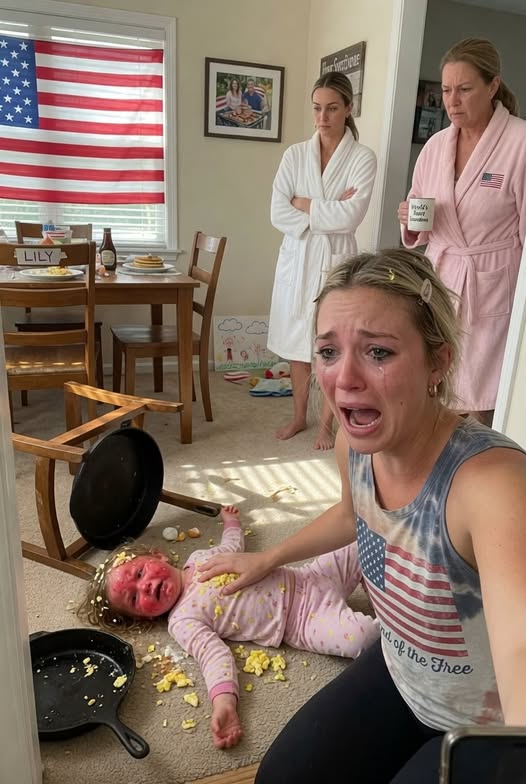
When we got to Vanessa, I said what I knew. I’d heard the crash. I saw the skillet beside Emma. I saw the eggs. I saw Vanessa with her arms folded.
I hadn’t seen her arm move. That was hard to say out loud. I worried the instant I gave somebody that sentence, it would become the only one they remembered.
Then I told Alvarez what I’d seen in the hospital room. I made myself slow down. I told her which wrist Vanessa had held. I told her where Bunny had been. I repeated what Vanessa had said to Emma, and Alvarez read the words back to me.
When we finished, she asked whether any of my family had contacted me since security walked them out.
I opened my phone.
My mother had sent five messages. My father had sent one. Vanessa had sent nothing.
The last one from my mother read, You saw how frightened Emma was. Imagine what it did to her to have all those people rush the room.
I stared at it for a few seconds and then handed the phone to Alvarez.
“This is how she talks,” I said. “She’ll say something that’s true. Emma was frightened. Then suddenly we’re talking about what I did when I walked in.”
Alvarez asked if she could preserve the messages. I said yes.
After she handed the phone back, I noticed my father’s message. He’d written, Come home for a minute. We’ve all had a terrible day.
Home was my rental across town, where Emma’s blue quilt was waiting on her bed. My parents still called their house home when they wanted me to come back and do something. I’d heard the word that way my whole life.
I put the phone face down.
Ben arrived just after ten with his work boots on and a paper airline tag attached to the zipper of his duffel. He looked in through the partly open door. For a second I saw him doing his best to recognize what he was looking at.
Then he set his bag down and came to Emma’s bed.
“Hey, Sprout,” he said.
His voice broke on the last word. He pulled a chair up anyway.
Emma was asleep. He asked if he could touch her hand. I told him she’d liked my finger resting on the sheet. He put his hand there. The two of us watched her little fingers for a while.
“Did she talk?” he asked.
“She asked for Bunny.”
“Where is he?”
I tipped my head toward the purple ear peeking out beside her arm.
Ben saw it and breathed out. Then he saw the pennies on the sill.
“Are those hers?”
I told him about paying for pancakes.
He sat back in the chair. His mouth opened once before anything came out.
“She was looking forward to it,” he said.
That was when he cried. He cried without making much sound, with one hand on the mattress where Emma could find it. I put my hand on his shoulder and thought about how many years we’d spent trading drop-off times and spare mittens and school forms. We knew how to be Emma’s parents in a dozen small ways. We were going to have to learn this one from the beginning.
I told him what had happened with Vanessa in the room. He listened all the way through. When I finished, he stood and paced once to the window and back.
“Did your mom see Vanessa go in?”
“I don’t know.”
“Did she know you’d said no visitors?”
“I don’t know that either.”
He nodded. Then he sat down.
“Okay,” he said. “We can start with what we know.”
I didn’t realize until he said it how badly I needed someone to let the things I knew be enough.
Around midnight, Emma stirred. I was standing up before I knew I’d moved. Her eye found me first, then Ben. He waved his fingers beside the mattress.
“Daddy,” she whispered.
“Yeah. I’m right here.”
She looked slowly past him, toward the door.
“Is she mad?”
For a second I thought Emma was asking if I was mad. I leaned closer.
“Who, honey?”
“Vanessa.”
Ben looked down at the floor. I could see his jaw moving.
I remembered all the times I’d answered that question for my family. Grandma was tired. Grandpa didn’t like noise in the morning. Aunt Vanessa had a lot on her mind. I’d thought I was teaching Emma to be kind about people’s feelings. In that room I heard what else I’d taught her to do. Look at who is angry. Work out what you did. Try to fix it.
“You were allowed to sit down and eat breakfast,” I said.
She blinked at me.
“Even there?”
“Even there.”
She thought about that. Then she pressed Bunny’s ear between her fingers and fell asleep again.
I stayed awake. Some of it was fear, and some of it was the simple fact that I could watch her breathe. At four in the morning, I moved my chair close enough for my knee to touch Ben’s. He was asleep with his chin against his chest. I pulled the spare blanket up over his arm.
The sky was getting pale by the time Detective Alvarez called again. I stepped out into the hall, close enough to see the foot of Emma’s bed.
She said Lily was with her father, Sam. Someone trained to talk to children would speak with her when she was ready. Alvarez couldn’t tell me what Lily had said or whether she’d said anything yet.
“Did she get Bunny from the sofa?” I asked.
“What do you mean?”
“Vanessa brought him. I keep thinking she’s the one who picked him up. Lily would know Emma needed him.”
Alvarez said she’d make a note of it.
I stayed in the hall after the call. Beyond the glass doors, I could see a custodian working his way along the far wall, carefully wiping the fingerprints off a window. The elevator chimed. I waited for my mother’s voice.
It was Leah, with her hair undone and the pencil finally gone. Her shift had ended. She was carrying her coat over one arm.
“Emma woke up and looked for you,” she said. “Ben told her you were just outside.”
I went back in. Emma looked at my face for a moment and seemed satisfied that I was really there. Then she pointed toward the window.
“Is that morning?”
“Yes.”
“Can we do this morning different?”
My throat tightened.
“What would you like to do?”
She thought about it for a little while.
“Can Bunny have my duck sock?”
I slipped the sock off her foot and pulled it over Bunny’s short purple arm. It was much too big for him. Emma rubbed her thumb over the duck.
“There,” she whispered. “He needed a mitten.”
Ben smiled. So did I. I pulled the blind up a little higher and sat down beside my daughter for the second morning.
FINAL PART — A CHAIR FOR EMMA
A few days later, Emma woke up asking what the hospital smelled like.
I’d stopped noticing it. I took a breath and said, “Soap?”
“Toast,” she said.
Sure enough, somebody down the hall had toast. It was the first time she’d seemed interested in food since we got there. I asked if she wanted some when she was allowed to eat.
“Can I pick the piece?”
“Of course.”
“The little square. With the edge.”
I wrote her request on the corner of the paper where Ben and I were keeping track of which nurse liked her coffee black and when Dr. Chen was likely to come through. Under three lines of things I hoped to remember about surgery, I wrote toast with the edge. All morning that was the thing I felt most capable of getting right.
Dr. Chen had talked to us about grafting the deepest area near Emma’s shoulder. I asked her to draw me a picture. She did, on the back of a hospital envelope, with two curved lines to show where the shoulder met the neck.
After she left, I looked at the drawing for a long time. Then I took out a piece of paper and drew the giraffe with his head in one quilt window and his body in another. Emma asked me to put a turtle underneath him. I thought I knew what a turtle looked like until a four-year-old watched me try to draw one.
“He has feet,” she said.
“He has four little feet right there.”
“Those are tables.”
I made the feet rounder. She accepted the second version. Ben stuck the drawing to the wall with a piece of tape a nurse gave him.
That afternoon Vanessa was arrested.
I learned about it from Detective Alvarez, who called before my family did. She said Vanessa had given a different account to investigators. Her first version was that Emma had climbed up and pulled the skillet down.
I pressed my phone hard against my ear.
“That’s what she came here to tell Emma,” I said.
“I have your statement,” Alvarez told me.
She said someone had spoken with Lily. She couldn’t give me the details over the phone.
When I got back to the room, Ben was making Bunny dance. He’d pushed his fingers up the duck sock and Bunny was waving it at Emma, singing a song about toast with the edge. Emma had the weary look children get when a parent’s joke has gone on about two lines too long.
“Daddy,” she said.
He stopped singing right away.
I sat down and put my phone deep into my bag.
My father left a voicemail that night. I listened to it the next morning in a corner of the cafeteria with a cooling cup of coffee in front of me.
“You need to talk to your mother,” he said. “She’s walking around the house with a dishrag in her hand. There must be some way to handle this without doing permanent damage.”
I listened to it again, just to be sure he’d used the word permanent. Above me the cafeteria television was showing a man put clean sheets on a bed in a commercial. He shook the top sheet out and it settled neatly on the mattress.
I deleted nothing. I sent the message to Alvarez and put the phone in my bag.
Then I sat there a little longer because I could. It was Ben’s turn to be with Emma, and I wanted five minutes to myself. Four minutes in, I missed her.
Vanessa’s explanation changed again. The prosecutor told me later that she acknowledged moving the skillet from the stove, but said it slipped when she turned. At the hospital, she said she’d gone to bring Bunny and help Emma remember the accident. She said I’d mistaken her concern for something else.
The sentence that stayed with me was the smallest one. Help Emma remember.
Emma did remember pieces. I found that out one evening when Ben put a plate of toast on the tray. The plate was white with a narrow blue rim. She looked at it and curled her toes under the blanket.
“Is that Lily’s?”
“It’s yours,” Ben told her.
“Did they make hers already?”
“We’re at Mercy, honey. This came from the kitchen downstairs.”
She watched him break one of the pieces down the middle. Then she took it and held it against her shirt.
“Can you give it to her?”
Ben looked at me.
“Give me what, sweetheart?” I asked.
She pressed the toast flatter against herself.
“My piece. She can have it.”
I sat down beside her. I wanted to tell her there would always be enough breakfast. I wanted to march into my parents’ house and put a plate of toast down in front of every single one of them. Both of those ideas could wait. Emma was still holding hot toast against her shirt because she thought somebody might need her to give it up.
“Would you like me to put it on the plate while you decide?” I asked.
She let me take it. A minute later she asked for it back, and ate it a corner at a time.
Sam called me the next day. He began by saying Lily was safe with him. She had sent something for Emma, and he was willing to drop it off with whoever I wanted.
“What is it?” I asked.
“A drawing. She’s made about twelve. This is the one she picked.”
I asked him to leave it with Jo.
There was a pause. I could hear water running in the background. When he spoke again, his voice was lower.
“Lily told me she put the rabbit by the door for you,” he said. “She thought you’d have to come back for it.”
I sat down on the windowsill.
“I wondered about that.”
“She asked me if Emma knows she can sit in her chair.”
Out in the hall, somebody laughed at a joke. The sound came and went. I looked over at Emma, asleep with Bunny up against her elbow, his mitten hanging off.
“Tell her Emma knows,” I said.
Sam made a small sound of acknowledgment. Before we hung up, he asked, “What do I say when she wants to see her mom?”
I couldn’t tell him. I said I was sorry Lily had to ask it.
“Yeah,” he said after a while. “Me too.”
The drawing came in a yellow envelope with four round stickers sealing the flap. Inside was a table with two chairs pulled up to it. Two stick figures sat side by side, each with a big brown circle on a plate. Over the left chair, in letters that crowded together at the end, Lily had written EMMA. Over the other, she’d written her own name.
I put it where Emma could see it when she wanted to. She looked at it for a long time.
“Lily always puts too much syrup,” she said.
“Does she?”
“She gets it on her elbows.”
Emma reached her good hand toward the paper. I brought it closer so she could touch the crooked line that made the back of her chair.
“Can this come home?”
“Yes.”
“Can the turtle come home too?”
“Yes.”
The turtle did. So did the drawing, the duck sock, and a plastic cup out of which Emma had drunk exactly two sips of apple juice. We brought home things we could have thrown away because she liked knowing where they were.
We also brought home a schedule thick with appointments and phone numbers, and a fear of the front door opening without warning. Jo took our doorbell batteries out after the delivery person rang it and Emma cried so hard she couldn’t tell us why. For a while, anyone coming over called from the porch.
Ben stayed in the spare room the first couple of weeks. He went home to pick up clothes and came back with the wrong charger for his laptop and every pair of pajamas Emma had ever left at his place. He set them out in a row on her bed.
She picked the blue ones with the moons. The shirt was too small. He found a way to let her wear the pants with a shirt she liked better, and she came down to breakfast looking pleased with herself.
On her first morning home, I stood in front of the stove and realized I’d taken the skillet out of habit. There was nothing on it. It was still cold. I slid it back in the cupboard and shut the door.
I turned around and saw Emma at the end of the hall. She was looking at the cupboard.
“Are we having eggs?”
“I was thinking about making some. What would you like?”
“Cereal.”
I took down two bowls and set them on the table. Emma stayed where she was.
“Where do I sit?” she asked.
“Wherever you want.”
She studied the table like it was a map. There was a chair on either side and one at each end. She pointed at the place I usually sat, by the window.
“Here?”
I pulled it out.
She walked over and put her fingertips on the seat. I thought she was checking whether it was warm. Then she pushed it out a little farther, until she could see the backyard from where she would be sitting. She climbed up slowly and waited for me to pass her the milk.
I sat down across from her with my own bowl. We looked out at a squirrel trying to carry something much too large across the fence.
“What’s he got?” she asked.
“I think it’s half a dinner roll.”
“Is he allowed to have it?”
“If he can get it over that fence, I’d say he’s earned it.”
She watched him drop it, scramble down, pick it back up, and try again. By the time she started eating, her cereal had gone soft. She ate it anyway.
My parents wanted to visit. They wanted it through texts, through calls, and through a cousin who said my mother was spending entire afternoons in Emma’s old room at their house. There was a little bed there with a rail my dad had made. It had taken him two Saturdays and a trip back to the hardware store for wood he liked better.
“Your father built that bed for her,” my mother said the one time I answered.
“I know.”
“Do you think he’d have done that if he thought she was a burden?”
She’d been standing in the doorway on the morning it happened. She’d heard him. Until that phone call, some part of me had believed I might have to convince her he’d said it.
“Ask him whether he’d say it again,” I told her.
“People say things they don’t mean when they’re in shock.”
“Did he ask how Emma is?”
My mother took a breath. I knew she could say yes, and I might never know whether it was true. The pause lasted long enough that I knew she was deciding.
“He asks about both of you,” she said.
My mother used to choose a different ribbon for every Christmas present. She remembered how I took my tea. She had sat with me through a long night when Emma was a baby and I was sure I’d never feel rested again. There were things I missed about her even while we were talking. That’s part of what made it so hard to hang up.
“Emma has an appointment this afternoon,” I said. “I have to get her ready.”
“Can I call her?”
“You can talk to me about how you’re going to acknowledge what happened. She isn’t ready to hear from you.”
“I’m her grandmother.”
I waited.
“That used to count for something,” she said.
“It did,” I answered, and ended the call.
I went into the bathroom and cried with the exhaust fan on. I stayed there until Emma knocked.
“I can hear the fan,” she said through the door. “Are you making it lonely in there?”
It was a sentence I’d said to her when she’d been in the bathtub too long, back when I could still get her out of the tub by making the shampoo bottle talk. I opened the door. She looked up at me.
“Did you cry?”
“Yes.”
“Do you need Bunny?”
“Maybe a hug.”
She leaned against my leg. I rested my hand lightly on her head and let myself have the hug.
There were months of recovery after that. Emma learned to reach up with her arm a little higher at a time. Some days she was proud of the extra inch. Some days she told the therapist she had done enough and wanted to go home. The therapist got good at finding things she wanted to reach for. Once she taped a picture of a tiny worm to the wall and asked Emma where it needed to go when winter came. Emma thought about it, peeled it off, and put it right back where it was.
“He’s already inside,” she said.
In therapy of a different kind, Emma played with a dollhouse. I stayed close when she wanted me, and in the waiting room when she didn’t. The first time she agreed to let me wait outside, I managed to read the same three lines of a magazine for half an hour.
On the way home she told me that the dollhouse family had a very good cat.
“What makes it a good cat?” I asked.
“It pushes everybody’s chair in after breakfast.”
I liked that cat. I liked that it had a job Emma could watch it finish.
The scars changed as Emma healed. There were mornings she wanted to look at them in the mirror and mornings she let me help with her hair and went straight to the kitchen. One day she wanted to know if her shoulder would always feel tight when she lifted her arm. We wrote the question down together for Dr. Chen. Emma insisted on putting a question mark on both sides so the doctor would see it from whichever direction she read.
Before her first trip back to the playground, she made me promise I’d bring the purple water bottle. I thought she’d want to talk about what people might say. She was mostly concerned somebody would get the good swing before she did.
A little boy by the slide asked what happened to her cheek. Emma touched it, looked at him, and said, “I got burned.” He asked whether it still hurt. She told him, “Sometimes,” then asked if she could go down the slide after him.
At home that evening, I cried while I was washing the purple water bottle. I’d done a lot of practicing in my head for that first question. Emma had answered it in five seconds and been halfway up the ladder by the time my heart caught up with me.
A few days after that, she came home upset because an older child had stared at her and whispered. She didn’t want to tell me what she thought the whisper meant. We sat on the back steps with our feet on the damp grass. After a while she asked if she could wear her hair a certain way tomorrow. I said yes. Then she asked me if I would still know it was her when she was a grown-up.
“I would know your voice from a different room,” I told her.
She leaned against me and thought for a minute.
“What if I use my cat voice?”
“Definitely then.”
She gave me one indignant meow. It was the first laugh either of us had managed since she’d come home.
I had a harder time with the grocery store. I’d turn a corner and catch a glimpse of an oatmeal-colored sweater, and my hands would get tight around the handle of the cart. For a while I ordered my groceries and picked them up in the parking lot. Then one evening I went in alone and bought a cucumber, a box of cereal, and a package of markers Emma hadn’t asked for. I carried the bag out to the car and realized my shoulders had dropped sometime between the checkout and the door.
Nobody at home could tell what it had cost me to buy those three things. I liked being able to put something ordinary on the counter and say, “Look what was on sale.”
Eventually I met with the prosecutor. She had a little dish of peppermints on her desk. I took one and held it in my hand until the wrapper got damp.
She told me Lily had described her mother telling Emma to get out of her chair. According to Lily, Emma had been sliding down when Vanessa turned from the stove with the skillet and threw it. Lily had talked about the eggs too. One piece had landed on her bare foot. She’d been afraid to brush it off because she didn’t know if she was allowed to move.
I asked if she’d been hurt.
“The account I have says she didn’t have a lasting injury to her foot.”
I thought about that wording for a while.
Then the prosecutor showed me enough of the evidence to understand the sequence after I’d left for the hospital. My parents had cleaned up the breakfast. My father had put the skillet in the sink. My mother had called Sam to pick up Lily and told him Emma had had a mishap in the kitchen. A photo one of the responding officers took showed the chairs pushed back into place. From the doorway, in a quick glance, you could have thought the family had finished breakfast and gone out for the day.
For weeks I’d been carrying a picture of that room frozen at the instant I came down the stairs. It hadn’t occurred to me to imagine my mother pulling a chair away from the table so she could wipe up the eggs under it. I knew precisely which cupboard she kept her cleaning cloths in.
“What happens to them?” I asked.
The prosecutor talked me through what she could prove about each person’s actions and what her office intended to pursue. The case moving forward was against Vanessa. I left with a date and a list of people to call if it changed.
Outside, I sat on a bench and unwrapped the peppermint. I’d wanted somebody official to hand me a piece of paper that described what all three of them had done to my daughter. There would be paperwork about Vanessa. I was going to have to make decisions about my parents on the strength of what I saw and heard myself.
The day before the first court date, my father called. He asked me to meet him at the coffee shop by the hardware store. I agreed to twenty minutes. I told Ben where I was going, then picked a table near the front window because I wanted to be able to see the street.
My father got there early. He had two coffees. He pushed one across the table to me.
“Two sugars,” he said.
I drank it black now. I’d been drinking it black for seven years. When we went places together, I generally drank whatever he handed me.
“What did you want to say?” I asked.
He looked at his cup and rotated it until the seam was facing him.
“Your sister made a terrible mistake.”
“What did you come to tell me about yourself?”
The question caught him. He moved his cup back the other way.
“I didn’t know what to do with what I was looking at.”
“You had a phone in your pocket.”
“I know.”
“You could have called for help.”
“I know that.”
I could see the line where his glasses rested above his ears. He’d gone gray in the last few years, first in his beard, then all the way up to his temples. I wanted him to say it himself, even though I understood by then he might make me do it.
“You said some children ruin peaceful mornings,” I said.
He dropped his eyes.
“I said something ugly.”
“Yes.”
“I was thinking about how I was going to get through the rest of that day.”
I let that sit there. He was finally telling me something I believed.
Then he asked if he could see Emma. I said no. He asked if he could send her a birthday present. Her birthday was months away.
“You can write her a letter and give it to me,” I said. “I’ll keep it. When she’s older, she can decide if she wants it.”
He was breathing harder through his nose, the way he did when he had another argument ready and was weighing whether to use it. He pulled a folded sheet of paper out of his jacket.
“I wrote something for the prosecutor,” he said.
He laid it flat on the table between us.
The first line said Vanessa was a devoted mother and aunt. The second said our family had experienced a terrible accident. I read those two lines and slid the sheet back toward him.
“Did you write anything about what you saw when you walked in?” I asked.
His hand came down on the edge of the page.
“They asked us to write about her character.”
“They’ll read what you send them.”
He put it back in his jacket. We sat there without talking for another couple of minutes. Finally he pushed my cup closer to me. I left it on the table when I went out.
Vanessa took a plea months later. It covered the assault and what she did at the hospital. The prosecutor called to tell me before the hearing became public. I asked what Vanessa had agreed to admit in court.
“That she threw the skillet,” she said.
For months I’d been asking what happened to every other person in that kitchen before I got there. On the phone, standing at my own kitchen sink, I heard the sentence I’d known the instant I saw Vanessa’s face above my daughter. I let the water run over my hand until it went from warm to cold.
When it was time for sentencing, I wrote a statement. The first draft was eight pages. I kept going past the things I could say without shaking. By the end I was writing about how long it had taken Emma to let anybody brush her hair near her neck, and about the first time she’d asked me to carry a breakfast plate to the table so she could choose where it went.
I crossed out the line I’d put at the top about how Vanessa destroyed Emma’s life. Every day I watched Emma do things she loved. That was her life too, and Vanessa had no claim on it.
In court, Vanessa wore a navy sweater. Her braid was gone. When I started to speak, she was looking down at the table.
I said that Emma had been four years old and wanted breakfast. I said she had spent the weeks after the hospital learning all the things she was still allowed to do. Sit at the table. Ask for toast. Leave some for later. Get up when she was done.
I said that when Vanessa came into the hospital, Emma heard her tell her to say she’d fallen. I looked up when I got to that part. Vanessa was looking at me by then.
“She had just opened her eye,” I said. “She’d been unconscious when I brought her in. You were the person she saw when she could see again.”
My hands shook so much the paper fluttered against the wood. I put it down and rested my palms on either side. I waited until I could get the next words out.
“She trusted you enough to be afraid she’d disappointed you. You knew that. I saw you use it.”
When I finished, I sat beside Ben. He moved his arm so ours touched. My parents were across the aisle. My mother was holding the strap of her handbag very tightly, exactly as she’d held it at every school assembly when she was waiting for one of us to come onstage.
Vanessa spoke before the judge sentenced her. She said she was sorry for hurting Emma. She said she was sorry for going into the room and for what she told her. Then she said she knew Lily had suffered too. Her voice caught on Lily’s name.
I believed that she missed her daughter. I’d spent months waiting to be certain I hated everything about my sister. Sitting in that courtroom, I heard my sister’s voice, and some part of me still wanted to know who would sit with her afterward. I let the feeling pass through me. My hands stayed in my lap.
The judge imposed a prison sentence and a no-contact order protecting Emma. There were conditions and dates, all of which were handed to us on paper. I tucked the pages into the folder Ben had brought.
The only other thing in the folder was a list Emma had made that morning of four things she wanted to look for on the walk home from Jo’s house. A bird, a red leaf, a dog that was either big or little, and a white rock.
We folded the court papers around her list and went outside.
My mother caught up to me by the steps.
“I don’t know what you want me to say,” she said.
I stopped. Ben went a few steps farther and waited.
“There was a time when I wanted you to say you were sorry you told me to stop screaming,” I said.
Her mouth moved, but she waited.
“I wanted you to ask me what it was like to see her like that. And I wanted you to listen without telling me why I should understand what you did.”
“I was scared,” she said.
“I believe you.”
She looked at me then. We stood there for a few seconds in the wind. It lifted one corner of the scarf she’d tucked into her coat.
She said, “I’m sorry I told you to stop screaming.”
For a minute I could see her in the doorway in her bathrobe. I heard the sentence in her voice. I’d been carrying it so long that when she said she was sorry, I felt a small loosening in my chest.
“Thank you for saying that,” I said.
She asked if I would bring Emma by after Christmas.
I told her I was willing to keep talking with her myself. I told her Emma would have a say in whether she saw her again, and that for now I was keeping the visits between adults.
My mother looked back at my father at the doors. I watched her discover that she’d have to walk back to him with my answer. It was the kind of moment when I would once have said something quick to make things easier for her. I waited with her instead.
Finally she said, “All right.”
Then Ben and I went to pick up Emma. She’d found a white rock in Jo’s driveway and carried it around in her coat pocket, making a little bulge at her hip. As soon as she saw me, she asked whether we could go the long way home because there was a dog behind a fence she wanted me to meet.
The dog turned out to be behind a hedge, with only its tail visible. We stood there watching the tail go back and forth until Emma said, very seriously, “Put it down as medium.”
Almost a year after the morning at my parents’ house, Emma asked if Lily could come over.
We were putting crayons into a shoebox. The drawing from the hospital had been on Emma’s wall at home the whole time. Two of the corners were curling inward. I asked what made her think of having Lily over that day.
“I just want to know if we can still play,” she said.
I told her I’d talk to Sam. I asked what she wanted to play if they did come.
She pulled out a purple crayon and turned it in her fingers.
“I don’t know. We usually make it up.”
Sam and I arranged to meet in the park first. Emma knew she could leave whenever she felt ready. I expected an awkward hello, maybe some hiding behind legs. Instead, Lily came across the grass carrying a plastic horse, and Emma called out that she knew where the horse could have a stable.
They went to the little hollow under the climbing frame and spent twenty minutes arguing about whether horses eat sticks.
When we were leaving, Lily pulled a paper bag out of her dad’s backpack. There were four crayons inside, wrapped in a ribbon. She had been saving the colors she thought Emma would like.
“I gave you the good yellow,” she said.
Emma examined it.
“This is the good yellow,” she agreed.
A few weeks later, Emma asked if Lily could come to the house for breakfast. We put the question to Lily too. She wanted to come, and Sam said he’d stay.
I took out a mixing bowl early that morning and stood at the counter for a minute, looking at the bag of flour.
Emma came in wearing her moon pajama pants. The cuffs were halfway up her shins, and she still insisted they fit. She climbed onto the step stool and peered into the bowl.
“Are we doing pancakes?”
“If you want them.”
She thought about it.
“Can I do the stirring?”
I handed her the spoon.
I used a small griddle. The first pancake spread into the rough shape of a shoe. Emma turned her head sideways to look at it.
“That one can be yours,” she said.
“Thanks.”
“I’ll make you a better one after.”
When Lily came in, the girls circled the table. Lily paused by the window chair. I saw her look at Emma, and for a second I could tell neither knew what to do with her hands.
“I like where you can see the squirrel,” Emma said.
“Can we move this one over?” Lily asked.
The two of them dragged the second chair around the table until it was next to the first one. The legs scraped loudly across the floor, and then it was quiet. Emma climbed up into her seat. Lily climbed up beside her.
I set down the pancakes. Emma cut into hers and pushed a piece toward Lily’s plate.
“The middle’s good,” she said.
Lily pushed a piece back.
“I know.”
Sam poured coffee. I made him look out the window at the exact place on the fence where the squirrel had tried to carry the dinner roll. He listened with a straight face while I explained the route the squirrel should have taken.
I glanced over at the girls again. Lily had syrup on her elbow. Emma took a napkin, touched it to the sticky spot, and waited while Lily turned her arm over to see whether there was more. Then they leaned toward the window together. There was actually a squirrel out there now, up on the fence, and neither wanted to stand up and scare it.
After breakfast, I carried the plates to the sink. Emma went down the hall and came back with Bunny under her arm. He still had the yellow sock on.
Something clicked against the table.
She’d put down the dark penny from the hospital windowsill. I kept both of them in a little dish by her bed. She uncurled her other hand and set the bright one beside it.
“Are you paying for breakfast?” I asked.
She shook her head.
“One for me and one for Lily. We’re gonna make wishes.”
Lily came over from the window and studied them.
“I like that one,” she said, pointing to the darker penny.
“Okay,” Emma said. She slid it over with one finger.
The girls took the pennies outside. I could hear them standing on the back steps, trying to decide whether to tell each other their wishes. I dried my hands and went out to join them. Emma moved Bunny over on the step and patted the space beside her, so I sat where she’d made room.