The cake had arrived at my apartment wrapped with a red ribbon, tucked beside a handwritten card, and carrying the kind of polished, graceful sweetness I had never once received from my mother-in-law in all the years I had known her.
That was exactly why, even before I lifted the lid of the box, even before I saw what was inside, something inside me tightened and whispered that this gift did not feel like a gift at all.
It was not because the cake looked cheap or careless. It was the complete opposite. It was clearly expensive, ordered from a luxury bakery in Manhattan, with a flawless mousse surface, thin dehydrated orange slices placed like decoration on fine china, and a glossy glaze so smooth it looked staged for a magazine photoshoot instead of sent to a daughter-in-law she barely tolerated.
The strange part, the part that made my fingers pause against the ribbon, was that it had come from Sophia.
My mother-in-law had never handed me anything — not a compliment, not a holiday present, not even a smile — without hiding some tiny, poisoned thorn beneath it.
To outsiders, Mrs. Sophia Velasco was elegance itself: a refined, educated woman with a gentle voice, polished manners, and a string of pearls resting neatly against her throat. To me, she was the same woman who would smile warmly at me in a room full of guests, then wait until no one else was listening to remind me, in that soft cruel tone of hers, that I had never been “up to the standard” required for her son.
“Andrew deserved a different class of woman,” she had told me more than once, each word delivered like she was correcting a stain on the family name. “A woman with a proper last name, a real family, an elite education.”
I always kept quiet, swallowing the humiliation until it burned at the back of my throat.
Not because I had nothing to say, not because her words did not wound me, but because I had learned very quickly that inside that family, every syllable I spoke could be twisted, polished, and later used as evidence against me.
That afternoon, Andrew was in Boston for business, far away from the tension that lived inside our home. I was completely alone in our Upper East Side apartment when the delivery driver appeared, holding the box like it was something precious. The card attached to it read:
“For my daughter-in-law and my son, to brighten your day. With love, Mom.”
I recognized Sophia’s handwriting immediately — the elegant slant, the careful loops, the kind of handwriting that looked affectionate only if you did not know the woman behind it.
I stood there staring at that card as if someone had placed one wrong object in the middle of an otherwise perfectly arranged room and expected me not to notice.
Andrew and I were following a strict diet at the time. No sugar. No carbs. Throwing the cake away would have felt insulting and dangerous in a family where every small action became gossip. Eating it, however, felt strangely foolish, almost like walking knowingly into a trap.
Then I remembered that Lucy’s birthday had been the day before.
Lucy, my sister-in-law, was spoiled, dramatic, capricious, and often openly cruel to me, but she adored desserts with the devotion of a child. Besides, I had been so busy that I had not bought her a birthday gift yet, and the cake suddenly looked like an easy solution to several problems at once.
So I did the most logical thing I could think of in that moment.
I sent the entire cake, untouched and still perfect in its expensive box, to Lucy’s apartment in Brooklyn with a simple note that felt polite, harmless, and even generous:
“Carmen wishes you a happy birthday. Your mother’s cake is delicious. Please eat it for me.”
After that, I closed my apartment door, leaned against it for a second, and took the first peaceful breath I had taken all afternoon, thinking that, for once, I had managed to avoid one of Sophia’s invisible family traps.
I had no idea that what I had really done was open the door to something much darker, much colder, and far more unforgivable than another Velasco family argument.
The next morning, while I was preparing boiled eggs and avocado in the quiet kitchen, my phone began vibrating nonstop against the counter, buzzing so violently it made the knife beside my plate tremble.
It was a FaceTime call from Sophia.
I frowned before answering. My mother-in-law never video-called me at that hour. In fact, she almost never contacted me directly when Andrew was away. She usually texted him, spoke through him, and treated me like a temporary guest in my own marriage.
I answered.
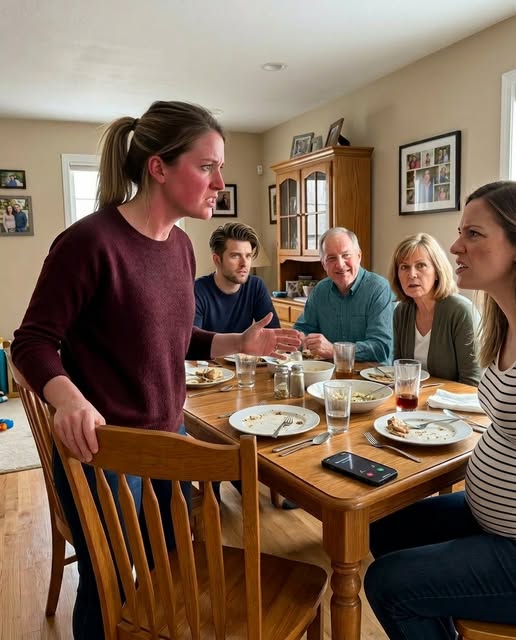
Her face appeared on the screen perfectly arranged, as always — her makeup flawless, her hair pulled back with controlled precision, her signature pearls glowing at her neck. But there was something wrong in her eyes, something sharp and watchful. They did not look like the eyes of a woman making casual conversation. They looked like the eyes of someone waiting for a specific answer.
“Carmen, honey… are you two up yet?”
“Good morning, Mom,” I said carefully, still holding the knife in one hand. “Andrew gets back tonight.”
Her smile came too fast, so fast it looked pasted onto her face.
“What a shame,” she said, her voice dripping with practiced warmth. “I wanted to know if you had tried the cake yet. I ordered it specially. It was expensive, artisanal, very rich.”
My whole body went still, the knife frozen halfway above the cutting board.
Why did she care so much whether I had eaten the cake?
“We didn’t try it,” I replied slowly. “We’re still on that diet from the doctor. I felt bad throwing it out, so I sent it over to Lucy for her birthday.”
The silence that followed was not ordinary silence.
It was sudden and cold, so complete that it felt as if the person on the other side of the screen had stopped breathing in the middle of the room.
Sophia’s smile disappeared.
Her face lost every trace of color.
“What did you say?” she whispered.
“That I sent it to Lucy,” I said, my own voice growing smaller without knowing why.
Her eyes widened in a way I had never seen before, not with irritation, not with the disgust she usually saved for me, but with raw, naked terror.
“Who did you give it to, Carmen?”
“To Lucy, Mom,” I said, my pulse beginning to pound. “The delivery tracker confirmed it was dropped off last night.”
Then Sophia screamed.
It was not the sharp scream of an angry mother-in-law who had lost control. It was the broken, animal sound of pure panic, the kind that strips all manners, all pride, all lies away in a single breath.
“My God, it can’t be eaten! You’ve killed my daughter!”
I froze so completely that even the kitchen seemed to go silent around me.
Before I could form a single word, Sophia began moving frantically, the phone shaking as she crashed into something off-camera, her pearls flashing across the screen like white beads of terror.
“Call her! Tell her not to eat it! Lucy, my baby girl!”
My hands went cold around the phone.
“Sophia — what’s in the cake?”
She didn’t answer. She was already off-screen, shouting for someone else in the house, her voice tearing into fragments I could barely follow. I didn’t wait to hear more. I hung up and called Lucy myself, my fingers shaking so hard I misdialed twice before the line connected.
It rang four times before she picked up, groggy, annoyed at being woken.
“Lucy — did you eat the cake? The one I sent you?”
“What? No, I was going to have it with coffee this afternoon, why—”
“Don’t touch it. Don’t let anyone touch it. I’m calling 911 and I’m coming to you right now.”
I don’t fully remember getting dressed. I remember the elevator ride down feeling endless, the cab ride to Brooklyn a blur of red lights and my own pulse in my ears, and the two police cars already parked outside Lucy’s building by the time I arrived, having been dispatched after Sophia’s own panicked call minutes before mine.
Lucy was standing in her doorway in pajamas, confused and irritated, the untouched cake box still sitting on her kitchen counter exactly where the delivery service had left it, its red ribbon still perfectly tied.
An officer was already photographing it when I walked in.
“Ma’am,” he said, “we’re going to need to send this box to the lab. Don’t eat, touch, or move it further.”
“Can someone please tell me what’s happening?” Lucy said, her voice climbing toward panic of her own now.
I didn’t have an answer for her. I didn’t have one for myself either.
Sophia arrived twenty minutes later, without her makeup, without her pearls, looking a decade older than the polished woman who’d appeared on my FaceTime screen that morning. She didn’t look at me. She went straight to Lucy and grabbed both of her arms, checking her face, her eyes, her hands, the way you’d check a child for injury after a fall.
“You didn’t eat it,” she said, half question, half prayer. “Tell me you didn’t eat it.”
“Mom, what is going on?” Lucy demanded. “Why does everyone think I ate a cake?”
Sophia sank into a kitchen chair like her legs had simply stopped working.
An officer stepped between them gently. “Ma’am, we’re going to need you to explain what you believe may be in that cake, and why.”
Sophia’s hands covered her face. When she finally spoke, her voice had none of its usual polish left in it.
“The bakery,” she said. “I found out two days ago they’d had a recall — a supplier contamination issue with one of their mousse bases. I called to cancel my order the morning after I sent it, but it had already shipped, and I couldn’t reach Carmen in time, and I panicked, and I—” she stopped, swallowing hard. “I should have called immediately. I should have told you the truth instead of asking whether you’d ‘tasted it’ like some kind of test.”
I stared at her. “You knew it might be contaminated, and instead of warning me, you called to check if I’d already eaten it?”
“I didn’t want Andrew to think I’d sent his wife something dangerous,” she said quietly. “I thought if I could just confirm you hadn’t eaten it yet, I could quietly have it replaced before anyone found out I’d made the mistake in the first place.”
The lab results came back two days later. The recall was real — a documented bacterial contamination affecting a batch of mousse base from the bakery’s supplier, serious enough that the health department had already issued its own public notice by the time our results confirmed it. Had either Lucy or I eaten a full slice, doctors told us afterward, it likely would have meant a hospital stay, not a fatality — but Sophia’s scream that morning hadn’t been about etiquette or appearances at all. It had been about genuine fear for her daughter’s health, tangled up so badly with decades of image management that she’d nearly let pride cost Lucy her safety.
Six months later, Sophia and I still don’t have an easy relationship — decades of quiet cruelty don’t dissolve because of one frightening morning. But something shifted permanently that day. She apologized to me directly for the first time in the eleven years I’d known her, not for the cake, but for the years before it — for never once treating me like I belonged in the family whose name I now carried.
I don’t know if I fully believe the apology yet. I know I believe the fear I saw on her face that morning was real.
Sometimes that’s the only crack a wall like hers ever gives you. I’ve decided, for now, that it’s enough to work with.
Click Here to continues Read Full Ending Story👉 Part 2: My Mother-in-Law Sent a Cake While My Husband Was Away, Then Called Asking If I’d Tasted It — When I Said I’d Given It to My Sister-in-Law Instead, She Screamed “You’ve Killed My Daughter” and the Police Showed Up That Same Night