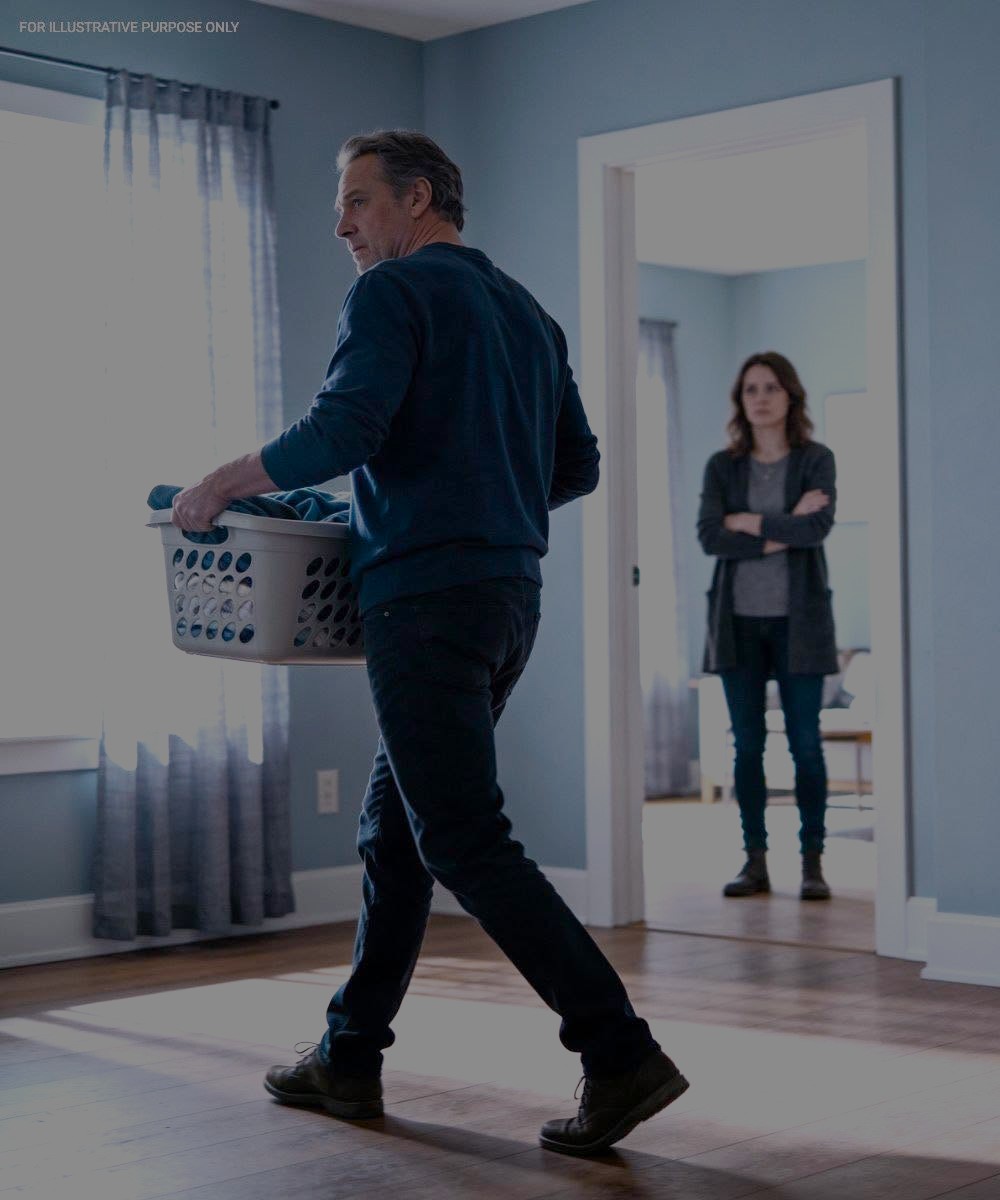
The quartz countertop felt like an ice block under my palms.
Grey light from the kitchen window caught the chrome edges of our double oven.
Daniel sat opposite me, tapping his heavy gold signet ring against a ceramic mug.
The sound was rhythmic, steady, and sharp.
“It is very simple, Emma,” he said.
He did not look at me when he spoke.
Instead, he stared at his legal pad, where he had written two columns of figures.
“We can do this quickly, or we can let the lawyers drag it out,” he said.
I pulled my cardigan tighter around my shoulders.
The heating was on, but the house always felt cold lately.
“What are you proposing, Daniel?” I asked.
My voice was quieter than I wanted it to be.
He finally looked up, his blue eyes flat and dry.
“I keep the house,” he said.
He tapped the top sheet of paper.
“I keep the equity, the investment accounts, and both vehicles,” he added.
I stared at him, trying to find a trace of the man I had married ten years ago.
There was nothing but calculated indifference on his face.
“And the savings?” I asked.
“The savings stay with me to cover the maintenance on the property,” he said.
He did not blink.
He adjusted the collar of his tailored grey shirt.
“You will need to vacate the premises by the end of next month,” he said.
“And where am I supposed to go?” I asked.
“That is for you to figure out,” he said.
He reached for his coffee, took a small sip, and set the mug down without making a sound.
“You get the custody,” he said.
He leaned back in his leather stool.
“You get the boy, 100 percent of the time,” he said.
His words hung in the quiet room.
The grandfather clock in the hallway ticked, filling the silence between us.
“The boy,” I repeated.
I looked down at my hands, my knuckles white.
“You mean our son, Ethan,” I said.
Daniel shrugged his shoulders slightly.
“You can have him,” he said.
He picked up his pen and drew a neat line through a row of numbers.
“I will not contest physical custody at all,” he said.
“You can take his clothes, his bed, and his toys,” he added.
He spoke as if he were cataloging old furniture that he wanted to clear out of the basement.
My heart hammered against my ribs, but I kept my face still.
I had spent years learning how to hide my reactions from him.
“He has school here,” I said.
“He needs his routine, Daniel.”
“He needs his therapists.”
Daniel waved his hand, dismissing my words.
“You can find new ones wherever you decide to rent,” he said.
“That is your responsibility now.”
He slid the legal pad across the white quartz.
The paper stopped inches from my hands.
“Sign the preliminary agreement,” he said.
“I will have my lawyer draft the formal petition tomorrow.”
I looked at the neat, block letters of his handwriting.
He had listed the house, the Mercedes, the Audi, the retirement portfolios.
Everything we had built together was on his side of the ledger.
On my side, there was only one word.
Dependents.
He had not even written Ethan’s name there.
Just a single category to be crossed off his personal balance sheet.
“You are taking everything,” I said.
“I am taking what is mine,” he replied.
“I earned the money for this lifestyle, Emma.”
“You stayed home.”
“This is a fair trade.”
He leaned forward, placing his forearms on the cold stone.
“You wanted a divorce,” he said.
“This is the price.”
I heard a soft footstep on the stairs in the hallway.
My breath caught in my throat.
I turned my head toward the kitchen doorway.
A small shadow fell across the hardwood floor.
Ethan stood there, clutching his worn stuffed dog by one ear.
His pajama pants were slightly too short, showing his bare ankles.
He blinked against the bright kitchen lights, his eyes wide and anxious.
“Mommy?” he whispered.
“I heard talking.”
Daniel did not turn around to look at him.
He kept his eyes fixed on me, his expression tightening with irritation.
“Go back to bed,” Daniel said, his voice loud and sharp.
Ethan flinched and took a step backward into the shadows of the hallway.
He looked at me, his lip trembling.
“Emma, tell him to go upstairs,” Daniel muttered, his hand twitching near his pen.
“We are trying to finish this.”
I stood up from my stool, the metal legs scraping loudly against the tile floor.
I walked toward my son, my knees shaking, but my mind suddenly clearing.
I looked back at Daniel, who was already looking down at his phone.
He was completely checked out.
He had no idea what he had just agreed to give away.
He thought he had won.
I reached Ethan and knelt down, wrapping my arms around his small, warm shoulders.
“Go back up, sweetie,” I whispered in his ear.
“I will be there in just one minute.”
Ethan nodded, turned, and climbed the stairs.
I stood up and walked back to the kitchen island, where Daniel was waiting with the pen.
I looked at the document, then looked him in the eye.
“I need twenty-four hours,” I said.
Daniel scoffed, tapping his fingers.
“There is nothing to think about, Emma.”
“You sign now, or I make this very difficult for you.”
He leaned in closer.
“I can tie you up in court for years until you have absolutely nothing left,” he said.
“No house, no money, and no help.”
I reached out and slowly touched the edge of the paper.
My hand was steady now.
“Twenty-four hours,” I repeated.
“Then I will give you my answer.”
Daniel stared at me, his eyes narrowing into thin slits.
He let out a short, sharp breath that smelled faintly of the black coffee he had been drinking all evening.
“Twenty-four hours is a waste of my time, Emma,” he said.
He tapped the cap of the heavy silver pen against the granite countertop.
The rhythmic clicking sound echoed in the quiet, drafty kitchen.
“You already know what the outcome will be,” he added.
I kept my hands flat on the cool stone, refusing to look down at the papers again.
“I need a day, Daniel,” I said.
“To think about what?” he asked, his voice flat and hard.
He gestured toward the dark stairs where Ethan had just disappeared.
“To think about how you will support the kid on your own?”
I watched his mouth close tightly after he spoke.
He had not used Ethan’s name once during this entire conversation.
In fact, he had barely used it over the last six months.
To Daniel, calling our son by his name was a vulnerability.
He believed that showing any personal connection, especially in a legal negotiation, was a sign of weakness.
He treated his own child like a line item on a corporate balance sheet.
“His name is Ethan,” I said, my voice barely above a whisper.
Daniel waved his hand as if brushing away a persistent fly.
“Whatever,” he said.
“The point is, the arrangement is set.”
He leaned back against the kitchen island, crossing his arms over his chest.
“I take the house, the investments, and the liquid accounts,” he said.
“You get full physical custody and the small savings account.”
He looked at me with a cold, superior smile that did not reach his eyes.
“You want the sole responsibility of the boy, you get the financial reality that comes with it,” he said.
There it was again.
The boy.
The child.
Never Ethan.
He viewed our son’s mild learning challenges as a personal defect, a bad investment he was happy to write off.
He wanted the pristine assets, the things he could show off to his business partners.
“I am not signing tonight,” I said, keeping my tone as even as possible.
Daniel picked up his phone from the counter and slid it into his pocket.
He picked up the silver pen and tucked it into his breast pocket.
“Fine,” he said, turning toward the hallway.
“Twenty-four hours.”
“If these papers are not signed by tomorrow evening, my lawyer files the contested motion.”
“You will lose the savings account too,” he said over his shoulder.
The heavy oak front door clicked shut behind him a moment later.
The silence in the house was sudden and heavy.
Outside, a cold autumn wind rattled the bare oak branches against the kitchen window.
I stood there for a long time, listening to the hum of the refrigerator.
My heart was still beating fast, but the panic had completely vanished.
I knew exactly what I had to do.
I walked over to the kitchen wall phone and dialed the direct number for my attorney.
Margaret Collins answered on the second ring, her voice crisp despite the late hour.
“Emma,” she said. “Has he presented the final draft?”
“He did,” I said. “He just left.”
“Did you sign anything?” she asked quickly.
“No,” I said. “I told him I needed twenty-four hours.”
“Good,” Margaret said, and I could hear her typing on a keyboard in the background.
“Bring the draft to my office tomorrow morning at nine.”
“We will go over his demands and draft our counter-proposal.”
I looked up at the stairs, thinking of Ethan asleep in his room.
“I don’t want to counter-propose, Margaret,” I said.
There was a brief pause on the other end of the line.
“What do you mean?” she asked.
“We have to fight for your share of the marital estate.”
“You are entitled to half of the house and his retirement accounts.”
I gripped the plastic receiver tightly.
“I will see you at nine, Margaret,” I said, and hung up.
I did not sleep that night.
I sat in the armchair in Ethan’s room, watching his quiet, rhythmic breathing.
He looked so small under his heavy blue blanket.
At eight years old, he did not understand the storm that was swirling around him.
He only knew that his father did not look him in the eye anymore.
When the sun finally rose, casting a pale gray light across the wet suburban street, I got dressed.
I wore a plain dark suit, the one I used to wear to parent-teacher conferences.
I drove through the light morning rain to the downtown office complex.
The glass doors of the building were cold to the touch.
I took the elevator to the fourth floor and walked into the reception area of Collins and Associates.
The smell of old paper and fresh coffee filled the warm air.
Margaret’s assistant nodded to me and pointed toward the corner office.
“She is waiting for you, Emma,” the assistant said.
I walked down the narrow carpeted hallway, the draft of Daniel’s agreement clutched in my hand.
Margaret was sitting behind her large mahogany desk, surrounded by tall stacks of legal folders.
She looked up, her sharp gray eyes scanning my face.
“Sit down, Emma,” she said, gesturing to the leather chair opposite her.
She took off her reading glasses and laid them on the desk.
“Let me see what he brought you.”
I handed her the stapled papers.
She flipped through the pages quickly, her face hardening with every second that passed.
“This is insulting,” Margaret said, her voice rising slightly.
“He wants the house, the mountain property, both vehicles, and ninety percent of the liquid assets.”
She slammed the document down onto her desk.
“He is leaving you with almost nothing, Emma.”
“We can easily get a judge to throw this out.”
I looked at the brass nameplate on her desk, then looked directly at her.
“I am going to sign it,” I said.