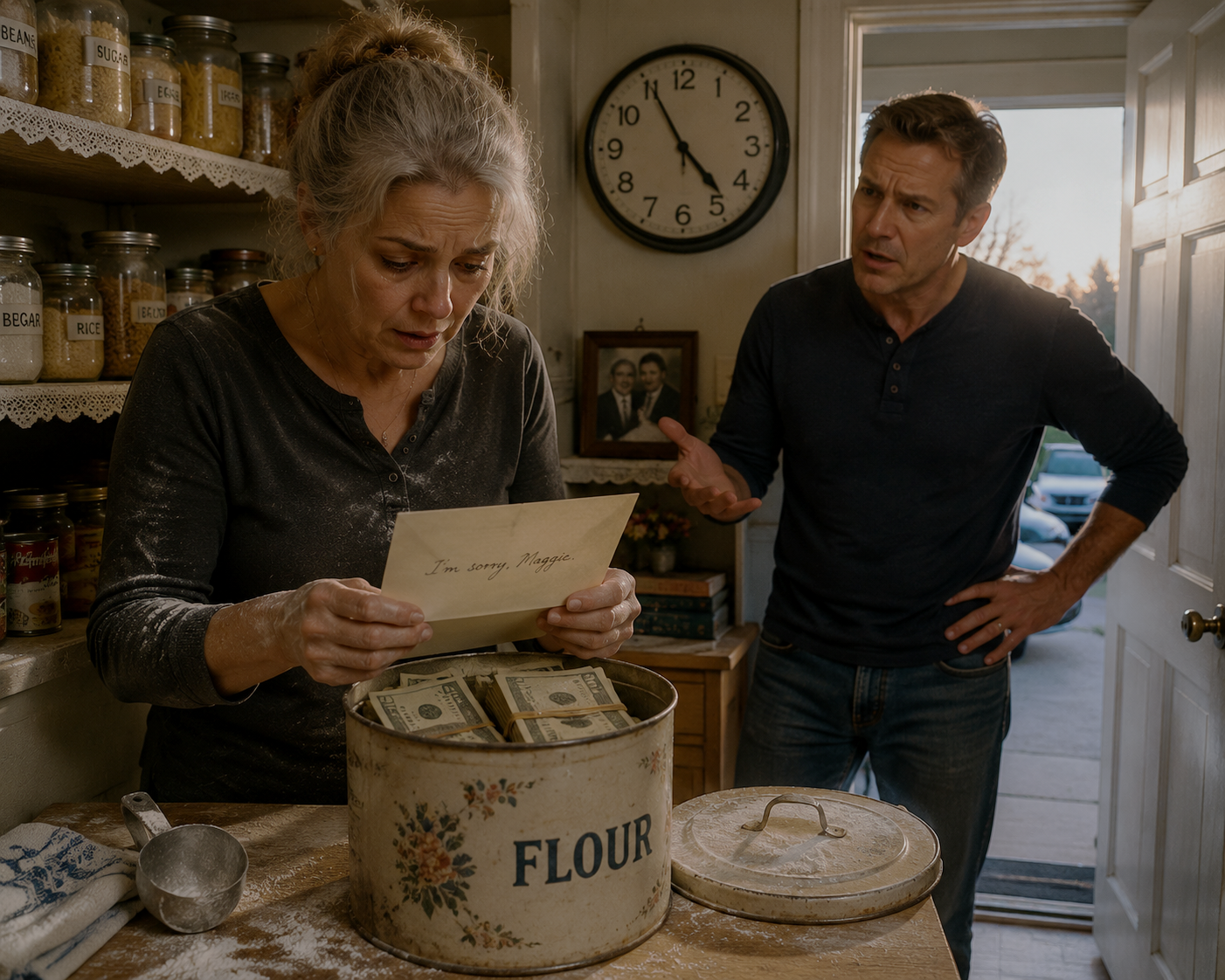
I cleaned out Mom’s pantry after her funeral and found $18,940 inside the flour tin she had forbidden us to touch for more than 60 years. Beneath the rubber-banded bills was an envelope with my name on it. The first line read: I’m sorry, Maggie. My brother glanced at the money and said, “Probably grocery cash she forgot about.” But the next sentence mentioned our stepfather, and by 4:55 that afternoon, I was driving to the bank with flour on my sleeves and my brother following close behind.
I was 78 when Mom died.
She was 96 and still living in the little brick house where my brother, Warren, and I had grown up. Arthur Vance, the man she married when I was 8, had died 6 years earlier.
Warren and I kept our biological father’s last name, Hayes. Arthur never adopted us, although he insisted we call him Dad whenever other people were listening.
Mom’s pantry was barely larger than a coat closet, but she organized it like a storm shelter.
Canned vegetables stood in rows according to expiration date. Sugar went in a glass jar with a red lid. Coffee filters stayed inside the same mustard-yellow container she had owned since 1993.
And the flour tin sat alone on the highest shelf.
It was white enamel with faded blue flowers and chips around the rim. I never once saw Mom use the flour inside it.
We were not allowed to touch it.
When I was 12, I dragged a chair into the pantry because I wanted to make biscuits. The moment my fingers closed around the tin, Mom slapped my hand away so sharply that I nearly fell.
I cried.
Mom cried harder.
Later, she made me cocoa and held my hand between both of hers.
“I’m sorry, Mags,” she whispered.
“Why can’t I use the flour?”
She looked toward the pantry.
“Because some things aren’t ready to be opened.”
At 12, I assumed it was another one of Mom’s peculiar rules.
She had plenty of them.
Never leave shoes upside down. Never throw away a button. Never lend money you cannot afford to lose. And never touch the flour tin.
After the funeral, Warren wanted the house emptied in 2 days.
He kept reminding me that he needed to return to Atlanta. He had a camper payment due, a bad back, and a wife who apparently could not survive another weekend without him.
I took the kitchen because nobody else wanted to examine decades of expired soup and mismatched plastic lids. Warren claimed the garage and living room, where he hoped to find tools or electronics worth selling.
The kitchen still smelled like cinnamon, dust, and the lemon oil Mom rubbed into the cabinets every spring.
I was standing on a chair when I finally reached for the flour tin.
The moment I lifted it, I knew there was no flour inside.
It was far too heavy.
I carried it to the counter and removed the lid.
Bundles of money filled the tin almost to the top.
Twenties, fifties, and hundreds had been folded together and secured with brittle rubber bands. Some bills were decades old. Others looked almost new, as though Mom had continued adding money until shortly before she died.
At the bottom was a cream-colored envelope.
MAGGIE was written across the front.
Not Warren.
I heard footsteps behind me.
Warren entered holding Mom’s television remote wrapped in newspaper as though it were a family heirloom.
When he saw the money, he stopped.
His entire expression changed.
He did not look astonished.
He looked worried.
“Where did that come from?” he asked.
“The flour tin.”
He placed the remote on the table and stepped closer.
“That’s probably grocery cash she forgot about.”
“You think Mom forgot nearly $19,000?”
“You haven’t counted it.”
“I’m about to.”
“Old people hide money.”
“Mom balanced her checkbook to the penny.”
“She wasn’t herself near the end.”
“That isn’t true.”
Warren reached toward the tin.
I moved it away.
“Maggie, whatever is in there belongs to the estate.”
“There’s an envelope with my name on it.”
His eyes dropped to the envelope.
For 1 second, I saw fear on his face.
Then it vanished.
“Well,” he said, “open it.”
I counted the money first.
$18,940.
Warren stood behind me, breathing heavily through his nose.
I slid my finger beneath the envelope flap.
Inside were 3 handwritten pages and a smaller sealed envelope.
The letter began:
My dearest Maggie,
I am sorry.
I should have told you the truth years ago, but fear made a coward of me. What I allowed cannot be undone. I can only leave you the evidence I collected and the money I managed to save.
Arthur took your settlement.
I dropped into Mom’s kitchen chair.
Warren muttered something behind me.
“What did you say?”
“Nothing.”
“You said, ‘Not this again.’”
“No, I didn’t.”
“Yes, you did.”
He turned away and began gathering newspaper from the floor.
“Don’t start digging up old misery. Mom’s gone. Arthur’s gone. Whatever happened was more than 60 years ago.”
That was when I knew.
Warren knew something.
When I was 17, a delivery truck struck me outside Miller’s Grocery.
I remembered walking out with a bottle of soda. I remembered Arthur following me. I remembered an argument.
Then there were brakes, red metal, and pain so complete that it seemed to tear the world in half.
My left leg broke in 3 places. My pelvis was fractured, and my hip required surgery. I spent 9 weeks in a cast, several more months using crutches, and nearly a year learning to walk without assistance.
Even afterward, I was left with a limp and pain that grew worse whenever the weather changed. I gave up the nursing program I had planned to enter because I could no longer stand for long periods.
The delivery company settled the claim.
Its driver had been speeding through the business district, had worked beyond the legal driving limit, and was operating a truck with badly worn brakes. Investigators concluded that he should have been able to stop, even after I entered the road.
Arthur handled everything.
Because I was still a minor, he persuaded Mom to petition the court to appoint him custodian of my settlement account. He told the judge that he understood finances better than Mom and would protect the money until I turned 18.
I knew none of that at the time.
Arthur later told me the settlement was approximately $20,000 and that medical bills, attorney’s fees, and rehabilitation costs had consumed almost all of it.
Mom cried as he explained.
I thought she cried because of everything I had endured.
Now I wondered whether those tears had been shame.
I continued reading.
The amount you received after the accident was much more serious than Arthur told you. He used false invoices and forged papers to remove it. I signed a document I knew was wrong because I was afraid of him. That is not an excuse. It is only the truth.
The money in the flour tin belongs to you. I saved it from my pension, grocery money, and everything I sold after Arthur died. It is not enough, but every bill is something I should have given you years ago.
Please do not let Warren take the tin or destroy the papers.
He knows what Arthur did.
My hands began to shake.
Warren was watching from the doorway.
“What does it say?” he asked.
“You tell me.”
“How would I know?”
“Mom said you knew what Arthur did.”
His face tightened.
“She blamed me for everything after Arthur died.”
“Did she have a reason?”
He did not answer.
I opened the smaller envelope.
Inside was a safe-deposit-box key and a note.
Take this to First Piedmont Bank. Ask for Eleanor Briggs. The box is in your name now. Bring identification and my death certificate.
Do not let Warren go to Atlanta alone.
He has the other key—the one Arthur gave him before he died.
I checked the time.
4:22.
“What’s inside that envelope?” Warren asked.
“A bank key.”
His attention sharpened.
“What bank?”
“First Piedmont.”
“They’ll be closing.”
“Then I’d better leave.”
“I’ll drive you.”
“No.”
“You shouldn’t carry that much cash alone.”
“I won’t be alone. You’ll be following me.”
His face reddened.
I placed Mom’s letter and the key in my purse, lifted the flour tin, and walked around him.
At 4:55, I entered First Piedmont Bank.
The branch closed at 5:30, but the teller still looked at the clock when I approached.
“I need to speak with Eleanor Briggs about a safe-deposit box.”
“May I ask your name?”
“Maggie Hayes.”
I handed her my driver’s license, Mom’s death certificate, and the key.
The teller checked the information, made a call, and asked me to wait.
Warren hurried through the doors 2 minutes later.
“I’m her brother,” he announced. “This concerns our mother’s estate.”
A silver-haired woman in a navy cardigan emerged from a hallway.
She examined my identification and the authorization attached to the safe-deposit-box record.
“Maggie?”
“Yes.”
“I’m Eleanor Briggs. I’m very sorry about your mother.”
Warren stepped forward.
“I should be included. We found money in her house.”
“I found it,” I said.
Eleanor looked at him.
“The box was transferred into Maggie’s name several months ago. Unless she authorizes your presence, I cannot include you.”
“I’m trying to help her.”
“I don’t authorize him,” I said.
His mouth tightened.
Eleanor led me through a locked gate into the safe-deposit area. After signing the access record, I inserted Mom’s key while Eleanor used the bank’s guard key.
The metal box was long and gray.
She carried it into a private viewing room, placed it on the table, and left me alone.
Inside was a thick brown folder, an old photograph, a cassette tape, and a card bearing the name of an attorney.
The folder began with a certified copy of my settlement agreement.
The amount printed near the bottom was $186,400.
I stared at it.
Then I read it again.
The figure was correct.
Because my injuries were severe and the company’s safety violations were well documented, its insurer had agreed to a large settlement rather than risk a trial.
The $186,400 was the amount remaining after medical expenses and attorney’s fees.
Arthur had told me there was barely enough left to buy a used car.
I turned the page.
The settlement had been placed in a court-approved custodial account for my benefit. Arthur was required to use the money only for my medical, educational, and living needs. When I turned 18, control was supposed to pass directly to me.
Instead, Arthur submitted false medical invoices and forged court correspondence to justify large withdrawals.
The records showed:
$75,000 transferred to an account controlled by Arthur and his friend, Rick Caldwell. $40,000 withdrawn for supposed home modifications that were never completed. $25,000 transferred to a shell company Rick owned. $20,000 removed 4 days after my 18th birthday using a forged version of my signature.
The remaining $26,400 disappeared through dozens of smaller withdrawals falsely labeled as physical therapy, nursing care, transportation, and educational expenses.
I had received none of it.
I recovered at Mom’s house using secondhand crutches. Arthur complained when I needed new shoes.
My fingers went cold.
Rick Caldwell had been Arthur’s closest friend.
He visited our house on Sunday afternoons carrying whiskey in a paper bag and a wooden cigar box beneath his arm. He always called me Birdie.
I had hated it.
Rick had died more than 15 years earlier.
The next document was a notarized statement from Mom.
I knew the transfer after Maggie’s 18th birthday was wrong.
Arthur told me it was the only way to keep Warren safe. He said the men he owed would take my son if I refused. I believed him because I had already seen what Arthur was capable of doing to my daughter.
I pressed my fingertips against my mouth.
What had Arthur done to me?
I picked up the photograph.
I was 17, sitting in a wheelchair outside the attorney’s office. Mom stood beside me. Arthur rested 1 hand on the wheelchair. Rick was near the courthouse steps.
Warren stood behind me.
On the back, Mom had written:
Look at Warren’s left hand.
He was holding a manila bank envelope.
I enlarged the image with my phone.
The First Piedmont Bank logo was visible in 1 corner.