A memory returned.
We had been driving home after meeting the settlement attorney. Arthur was behind the wheel. Mom sat rigidly beside him. Warren and I were in the back.
I asked where the settlement money would go.
Arthur laughed.
“It’s safe in the bank, sweetheart.”
Then Warren squeezed my shoulder.
“Don’t worry, Mags. We’ve got everything handled.”
I had believed them.
I had been 17, injured, and grateful to be alive.
The next page was a copy of Arthur’s handwritten ledger.
Beside Warren’s name were 2 entries:
Truck—$4,800. College tuition—$6,200.
Arthur had bought Warren a new pickup shortly after my settlement. Later, he paid Warren’s first year of college.
At the time, Arthur claimed he had received a work bonus.
Now I knew whose money he had used.
Warren had not merely carried an envelope because he was frightened.
He had benefited.
The final page was another note from Mom.
The woman outside Miller’s Grocery told the police that Arthur pushed you. She withdrew her statement 3 days later after Rick paid her $2,000.
A copy of her original statement is in Arthur’s storage unit.
Arthur gave Warren the key before he died. Warren thinks I never discovered that.
I know because I heard Arthur tell him to destroy the boxes if anyone began asking questions.
Do not confront Warren until the documents in this box are protected.
I sat perfectly still.
A delivery driver had not simply struck me because I stepped carelessly into the road.
Someone had pushed me.
And my brother knew.
I used the phone in the viewing room to call the attorney listed on Mom’s card.
A man answered after 3 rings.
“Sterling and Vance.”
“My name is Maggie Hayes. My mother left your card in a safe-deposit box.”
There was a pause.
“Ms. Hayes, my name is David Sterling. I’ve been expecting your call.”
“Why?”
“My father represented you after your accident. Your mother came to see me last month.”
“She was 96. Why didn’t she tell me herself?”
“She said she had tried several times and lost her courage. She asked me to protect what she had collected in case she failed again.”
I told him about the storage unit.
“I know the facility,” he said. “Your mother gave me the name and address, but she did not have the unit number or key. She believed Warren had both.”
“He does.”
“Do not let him leave.”
“He’s sitting in the lobby.”
“Ask the bank manager to keep you inside while I call the storage company. If an auction is pending, I’ll pay the arrears from our client-trust account and send immediate written notice that the unit may contain evidence connected to an estate claim.”
“Can they stop the sale?”
“They can voluntarily place a temporary hold. If they refuse, I’ll request an emergency preservation order. The risk that the boxes could be sold to strangers or destroyed should justify urgent court action.”
I gave him Warren’s full name and phone number.
Then I returned to the lobby.
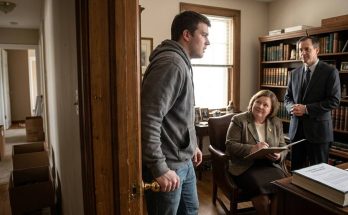
Warren stood as soon as he saw the folder in my arms.
“Are we finished?”
“Did you know Arthur stole my settlement?”
His eyes moved toward the documents.
“Not here.”
“Did you know?”
“Maggie, lower your voice.”
I held up the ledger.
“Arthur bought your truck and paid your tuition with my money.”
Warren went pale.
“You shouldn’t have that.”
The answer hurt more than a denial.
“How much did you know?”
He glanced at the bank doors.
“Some of it.”
“How much?”
He did not answer.
“How much did you know, Warren?”
His shoulders dropped.
“Everything.”
The word seemed to silence the entire lobby.
“You knew the settlement was $186,400?”
“Yes.”
“You knew Arthur was taking it?”
“Yes.”
“You knew my signature was forged?”
“Yes.”
“And you let me believe there had been nothing left?”
“I was 19.”
“I was 17.”
“You don’t understand what Arthur was like.”
“Then explain it.”
Warren looked toward the doors again.
“Can we go outside?”
“No.”
His eyes filled with tears.
“Arthur wasn’t only stealing your money. He was paying people to stay quiet.”
“Quiet about what?”
The pain in my leg seemed to sharpen.
“What about it?”
He swallowed.
“You didn’t step into the road.”
I stared at him.
“What did you say?”
“You didn’t lose your balance.”
The memory inside my mind had always been incomplete. A shout. Arthur’s hand on my arm. Brakes. Red metal.
I had spent 61 years assuming the missing pieces had vanished because of shock.
Warren whispered, “Arthur pushed you.”
My knees weakened.
Eleanor moved a chair behind me.
This time, I sat.
“Why?”
“You overheard him and Rick talking about money they had taken from Arthur’s employer. You told Mom you thought they were stealing.”
“That was the night before.”
“Yes. Arthur followed you to Miller’s Grocery because he wanted to frighten you into staying quiet.”
“So he pushed me in front of a truck?”
“No. He grabbed your arm during the argument. You pulled away. Then he shoved you. He didn’t see the truck turning the corner.”
The distinction offered no comfort.
“He left me in the road.”
“He panicked.”
“And then he stole the settlement.”
Warren lowered his head.
“Yes.”
“You saw him push me?”
“Yes.”
“You told the police?”
“No.”
“You let me blame myself for 61 years.”
“I was afraid.”
“You also accepted the truck he bought with my money.”
He closed his eyes.
“Yes.”
“And the tuition.”
“Yes.”
“So every year you stayed silent, you were protecting more than Mom.”
“Yes.”
At least he did not lie again.
“Why didn’t you tell me after Arthur died?”
“Mom was terrified she would be blamed for signing the transfer. I told myself I was protecting her.”
“And after Mom died?”
He looked toward the folder.
“I knew she had found some of Arthur’s records.”
“You have the key to his storage unit.”
His face changed.
“How do you know that?”
“Mom knew Arthur gave it to you.”
Warren looked as though the air had left his body.
“He told you to destroy the records if anyone started asking questions.”
“Yes.”
“You planned to go there today.”
“Yes.”
“Why?”
“The unit is scheduled for auction tomorrow morning. Mom had been paying for it without telling me, but the last payment expired 3 weeks ago.”
“You were going to reach it before the auction.”
“Yes.”
“And burn everything.”
His silence answered me.
“You were going to steal my life from me a second time.”
Tears ran down his face.
“I wanted to protect myself.”
The honesty of the answer felt brutal.
“What’s inside?”
“Bank records. Letters. Arthur’s ledgers. Files connected to other families.”
“Other families?”
“Arthur and Rick helped manage settlements and insurance payments for people who trusted them. You weren’t the only one.”
I took out my phone.
“The attorney has already contacted the facility. The auction is being stopped, and the papers in Mom’s safe-deposit box have been copied. Destroying the storage unit won’t protect you now.”
Something inside Warren seemed to collapse.
For several seconds, he said nothing.
Then he reached into his jacket and removed a small brass key.
He placed it in my palm.
“I’ll tell them everything.”
“Even about the truck and tuition?”
“Yes.”
“Even about what you planned to do today?”
“Yes.”
“I don’t trust you.”
“I know.”
“I may never trust you again.”
“I know that too.”
Mr. Sterling paid the storage arrears that evening. The facility voluntarily suspended the auction for 72 hours after receiving his notice.
The following morning, he petitioned the court for an emergency preservation order. He explained that the unit contained documents potentially belonging to Arthur’s estate and that an immediate auction could scatter or destroy irreplaceable evidence.
The court granted the order 3 days later.
No one rushed into the unit that night.
No police officers dramatically reopened a 61-year-old case before seeing the evidence.
First came lawyers, signatures, court filings, photographs, and a formal inventory.
Five days after I found the flour tin, I stood outside the storage unit with Mr. Sterling, Warren and his attorney, a court-appointed inventory officer, and a representative from the storage company.
The unit was near the back of the property.
Warren handed me Arthur’s key.
“You should open it,” he said.
I fitted it into the lock.
Click Here to continues Read Full Ending Story👉 PART 3 : I cleaned out Mom’s pantry after her funeral and found $18,940 inside the flour tin she had forbidden us to touch for more than 60 years. Beneath the rubber-banded bills was an envelope with my name on it. The first line read: I’m sorry, Maggie. My brother glanced at the money and said, “Probably grocery cash she forgot about.” But the next sentence mentioned our stepfather, and by 4:55 that afternoon, I was driving to the bank with flour on my sleeves and my brother following close behind.

One Comment on “PART 2 : I cleaned out Mom’s pantry after her funeral and found $18,940 inside the flour tin she had forbidden us to touch for more than 60 years. Beneath the rubber-banded bills was an envelope with my name on it. The first line read: I’m sorry, Maggie. My brother glanced at the money and said, “Probably grocery cash she forgot about.” But the next sentence mentioned our stepfather, and by 4:55 that afternoon, I was driving to the bank with flour on my sleeves and my brother following close behind.”