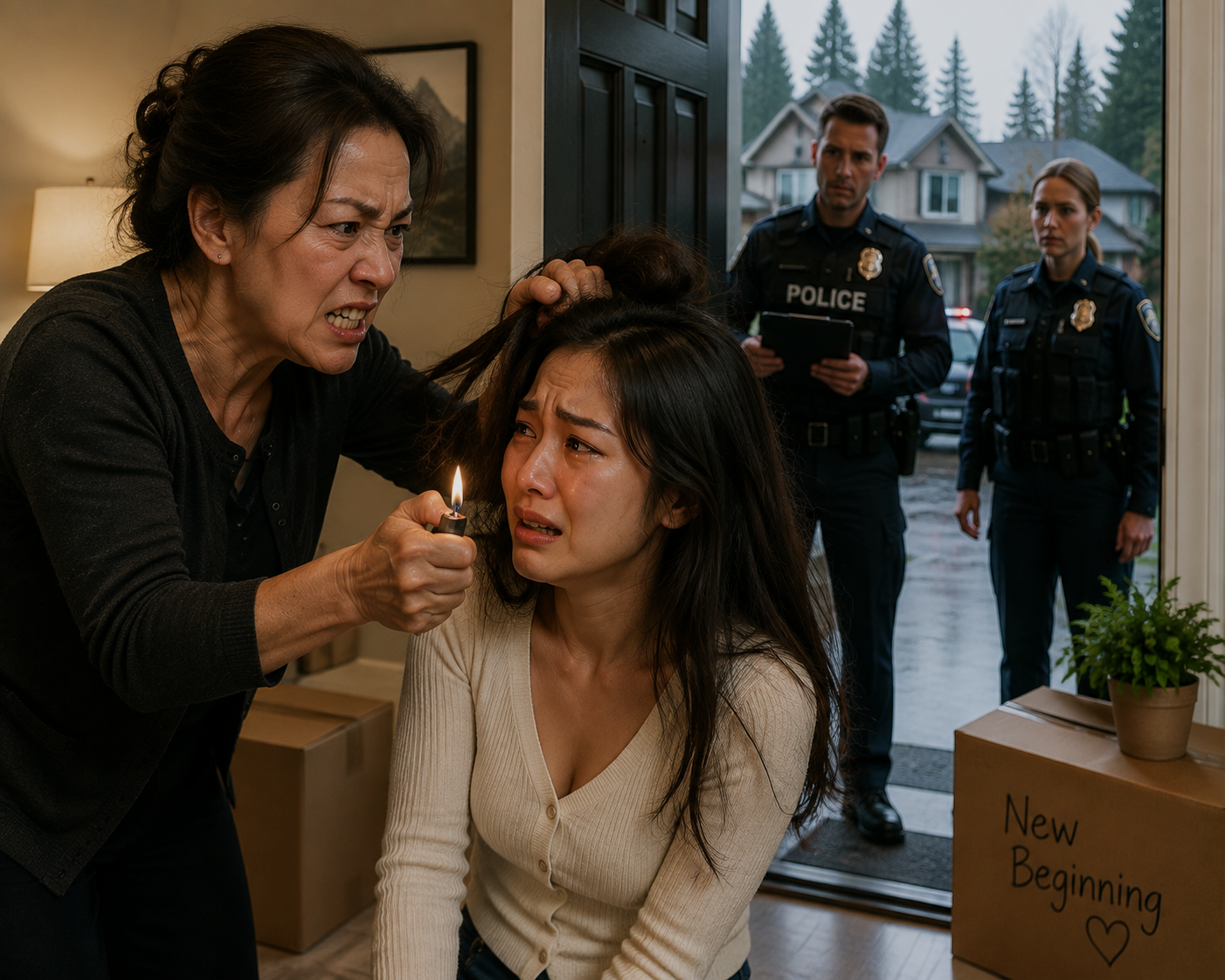
When I told my mother I had bought my first house after ten years of saving, she grabbed my hair and held a lighter inches from my face. “You’re not even married,” she hissed. “That money was for your sister’s wedding.” Then, two weeks after I moved into my new home near Bellingham, Washington, the police knocked on my front door, and I realized my mother had never intended to merely frighten me.
For a decade, I saved every dollar like someone who already understood that no one else was ever going to rescue her.
I skipped vacations. I packed the same ham and cheese sandwiches for lunch until the smell of mustard made me sick. I drove a battered Toyota with a broken air conditioner through three brutal Nevada summers because fixing it would have taken thousands away from my down payment.
When coworkers invited me out for expensive dinners, I blamed deadlines. When friends planned a trip to Paris, I smiled at their photos from my cramped apartment. I worked as a data analyst during the day and took on freelance virtual assistant jobs at night.
I wasn’t dreaming of a mansion.
I just wanted a modest house with white walls, a small porch, and enough quiet that I could finally hear my own thoughts.
My name is Elena Vance, and I was 34 when I found it: a small two-bedroom craftsman in Fairhaven, just outside Bellingham.
It had faded blue shutters, uneven hardwood floors, and a porch light that hung slightly crooked. The kitchen had outdated oak cabinets from the 1980s, and the backyard was mostly weeds.
I loved it immediately.
The house cost more than I had imagined spending when I first started saving, but I had accumulated enough for a substantial down payment, closing costs, and a solid emergency fund. My lender approved the rest based entirely on my income and credit history.
No cosigner. No family gift. No inheritance. Every single dollar came from the work I had done.
Ten days before closing, I received my final loan approval and the initial Closing Disclosure. The transaction still had to be signed and recorded, but unless something catastrophic happened, the house would soon be mine.
I sat alone in my car outside the title office and cried into a coffee shop napkin. I believed I was about to purchase my freedom.
I didn’t know I had just started a war.
My first mistake was flying back to Las Vegas to tell my family in person.
I could have called. I could have texted a photo after I got the keys. But some foolish part of me still wanted the moment that other people seemed to get so naturally—the hug, the proud smile, the mother who said, “You worked so hard for this.”
My mother, Brenda, was standing at the kitchen island when I arrived.
My father, Thomas, sat at the dining table pretending to read a sports magazine. My younger sister, Chloe, leaned against the counter, scrolling through photos of floral centerpieces on her phone.
Chloe was supposed to get married in five months.
My mother had turned the wedding into a full-time military campaign. There were venue tours, cake tastings, imported roses, a live ten-piece band, and a guest list that seemed to swell every week. She talked about the reception as if she were planning a state dinner for royalty.
I had already given Chloe $3,000 toward her wedding dress. That was more than I could comfortably afford, but I loved my sister, and I genuinely believed it was a gift freely given.
I held the closing folder tightly against my chest.
“I bought a house,” I announced. “Closing is next Friday.”
The kitchen went dead silent. For one hopeful second, I thought they were just stunned.
Then my mother’s expression shifted. Not into pride. Not into surprise. Into something ice-cold and calculating.
“You’re not even married,” she said. “Why would you need a house?”
I let out a weak laugh, assuming she was making a joke. She didn’t laugh back.
“I need somewhere to live.” “You already have an apartment.” “And now I’ll have a home.”
Her eyes darted down to the folder in my arms. “What did you pay?” “That’s private.” “How much are you putting down?” “Enough.” “Enough for what?” “The house.” “What about Chloe’s wedding?”
I looked at my sister. “What about it?”
My mother glared at me as if I had just slapped her across the face. “That money was supposed to pay for the wedding.”
I waited for my father to correct her. I waited for Chloe to say there had been a misunderstanding. Neither of them made a sound.
“I never agreed to pay for the wedding,” I said. “You didn’t need to agree. You’re her sister.” “I already helped pay for the dress.” “The dress?” My mother let out a sharp, mocking laugh. “Do you have any idea what the country club costs? Do you know what I’ve promised the caterer?” “Those were your decisions.” “They were family decisions.” “No. They were yours.”
Her jaw clenched. That was the rule I had lived under since earning my first paycheck at sixteen: My work belonged to everyone. My plans were selfish. My boundaries were insults.
When Chloe needed braces, I was told to hand over the money I’d saved for my college textbooks. When my father’s business, Vance Event Dining, hit a rough patch, I covered my parents’ electric bill for four months. When my mother wanted to remodel the bathrooms, she accused me of humiliating the family because I refused to pay for the new tile.
They always promised to pay me back. They never did.
I looked directly into my mother’s eyes. “I’m not paying for the wedding.”
She took a step closer. “You’re going to let your sister be humiliated?” “If the wedding is too expensive, cut the budget.” “We have signed contracts.” “Then you shouldn’t have signed contracts you couldn’t afford.” “You have the money.” “It’s mine.”
Her face twisted. “You selfish little—” “No.”
It was the first time I had ever interrupted her without immediately apologizing. That single word didn’t just make her angry. It completely exposed her.
She crossed the kitchen before my brain could process what was happening. Her hand twisted into my hair right at the scalp, jerking my head backward with so much force that tears instantly blurred my vision.
The folder slipped from my arms. Papers scattered across the tile floor.
“Mom!” Chloe gasped.
My mother reached into her pocket and pulled out a silver lighter. She flicked it open with her thumb. The metallic click echoed in the room. A flame flared up between us.
My father shoved his chair back. “Brenda,” he whispered. But he didn’t take a single step closer.
My mother held the flame just inches from my cheek. I could feel the intense heat on my skin and smell the sharp, chemical stench of lighter fluid.
“You have spent your entire life taking from this family,” she hissed.
The accusation was so wildly absurd I almost couldn’t comprehend it.
“I paid your bills.” “You did what a daughter is supposed to do.” “Let go of me.” “If you refuse to belong to this family willingly, you’ll learn the hard way.”
Chloe stood frozen by the counter. My father stayed by the dining table, one hand gripping the back of his chair. Neither of them moved to help me. That realization hurt almost as much as the pulling at my scalp.
I stopped waiting for them.
I drove my elbow backward, hitting my mother hard in the shoulder, and wrenched myself free. The lighter dropped from her hand and clattered against the floor. The flame went out.
I grabbed my purse and scrambled to gather the scattered papers. My hands were shaking so violently I couldn’t even slide them back into the folder properly.
My father finally moved, but not to comfort me. He bent down to pick up the lighter.
“Elena, everyone is just riled up,” he said. “Let’s calm down before this turns into something it doesn’t need to be.”
I stared at him. “She held fire to my face.” “She wasn’t actually going to hurt you.” “How do you know that?”
He didn’t have an answer.
My mother stood by the island, breathing heavily. “You’ll come crawling back,” she spat. “You always do.”
I walked out without saying goodbye.
At the airport terminal, I went through the folder to organize the mess and realized my Closing Disclosure was missing. It contained my lender’s name, the title company, my closing date, the purchase price, and the exact amount of my down payment.
It didn’t have account passwords, so no one could drain my bank account directly, but it still made my stomach turn.
I called my dad. It went straight to voicemail. I texted Chloe: Did Mom take a document from my folder? She left me on read.
First thing the next morning, I called my lender and title company. I explained that an estranged family member had taken a copy of my paperwork without permission and asked them to require a verbal password for any inquiries. I changed the passwords to my email and bank accounts. I took photos of the red, inflamed skin on my scalp and screenshot every text my mother sent me.
I thought about filing a police report for the assault. But then I imagined trying to explain the lighter, my father’s passivity, my sister’s silence, and the fact that I had just walked away. A lifetime of being told I was “overreacting” made me doubt my own reality. I convinced myself that securing the house closing was enough.
Over the next week, my mother called twenty-two times. I let every single one go to voicemail.
She sent long texts accusing me of destroying the family’s reputation. She said Chloe’s wedding would be ruined because of me. She claimed my father was having chest pains from the stress I caused.
Her final text read: You have 48 hours to fix this before I do.
I took a screenshot and blocked her number.
The following Friday, I signed the final documents in Washington. The deed recorded that afternoon, and my realtor handed me the keys on the front steps of the little craftsman.
I moved in with eight boxes, a mattress on the floor, two folding chairs, and a cheap floor lamp that flickered if you bumped the cord. The rooms echoed. I had no sofa, no dining table, and bare walls. But every morning, sunlight poured into the bedroom, and every evening, I sat on the porch listening to the wind come off the bay.
For the first time in my life, the quiet didn’t feel lonely. It felt entirely safe.
That peace lasted exactly two weeks.