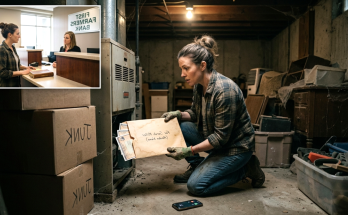
“What’s a bottom-feeder like you doing here?”
Those were the first words my son said to me on Thanksgiving morning.
Not hello.
Not Happy Thanksgiving.
Not even Dad.
I was standing on the covered porch of the mountain lodge I had spent three years building and the next twelve maintaining, with a grocery bag in one hand, an overnight duffel in the other, and cold Colorado wind pushing pine needles across the deck.
Marcus stood in the doorway like a hotel manager dealing with an unwelcome guest.
Behind him, I could see people moving through my great room.
A woman I recognized as his mother-in-law was setting serving bowls on my dining table.
Her husband was sitting in my leather recliner.
His brother-in-law had a beer in his hand and his boots on my coffee table.
Two children were arguing over a video game connected to a television I had never seen before.
And behind all of them, above the stone fireplace, the framed photograph of my late wife had disappeared.
I looked at my son.
“What did you call me?”
Marcus’s jaw tightened.
He was thirty-three years old, tall like his mother, dark-haired like me, wearing a flannel shirt I had bought him the previous Christmas.
“Dad, you weren’t supposed to come up this weekend.”
“That’s interesting.”
I put the grocery bag down.
“Because I’m pretty sure I own the place.”
Someone laughed inside.
A man’s voice.
Brian.
Sarah’s younger brother.
Marcus shifted in the doorway.
“You can’t keep doing this.”
“Doing what?”
“Showing up whenever you feel like it.”
I almost smiled.
For fifteen years, I had been showing up whenever I felt like it because there had never been a reason not to.
My key hung on the same ring it had hung on since the lodge was finished.
I reached toward the deadbolt.
Inserted it.
The key stopped halfway.
Wrong cylinder.
I tried again.
Nothing.
For the first time that morning, the cold outside got all the way through my coat.
“You changed the locks.”
Marcus looked toward the driveway.
“Sarah wanted better security.”
“From who?”
He did not answer.
I looked past him again.
“Where’s the photograph of your mother?”
His face changed.
Barely.
“Dad.”
“Where is it?”
“We moved some things.”
“Where?”
“Storage.”
Storage.
The word sat between us.
Fifteen years earlier, I had carried that photograph up the mountain wrapped in a moving blanket because I was afraid the glass would break on the drive.
Rebecca standing beside me at Lake Dillon in 1987.
Wind in her hair.
My arm around her waist.
Both of us younger than Marcus was now.
That photograph had been on the mantel since the day the fireplace was finished.
Now it was in storage because my son’s new family had decided it no longer suited the room.
I looked back at Marcus.
“Move.”
He folded his arms.
“No.”
That was when Sarah came up behind him.
She was thirty-one, a third-grade teacher, mother of two, and my daughter-in-law for less than two years.
She put one hand on Marcus’s shoulder.
“Cameron, this isn’t a good time.”
Cameron.
Not Dad.
Not Mr. Palmer.
Cameron.
I glanced down at my grocery bag.
A frozen turkey breast.
Coffee.
Bacon.
Bread.
The pecan pie from a bakery in Denver that Marcus used to ask for every Thanksgiving.
I had planned to spend two nights.
That was all.
I had called him three times during the week.
No answer.
Sent a message.
No response.
I assumed they were busy.
I had no idea they had apparently decided the owner of the lodge required an appointment.
“What exactly is a good time for me to enter my own property?”
Sarah’s lips tightened.
“This is our home now.”
I looked at her.
“Excuse me?”
She sighed, the way people sigh when they believe they are explaining something obvious to somebody slow.
“Marcus told you.”
“No.”
“He told us you gave him the lodge after the wedding.”
Behind her, Linda Harrison—Sarah’s mother—appeared carrying a dish towel.
She wore an apron that said QUEEN OF THE MOUNTAIN.
I remember that because I almost laughed.
Almost.
Linda gave me a tight smile.
“Cameron, we really were hoping to keep today peaceful.”
“My key doesn’t work.”
“Yes.”
“We changed the locks a month ago.”
“We?”
Linda looked toward Marcus.
“This is Marcus and Sarah’s family home now.”
My son said nothing.
I waited.
He had a chance.
One sentence.
Dad, that’s not what I meant.
Dad, there’s been a misunderstanding.
Dad, come inside.
Instead, he looked at me and said:
“We’ve been here eight months.”
“So?”
“We’re established.”
“Established as what?”
“Residents.”
“That’s different from owners.”
Brian called from inside:
“Not necessarily.”
He appeared holding my beer.
Not just the same brand.
My beer.
I kept a case of Colorado lager in the basement refrigerator.
Brian leaned against the doorframe.
“Adverse possession.”
I stared.
He smiled.
“Look it up, old man.”
My son did not correct him.
That was the moment the situation stopped feeling like a family misunderstanding.
I was sixty-eight years old.
Not frail.
Not confused.
Not some lonely man wandering onto the wrong porch.
I was a retired general contractor who had spent forty-one years building houses, medical offices, schools, restaurants, warehouses, and two fire stations.
I knew what a deed was.
I knew what a property line was.
I knew what happened when someone confused permission with ownership.
And I knew my own son had just allowed a man drinking my beer to call me an old man while explaining how they intended to keep my land.
I lowered my voice.
“Marcus.”
He looked at me.
“Is this your position too?”
His discomfort became visible.
“Dad, don’t make this ugly.”
“I asked a question.”
“We’ve been maintaining the place.”
“Paying utilities.”
“Making improvements.”
“Sarah’s kids are settled.”
“Tom and Linda are helping.”
“That does not answer the question.”
Marcus rubbed the back of his neck.
Then:
“Yes.”
I felt something in my chest pull tight.
“Yes what?”
“Yes, this is our home.”
I nodded.
“Do you believe you own it?”
He hesitated.
Sarah answered first.
“You said it would be his someday.”
Someday.
There it was.
The sentence I had said years earlier.
Not a gift.
Not a transfer.
Not a present conveyance.
Someday.
When you earn it.
My stomach turned.
“I said Marcus might inherit the lodge someday.”
Marcus’s face reddened.
“You said it was for me.”
“I built it for us.”
“That’s not the same thing as giving it to you while I’m alive.”
Linda stepped forward.
“Cameron, you need to stop being possessive.”
I almost laughed again.
“Possessive.”
“It’s a building.”
“It’s family.”
“You can’t hold property over people’s heads forever.”
“I have not held anything over anyone.”
I looked at her.
“I let you and your husband stay here rent-free because you were losing your apartment.”
Her expression sharpened.
“We’ve contributed.”
“You pay electricity.”
“We pay more than that.”
“Then show me.”
Tom Harrison appeared behind his wife.
“Cameron.”
His tone was the kind men use when trying to sound reasonable while standing in someone else’s doorway.
“You’re a good man.”
I hated that opening immediately.
“But you need to accept reality.”
“What reality?”
“Marcus is the next generation.”
“He’s taken responsibility for this place.”
“Property ownership has moved forward.”
“Legally?”
Tom paused.
“Functionally.”
“No.”
I shook my head.
“Those are not the same thing.”
Brian laughed.
“Here we go.”
“Legal mumbo jumbo.”
I looked at him.
“You’re the one who said adverse possession.”
“Yeah.”
“And how long do you think it takes?”
His confidence flickered.
“Long enough.”
“How long?”
He shrugged.
“Depends.”
I nodded.
“It does.”
Then:
“And eight months isn’t close.”
Silence.
I did not know the exact legal analysis yet.
I was not going to stand on a porch and improvise law.
But I knew enough to understand no one acquired a deed to a Colorado mountain property after eight months because their mail arrived there.
Sarah crossed her arms.
“You can visit.”
That sentence almost did more damage than bottom-feeder.
“Visit.”
“Yes.”
“Just call first.”
I looked at my son.
He would not meet my eyes.
I bent.
Picked up the grocery bag.
“Understood.”
Marcus looked relieved.
“Dad—”
“No.”
I held up one hand.
“You’ve said enough.”
I turned.
Walked down the steps.
Behind me, Brian laughed.
“Crazy old coot really thought he still owned it.”
More laughter.
Not Marcus.
At least I do not remember hearing his.
That distinction mattered later.
At the time, it did not matter at all.
I got into my truck.
Set the groceries on the passenger floor.
Then sat with both hands on the steering wheel.
The lodge stood above me.
Two stories of timber and stone.
Wraparound deck.
Metal roof.
Three bedrooms.
A great room with windows facing the valley.
I knew every measurement.
Every structural post.
Every stubborn piece of rock we had moved from the foundation trench.
I knew the section of deck where Marcus had misread the tape by an inch when he was sixteen and tried to convince me trim would hide it.
I knew which roof panel had a tiny crease because a wind gust caught it during installation.
I knew the fireplace lintel came from a salvage yard outside Pueblo.
I knew exactly where Rebecca’s photograph should have been.
And somehow, strangers had made me feel like I was trespassing.
I started the truck.
Drove away.
My wife died in 2008.
Pancreatic cancer.
Ten months from diagnosis to funeral.
Rebecca Palmer was fifty-three years old.
We had been married thirty-five years.
Marcus was fifteen.
There is no elegant way to describe what grief did to the two of us.
I stopped sleeping.
Marcus stopped talking.
For months, our house in Denver felt like a museum where nobody wanted to touch anything.
Her coffee mug stayed in the cabinet.
Her coat stayed in the hall closet.
Her gardening gloves stayed beside the back door through an entire winter.
I went to work because contractors do not get compassionate leave from concrete pours.
Marcus went to school because teenagers are still expected to do algebra after their mothers die.
We survived mostly by moving.
One Saturday, about six months after the funeral, I took Marcus fishing.
He barely spoke.
We drove west.
Mountains.
Cold morning.
Snow still visible above timberline.
We stopped at a piece of property I had been watching.
Forty acres.
Pines.
Rock.
A ridge looking over a broad valley.
No house.
No road beyond an old service track.
Marcus looked around.
“What is this?”
“Maybe something.”
“What?”
“I don’t know yet.”
I bought the land three months later.
Eighty-five thousand dollars.
Cash from savings and part of Rebecca’s life-insurance proceeds.
I struggled with that.
Using money connected to her death for something permanent felt wrong at first.
Then a grief counselor said something useful.
“Money is not the person.”
That sentence gave me permission.
The lodge began as a project.
Something to keep my hands occupied during weekends.
Then Marcus started coming.
At first because I made him.
Fifteen-year-olds should not spend every Saturday alone with grief and an Xbox.
We cleared brush.
Measured the building pad.
Worked with an engineer because despite Brian’s later mythology, I did not literally build a permitted mountain lodge with nothing but two hands and fatherly wisdom.
I was a contractor.
I hired excavators.
Electricians.
Plumbers.
Roofers.
Concrete crews.
People whose work I respected.
But I was there for everything.
Foundation.
Framing.
Interior finish.
Stonework.
Decking.
Cabinets.
Trim.
Marcus learned beside me.
“Measure twice.”
“I know.”
“No.”
“You know the phrase.”
“That is different from knowing how expensive a bad cut is.”
He rolled his eyes.
Typical sixteen.
We camped on the land the first summer.
A tent.
Cooler.
Mosquitoes.
One night Marcus sat near fire and said:
“Mom would like this.”
First time he mentioned her voluntarily in months.
“Yeah.”
“She hated camping.”
“She hated tents.”
“She liked mountains.”
He smiled.
“She’d make you build a bathroom before visiting.”
“She’d make me build two.”
That was how the lodge became healing.
Not because construction cured grief.
It gave grief somewhere to sit while our hands were busy.
By the second year, framing was complete.
By the third, we had a certificate of occupancy.
Total cost, once you counted land, hired trades, materials, permits, road work, well, septic, furnishings, and years of small additions, was far above the first number people later repeated.
The original major build cost was around $340,000 excluding the raw land and some later improvements.
I kept every receipt.
Every permit.
Every inspection.
Not because I expected a family dispute.
Because contractors keep records if they want to stay contractors.
The deed was in my name.
Cameron Palmer.
Sole owner.
Property taxes:
Me.
Insurance:
Me.
Major repairs:
Me.
When Marcus was eighteen, we sat on the half-finished deck eating sandwiches.
He looked at the valley.
“This is going to be amazing when I inherit it someday.”
I laughed.
“When you earn it.”
“What does that mean?”
“Means don’t start measuring curtains.”
He threw crust at me.
I had forgotten that conversation until Thanksgiving.
He apparently had not.
But memory had edited out my second sentence.
Marcus went to college in Fort Collins.
Business degree.
Then sales.
He returned to Denver after graduation and worked for an equipment distributor.
Good job.
Not glamorous.
Steady.
We stayed close.
Not weekly-call close.
Men sometimes lie to themselves about closeness because both parties know where the other one lives.
We hunted once a year.
Lodge weekends.
Christmas.
Birthday dinner.
He brought friends up.
I liked it.
The lodge sounded better with young people in it.
Then he met Sarah.
She was a teacher.
Divorced.
Two children.
Ava was ten when they married.
Luke was eight.
Good kids.
I liked them.
Ava asked a thousand questions.
Luke wanted to hammer every nail whether a nail was needed or not.
Sarah was warm at first.
Organized.
Protective of her children.
I respected that.
When Marcus proposed, I gave them money toward the wedding.
Thirty-eight thousand dollars.
Too much.
I knew it then.
I did it anyway.
Why?
Because I had money.
Because Marcus was my only child.
Because Rebecca was not there to help.
That last reason influenced more decisions than I admitted.
Sarah’s family was different from ours.
Her parents, Linda and Tom, had gone through a rough period after Tom’s small remodeling business failed.
Not fraud.
Not laziness.
A sequence of bad contracts, medical bills, and debt.
They lost their rental after falling behind.
Brian, Sarah’s younger brother, was twenty-nine, a part-time mechanic whose employment changed frequently.
He also gambled more than he should have.
I knew that vaguely.
Not my business at first.
Family gatherings got larger.
Then more expensive.
I paid more often.
Again:
Only child.
Money.
Habit.
Eighteen months before the Thanksgiving confrontation, Marcus called.
“Dad.”
“What?”
“I need a favor.”
“How expensive?”
He laughed.
“Not money.”
“Sarah’s parents are in trouble.”
“What kind?”
“Apartment.”
“They’ve got to be out at end of month.”
I became quiet.
“What do you want?”
“Could they stay at the lodge?”
I almost said no.
Then:
“How long?”
“A few weeks.”
“Maybe six.”
“Until they find something.”
“What about Brian?”
“He’d stay too.”
“Marcus.”
“I know.”
“He’s between places.”
“And the kids?”
“Sarah and I would probably stay up there more while everybody settles.”
I stared through my kitchen window.
The lodge sat empty much of year.
I used it one or two weekends a month.
Sometimes more in summer.
“Temporary.”
“Yes.”
“I mean it.”
“I know.”
“No changes.”
“No renovations.”
“No one touches the workshop.”
“Of course.”
“Utilities?”
“They’ll cover them.”
“No rent.”
“Dad, you’re the best.”
I should have written it down.
That is one of the lessons.
Not because I expected theft.
Because temporary has a way of becoming permanent when family embarrassment makes deadlines feel cruel.
Six weeks passed.
Linda told me Tom had interviews.
Fine.
Three months.
Marcus said the rental market was tight.
Fine.
Four months.
Sarah asked if the kids could use the workshop as a homework room “temporarily.”
I said no.
At least I thought I had been clear.
Then work became busy.
I had retired from full-time contracting at sixty-six but still consulted on projects.
I traveled for six weeks.
When I returned, I went to lodge.
They were there.
Everything seemed mostly normal.
More shoes.
More food.
Kids’ drawings.
Linda had reorganized kitchen.
Annoying.
Not catastrophic.
Marcus said:
“We’re getting close.”
“To what?”
“Finding a place.”
“Good.”
I should have pushed.
I didn’t.
Why?
Because telling a family with children to hurry up feels harsh when you have an empty lodge.
That was my weakness.
Generosity without a defined end date becomes difficult to withdraw because every additional week looks less expensive than conflict.
At five months, mail began arriving.
I noticed.
“Why is Tom’s bank statement here?”
“Just easier.”
“No.”
Marcus laughed.
“Dad, it’s mail.”
“This is not their permanent address.”
“I’ll tell them.”
At six months, I found utility account updated to Marcus’s name for electricity.
I called.
“Why?”
“You said we’d cover utilities.”
“I said your in-laws would cover what they used.”
“It was easier to put it under me.”
That was reasonable enough.
I let it go.
At seven months, Murphy’s General Store owner Dave asked:
“How does it feel giving the place to the next generation?”
I laughed because I thought he was joking.
“What?”
“Marcus.”
“He’s really made it home.”
I said:
“They’re staying temporarily.”
Dave looked confused.
That should have stopped me.
Instead, I assumed small-town gossip.
By month eight, Thanksgiving.
Changed locks.
Bottom-feeder.
That was how quickly “temporary” can become “we have rights” when nobody forces the language to remain precise.
After I drove back to Denver, I did not call Marcus.
That surprised me.
I wanted to.
I wanted to yell.
Instead, I opened my safe.
Fireproof.
Basement.
Inside:
Deed.
Title insurance.
Tax receipts.
Insurance policies.
Permits.
Survey.
Well documentation.
Septic records.
Construction records.
Trust and estate plan.
I spread them across my dining table.
Then I called Janet Morrison.
Janet had handled my estate documents and several property transactions over years.
Sixty-four.
Sharp.
Never impressed by indignation.
I left a message.
She called at seven the next morning.
“Cameron?”
“Morning.”
“You sound angry.”
“My son changed locks on my lodge.”
Silence.
Then:
“Start at the beginning.”
I told her.
Not every insult.
The relevant facts.
Permission to stay.
No lease.
No rent.
Utilities.
Eight months.
Changed locks.
Ownership claim.
Community statements.
Workshop alterations.
Adverse possession talk.
Janet stopped me there.
“Do not rely on internet research.”
“I haven’t.”
“Good.”
“Do not break in.”
“It’s my property.”
“I know.”
“Do not change locks while people are living there.”
I exhaled.
“Fine.”
“Do not throw belongings outside.”
“I wasn’t planning to.”
“Good.”
“Do not shut utilities off.”
“I know.”
Then:
“Now, deed?”
“My name.”
“Any transfer?”
“No.”
“Any written promise to gift?”
“No.”
“Estate plan?”
“Marcus is beneficiary subject to current documents, but nothing gives him present ownership.”
“Taxes?”
“I pay.”
“Insurance?”
“I pay.”
“Any mortgage?”
“No.”
“Good.”
Then:
“Cameron, based on what you’re telling me, they do not become owners because they occupied with your permission for eight months.”
“I know.”
“Adverse possession generally requires a much longer statutory period and specific elements, and permissive possession usually creates additional problems for that theory.”
“So Brian is wrong.”
“Brian is not your lawyer.”
“Thank God.”
Janet almost laughed.
Then:
“Your bigger issue is possession.”
“They began there with permission.”
“Now you want that permission ended.”
“Yes.”
“Then we do that lawfully.”
“What does that look like?”
“Written notice appropriate to the facts.”
“If they refuse, we file for possession.”
“Court order.”
“Sheriff enforcement if necessary.”
“How long?”
“Depends on service, response, court calendar, and whether they contest.”
“No movie deadlines.”
“Exactly.”
That was Janet.
She refused to make law emotionally satisfying.
I asked:
“Can I go up there?”
“Yes.”
“Should you?”
I hated that question.
“What do you think?”
“Not alone if you expect conflict.”
Good.
The next morning, I tried one last conversation.
Not because Janet recommended it.
Because Marcus was my son.
I called.
No answer.
Drove up.
At nine, I knocked.
Brian opened.
Pajama pants.
T-shirt.
“What do you want?”
“To speak with Marcus.”
“He’s busy.”
“I’ll wait.”
“No.”
He started closing the door.
I put my hand lightly against it.
Not forcing entry.
Just enough to keep conversation.
“This is still my property.”
Brian smirked.
“You keep saying that.”
“Because it remains true.”
“Dad?”
Marcus’s voice.
He appeared.
His face tightened.
“What are you doing here?”
“Talking to you.”
“We talked.”
“No.”
“You announced.”
“That’s different.”
Sarah joined.
Linda called from kitchen:
“Who is it?”
No one answered.
I looked at Marcus.
“When exactly did I give you this lodge?”
He rubbed his forehead.
“Dad.”
“When?”
“You said it was ours.”
“When?”
“After the wedding.”
“Where?”
“I don’t remember.”
“What words?”
“Why does this matter?”
“Because you’re telling a town I signed over property worth hundreds of thousands of dollars.”
Sarah stepped forward.
“We’re not saying you signed it over exactly.”
I looked at her.
“Dave Murphy says Marcus told him legal transfer.”
Her face changed.
Marcus looked at her.
“What?”
Good.
Not all of them knew every lie.
Interesting.
I continued.
“Sally at the post office thinks this is your forever home.”
“Tom at hardware says you’ve been talking about adverse possession.”
Brian crossed his arms.
“Because we have rights.”
I ignored him.
“Show me the deed.”
Marcus became quiet.
“Dad.”
“If you own it, show me the document.”
“We don’t need paperwork.”
Brian said.
I turned.
“You absolutely do.”
“Family doesn’t.”
“Family especially does when people start changing locks.”
Silence.
Then I asked:
“Who pays property taxes?”
No answer.
“Who is named on permits?”
No answer.
“Who insured the structure last year?”
Marcus looked away.
“Who built it?”
“Dad, stop.”
“Who owns it?”
His eyes met mine.
Then he said:
“This is our home.”
Not answer.
But enough.
I nodded.
“Okay.”
Sarah smiled slightly, thinking I had surrendered again.
I turned.
Then stopped.
“By the way.”
Marcus looked.
“What?”
“Who authorized removal of my workshop?”
Brian’s grin returned.
“We needed a room for the kids.”
“What did you do?”
“Partition.”
“Carpet.”
“Some drywall.”
“You removed benches?”
“Yeah.”
“Where are my tools?”
“Storage shed.”
I closed my eyes.
The workshop had been the last part of lodge still exactly mine and Marcus’s.
Workbenches we built.
Cabinets.
Old framing square that belonged to my father.
The vice I used for thirty years.
I opened my eyes.
“Do not change anything else.”
Brian laughed.
“Or what?”
I looked at Marcus.
“Do you agree with him?”
My son hesitated.
Then:
“If you can’t accept this is our home, maybe you shouldn’t come around.”
That sentence ended informal negotiation.
I drove away.
That afternoon, Janet prepared formal notices.
Not because I wanted a public humiliation.
Because I needed paper.
That distinction mattered.
She also asked me to photograph the exterior from public areas and preserve every text.
I pulled phone history.
There were messages.
Marcus:
Thanks again for letting everyone stay while Tom and Linda get sorted. Promise we’ll get them out of your hair soon.
Month two.
Then month four:
We may need a little longer. Rental market is rough.
Month six:
Would you mind if I moved electric into my name while we’re here? Easier to track.
Evidence.
Permission.
Temporary.
Not a gift.
Janet smiled when she saw them.
“This is useful.”
“What about workshop?”
“Document.”
“What if they destroy something?”
“We handle damages separately.”
“And my key?”
“Changing locks on property they occupy is not proof of ownership.”
“Good.”
Then she gave me advice I did not want:
“Stop telling community your version.”
“Why?”
“Because every person you correct becomes a future witness with three versions of gossip.”
“What am I supposed to do when someone says I gave away the lodge?”
“Say there is a property dispute being handled formally.”
“That’s it?”
“That’s it.”
I hated it.
Followed.
At Murphy’s, Dave asked again.
I said:
“There’s no transfer.”
“My attorney is handling occupancy.”
His face changed.
“Oh.”
Good.
At post office:
Same.
Hardware:
Same.
No speeches.
Facts.
The community gossip reversed slowly.
Not because I campaigned.
Because Marcus’s claims became less credible once people realized no deed existed.
Janet arranged service.
The written notice gave them the period required under our counsel’s interpretation of their occupancy circumstances.
It was roughly thirty days before we could seek the next step if they refused.
I met a process server, not a sheriff’s deputy for the initial notice. Better legal realism. A private process server delivered the papers, while certified copies created a record.
I did not stand behind him like a victorious landlord.
I waited in my truck farther down the road.
That was Janet’s rule.
“No theatre.”
Fine.
From the road, I saw Marcus open the door.
Receive envelope.
Read.
Sit on porch step.
For a moment, I wanted to go to him.
Did not.
He called fifteen minutes later.
“Dad.”
“Hi.”
“What did you do?”
“I ended your permission to occupy.”
“We’re your family.”
“Yes.”
“You’re evicting your own family.”
“I’m asking people who claimed ownership of my property to leave it.”
His breathing became rough.
“Sarah’s kids are enrolled up here.”
“That was your decision.”
“Tom and Linda have nowhere.”
“They had eight months.”
“You said they could stay.”
“Temporarily.”
He became angry.
“You never gave an exact date.”
That was true.
My mistake.
“You’re right.”
He went quiet.
“What?”
“I should have.”
“I should have written six weeks.”
“I didn’t.”
“That does not turn temporary permission into ownership.”
Silence.
Then:
“What do you want?”
“My lodge returned.”
“Then what?”
“That’s my decision.”
“You’re going to sit there alone?”
The sentence hurt.
He knew it.
I answered:
“Maybe.”
Then ended call.
Phone calls came for days.
Sarah.
Linda.
Tom once.
Not Brian.
He apparently had found an online forum telling him they could fight.
Good.
Let lawyer explain it.
Sarah said:
“You’re traumatizing the children.”
I answered carefully.
“I’m not discussing adult property conflict with children.”
“You need to give us more time.”
“Have your attorney contact Janet.”
No argument.
Linda said:
“You’re throwing two seniors into the street.”
She and Tom were sixty.
Healthy enough to occupy my mountain lodge for eight months and rearrange it.
I did not say that.
“Your attorney can contact mine.”
Then Dad? no.
Marcus called repeatedly.
Eventually, day four after service, he came to my Denver house.
I almost did not open.
Then did.
He looked terrible.
Red eyes.
Wrinkled clothes.
“Can I come in?”
I moved aside.
He sat at kitchen table.
The same table where he did homework after Rebecca died.
“Dad.”
I waited.
“I messed up.”
First time.
“Yes.”
“I shouldn’t have let Brian talk to you like that.”
“No.”
“I shouldn’t have changed locks.”
“No.”
“I shouldn’t have told people the lodge was mine.”
“No.”
He looked down.
“Are you going to make me list every one?”
“Probably not.”
He laughed weakly.
Then cried.
My thirty-three-year-old son covered his face.
I sat across.
Did not touch him yet.
“I’m losing everything.”
“What?”
“Sarah says if her parents have to leave, she doesn’t know if our marriage survives.”
“That is between you and Sarah.”
“Her family blames me.”
“For what?”
“For promising the lodge.”
There.
“Did you promise them?”
He looked down.
“Yes.”
My chest tightened.
“What exactly did you say?”
“That you’d always said the lodge would be mine.”
“I said someday.”
“I know.”
“Did you know then?”
He did not answer.
“Marcus.”
“I knew you hadn’t given it to me yet.”
Yet.
That word mattered.
“So why tell them?”
He wiped his face.
“Because they were scared.”
“Linda and Tom were losing apartment.”
“Sarah was embarrassed.”
“She kept saying we needed something stable.”
“I said I had the lodge.”
“Did Sarah know there was no transfer?”
Silence.
“At first?”
“I think she thought it was coming.”
“And later?”
Marcus shook head.
“I don’t know.”
“Try.”
He looked at me.
“Later she knew you hadn’t signed anything.”
That hurt.
Less than his part.
Still.
“Why change the locks?”
“Brian said if we were going to claim residency, we needed to treat it like ours.”
I laughed once.
Not funny.
“Your brother-in-law is not a lawyer.”
“I know.”
“Why did you listen?”
“I don’t know.”
“No.”
“You do.”
Marcus became angry.
“Because I was tired of being the guy whose dad owned everything.”
There.
The sentence sat between us.
“What does that mean?”
“You built the lodge.”
“You paid for my college.”
“You paid for wedding.”
“You always know how to fix things.”
“Sarah’s family thought I was successful because I had this mountain place.”
“I liked that.”
My anger shifted.
Not gone.
Context.
“So you made it yours in the story.”
“Yes.”
“And once you told enough people, correcting it would make you look like liar.”
“Yes.”
“So you doubled down.”
He nodded.
There was my son again.
Not innocent.
Human.
“I’m sorry.”
I believed he was sorry.
That did not answer next question.
“Are you leaving?”
He looked up.
“Dad.”
“The notice stands.”
“Can Sarah and kids stay if her family leaves?”
That told me where he was mentally.
Negotiating access.
Not yet understanding.
“No.”
His face fell.
“Why?”
“Because this is not about Brian alone.”
“You looked me in the face and told me not to come back unless I accepted your ownership.”
“I know.”
“You need to live somewhere that is actually yours.”
“For how long?”
“I don’t know.”
“Forever?”
“I don’t know.”
Marcus cried again.
I finally reached across.
Put hand on his wrist.
“I love you.”
He looked up.
“That does not change the lodge.”
He nodded.
“Forgiveness is not possession.”
“I know.”
“Do you?”
“I’m trying.”
Good.
He left.
The next weeks were ugly.
No dramatic public reckoning.
Apartment searches.
Calls.
Attorneys.
Sarah’s parents found a rental forty-five minutes away.
Not ideal.
Affordable if all three adults contributed.
Brian moved into a room above a garage owned by a friend.
Sarah and Marcus found a townhouse near her school.
Smaller.
No mountain view.
Normal.
That should have solved occupancy.
Then Brian convinced Linda they should contest.
They hired lawyer.
The lawyer apparently read facts and advised settlement.
How do I know?
Janet received letter.
No adverse possession claim.
No gift deed claim.
Instead, request for additional move-out time and compensation for certain improvements.
That was legally serious enough to discuss.
They had spent money on workshop conversion.
Utilities.
Some maintenance.
Could they seek reimbursement?
Maybe in part depending on facts.
I wanted to say:
They damaged it.
Janet said:
“Document.”
An independent contractor inspected.
Workshop alteration.
One non-load-bearing partition.
Carpet glued over hardwood in part of room.
Bench removed but stored.
Electrical outlets modified improperly.
Estimated restoration:
$8,600.
The family claimed $4,200 in improvements.
We negotiated.
No reimbursement for unapproved alterations.
No additional damages if they restored certain things before move-out or allowed my contractor access.
They chose to leave as-is.
I preserved damage claim.
Later, I decided not to pursue every dollar because litigation cost more than restoration.
That was not weakness.
Math.
The possession case proceeded only far enough to produce a stipulated move-out order rather than a contested eviction trial.
Better.
They agreed to vacate by December 18.
If not, court enforcement available.
That gave them certainty.
Me too.
No sheriff physically throwing children onto road.
No moving crew descending as punishment.
They had weeks.
They packed.
The day before deadline, Marcus called.
“We’ll be out tomorrow.”
“Good.”
“Can you come after noon?”
“Why?”
“I want to hand you keys.”
I thought.
“Okay.”
At 12:30, I drove up.
Snow along shaded edges.
A moving truck was parked near deck.
Linda and Tom were gone.
Brian gone.
Sarah was loading last boxes into SUV.
Children sat in back.
Marcus stood by front door.
No one insulted me.
No police.
No spectators.
That was better.
Sarah saw me.
Her face hardened.
Then softened slightly.
“Cameron.”
“Sarah.”
She held a box of blue ceramic dishes.
My dishes.
I recognized them.
Bought at a pottery shop in Salida years earlier.
I could have said:
Those stay.
Instead, I asked:
“Are those from lodge?”
She looked.
Then realized.
“Oh.”
“I thought they were ours.”
“That’s been the problem.”
The line came out sharper than I intended.
She flinched.
I regretted tone.
Not fact.
“Leave them on counter, please.”
She did.
Then:
“I’m sorry.”
I looked at her.
“For what?”
Her eyes filled.
“For believing Marcus when part of me knew there was no paperwork.”
That was specific.
Good.
“And for letting Brian treat you that way.”
“Why didn’t you stop him?”
She looked toward children.
“I was scared.”
“Of what?”
“If the lodge wasn’t ours, everything fell apart.”
There.
Housing.
Parents.
Marriage.
Identity.
The lie had become structural.
“Fear does not create ownership.”
“I know.”
She nodded.
Then:
“I’m sorry.”
“Thank you.”
No hug.
She left.
Marcus remained.
The lodge was nearly empty of their personal belongings.
My furniture stayed.
Recliner.
Dining table.
Beds.
The television they had bought? They took it. Fine.
Kitchen looked larger.
On mantel, nothing.