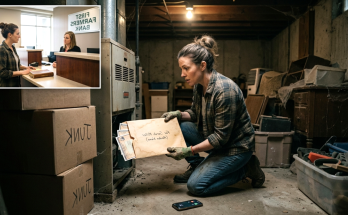
I read the memorandum again.
The paper smelled faintly of dust and old filing cabinets.
My father's signature appeared beneath a paragraph dated thirty-two years earlier.
I knew the handwriting immediately.
There was no mistaking the sharp downward stroke of the H in his surname or the way he pressed harder on the final letters.
“What does it say?” Clara asked.
I looked at her.
“Your grandfather knew about the property.”
She came closer.
Julian remained near the window.
The memorandum described a proposed transportation corridor.
The plans had never been approved at the time.
But my father had written that the land surrounding the proposed interchange could eventually become strategically important.
He had apparently intended to purchase the acreage himself.
He never did.
Instead, the memorandum ended with a handwritten note.
“Arthur will understand the value if he ever sees what lies beyond the obvious.”
I read the sentence three times.
Clara frowned.
“What does that mean?”
“I don't know.”
Julian spoke quietly.
“There’s more.”
He handed me another page.
This one was from a county archive.
A survey map.
Several sections had been marked in pencil.
One was the Smyrna property.
Another was an adjacent parcel that had once belonged to a company connected to my father.
I stared at the map.
“Why didn't I know about this?”
Julian shrugged.
“The company records were a mess after Grandpa died.”
“That isn't an answer.”
“No.”
He looked embarrassed.
“I found the papers because I was checking old acquisition files.”
“Why?”
“Because I wanted to know whether the land had always been part of your plan.”
I looked at him.
“It wasn't.”
He gave me a strange expression.
“Are you sure?”
“Yes.”
I remembered the purchase.
The arguments with Eleanor.
The drainage problems.
The environmental restrictions.
The lawyers telling me I was wasting money.
I had bought it because I thought the price was ridiculous.
But perhaps my father had planted the idea years earlier without my knowing it.
The possibility unsettled me.
“Did Grandpa leave anything else?”
Julian shook his head.
“Not that I found.”
Elias arrived later that afternoon.
I handed him the memorandum.
He read it carefully.
“Where did you get this?”
“Julian found it.”
Elias examined the signature.
“This is your father's?”
“Yes.”
He turned the page.
“There may be a reason he never acted on this.”
“What reason?”
“The transportation project could have failed.”
“It did.”
“Then perhaps he decided the risk was too high.”
I pointed to the handwritten note.
“What about that?”
Elias read it again.
“That is interesting.”
“That's all?”
“It doesn't establish ownership.”
“I know.”
“But it may explain why you were drawn to the property.”
I shook my head.
“I didn't know this existed.”
Elias folded the paper.
“Then don't let an old note turn a sound transaction into a mystery you need to solve.”
I looked at him.
“Too late.”
The following day, the developer's attorneys requested additional documentation.
They wanted confirmation that the trust had clear title.
Elias provided it.
Then they asked about environmental restrictions.
Those had been the very restrictions that had made the land worthless in the first place.
A week later, they sent their answer.
The new interchange had changed the economics completely.
The environmental limitations remained, but the developers had a plan.
They intended to preserve the protected sections and build around them.
The proposal included a mixed-use development, commercial access roads, and a conservation corridor.
I read the proposal carefully.
For the first time, I understood why the property had become so valuable.
The land itself hadn't changed.
The world around it had.
After my discharge, I returned home.
The house looked exactly the same.
The hallway still had the framed photograph of Julian and Clara as children.
The clock in the dining room still lost three minutes every week.
Eleanor was sitting in the living room when I entered.
She stood.
“You're home.”
“Yes.”
She hugged me briefly.
Then she stepped back.
“You look thinner.”
“I feel thinner.”
She smiled.
We stood there awkwardly.
Finally, she said, “We need to talk.”
“I know.”
She gestured toward the sofa.
I sat.
She remained standing.
“I've been thinking about the property.”
“I assumed you had.”
“You know I never believed it would be worth anything.”
“I know.”
“I signed that agreement because I wanted to protect our marriage.”
I looked at her.
“I believed you.”
She swallowed.
“But I also knew Julian had advised me.”
“I remember.”
“He told me the property was dangerous.”
“He did.”
She sat down.
“Now I keep wondering whether he knew more than he told me.”
I didn't answer.
“Did he?”
“I don't know.”
She looked toward the window.
“I don't want to be greedy.”
“I don't think you are.”
“But I feel betrayed.”
“By whom?”
She looked at me.
“You.”
I said nothing.
“You could have told me about the offer.”
“I could have.”
“You could have told me before transferring the property.”
“Yes.”
“Why didn't you?”
I thought carefully.
“Because I didn't trust what would happen after I told you.”
Her face tightened.
“You thought I'd take it?”
“I thought money would change the conversation.”
She looked away.
“That hurts.”
“I know.”
“I stayed with you through years when that property was costing us money.”
“And I never forgot that.”
“Then why do I feel like I have been erased?”
I leaned back.
“You haven't been erased.”
“It feels that way.”
I understood.
The legal document had separated ownership.
But marriage was not a legal document alone.
There were years of shared meals, hospital visits, arguments, vacations, mistakes, children, funerals, birthdays.
A person could have no legal claim to something and still feel wounded by losing it.
“I am sorry,” I said.
She looked at me.
“For what?”
“For making the decision without telling you.”
She nodded.
“But I won't undo it.”
She closed her eyes.
“I knew you would say that.”
That evening, Julian came over.
Eleanor told him about the memorandum.
He looked surprised.
“You found that?”
“Dad did.”
I watched him carefully.
“Did you know about it?”
“No.”
“Then why did you say the property wasn't worth anything all those years?”
“Because I believed it wasn't.”
“You advised your mother.”
“I did.”
“Why?”
He looked at me.
“Because I was protecting her.”
I nodded.
“From the same risk she had asked you to protect her from.”
“Yes.”
The three of us sat in silence.
Then Julian said, “I think Grandpa wanted Dad to buy the land.”
I looked at him.
“Why?”
“Because the memorandum wasn't the only thing.”
He took another folder from his briefcase.
My stomach tightened.
“You had more?”
“I found it this morning.”
Inside was an old envelope.
My father's handwriting appeared on the front.
Arthur.
No address.
No stamp.
Just my name.
I stared at it.
“Why didn't you give me this earlier?”
“I didn't know it existed.”
Eleanor leaned closer.
“Open it.”
I hesitated.
Then I slid my finger beneath the flap.
Inside was a single letter.
My father's words filled one page.
He explained that he had studied the proposed transportation corridor and believed the land could someday become extremely valuable.
But he had not purchased it.
Instead, he had written that he wanted me to learn something.
He didn't want to give me wealth.
He wanted me to learn patience.
The final paragraph stopped me.
“If you ever own that land, remember that its value will test everyone around you. Pay attention not to who asks for a share, but to who stands beside you before there is anything to gain.”
I lowered the page.
Clara was standing in the doorway.
She had arrived without us noticing.
“Dad?”
I looked at her.
“Your grandfather left me a letter.”
“What did he say?”
I folded it carefully.
“Something I should have remembered years ago.”
“What?”
I looked at my children.
“Money reveals things.”
Julian lowered his eyes.
Clara came into the room.
“And what did it reveal?”
I looked at her.
“I'm still finding out.”
Click here to continue reading: PART 7: My father’s warning became painfully clear when the developer raised its offer, and suddenly everyone had a reason to call me before dinner
The surgeon gave me one deadline, but the phone call to my son told me far more about my family than the hospital bill ever could
Part 6 of 12