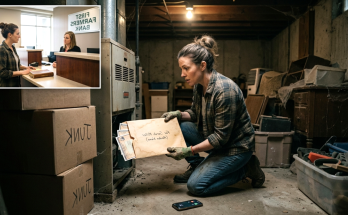
The key was brass.
Small.
Heavy.
The teeth were worn smooth.
I held it in my palm while Emily examined the note.
“This belonged to your husband.”
Nothing else.
“No name,” she said.
“No.”
“Who sent it?”
“I don't know.”
Greg arrived before lunch.
He looked at the key.
“That's Dad's.”
“How do you know?”
“I remember it.”
“Where?”
He frowned.
“He kept it on his ring.”
I searched my memory.
Walter had carried several keys.
House.
Garage.
Car.
Workshop.
There had always been one small brass key I never recognized.
I had assumed it opened an old cabinet.
Greg seemed to remember something else.
“There was a shed.”
“What shed?”
“Behind the garage.”
“There isn't a shed now.”
“There used to be.”
He walked outside.
We followed.
He stood near the far end of the yard.
“Here.”
The grass was thick.
The ground looked undisturbed.
Emily brought a shovel.
I laughed.
“Are we really doing this?”
Greg smiled.
“Apparently.”
They searched for nearly an hour.
Then Emily's shovel struck wood.
They cleared the dirt.
A small metal hatch appeared.
I stared at it.
“I've lived here forty years.”
Greg looked at me.
“Dad never told you?”
“No.”
The brass key fit.
The lock turned.
The hatch opened with a groan.
Below it was a narrow storage space.
Not a room.
More like an old root cellar.
There were shelves.
Boxes.
A lantern.
And a metal trunk.
Walter's name was stamped across the lid.
I sat on the grass.
“I don't think I'm climbing down there.”
Greg laughed.
“I'll go.”
Emily followed.
They opened the trunk.
Inside were documents.
Old photographs.
Receipts.
And a bundle of letters tied with string.
Greg climbed out first.
He carried the bundle.
Emily followed with the trunk's folder.
We brought everything inside.
The first document was dated nearly thirty years earlier.
It concerned the original construction loan.
The next concerned property taxes.
Then came something unexpected.
A letter from Walter's father.
I had never met him.
He had died before I married Walter.
The letter was about money.
Not much money.
But enough to explain something.
Walter's father had offered to help Walter finish the house.
Walter had refused.
He wanted to build it himself.
Greg stared at the page.
“That sounds like Dad.”
“It does.”
The next letter explained why.
Walter had grown up believing that accepting money came with expectations.
He did not want his children to feel the same.
I looked at Greg.
He looked away.
The irony was painful.
Walter had built the house partly to give his children security.
But he had never intended security to become entitlement.
Emily found another document.
“This one is different.”
It was a handwritten agreement.
Between Walter and me.
I frowned.
“What is that?”
She read it.
My name appeared several times.
The agreement was informal.
It stated that if Walter died first, I would have complete authority over the house.
Not ownership.
Authority.
He had written that I should never be forced to leave simply because someone else believed the property was theirs.
I stared at the page.
“I never saw this.”
Greg looked at me.
“Dad planned everything.”
“No.”
I shook my head.
“He planned enough.”
There was another envelope.
This one had Greg's name.
He opened it.
Inside was a letter Walter had written when Greg was twenty-two.
It discussed responsibility.
Walter told him that one day he might inherit money.
If he did, he should treat it as a tool, not proof of superiority.
Greg read silently.
Then he handed it to me.
“I don't want to read it again.”
I understood.
The words were too close to the truth.
We found no secret fortune.
No hidden deed.
No dramatic inheritance.
What we found was more important.
Evidence of Walter's values.
He had spent his life trying to teach us something none of us understood until much later.
Ownership was temporary.
Character was not.
We spent the rest of the afternoon organizing the documents.
By evening, the cellar had become almost forgotten again.
We left the hatch locked.
The brass key went into the desk drawer.
Greg stayed for dinner.
Afterward, he stood in the hallway looking at the photograph of Walter.
“I thought I knew him.”
“You did.”
“I knew one version.”
“So did I.”
Emily came over.
“What did you find?”
Greg told her.
She listened.
Then she said something simple.
“He was trying to leave you lessons.”
Greg smiled sadly.
“He succeeded eventually.”
I went upstairs later.
The house felt different.
Not because of the cellar.
Because secrets had a way of changing shape once they were brought into the light.
I thought about all the things Walter had left behind.
Tools.
Letters.
Photographs.
A house.
An apple tree.
None of them had mattered as much as the decisions he had made quietly.
The next morning, I received another letter.
This time, it was from a law office.
My heart sank.
I opened it.
It was not a threat.
It was a request for confirmation concerning an old account Walter had held.
The account had been inactive.
There was a small balance.
Very small.
But there was a beneficiary.
Me.
I almost laughed.
After all those years, Walter had left me something after all.
Not the house.
Not a fortune.
A few thousand dollars.
I called Greg.
He laughed when I told him.
“Dad finally left you money.”
“Apparently.”
“What will you do with it?”
“I don't know.”
Emily suggested something.
“Use it on the house.”
I shook my head.
“Why?”
“Because it's part of his.”
I thought about that.
Then I knew.
We used part of the money to restore the apple tree.
A professional arborist examined it.
The tree was old.
Older than I realized.
Some branches were diseased.
But the trunk was strong.
We had it carefully trimmed.
The tree survived.
That spring, it produced more apples than it had in years.
I stood beneath it with a basket.
Greg took a bite.
“These are good.”
“Don't eat them all.”
“No promises.”
Emily laughed.
For a while, everything felt complete.
Then Greg received a phone call.
He stepped away.
When he returned, his face was serious.
“What happened?”
He looked at me.
“It's Dana.”
I set down the basket.
“What does she want?”
“She wants to see you.”
“Why?”
“She says she owes you an explanation.”
I sighed.
“About the house?”
“About everything.”
I did not want another confrontation.
But I also knew there was something unfinished.
“Tell her she can come.”
She arrived two days later.
She stood on the porch.
No folder.
No lawyer.
No papers.
Just herself.
“Thank you for seeing me.”
I stepped aside.
She entered.
We sat in the living room.
Dana looked around.
“I forgot how much I liked this house.”
I said nothing.
“I know that sounds terrible.”
“It does.”
She smiled sadly.
“I deserved that.”
She told me the truth.
She had been deeply in debt too.
She had convinced herself that owning the house would solve everything.
When Greg hesitated, she pushed harder.
When I resisted, she decided I was confused.
She admitted that she had encouraged Greg to arrange the nursing home.
She admitted she had called Chuck.
She admitted she had contacted an attorney about challenging the sale.
And then she apologized.
“I thought I was fighting for our future.”
“You were fighting for yourself.”
“Yes.”
Her eyes filled.
“I know.”
I looked at her.
“I can't erase what happened.”
“I don't expect you to.”
“I may never trust you.”
“I understand.”
“But I don't hate you.”
She looked surprised.
“Why?”
“Because hate is too much work.”
She laughed through her tears.
“That sounds like you.”
“It's practical.”
She nodded.
When she left, I watched her walk down the steps.
Greg stood beside me.
“Was that enough?”
“No.”
He looked at me.
“Then what?”
“Enough for today.”
He nodded.
That evening, I opened Walter's final letter again.
I read the sentence about generosity becoming surrender.
I understood it more clearly than ever.
I could forgive Dana without inviting her back into my life.
I could love Greg without trusting him blindly.
I could cherish Walter without turning his memory into a rulebook.
And I could live in a house I no longer owned without feeling displaced.
The next morning, Emily arrived.
She had a strange expression.
“What now?”
She handed me an envelope.
“Another one?”
“Yes.”
I looked at the handwriting.
It wasn't Walter's.
It was Greg's.
I opened it.
Inside was a single page.
He had written that he had made one final decision.
He wanted to transfer something to Emily.
Not the house.
Something else.
Something that had belonged to him.
A property.
A small parcel of land.
The letter said he wanted Emily to have it because he no longer wanted to measure family by inheritance.
He wanted to give her something freely.
No conditions.
No expectations.
No claim on her future.
I looked at him when he arrived later.
“You're serious?”
“Yes.”
“Why?”
“Because I finally understand the difference.”
“Between what?”
“Giving and taking.”
I smiled.
That was the lesson Walter had left us.
And perhaps, at last, we had learned it.
Click here to continue reading: PART 12: Years After the Suitcase Was Packed, I Finally Understood What the House Had Been Trying to Teach All of Us
My Son Packed My Suitcase Before Breakfast, Certain I Had Nowhere Left to Go
Part 11 of 12