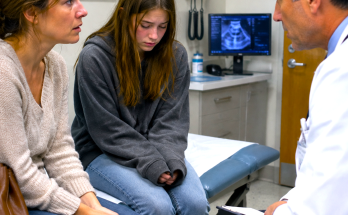
The DNA results arrived several weeks later.
I didn't request them.
I didn't want them.
But information has a way of reaching you when enough people believe you ought to know.
Marcus called one afternoon.
"You may want to sit down."
I was at my desk reviewing a Northstar contract.
"Is Daniel in trouble again?"
"Not exactly."
I waited.
"The test showed that only one of the twins is biologically his."
I stared at the papers in front of me.
For a moment, I didn't know what to say.
"Did Daniel know?"
"I don't know."
"Do you know which child?"
"No."
I looked out the window.
Cars moved along the street below.
People carried coffee cups. A cyclist waited at a red light. Someone hurried across the pavement with a briefcase pressed against his side.
The city continued as if nothing had happened.
"Don't tell me anything else," I said.
Marcus paused.
"All right."
I ended the call.
That was all.
Once, I would have needed every detail.
Now I didn't.
The divorce moved forward.
Daniel's attorney eventually advised him to settle.
The financial records were too clear.
The home-equity withdrawals had been documented.
The inheritance records were established.
The disputed research payments were being investigated separately.
Northstar's funding agreement had been followed correctly.
There was little room left for the version of events Daniel had imagined when he walked into my house with suitcases.
He had expected half of everything.
Instead, he received only what the law and the documented finances required.
The house was sold.
I hired movers.
The process took two days.
Every room produced something I hadn't remembered.
A cracked mug.
An old conference badge.
A photograph from a trip we took before the fellowship.
A sweater Daniel had left behind years earlier.
I put most of it into boxes.
Some things I donated.
Some I kept.
None of it felt dramatic.
That surprised me.
The pain had been dramatic.
The ending was mostly practical.
On the final morning, I stood in the kitchen with a cup of coffee.
Sunlight fell across the counter.
For years, this had been the room where I organized Daniel's life.
Bills.
Travel.
Insurance.
Appointments.
Deadlines.
Now there was nothing left to organize.
I carried the last box outside.
Then I locked the door.
I didn't look back.
Daniel's professional life continued to unravel over the following months.
The institute completed its investigation.
His research position ended.
Northstar pursued recovery of funds connected to the disputed reimbursements.
Other authorities reviewed transactions independently.
The gene-therapy project itself survived.
That mattered to me.
I had never invested in it because of Daniel.
I had invested because the science was promising.
The project deserved a chance to continue without being tied to one person's choices.
A respected researcher from Boston eventually took over the program.
The team was rebuilt.
The valid work continued.
And slowly, the headlines disappeared.
There were no dramatic public confrontations.
No speeches.
No grand revenge.
Daniel simply stopped being part of my daily life.
That absence took some getting used to.
For eleven years, his existence had been woven into nearly every practical decision I made.
Now I could choose dinner without asking what time he would be home.
I could plan a trip without checking his schedule.
I could work late without explaining why.
I could wake on a Sunday morning and have no obligation to wait for a call.
The freedom felt strange before it felt natural.
Six months after the divorce, Northstar moved into a larger headquarters.
The company had grown substantially.
I stood in the unfinished executive office on the top floor while workers installed the last pieces of furniture.
Marcus came in carrying two coffees.
"One black," he said.
"You're learning."
"I've known you for eight years."
"Still."
He handed me the cup.
We stood beside the windows.
The city spread below us.
"How's the house sale?"
"Done."
"Any regrets?"
I thought about it.
"No."
"None?"
"I miss what I thought it represented."
Marcus looked at me.
"But not the house."
"No."
He nodded.
"That's different."
"It is."
We watched traffic move below.
After a while, Marcus asked the question I knew he had been avoiding.
"Do you ever miss Daniel?"
I didn't answer immediately.
I thought about Terminal 4.
The lilies.
The woman in the cream coat.
The two boys.
The ring in Daniel's hand.
Then I thought about the kitchen in our old house.
The Sunday calls.
The money transfers.
The years spent believing that patience was proof of love.
Finally, I shook my head.
"No."
Marcus smiled faintly.
"That was quick."
"It wasn't."
He waited.
I took a sip of coffee.
"I don't miss him."
The distinction mattered.
There had been a time when I thought losing Daniel meant losing the future.
Now I understood that I had been grieving a future that had never existed in the form I imagined.
Daniel had been building another life while I was maintaining ours.
I hadn't failed to save the marriage.
I had simply been the last person to learn that there was no marriage left to save.
Marcus leaned against the railing.
"Do you think you'll ever marry again?"
I laughed softly.
"That's a question for another decade."
"Fair."
He looked through the glass wall toward the main office.
Employees were gathering around a conference table.
Researchers were discussing data.
A new project manager was reviewing a schedule.
Everything moved.
That was what struck me most.
Life didn't stop when Daniel left.
It had not even stopped when he betrayed me.
It had simply become mine again.
A year after the airport, the gene-therapy program released encouraging early clinical results.
The work wasn't finished.
There were still years of research ahead.
But the project had survived.
Northstar had grown.
And I had finally stopped measuring my life by whether Daniel was proud of me.
One evening, I stood on the balcony outside my office.
The glass doors behind me reflected the lights of the building.
Marcus stepped outside.
He rested his arms on the railing.
"You ever think about that day?"
"The airport?"
"Yes."
I looked at the city.
"Sometimes."
"What do you remember first?"
"The flowers."
"The lilies?"
I nodded.
"I spent three years imagining what I'd say when Daniel came home."
"And what did you say?"
"Almost nothing."
Marcus smiled.
"Probably wise."
I shook my head.
"It wasn't wisdom."
"What was it?"
I considered the question.
"Exhaustion."
He waited.
"By then, I had spent years explaining him to myself. Explaining the delays. The money. The distance. The missed plans. The extensions. The strange gaps in his stories."
I looked down at my hands.
"When I saw Vanessa, I finally ran out of explanations."
The balcony became quiet.
Below us, headlights moved through the streets.
"Do you regret giving him the ring?"
Marcus asked.
"No."
"Why?"
"Because he thought it meant I had lost."
I smiled.
"He didn't understand that I was giving back something he had already abandoned."
Marcus looked toward the city.
"That's a good line."
"It's not a line."
"I know."
The truth was simpler than any revenge story.
I had not destroyed Daniel.
I had not needed to.
His choices had been his.
The false invoices were his.
The unauthorized withdrawals were his.
The affair was his.
The decisions that brought the consequences were his.
My role was only to stop protecting him from the results.
That was the part I understood last.
For years, I had confused loyalty with responsibility.
I thought loving someone meant absorbing the consequences of their decisions.
It didn't.
Love could not turn dishonesty into honesty.
Patience could not make betrayal disappear.
And a marriage certificate could not force two people to remain loyal to the same future.
Daniel had wanted a clean beginning with Vanessa and the boys.
He had believed the house would provide it.
He had believed his career would provide it.
He had believed I would simply step aside.
Instead, he discovered that the life he had taken for granted was supported by people and structures he had never bothered to understand.
Including me.
The next morning, I arrived early at Northstar.
The office was quiet.
I placed my coffee beside my laptop and opened the latest research report.
The project was moving forward.
The company was stable.
The future was uncertain in all the ordinary ways that futures are uncertain.
And for the first time in a long time, uncertainty didn't frighten me.
I looked through the windows at the morning light spreading across the city.
I thought about the woman who had stood at Terminal 4 holding white lilies for a man who had already chosen another life.
I felt no hatred toward her.
No longing for him.
Only a quiet recognition of how much had changed.
Daniel had once believed my world revolved around his ambitions.
He had been wrong.
I had simply been standing close enough to his life that he mistook my support for dependence.
When he walked away, I didn't lose myself.
I finally stopped postponing myself.
And when I went home that night, I understood something I had never been able to see while waiting for him to return.
The future I had been waiting for wasn't coming through an airport door.
It had been waiting for me all along.
Click here to continue reading: PART 5: The Call I Never Expected Came From the Research Institute, and It Forced Me to Revisit One Detail I Had Chosen to Leave Behind
I Had Spent Three Years Waiting at Home, So I Wasn’t Prepared for Who Walked Through the Airport Doors Beside Him
Part 4 of 12