The invitation came in spring.
Harvard wanted Sarah to return.
Not for another degree.
Not for an award.
For a small gathering honoring mentors and scholarship recipients who had expanded access to medical research.
The email was polite and formal.
Sarah read it three times.
Then she laughed.
When she had first arrived in Boston, she had thought Harvard was the answer to every question she had carried from home.
Years later, she understood that the place had never answered anything.
It had simply given her room to ask better questions.
She accepted the invitation.
Her father offered to drive her to the airport.
“You don't have to.”
“I know.”
“You're doing it anyway.”
“Yes.”
He smiled.
“Your mother packed food.”
“Of course she did.”
“She thinks airports don't sell anything edible.”
“They don't.”
He laughed.
At the airport, they stood near the security entrance.
Her father looked older than he had a few years earlier.
Sarah noticed the changes now.
The slower movement.
The gray at his temples.
The way he sometimes paused before standing.
She didn't pretend not to see.
“Are you taking care of yourself?” she asked.
“I could ask you the same thing.”
“You could.”
“Then?”
“I am.”
“Good.”
He nodded.
Neither wanted the goodbye to become sentimental.
So they avoided it.
“I'll call when I land,” Sarah said.
“Okay.”
She turned.
“Dad?”
He looked up.
“Thank you.”
“For what?”
“For learning.”
He swallowed.
“I should have learned sooner.”
“Yes.”
He smiled sadly.
“I know.”
Sarah walked toward security.
She didn't look back until she reached the escalator.
Her father was still standing there.
He raised one hand.
She raised hers.
Then she disappeared into the crowd.
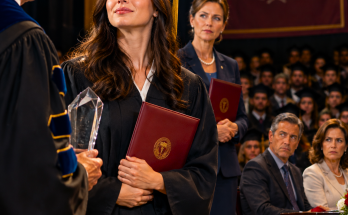
At Harvard, the ceremony took place in a room Sarah had never seen during her student years.
That seemed fitting.
The building looked familiar without feeling like home.
She walked through the hallway and remembered the first months when she had been terrified someone would discover she didn't belong.
Now she knew belonging was not something another institution could grant permanently.
It was something she had built through years of work, friendship, mistakes, and choices.
Maya attended the ceremony too.
She had finished her first major research project and was preparing applications for doctoral programs.
“You're really stepping away from the scholarship?” Maya asked.
“Yes.”
“Does that scare you?”
“A little.”
“Good.”
Sarah laughed.
“You sound like Professor Liang.”
“I'll take that as a compliment.”
“It is.”
During the reception, an older professor approached Sarah.
“I knew Professor Liang.”
Sarah smiled.
“Then you have my sympathy.”
The professor laughed.
“He spoke highly of you.”
Sarah looked down.
“What did he say?”
“That you were unusually persistent.”
Sarah laughed.
“That sounds like him.”
The professor studied her.
“He also said you were too hard on yourself.”
Sarah looked surprised.
“He said that?”
“Several times.”
She smiled.
“I wish he'd said it to me.”
“He probably did.”
“He did.”
They both laughed.
Later that night, Sarah walked alone across campus.
The air was cold.
Students crossed the courtyard carrying books.
A young man sat on a bench reading.
Two women argued quietly about a laboratory schedule.
Somewhere, a bicycle bell rang.
Sarah stopped near a building where she had once studied late into the night.
She remembered being twenty-three and exhausted.
She had called her mother.
Then her father.
Neither had known what to say.
She had cried after the call.
Then she had gone back to studying.
At the time, she thought that was resilience.
Now she wondered if it had also been loneliness.
The distinction mattered.
She sat on a bench.
Her phone vibrated.
A message from her father.
“Did you make it?”
Sarah replied.
“Yes.”
“Good.”
Then another message arrived.
“Your mother wants pictures.”
Sarah smiled.
She sent one.
The campus lights.
The old buildings.
The path.
Nothing dramatic.
Her father responded.
“She says it's beautiful.”
Sarah typed:
“It is.”
Then she added:
“Wish you were here.”
She almost deleted it.
She didn't.
His response came quickly.
“So do I.”
Sarah stared at those three words.
She hadn't expected them to hurt.
They did.
But it was a clean kind of hurt.
The kind that came from understanding that some years could never be recovered.
She could forgive her father.
She could love him.
She could accept his apologies.
But she could not travel backward.
No one could.
And perhaps that was why she had finally stopped trying.
The next morning, Sarah gave a short speech.
She spoke about access.
About mentorship.
About students who had talent but lacked money, connections, confidence, or someone willing to take them seriously.
Then she told the story of the thirteen-year-old girl.
“I used to think the important part was that someone destroyed her project,” Sarah said.
The audience listened.
“Now I think the important part is that she built it in the first place.”
She paused.
“That girl didn't know what Harvard was. She didn't know what a scholarship was. She didn't know whether she would become a doctor. She simply wanted to understand why something stopped working.”
Sarah smiled.
“And I think that's where I began.”
After the speech, several students approached her.
One wanted advice about medical school.
Another asked about research.
A third simply said, “I needed to hear that.”
Sarah thanked them.
She did not tell them they would succeed.
She told them to keep asking questions.
On her flight home, Sarah opened her laptop.
She wrote to Professor Liang.
She knew he might not answer immediately.
“Today I finally understood what you meant.”
She described the speech.
Then she added:
“I spent years trying to prove I belonged. I think I'm done with that.”
His response arrived that evening.
“You should be.”
Then another sentence.
“Now go live.”
Sarah read it.
She smiled.
At home, she opened the drawer one more time.
The photograph.
The ribbon.
The clipping.
The cardboard fragment.
The notebook.
The letters.
They were all there.
But something had changed.
The drawer no longer felt like a museum.
It felt like an archive.
A place where history could be kept without being worshipped.
Sarah closed it.
She went into the kitchen.
Her phone rang.
Maya.
“Bad time?”
“No.”
“I have news.”
“What happened?”
“I got the fellowship.”
Sarah smiled.
“I knew you would.”
“You weren't allowed to know.”
“I didn't.”
“You sounded like you did.”
Sarah laughed.
Maya continued.
“I was scared to tell my father.”
“And?”
“He cried.”
Sarah's smile softened.
“Good.”
“He said he was proud.”
Sarah looked toward the closed drawer.
“What did you say?”
“I said thank you.”
Sarah nodded.
Sometimes, she thought, healing was not dramatic.
Sometimes it was simply hearing a sentence that should have been spoken years earlier and realizing you no longer needed it to survive.
Click here to continue reading: PART 19: What Remained
The Night Her Father Said She Had Wasted Her Potential, Sarah Quietly Decided She Would Stop Asking Them to See It
Part 18 of 20

One Comment on “PART 18 – The Last Question”