The first thing I noticed about Boston was how little anyone cared who my family thought I was.
The driver didn't know my father.
Dr. Porter didn't know Marcus's opinions mattered to me.
Professor Liang didn't know how many times my mother had told me to choose a safer path.
Nobody on the campus knew I had once stood in a bedroom searching for a science project that had been deliberately thrown away.
They only knew my name.
That was strangely comforting.
The university car stopped outside the building where I would be staying.
I carried my box upstairs myself.
My room was small.
One bed.
One desk.
One narrow window.
A radiator clicked beneath it.
I set my bag on the floor.
Then I took out the blue ribbon.
I placed it on the desk.
For several minutes, I simply looked at it.
It belonged to a girl who had no idea what was coming.
A girl who believed adults told the truth.
A girl who thought winning would make people proud.
I wanted to tell her she was wrong.
But I also wanted to tell her something else.
She had survived.
That mattered more.
My phone buzzed.
A message from Professor Liang.
You arrived?
I replied.
Yes.
Then another message appeared.
Sleep.
I smiled.
I hadn't told him about the confession yet.
I wasn't ready.
That night, I couldn't sleep.
I opened my laptop and started reviewing the research material for the program.
The pages were dense.
The expectations were intimidating.
For the first time, Harvard wasn't a fantasy.
It was a schedule.
Deadlines.
Labs.
Exams.
People who were just as intelligent as I was and had spent years preparing for the same opportunity.
I felt the familiar fear rising.
What if my father had been right?
What if I had mistaken stubbornness for talent?
What if I wasn't good enough?
I stopped.
Then I looked at the ribbon.
The question changed.
What if I was good enough even when nobody believed it?
I closed the laptop.
The next morning began before sunrise.
By seven, I was in the laboratory.
By eight, I had already made my first mistake.
The researcher beside me corrected it without comment.
I thanked her.
At lunch, I realized I had forgotten to eat.
Some things didn't change.
I bought a sandwich and sat outside.
The campus was full of movement.
Students hurried between buildings.
Professors carried stacks of papers.
Someone played music near the courtyard.
I watched them and wondered how many of them had spent years believing they didn't belong.
Probably more than I imagined.
That afternoon, Dr. Porter called me into her office.
She closed the door.
“You look exhausted.”
“I am.”
“Good.”
I laughed.
She smiled.
“Exhaustion is not a badge of honor, Sarah. Learn the difference between commitment and destroying yourself.”
I nodded.
She placed a folder on the desk.
“Your scholarship paperwork.”
I opened it.
Everything was official.
Tuition.
Housing.
Research funding.
Medical program requirements.
I ran my finger over my name.
Sarah Thompson.
For years my name had sounded like an accusation when my father said it.
Now it sounded like an opportunity.
Dr. Porter watched me.
“You've worked very hard to get here.”
“I know.”
“No.”
She shook her head.
“I don't think you do.”
I looked up.
“You think getting here means the hard part is over.”
“It doesn't?”
“No.”
She smiled.
“The hard part changes.”
I laughed softly.
“That sounds encouraging.”
“It is.”
She leaned back.
“You've learned how to survive without much support. Now you need to learn how to succeed without believing you must do everything alone.”
I thought of Professor Liang.
Then my mother.
Then my father.
“I'll try.”
“That is enough for today.”
When I returned to my room, there was a voicemail from my father.
I didn't play it immediately.
I stared at the notification for several minutes.
Then I pressed the button.
His voice sounded different.
Older.
“Sarah, it's Dad.”
A pause.
“I don't know if you want to hear from me.”
Another pause.
“I found something else.”
My stomach tightened.
“It was with the ribbon.”
He took a breath.
“I think you should have it.”
The message ended.
I called him.
He answered on the first ring.
“Sarah?”
“What did you find?”
He was silent.
“A photograph.”
“Of what?”
“You.”
My heart began beating faster.
“Where?”
“In the attic.”
“Send it.”
“I will.”
He hesitated.
“Your mother wanted me to throw it away.”
“Why?”
“Because it was painful.”
I closed my eyes.
“Send it.”
He did.
A minute later, the image appeared on my phone.
I stared.
It was me at thirteen.
Standing beside my science project.
The day before it disappeared.
I was smiling so widely my eyes were almost closed.
There was a handwritten note on the back.
I enlarged the image.
One sentence.
She deserves to know she was good enough.
I didn't remember writing it.
My throat tightened.
“Dad?”
“Yes.”
“Who wrote that?”
“I think you did.”
I stared at the screen.
“I don't remember.”
“You were thirteen.”
He sounded ashamed.
“I should have kept this somewhere you could find it.”
“You should have kept a lot of things.”
“I know.”
Silence.
Then he said, “I'm sorry.”
I didn't answer.
He didn't push.
That was new.
Finally, he said, “You don't have to forgive me.”
“I know.”
“I just wanted you to know that I understand now.”
I looked at the photograph.
“Do you?”
“I think I'm beginning to.”
We ended the call without resolving anything.
But for the first time, there had been no argument.
No defense.
No explanation.
Just two people standing on opposite sides of something that had happened a long time ago.
I printed the photograph the next day.
I carried it in my notebook.
Whenever the workload became too heavy, I looked at it.
The girl in the picture didn't know about Harvard.
She didn't know about the scholarship.
She didn't know she would work two jobs.
She didn't know that one day her family would learn the truth.
She only knew that she had built something she was proud of.
That was enough.
Months passed.
The work became harder.
There were exams that made my hands shake.
Research nights that stretched past midnight.
Patients whose stories followed me home.
Sometimes I called Professor Liang.
Sometimes he answered.
Sometimes he didn't.
He had taught me something important without ever saying it directly.
Needing people did not make me weak.
But depending on people to define my worth was dangerous.
My family began changing slowly.
My mother sent short messages.
How was your exam?
Did you eat?
My father sent photographs of the garden.
Marcus wrote once.
No excuses.
Just:
I know I can't undo it. I'm trying to be better.
I didn't respond immediately.
Weeks later, I wrote back.
Then keep trying.
It wasn't forgiveness.
But it was a beginning.
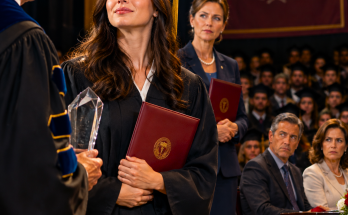
Years later, when I stood in a white coat for the first time, Professor Liang was in the front row.
Dr. Porter sat beside him.
I looked out at the audience and thought about the thirteen-year-old girl in the photograph.
I thought about the ribbon.
I thought about the father who had once called me a failure.
And I understood something I hadn't understood when I left home.
I hadn't needed Harvard to prove my father wrong.
I had needed to stop letting his judgment become my own.
After the ceremony, a little girl approached me.
She held a homemade model of the human brain against her chest.
“Can I ask you something?”
“Of course.”
“Do you think I could become a doctor?”
I looked at the model.
Then at her face.
For a moment, I saw myself.
Not the woman in the white coat.
The girl before everything became complicated.
I smiled.
“I don't think you can.”
Her face fell.
Then I continued.
“I know you can.”
She smiled.
Her father reached down and carefully took the model from her before it slipped.
He carried it as though it were precious.
I watched them walk away.
And I finally understood why the old photograph had mattered so much.
It wasn't proof that I had succeeded.
It was proof that I had once believed in myself before anyone taught me not to.
The photograph went back into my notebook.
The blue ribbon went into a drawer.
My family remained imperfect.
So did I.
We never erased what happened.
We simply stopped allowing it to decide everything that came afterward.
Some wounds don't disappear.
They become part of the map.
You learn where they are.
You learn how to walk without letting them choose the direction.
And sometimes, after enough years, you realize the life you were told you could never have was never waiting for anyone's permission.
It was waiting for you to claim it.
Click here to continue reading: PART 5: The First Letter From Home Arrived Months After Sarah Left, Carrying an Apology That Asked for Nothing in Return
The Night Her Father Said She Had Wasted Her Potential, Sarah Quietly Decided She Would Stop Asking Them to See It
Part 4 of 20