Marcus came to Boston without telling her.
Sarah learned this from a text message.
I'm outside your building.
She stared at it.
Her first instinct was anger.
Her second was to ignore him.
Her third was curiosity.
That third instinct won.
She went downstairs.
Marcus stood beneath the awning with his hands in his coat pockets.
He looked older.
Not dramatically.
Just enough that Sarah could see time had happened to him too.
“You should have called.”
“I was afraid you wouldn't answer.”
“That hasn't stopped you before.”
He nodded.
“I deserve that.”
Sarah leaned against the doorframe.
“Why are you here?”
“I wanted to apologize in person.”
“You already apologized.”
“I know.”
“Then what changed?”
He looked at her.
“I finally understood that saying sorry isn't the same as admitting what I did.”
Sarah said nothing.
Marcus took a breath.
“I didn't destroy your project because I thought it was bad.”
“I know.”
“I destroyed it because everyone was proud of you.”
She watched him.
“I was jealous.”
“I know.”
“I hated myself for being jealous.”
“And that became my problem.”
He nodded.
“Yes.”
Sarah looked down the street.
Cars moved through the rain.
People hurried beneath umbrellas.
“You were a teenager.”
“I know.”
“So was I.”
He looked at her.
“I keep thinking about that.”
“Good.”
“I wish I could go back.”
“You can't.”
“I know.”
He rubbed his palms together.
“Dad told me you kept the ribbon.”
“I did.”
“Why?”
Sarah considered the question.
“Because it belongs to me.”
Marcus nodded.
“I thought maybe you'd throw it away.”
“I almost did.”
He looked surprised.
“Why didn't you?”
“Because the girl who won it didn't do anything wrong.”
His eyes filled.
Sarah saw it but didn't comfort him.
That was not cruelty.
It was a boundary.
He had spent years expecting her pain to become his redemption.
She was not going to do that anymore.
Marcus looked toward the entrance.
“Can I come upstairs?”
“No.”
He nodded.
“Okay.”
“I'll talk to you here.”
He accepted that.
They stood beneath the awning.
For twenty minutes, Marcus told her things she had never known.
He had struggled in school.
Their father's approval had become the measure of everything.
When Sarah started winning awards, Marcus felt as though the family had suddenly acquired a replacement for him.
It was irrational.
He knew that now.
But at seventeen, jealousy had felt like evidence.
Sarah listened.
Then she said, “I understand why you did it.”
Marcus looked at her.
“I don't forgive it.”
His eyes lowered.
“I know.”
“But understanding helps me stop wondering whether I imagined it.”
He nodded.
“That matters.”
After he left, Sarah stood outside for another few minutes.
She had expected closure.
Instead, she felt something subtler.
The past had become specific.
That made it easier to carry.
A month later, Sarah received an email from her father.
Not a letter.
An email.
The subject line was simple.
Your old project.
Attached was a scanned photograph.
Her father had found a newspaper clipping.
Sarah opened it.
There she was.
Thirteen years old.
The article described the science fair winners.
Her name appeared beneath the photograph.
The article quoted her.
I want to study how the brain works because I think understanding people can help us understand what they need.
Sarah read the sentence several times.
She didn't remember saying it.
Her father had written beneath the attachment:
I never understood how much of you was already there.
She closed the email.
Then she opened it again.
This time, she replied.
You don't have to understand everything. Just don't tell me I'm failing when you don't understand me.
She sent it.
Her father responded the next morning.
I won't.
It was the shortest promise he had ever made.
For the first time, Sarah believed he might keep it.
Life at Harvard became more demanding.
Her schedule filled with lectures, research meetings, clinical preparation, and long hours spent studying material that seemed endless.
She stopped measuring herself against other people.
That was harder than she expected.
Competition had been part of her childhood.
Now she had to learn cooperation.
One afternoon, a fellow student named Elena found Sarah asleep over her notes.
“You're going to hurt yourself.”
Sarah opened one eye.
“I'm fine.”
“No.”
Elena took the notebook.
“You're exhausted.”
“I have an exam.”
“You have a brain. It needs sleep.”
Sarah laughed.
“You sound like Professor Liang.”
“Who?”
“My mentor.”
Elena handed her a bottle of water.
“Call him.”
Sarah did.
Professor Liang answered immediately.
“I told you to sleep.”
“Everyone keeps telling me that.”
“Perhaps everyone is right.”
Sarah smiled.
There were people in her life now who noticed things without being asked.
That realization was almost painful.
She had spent years believing independence meant needing nobody.
Now she understood the difference.
Independence meant choosing whom to trust.
Months later, Sarah received an invitation from her hometown university.
The science department was dedicating a small scholarship in her name.
She nearly refused.
Then she read the details.
The scholarship would go to a student interested in medical research who lacked financial support.
Sarah stared at the words.
A scholarship.
For someone else.
She accepted.
When she returned home for the ceremony, her father was waiting outside the auditorium.
He didn't hug her.
He simply said, “You came.”
“I did.”
He nodded.
“You look tired.”
“I am.”
He smiled.
“Still working too hard.”
“Probably.”
They walked inside together.
The old hallway smelled exactly as she remembered.
Waxed floors.
Paper.
Dust from the heating vents.
Sarah stopped outside the science classroom.
Her father noticed.
“You okay?”
“Yes.”
She looked through the glass.
“I used to sit there.”
“I remember.”
“No.”
He looked at her.
“You remember now.”
His face tightened.
“Yes.”
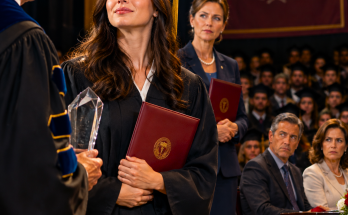
The scholarship ceremony was short.
Sarah spoke for ten minutes.
Her father sat in the back.
Her mother sat beside him.
Marcus came too.
When Sarah finished, the room applauded.
She looked toward her family.
They were standing.
Not because they were trying to prove anything.
Just because they were proud.
For once, she didn't wonder whether the pride was conditional.
After the ceremony, a teenage boy approached.
“Dr. Thompson?”
Sarah smiled.
“Just Sarah.”
He held a notebook.
“My teacher said you almost quit.”
“I thought about it.”
“Why didn't you?”
Sarah looked at him.
“Because I realized quitting and changing direction aren't the same thing.”
He frowned.
“I don't understand.”
“You don't have to.”
She smiled.
“You're allowed to take your time figuring out what your life should look like.”
He nodded.
Then he asked, “Did your parents believe in you?”
Sarah glanced across the room.
Her father was talking quietly with Professor Liang.
Her mother was looking through old photographs.
Sarah answered honestly.
“Not at first.”
The boy waited.
“But that didn't stop me.”
That evening, her father walked her to the car.
“I want to give you something.”
He handed her a small envelope.
Inside was the original newspaper clipping.
The edges were yellow.
“You kept it?”
“For years.”
“Why?”
He looked at her.
“Because I was proud of you before I knew how to say it.”
Sarah looked at the clipping.
Then she folded it carefully.
“Thank you.”
He nodded.
She put it in her bag.
Before getting into the car, she turned.
“Dad?”
“Yes?”
“Don't hide things from me anymore.”
“I won't.”
She believed him.
Not completely.
But enough to keep walking.
Click here to continue reading: PART 7: The Scholarship Ceremony Forced Sarah to Face the Version of Her Father She Had Carried for Years, and He Finally Stopped Asking Her to Forget
The Night Her Father Said She Had Wasted Her Potential, Sarah Quietly Decided She Would Stop Asking Them to See It
Part 6 of 20