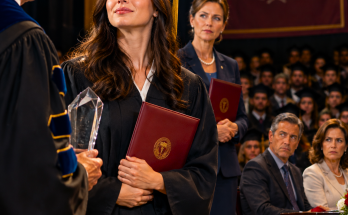
The foundation held its first annual family gathering in the backyard five years after Arthur died.
There were folding tables beneath the trees.
Children ran between the chairs.
Firefighters stood near the grill.
Families who had received housing assistance brought food.
The atmosphere was noisy in the way Arthur had always liked.
He hated formal dinners.
He loved crowded kitchens.
I stood near the porch with a glass of lemonade.
Roy was arguing with a firefighter about barbecue sauce.
Sandra was helping a teenager fill out a scholarship application.
I watched them both.
There were still traces of the people they had been.
Roy still became defensive when he felt accused.
Sandra still apologized before admitting she needed help.
But they were different.
Not transformed into perfect people.
Just honest ones.
Mr. Katz arrived late.
He carried a small wooden box.
My heart tightened.
“What is that?”
He smiled.
“Something Arthur left with me.”
“You've had it five years?”
“Longer.”
I stared at him.
“You really enjoy dramatic timing.”
He laughed.
“Arthur requested it be given to you at the fifth annual foundation gathering.”
“This is the fifth.”
“Yes.”
Roy and Sandra came over.
“What is it?” Sandra asked.
Mr. Katz placed the box on the table.
A brass latch held it closed.
I recognized the wood.
Arthur had made it himself.
My fingers shook.
“Open it,” Roy said.
Inside was a bundle of letters.
Three.
One for me.
One for Roy.
One for Sandra.
There was also a small brass key.
Roy frowned.
“Another key?”
Mr. Katz smiled.
“Not this time.”
The key belonged to a storage locker.
I looked at him.
“Where?”
“The old firehouse.”
Roy's expression changed.
“Dad's old station?”
“Yes.”
“What's there?”
“You'll find out.”
We drove there the next morning.
The old firehouse had been renovated, but the back storage room remained almost unchanged.
An elderly captain greeted us.
He remembered Arthur.
“He talked about you,” he told me.
“About me?”
“All the time.”
I smiled.
“What did he say?”
“That you hated his chili.”
“I did.”
The captain laughed.
“Good.”
He led us to a row of lockers.
The key opened one.
Inside was a battered red toolbox.
Nothing else.
Roy lifted it.
“It weighs a ton.”
We carried it to a table.
The toolbox contained letters, photographs, medals, old firehouse patches, and a cassette tape.
A handwritten label read:
For when they are finally ready.
Sandra touched the tape.
“What is it?”
“Probably another lecture,” Roy said.
I smiled.
We found an old player in the station office.
The tape crackled.
Arthur's voice emerged.
Older.
Stronger.
He was speaking to Roy and Sandra.
“I don't know when you'll hear this.”
Sandra covered her mouth.
“But if you're hearing it, then I assume Helen has survived my stubbornness, and you've survived your own.”
Roy laughed.
Arthur continued.
“I spent much of my life thinking being a father meant protecting my children from pain.”
He paused.
“I was wrong.”
The room became still.
“Sometimes protecting someone from pain only delays the lesson they need.”
Sandra began crying.
“I should have told you about your mother.”
Roy closed his eyes.
“I should have told you about the illness. I should have trusted you to grieve with me.”
The tape hissed.
“But I was afraid.”
That admission mattered more than anything else.
Arthur was not defending himself.
He was confessing.
“I thought if you knew how sick she was, you would remember her illness instead of her laughter.”
Sandra whispered, “Mom.”
Arthur continued.
“I was wrong about some things. I was right about others. You will never know which is which unless you decide for yourselves.”
The tape ended.
Nobody spoke.
Then Roy asked the question we had all been avoiding.
“Why did he leave the house to Helen?”
Mr. Katz answered.
“Because he wanted to break the argument before it began.”
“What argument?”
“Who loved him more.”
Roy looked away.
Arthur had understood something none of us had.
A house could become evidence.
Money could become evidence.
Possessions could become evidence.
Children could turn inheritance into a courtroom where everyone tried to prove they had been the favorite.
Arthur had refused to let his death become that trial.
Instead, he had given the house to the person who had built a life with him.
Then he gave his children something harder.
A chance to decide what kind of people they would become after he was gone.
Sandra sat down.
“I think I finally understand.”
Roy nodded.
“So do I.”
I looked at them.
“Understand what?”
“That Dad wasn't choosing between us.”
Sandra answered.
“He was choosing what he wanted his death to mean.”
That sentence stayed with me.
The foundation's fifth anniversary ceremony was that afternoon.
There were no speeches planned.
But Roy asked if he could say something.
He stood beneath the tree.
The crowd became quiet.
“My father left me a house I didn't receive.”
A few people laughed softly.
Roy smiled.
“I spent years thinking that meant I had lost something.”
He looked at me.
“I hadn't.”
He told them about the foundation.
About the first families.
About the people who had helped him understand his father differently.
He did not mention the medication.
He did not mention the thefts.
Those belonged to private history.
But he said one thing I would never forget.
“My father taught me that inheritance isn't what you get when someone dies. It's what you do with what they taught you while they were alive.”
Sandra stepped beside him.
“And sometimes,” she added, “the person you blamed for your pain is the person who stayed when everyone else left.”
She looked at me.
I felt tears rise.
The applause came slowly.
Then everyone stood.
I hated standing ovations.
Arthur would have loved one.
That evening, after everyone left, I sat beneath the tree.
Roy brought me a cup of coffee.
“Black?”
“Yes.”
“Still no sugar?”
“Still.”
He sat beside me.
“You know what Dad would say?”
“What?”
“That you finally learned to drink coffee properly.”
I laughed.
“He would be wrong.”
“Of course.”
We sat quietly.
Then Roy said, “I want to tell you something about the pills.”
I turned toward him.
“I know.”
“No. You know I took them.”
“Yes.”
“You don't know why I stopped.”
I waited.
“I stopped because I realized Dad knew.”
I looked at him.
“He didn't threaten me.”
“What did he do?”
“Nothing.”
Roy looked toward the building.
“That was worse.”
He explained that after one of the missing-pill incidents, Arthur had called him into the bedroom.
Roy had expected anger.
Arthur had simply looked at him and said, “You're hurting.”
Roy had denied it.
Arthur had said, “You don't steal medicine from someone you don't love.”
Roy's eyes filled.
“He told me to get help.”
“Did you?”
“Eventually.”
I put my hand over his.
“I'm glad.”
“So am I.”
Sandra joined us.
She had heard the last part.
“I didn't know that.”
Roy nodded.
“I didn't tell you.”
“Why?”
“Because I was ashamed.”
Sandra sat down.
“We were both ashamed.”
I looked at them.
“Your father knew.”
“That was his gift,” Sandra said. “He saw the ugly parts and still believed we could choose differently.”
The tree moved overhead.
A few white petals fell onto the grass.
I picked one up.
Arthur had once said trees didn't hurry.
Maybe people shouldn't either.
The next morning, I returned to the house.
The kitchen was quiet.
I made coffee.
I stood where Roy had once measured the cabinets.
The tape measure had disappeared years ago.
I had thrown it away.
Not angrily.
It simply no longer mattered.
I opened the drawer where Arthur kept the old black notebook.
It was still there.
Twenty-two months.
Twenty-two envelopes.
Twenty-two records.
I turned to the final page.
Beneath my last sentence, I found something I had never noticed.
A small note in Arthur's handwriting.
You did enough.
I sat down.
Those three words were worth more than every document in the bank.
You did enough.
I had spent years wondering whether I had cared for him properly.
Whether I had missed signs.
Whether I had done enough.
Arthur had known I would ask.
He had answered before I could.
I closed the notebook.
Outside, the tree beside the foundation was moving in the wind.
The house remained.
The foundation remained.
His children remained.
And I remained.
Not waiting.
Living.
Click here to continue reading: PART 12: When I Finally Opened Arthur’s Last Letter Alone, I Discovered the One Thing He Wanted Me to Carry After Every Argument and Every Goodbye
The Morning I Found My Husband’s Son Measuring Our Kitchen, I Realized They Were Planning for Arthur’s Death Before He Was Gone
Part 11 of 12