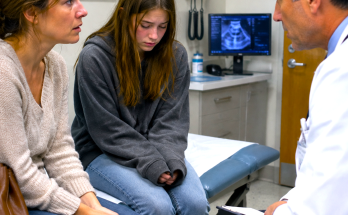
The emergency department was quieter than I expected. It was after midnight, and the automatic doors opened with a soft mechanical sigh every time someone came through. Emmeline leaned against me as we checked in.
The nurse asked her where it hurt.
“My right side.”
“How long?”
She hesitated.
“Months.”
I looked at her.
Months.
The nurse looked at me, then back at my daughter.
“How many months?”
“I don't know.”
That answer followed us into the examination room.
The first doctor asked several questions. When did it begin? Did food make it worse? Did she have nausea? Fever? Changes in appetite? Had she lost weight?
Emmeline answered quietly.
I filled in some gaps where I could.
When the doctor asked whether she had seen anyone about it before, Emmeline looked at me.
Then she looked at the floor.
Her silence was enough.
The doctor asked gently, “Has anyone evaluated this before?”
“Yes,” she finally said.
“Who?”
“My dad took me.”
“When?”
“I think about five weeks ago.”
I felt my stomach tighten.
Five weeks.
I had not known.
The doctor entered something into the computer.
“Do you remember where?”
She gave the name of the hospital.
It was the same regional medical center where we were sitting.
The doctor left the room.
I stared at my daughter.
“Why didn't you tell me?”
“I thought Dad told you.”
“He didn't.”
She pulled her knees toward her chest.
“He said it wasn't important.”
“What did they tell you?”
“I don't remember.”
I wanted to call Ross immediately.
Instead, I asked the nurse if there were records from the earlier visit.
She said there were.
That was how I learned that my daughter had already been seen for the same complaint.
The previous visit had included an examination, blood work, and instructions for follow-up.
I read the words twice.
Follow-up recommended.
Additional evaluation advised.
I felt my hands go cold.
“Why didn't anyone call me?”
The nurse looked uncomfortable.
“I can't speak to the family arrangements, ma'am.”
I understood.
The problem wasn't that the hospital had hidden anything.
The information had apparently gone where it was supposed to go.
I simply hadn't known enough to look.
The doctor returned and said they wanted imaging done that night.
Emmeline squeezed my fingers.
“Mom?”
“I'm here.”
“Am I in trouble?”
“No.”
She looked relieved.
That frightened me too.
The scan took longer than expected.
I watched the technician's face through the small window. At first he spoke casually. Then he became quieter.
Finally, he said the radiologist needed to review the images.
The waiting was unbearable.
When the doctor came back, he didn't give us a diagnosis.
He said there were findings that required further investigation and that her recurring pain needed to be taken seriously.
He also asked me a question.
“How long has she been experiencing this?”
I told him the truth.
“I don't know.”
He looked at Emmeline.
“Did you tell your father about the pain?”
“Yes.”
“What did he tell you to do?”
She looked at me.
“He said to wait.”
“Wait for what?”
“I don't know.”
The doctor nodded.
“Okay.”
He did not press her further.
Instead, he explained what would happen next. More testing. Specialist follow-up. Monitoring her symptoms.
Before we left, I asked for copies of the records.
The nurse printed them.
I put everything into a folder.
On the drive home, Emmeline slept.
I didn't.
I kept thinking about the first appointment.
Five weeks earlier.
Her father had known.
He had taken her there.
He had received the instructions.
And I had known none of it.
When we reached the house, Ross was awake.
He was sitting at the kitchen table.
The moment he saw the folder in my hand, he stood.
“What happened?”
“You knew.”
His face changed.
“About what?”
“She went to the hospital five weeks ago.”
He looked at Emmeline.
She immediately stepped behind me.
Ross exhaled.
“I told you it wasn't serious.”
“You didn't tell me at all.”
“They said to follow up.”
“Did they?”
He didn't answer.
I put the papers on the table.
“Why didn't you take her back?”
“I was going to.”
“When?”
“I don't know.”
“Why didn't you tell me?”
He rubbed his jaw.
“Because you were already stressed.”
“That wasn't your decision to make.”
“She didn't want you to worry.”
I looked at Emmeline.
She was standing by the stairs.
“Did you tell Dad you didn't want me to know?”
She shook her head.
“No.”
Ross stared at her.
“Em.”
She flinched.
I noticed.
He noticed that I noticed.
The room became very quiet.
“I didn't mean it like that,” he said.
I didn't answer.
Emmeline went upstairs.
Ross sat down.
“I thought I was protecting both of you.”
“By keeping her medical information from me?”
“She was scared.”
“So you made her carry it alone.”
“I thought the pain would pass.”
“You don't get to decide that.”
He stared at the papers.
For the first time, he looked genuinely shaken.
“I was scared too.”
I sat opposite him.
“Then you should have told me.”
He didn't respond.
The next morning, I called the specialist.
The earliest appointment was weeks away.
I asked whether they could move it forward because of the emergency visit.
They did.
In the meantime, Emmeline's pain continued.
She began missing breakfast.
Then lunch.
She stopped going to after-school activities.
She came home and went straight upstairs.
I tried not to hover.
That was difficult.
Every time she put her hand against her side, I wanted to ask what was wrong.
Instead, I started asking a different question.
“Do you need anything?”
Sometimes she said no.
Sometimes she said water.
Once she asked me to sit beside her.
We watched television without talking.
Halfway through the program, she said, “Dad isn't bad.”
I looked at her.
“I didn't say he was.”
“He's just…”
She searched for the word.
“Bad with things.”
“What things?”
“Things that scare him.”
That sentence stayed with me.
A few days later, Ross came home carrying groceries.
He acted as though nothing had changed.
He put the bags on the counter.
“I got the cereal she likes.”
I looked at him.
“Did you make the appointment?”
He paused.
“What appointment?”
“The follow-up you were supposed to arrange.”
“I thought you did.”
I stared at him.
He stared back.
Then he said, “I'll handle it.”
“No.”
He looked surprised.
“I'll handle it.”
He nodded slowly.
From that point on, I kept every medical document.
Every appointment.
Every test.
Every question.
Not because I wanted to control everything.
Because I had finally understood that information mattered.
One afternoon, Emmeline came home early.
She dropped her backpack on the floor.
“Mom?”
I came out of the kitchen.
“My side hurts really badly.”
“How badly?”
“Eight.”
I grabbed my keys.
She looked toward the living room.
“Don't tell Dad yet.”
I stopped.
“Why?”
“He'll say I should wait.”
I felt something inside me crack.
“Why would he say that?”
She looked down.
“Because last time I told him it hurt really bad, he said we couldn't keep going to doctors for every little thing.”
I closed my eyes for a second.
Then I opened them.
“Get your shoes.”
She did.
At the hospital, the same nurse from the earlier visit recognized her.
The nurse's expression changed when she saw Emmeline holding her side.
“Come with me.”
We were taken back quickly.
The nurse asked when the pain had become worse.
Emmeline answered.
She didn't look at me for permission.
She just answered.
That was progress.
The doctor examined her and ordered additional testing.
While we waited, I looked at my daughter.
She was exhausted.
I reached for her hand.
She took it.
“Mom?”
“Yeah?”
“Am I going to have to tell Dad everything?”
“No.”
She swallowed.
“But what if he gets mad?”
“That's his feeling to manage.”
She looked at me for a long moment.
Then she nodded.
The doctor returned later and told us they needed more information before making any conclusions.
He said the condition might be manageable, but they needed a specialist.
He also told me something I would never forget.
“Whatever happens next, please don't let her believe the pain is something she has to hide.”
I nodded.
“I won't.”
On the way out, I requested another copy of the records.
The nurse handed me the folder.
As I held it, I realized something unsettling.
There were now two hospital visits.
And only one of them had been known to me.
I opened the folder in the car.
The first report was there.
Then I noticed a notation I hadn't seen before.
A recommended follow-up had been entered five weeks earlier.
Under accompanying adult was Ross's name.
I stared at it.
Emmeline sat beside me.
“What is it?”
I looked at her.
“It says Dad was told you needed to come back.”
Her face went pale.
“He told me they didn't find anything.”
The parking lot seemed to become completely silent.
I looked again at the paper.
Then at my daughter.
And finally, for the first time, I understood that the secret wasn't merely that her father had known she was hurting.
He had known she needed more care.
And he had chosen not to tell me.
Click here to continue reading: PART 3: The Doctor Asked One Question That Turned My Husband’s Quiet Mistake Into Something I Could No Longer Explain Away
The Sentence My Daughter Whispered in the Pickup Line Made Me Realize Something at Home Had Changed
Part 2 of 4