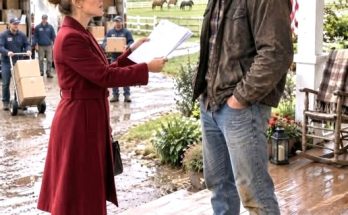
Clare moved in October.
She called me from the highway on her first night away.
“I made it.”
“Good.”
“You sound disappointed.”
“I was hoping you'd get lost.”
She laughed.
“Still annoying.”
“Always.”
We talked for a few minutes.
Then she said, “Take care of the place.”
“I will.”
“And yourself.”
“I'll try.”
She paused.
“Thank you.”
“For what?”
“For not making me pay for the rest of my life.”
I leaned against the kitchen counter.
“You paid plenty.”
She was quiet.
“I know.”
Then the call ended.
For several weeks, the ranch felt different.
Not empty.
Just quieter.
Clare had become part of the routine.
Her absence reminded me how strange the past year had been.
I had once believed I needed her to stay away forever.
Now I missed having someone in the office complaining about my accounting system.
Life was complicated.
One afternoon, a package arrived.
The return address was Clare's new city.
Inside was a wooden box.
I opened it.
There was Dad's old compass.
I hadn't seen it in years.
A note was taped to the lid.
I read it.
She wrote that she'd found it while unpacking and remembered Dad giving it to her when she was sixteen.
She said she wanted me to have it because I was the one still working the land.
At the bottom she wrote:
Maybe this belongs where he always wanted us to find our way back to.
I sat at the table holding the compass.
The needle trembled.
Then settled.
I laughed quietly.
Clare had always been better at sentimental gestures than she admitted.
I placed the compass beside Dad's watch.
The two objects looked insignificant.
But they carried decades.
A few weeks later, Clare returned for Thanksgiving.
She stayed in the guest room.
The first evening was awkward.
We both knew it.
We moved around each other in the kitchen like strangers sharing a small apartment.
Finally, she said, “This is ridiculous.”
I looked at her.
“What?”
“We're siblings.”
“You tried to steal my ranch.”
She winced.
“I know.”
“So.”
She picked up a dish towel.
“I deserved that.”
We laughed.
The tension broke.
Thanksgiving dinner wasn't perfect.
The turkey was dry.
The potatoes were too salty.
Clare burned the rolls.
We ate anyway.
After dinner, we sat on the porch.
The fields were dark.
She asked whether I still thought about selling.
“No.”
“Never?”
“Not anymore.”
She nodded.
“I used to dream about selling it.”
“I know.”
“I thought money would make me feel safe.”
“What changed?”
She looked toward the road.
“I learned that needing money and needing control aren't the same thing.”
I nodded.
“That took me a long time.”
“It took me too.”
She turned toward me.
“Do you think Mom knew?”
“Knew what?”
“That we would fight.”
I smiled.
“Mom knew everything.”
Clare laughed.
“She really did.”
We sat there until the porch light attracted moths.
The next morning, Clare helped with the school program.
She was leaving the following afternoon.
Before she went, she asked to see Dad's workshop.
We walked inside.
She looked around.
“He'd hate what you've done to this place.”
I stared at her.
“What?”
She pointed to the shelves.
“Everything is organized.”
I laughed.
“He'd be proud.”
“No. He'd think you were wasting time.”
We both laughed.
Then Clare noticed the old wooden bench.
She ran her hand across it.
“I remember him teaching you here.”
“You were here too.”
“No.”
She shook her head.
“I was already gone by then.”
That was true.
Clare had moved away earlier.
I had stayed.
For the first time, I understood how differently we had experienced our parents' final years.
I had been physically present.
She had been away.
Maybe that mattered.
Maybe some of her anger had grown from feeling excluded.
Maybe mine had grown from feeling abandoned.
Neither explanation excused what happened.
But both made the history more human.
We spent the afternoon looking through old photographs.
There were hundreds.
Birthdays.
Christmas mornings.
Harvests.
Storms.
School plays.
Broken tractors.
Family dinners.
In nearly every photograph, the ranch appeared somewhere in the background.
Sometimes only a corner of the barn.
Sometimes the fields.
Sometimes the porch.
It was always there.
Our childhood had been built around it.
That evening, Clare packed her car.
Before leaving, she handed me a small envelope.
“What is this?”
“Open it later.”
She drove away.
I waited until she was gone.
Then I opened it.
Inside was a copy of a letter she had written to herself during the legal dispute.
She had never sent it.
She wrote about fear.
About debt.
About anger.
About feeling like I had inherited the only part of our parents' lives that still mattered.
She admitted that she had convinced herself the ranch was the reason she was unhappy.
Then she wrote something I didn't expect.
The ranch wasn't the problem. I was trying to make it solve a problem it couldn't solve.
I read the letter twice.
Then I folded it.
I didn't need to answer.
Clare had already answered herself.
The years continued.
The agricultural program became permanent.
The school built a curriculum around the visits.
The riding program hired another instructor.
The ranch remained financially stable.
I kept the LLC.
I kept the preservation protections.
I kept the property maintained.
And I kept the promises my parents had made in writing.
Not because I was trapped by them.
Because I agreed with them.
On the fifth anniversary of my parents' deaths, I organized a memorial day.
We planted two trees near the north pasture.
One for Mom.
One for Dad.
Clare came back.
She stood beside me with a shovel.
We worked without speaking.
When the trees were planted, she pressed the soil around hers.
“They'll need water.”
“I know.”
“Don't forget.”
“I won't.”
She smiled.
“Good.”
That evening, we sat on the porch.
The trees were barely taller than we were.
Someday, they would be enormous.
Someday, children visiting the ranch wouldn't know why they were there.
They would simply be part of the landscape.
That thought comforted me.
Not everything had to remain a story.
Some things could simply become part of life.
Clare looked at the house.
“Do you think we'll ever stop talking about what happened?”
“Probably.”
She laughed.
“Fair.”
“But maybe we won't talk about it as much.”
She nodded.
“I'd like that.”
I looked at the dark pasture.
“Me too.”
The next morning, Clare left.
This time, I didn't feel afraid of her leaving.
I knew she would come back.
Not because she had any claim on the ranch.
Because she had a place here as family.
Those were different things.
And understanding that difference was one of the hardest lessons I had learned.
The ranch belonged to me legally.
But the memories belonged to all of us.
I didn't need to give away ownership to acknowledge that.
That was the balance I had been missing.
The sun rose over the eastern pasture.
I walked toward the new trees.
Their leaves moved gently in the morning wind.
Behind them stood the farmhouse.
Behind the farmhouse stood the barn.
Everything remained.
But nothing was frozen.
The ranch had survived because it was allowed to keep changing.
Maybe families were the same.
Not every relationship returned to what it had been.
Sometimes survival meant building something new from what remained.
I touched the young tree's trunk.
Then I went back to work.
Click here to continue reading: PART 12: Years After the Deed Fight, I Finally Understood What My Parents Had Really Left Me, and It Was Worth More Than the Ranch
The Will Was Supposed to End the Arguments, Until My Sister Started Treating My Parents’ Ranch Like Property She Had Already Bought
Part 11 of 12