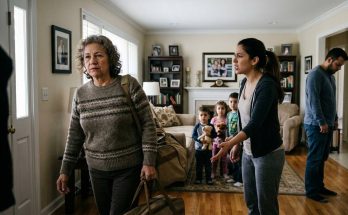
By ten that morning, the house had changed.
Not visibly at first.
The walls were still painted the same warm color. The furniture was still in place. The children's shoes were still scattered near the stairs.
But the rhythm was gone.
Mariana opened the refrigerator three times as if the missing person might somehow reappear between the shelves.
“Where did she put the medicine?” she demanded.
Andrew was standing near the counter.
“For Sophia?”
“Yes.”
“Maybe in the bathroom.”
“It isn't there.”
He searched the cabinet.
Nothing.
Sophia began calling from upstairs.
“Mom!”
Mariana closed her eyes.
“What?”
“I can't find my school shirt.”
“Look in your closet.”
“I already did!”
Normally, I would have appeared before the second shout.
That morning, nobody came.
Andrew looked toward the stairs.
He remembered every morning his mother had answered those calls.
He had never wondered why she was always awake.
He had simply assumed she would be.
Nico began crying.
Matthew couldn't find his homework.
Sophia needed her medicine.
The school bus would arrive in twenty minutes.
Mariana stood in the middle of the kitchen with her phone in one hand and a coffee cup in the other.
“She can't just leave us like this.”
Andrew looked at her.
The sentence bothered him.
“She's not responsible for us.”
Mariana's expression hardened.
“She lives here.”
“She lived here.”
The correction surprised both of them.
Mariana stared at him.
Andrew looked away.
He didn't know why he had said it.
Perhaps because the empty bedroom had forced a truth into the open.
His mother had not belonged to that house.
She had been serving it.
There was a difference.
Two hours later, Mariana had called three babysitters.
One was unavailable.
Another quoted a rate she called ridiculous.
The third asked how many hours of care they needed.
“Every weekday,” Mariana said.
The woman paused.
“That isn't occasional babysitting.”
Mariana ended the call.
“She’s making this difficult on purpose.”
Andrew was sitting at the table.
“Who is?”
“Your mother.”
He looked up slowly.
“You think she left to punish us?”
“I think she knows exactly what she's doing.”
Andrew didn't answer.
Because for the first time, he was beginning to wonder if his mother had spent years doing exactly the opposite.
She had made everything easy.
So easy that nobody had seen the cost.
Around noon, Andrew found the black notebook.
He recognized the handwriting immediately.
He opened it.
The first pages were practical.
Matthew's allergy medication.
Sophia's favorite foods.
Nico's sleep schedule.
Andrew's prescription refill.
Mariana's coffee order.
Then he turned another page.
And another.
There were dates.
Notes.
Small observations.
“Andrew looked tired today. I wanted to ask if he was all right, but he rushed out.”
“Mariana seems worried. I made her favorite dinner.”
“Sophia has been coughing. Call the pediatrician if it continues.”
“Matthew has a test Friday.”
Andrew's fingers stopped moving.
He turned another page.
“I miss talking to my son.”
He stared at that sentence for a long time.
It was not an accusation.
That made it worse.
He closed the notebook.
Then opened it again.
There was one line near the bottom of another page.
“I hope someday they notice I was here.”
Andrew sat down.
The house was noisy around him.
Nico was crying.
Mariana was arguing with someone on the phone.
A television played in the living room.
But Andrew heard none of it.
He was remembering his mother's hands.
The hands that had buttoned his school shirts.
The hands that had held a thermometer against his forehead when he was sick.
The hands that had prepared thousands of meals without anyone asking whether she wanted to sit down first.
He had seen those hands every day.
He had simply stopped seeing the woman attached to them.
That afternoon, he checked the household accounts.
The first payment that failed was a grocery account.
Then another automatic transfer.
Then an insurance payment.
Andrew stared at the screen.
“What is this?”
Mariana came over.
“What?”
“The transfers.”
She looked.
“Maybe the bank made a mistake.”
He shook his head.
“They're cancelled.”
Mariana's face tightened.
“By who?”
Andrew didn't answer.
They both knew.
His mother had quietly contributed money every month.
Groceries.
School supplies.
Unexpected medical expenses.
Household costs.
Things Mariana had come to regard as part of their normal income.
Andrew looked at the figures.
Then he remembered the phrase she had used the previous night.
Useless.
He closed the banking application.
“She wasn't useless.”
Mariana folded her arms.
“She chose to help.”
“Yes.”
“So why are you acting like we owe her?”
Andrew looked at her.
“Because maybe we do.”
That evening, the house was unusually quiet.
Mariana ordered dinner.
Nobody had prepared anything.
The children ate in front of the television.
Andrew stood in the kitchen afterward, staring at the empty space where his mother usually worked.
A small blanket she had folded was still on the couch.
Her plants were watered.
Her handwriting was still visible on the refrigerator.
Everything she had done remained.
Only she was missing.
Mariana came into the room.
“We need to find someone.”
Andrew turned.
“Someone for what?”
“To help.”
“My mother isn't coming back to be replaced.”
Mariana's face hardened.
“You're blaming me.”
Andrew stared at her.
“You called her lazy.”
“She was always around.”
“You called her useless.”
“She wasn't doing anything important.”
Andrew's voice dropped.
“She raised our children.”
Mariana looked away.
“She lived here.”
“She paid for things.”
“She wanted to.”
“She loved us.”
Mariana said nothing.
Andrew stepped closer.
“You know what the worst part is?”
She looked at him.
“I let you say those things because I didn't want an argument.”
He swallowed.
“And I thought staying quiet meant I was keeping peace.”
Mariana's expression changed.
“It did.”
“No.”
Andrew shook his head.
“It meant I was abandoning my mother.”
Across town, I sat beside my apartment window with a cup of coffee.
I had forgotten how quiet mornings could be.
Nobody needed breakfast.
Nobody needed a missing shoe.
Nobody called from upstairs.
I ate toast and eggs at my own table.
Slowly.
Without rushing.
My phone buzzed.
Andrew.
I let it ring.
Then another message arrived.
Mom, please call me. We need to talk.
I read it.
My finger hovered over the screen.
Three years earlier, I would have answered immediately.
That morning, I put the phone down.
Not because I hated my son.
Because I needed to discover who I was when nobody was asking something from me.
Then another message arrived.
This time it was from Sophia.
A voice recording.
I pressed play.
“Grandma, where are you? Mommy said you left. Did we do something wrong?”
I closed my eyes.
That hurt.
Children should never carry the weight of adult mistakes.
I wrote back.
My sweet Sophia, you did nothing wrong. Grandma loves you very much. I just need some time to rest and take care of myself.
I sent it.
Then I placed the phone facedown.
For the first time in years, I made breakfast and ate it while it was still warm.
Three days passed.
The house became harder to manage.
Andrew woke before sunrise.
He dressed the children.
He packed lunches.
He searched for missing homework.
He learned which medicine Sophia needed and when.
He discovered that Nico would only sleep if someone sat beside him for several minutes.
He found out Matthew hated crusts on sandwiches.
None of these things were impossible.
That was what made them painful.
They were simply constant.
My mother had done them constantly.
Without applause.
Without asking to be thanked.
On the fourth evening, Andrew came home and found Mariana sitting on the couch.
The children were watching television.
The kitchen was a mess.
“Where's dinner?”
Mariana didn't look up.
“Order something.”
Andrew stared at her.
“You don't have to do everything.”
She laughed bitterly.
“Exactly.”
The words stopped him.
He had heard them before.
From his mother.
In different circumstances.
Same exhaustion.
Same feeling.
Different speaker.
That night, Andrew opened the black notebook again.
He read every page.
By the time he reached the last entry, his eyes were burning.
The next morning, he drove to my apartment.
I opened the door before he knocked twice.
He looked exhausted.
“Mom.”
I held his gaze.
“My name is Elena.”
He stopped.
The correction was gentle.
That was what made it hurt.
He nodded.
“Elena.”
I opened the door.
“Come in.”
He stepped inside.
He looked around the apartment.
Books.
Plants.
Carlos's photograph.
No toys.
No laundry.
No lunch boxes.
No evidence that three children lived there.
It was the first time he had seen a room that belonged entirely to me.
He sat down.
“I’m sorry.”
I remained standing.
“For what?”
He looked at the floor.
“For not defending you.”
I nodded.
“Yes.”
His eyes lifted.
“I should have.”
“Yes.”
No anger.
No shouting.
Just the truth.
He swallowed.
“I want you to come home.”
I looked at him for several seconds.
“Andrew, I left because I was never really home.”
He had no answer.
Before he left, I handed him an envelope.
“Read this when you get back.”
He held it.
“What is it?”
“You'll understand.”
He nodded.
“Elena.”
It was the first time he had said my name like it mattered.
Click here to continue reading: PART 3: The Envelope Revealed What I Had Paid, What I Had Hidden, and Why My Son Was Never Meant to Know About the Land
The Morning I Realized My Family Had Stopped Seeing Me as a Mother and Started Seeing Me as Something They Could Use
Part 2 of 12