The answer came slowly.
The transaction had been closer than I wanted to believe.
The title company had already opened a file.
The developer had already reviewed the proposed agreement.
The lender had already begun underwriting the $350,000 bridge loan.
And Derek had already positioned himself on paper as the person authorized to sell.
The only thing he had not secured was clean, legitimate authority.
That was why the cabin mattered so much.
It wasn't simply valuable.
It was the missing piece that could turn Derek's financial emergency into someone else's payment.
Sarah explained it plainly.
"He needed the title company to believe the trust transfer was legitimate long enough to close."
"And after closing?"
"The property would have belonged to the buyer."
I looked at the documents on her desk.
"Could I have gotten it back?"
"Maybe."
"Maybe?"
"Once real estate changes hands through a completed transaction, unwinding it becomes much more complicated."
I sat back.
"So the timing mattered."
"Very much."
Derek had not chosen a random day to move his parents in.
He had chosen a day close to the planned transaction.
He wanted possession established.
He wanted the paperwork in the system.
He wanted the lender moving.
He wanted the developer expecting a clean closing.
And he wanted me to discover it as late as possible.
The more I learned, the less accidental anything seemed.
Meanwhile, Thomas and Barbara had to arrange somewhere else to live.
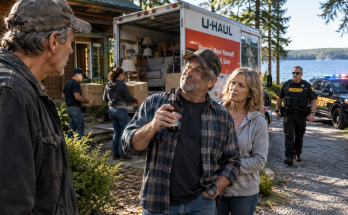
Their belongings went back into the U-Haul.
I watched them carry the sofa down the porch steps.
Thomas looked embarrassed.
Barbara cried quietly as she folded the last of the towels.
Before they left, Thomas came over.
"We didn't know everything."
I looked at him.
"You knew Derek hadn't asked me."
He said nothing.
"You knew you hadn't spoken to me."
Silence.
"You knew there was a chance I'd refuse."
He stared at the gravel.
"Derek said you were becoming forgetful."
"And you believed him."
He shifted his weight.
"I wanted to believe him."
That answer was more honest than anything else he had said.
I nodded slowly.
"That's the problem."
He looked at me.
"Arthur, I'm sorry."
"I believe you're sorry."
His eyes lifted.
"But you're still responsible for what you chose to do."
He swallowed.
"I know."
Then he climbed into the U-Haul.
Barbara sat beside him.
The truck disappeared down the road.
I remained in the driveway until the sound of the engine faded.
Claire came outside.
She had spent most of the morning speaking with her attorney.
She looked exhausted.
"Dad."
I turned.
"I'm not defending him."
"I know."
"I should have checked the documents."
"Yes."
"I should have called Sarah."
"Yes."
She nodded.
"I did something stupid."
"You did."
She took a breath.
"But I didn't know he was trying to steal the cabin."
"I believe you."
Her eyes filled.
"Do you?"
"Yes."
That seemed to hurt her more than anger would have.
She looked toward the lake.
"I don't expect you to forgive me immediately."
"I'm not sure what forgiveness looks like yet."
She nodded.
"I understand."
We stood together in silence.
The cabin behind us looked almost normal.
Except it wasn't.
There were scratches on the floor where furniture had been dragged across it.
A cardboard box had left a smear against the wall.
One of Eleanor's framed photographs had been moved from the shelf.
Claire noticed it.
She picked it up carefully.
"Mom."
I nodded.
She wiped the glass with her sleeve.
"I hate that he brought this into this place."
"So do I."
She put the photograph back.
Then she said something that stayed with me.
"He never saw this cabin the way we did."
"No."
"He saw a number."
"Exactly."
She looked at the lake.
"That's what scares me."
"What?"
"That someone can look at something that holds your whole life and only see what it could sell for."
I didn't answer.
Because I understood.
To Derek, the cabin had become an asset long before he ever brought a moving truck.
The old dock wasn't a place where Claire learned to swim.
The porch wasn't where Eleanor drank coffee.
The kitchen wasn't where we spent Christmas mornings.
The shoreline wasn't where I scattered part of Eleanor's ashes.
It was acreage.
Valuable acreage.
And once Derek decided he deserved access to that value, every other fact became an inconvenience.
Within the following weeks, investigators built a clearer picture.
Derek's company was in worse condition than I had known.
Two major projects had stalled.
Investors were demanding money.
A bank was threatening litigation.
Several creditors were pressing for repayment.
Derek had personally guaranteed significant debts.
He had been searching for liquidity.
Then he saw my cabin.
The land was worth close to two million dollars.
The developer had made an offer of $1.9 million.
The $350,000 loan could keep Derek afloat until closing.
The sale could give him the larger infusion he needed.
And Claire was the beneficiary.
That last fact seemed to be what Derek used to justify everything.
He told himself the property would eventually be hers.
He treated eventual inheritance as current ownership.
He apparently convinced himself that accessing it early was somehow different from stealing it.
But there was another layer.
He needed me out of the way.
Not physically.
Legally.
He needed records saying I was incapable of serving as trustee.
He needed a successor.
He needed that successor to be him.
And he needed the paperwork to look authentic long enough for everyone else to stop asking questions.
The forged medical certification became especially important.
Investigators confirmed that Dr. William Barrett had died eighteen months earlier.
He could not have examined me.
He could not have signed the letter.
He could not have appeared before anyone to certify my mental state.
The document had been manufactured.
The supposed notary appearance eight days earlier was also being investigated.
I had photographs and receipts proving I was nowhere near the location listed.
Eleven relatives could confirm where I had been.
There was no legitimate appointment.
There was no legitimate medical examination.
There was no legitimate transfer.
The entire foundation was false.
One afternoon Sarah came to the cabin with revised trust documents.
"We need to talk about the future."
I knew what she meant.
"Claire."
"Yes."
I looked through the papers.
The cabin would remain protected.
Claire would remain the primary beneficiary.
But there would be an independent corporate co-trustee.
Any future sale, mortgage, or major transfer involving the property would require another set of eyes.
Claire would not be able to authorize everything alone.
Neither would a future spouse.
Neither would a creditor.
Neither would someone who convinced her to sign a document without reading it.
When Sarah explained the structure to Claire, my daughter didn't object.
Instead she said, "I want that."
Sarah looked at her.
"You understand you won't have unlimited control over the property?"
"Yes."
Claire glanced at me.
"I've seen what unlimited control can attract."
The words were quiet.
But they were exactly right.
Months passed.
The investigation continued.
There were interviews.
Handwriting examinations.
Notary records.
Computer records.
Bank documents.
Emails.
The authorities followed the electronic trail from Hayes Summit's systems.
The developer's lawyers cooperated.
The lender supplied its files.
The recorded deed was challenged.
The proposed loan remained canceled.
The $1.9 million transaction disappeared.
Derek's company suffered the consequences of losing the rescue it had been counting on.
Claire's marriage ended.
She told me later that the moment she knew she was finished with Derek was when she read the message to Thomas.
Not because it proved he was desperate.
Because it proved he had planned to overcome my refusal.
He had already decided that my wishes were an obstacle rather than a boundary.
That distinction mattered.
One evening, months after the U-Haul incident, Claire and I returned to the cabin together.
The porch roof still needed repairs.
I brought the ladder.
She brought coffee.
We spent two days replacing rotted boards, sealing the copper flashing, cleaning the gutters, and repainting the trim.
The work was ordinary.
That was what I liked about it.
No lawyers.
No deputies.
No deeds.
No fake medical certificates.
Just the smell of sawdust, the scrape of a pry bar against old wood, and Claire handing me screws while I worked.
On the second evening, we sat on the porch swing.
The sun was dropping behind the pines.
Claire looked toward the mudroom.
Eleanor's yellow raincoat still hung beside the door.
"You haven't moved it."
"No."
"Mom would tell you to put it away."
I smiled.
"She'd probably complain that I've been leaving it there too long."
Claire smiled too.
Then she grew quiet.
"You don't have to keep everything exactly where she left it."
I looked at the raincoat.
For three years, touching Eleanor's things had felt like disturbing something sacred.
But Claire's words didn't sound like pressure.
They sounded like permission.
The next morning, we boxed some of Eleanor's old clothes.
I gave Claire the yellow raincoat.
She held it against her chest and cried.
I kept the ceramic coffee mug.
I wasn't ready to let go of everything.
Maybe I never would be.
Before we left, I stood in the driveway and looked back at the cabin.
I had driven there months earlier expecting nothing more dramatic than a leaking roof.
Instead, I had found a moving truck, strangers carrying furniture into my late wife's sanctuary, and a man drinking beer on my porch while telling me the place would belong to his family anyway.
He had believed physical possession would pressure me.
He had believed paperwork would confuse me.
He had believed my age could make people question whether I understood what was happening.
Most of all, he had mistaken a future inheritance for present ownership.
He had been wrong.
The strange part was that none of this might have surfaced when it did if that roof had not leaked.
I might not have driven to the cabin that Tuesday.
The U-Haul might have remained there.
The fraudulent deed might have sat in the county records unchallenged.
The lender might have continued underwriting.
The developer might have proceeded toward closing.
A water stain on an old porch ceiling had led me straight into a scheme involving nearly two million dollars.
Eleanor used to complain about that roof.
Every fall she would look up at the shingles and tell me I was going to regret waiting another season.
She had been right.
Just not for the reason either of us imagined.
Claire and I got into the truck.
Before starting the engine, I looked once more at the cabin.
The property was still mine.
More importantly, it was still what it had always been.
A place built from memories.
A place where my daughter had learned to swim.
A place where Eleanor had laughed.
A place that, for one terrifying week, had been treated like a line on a balance sheet.
I understood something after all of it.
Being family doesn't give anyone authority over your property.
Expecting to inherit something doesn't make it yours today.
And when someone tells you a thing is going to belong to them anyway, don't ignore the tense.
Going to belong is not the same as belongs.
Someday is not today.
Click here to continue reading: PART 5: The Investigation Turned the Fraud Inside Out, and One Small Detail in Derek’s Company Records Revealed Who Had Helped Build the Lie
The U-Haul Was Already Half Empty When I Reached the Cabin, and the Man on My Porch Spoke as Though My Wife’s Property Had Become His
Part 4 of 8