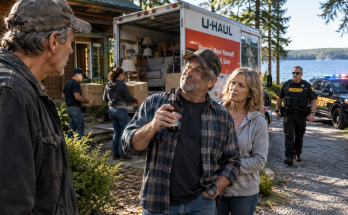
The formal charges were announced on a gray morning in November.
Sarah called before breakfast.
"They've filed."
I sat at the kitchen table with a cup of coffee.
"Against Derek?"
"Yes."
"What about Mark?"
"He's cooperating."
I wasn't surprised.
"What does that mean for Derek's parents?"
"They're not being charged at this stage."
I thought about Thomas standing on my porch with that beer.
"That's probably right."
Sarah paused.
"Arthur, there's something you should know."
"What?"
"Derek's attorney may try to argue that Thomas and Barbara believed they had permission to move in."
"They probably did."
"But their messages show they knew you might object."
"That doesn't make them equal to Derek."
"No."
I appreciated that Sarah understood the distinction.
People had made bad choices.
Derek had built a strategy around those choices.
Those were not the same thing.
The charges themselves were less dramatic than I expected.
Fraud-related offenses.
Forgery.
Attempted fraudulent transfer.
False documentation connected to financing.
The language was dry.
The consequences were not.
Derek had once walked into meetings believing he was about to sell a piece of land worth nearly two million dollars.
Now his company was under financial pressure, his marriage was ending, and his freedom was at risk.
Still, I didn't feel triumphant.
That surprised me.
I had imagined that seeing him held accountable would bring relief.
Instead, I felt tired.
There was nothing satisfying about watching a family break apart.
Even when one person had caused the damage.
Claire felt the same.
She attended the first hearing.
I did not.
She later told me Derek looked different.
Smaller.
Not physically.
In the way he carried himself.
The confidence was gone.
His attorney spoke.
The prosecutor responded.
The judge set conditions.
And then everyone went home.
Real life.
No dramatic speech.
No sudden confession.
Just paperwork, calendars, and consequences.
The investigation into Hayes Summit continued.
The company eventually lost two development projects.
Several investors pulled out.
The lender that had been expecting repayment tightened its terms.
Derek's financial problems became public enough that other creditors began examining their own agreements.
The $1.9 million sale remained dead.
The cabin stayed in the trust.
The bridge loan never funded.
And the fake trustee appointment was formally invalidated.
One afternoon Sarah sent me the final title report.
My name was there.
The trust was there.
No Derek.
No developer.
No lender.
No claim.
I printed it and placed it in the cabin's desk.
Not because I needed the reassurance.
Because I wanted the record there.
Months earlier, I had thought the cabin's greatest vulnerability was the roof.
It wasn't.
The roof could be repaired.
Trust was harder.
Claire came with me that weekend.
We drove up in silence.
Halfway there, she asked, "Are you nervous?"
"About what?"
"Going back."
I thought about it.
"A little."
"Me too."
When we arrived, the driveway was empty.
No U-Haul.
No boxes.
No strangers.
Just pine needles scattered across the gravel.
Claire got out first.
She walked to the porch and touched the railing.
"Feels different."
"It does."
"Better?"
"Eventually."
We unlocked the door.
The cabin smelled like cedar and dust.
The old clock on the wall was still running.
Eleanor's photograph remained above the fireplace.
Claire stopped beneath it.
"I miss her."
"So do I."
"She would have hated this."
"The fraud?"
"The paperwork."
I smiled.
"Absolutely."
We spent the afternoon cleaning.
Not because the cabin needed much work.
Because doing ordinary things made it feel ordinary again.
Claire washed the windows.
I swept the porch.
We opened the curtains.
We aired out the bedrooms.
Then she found the old fishing box.
She laughed.
"Remember this?"
"Your mother hated that thing."
"Because Dad kept worms in it."
"I did not."
"You absolutely did."
"I kept bait in it."
"Same thing."
For a while, we were simply father and daughter again.
Not victim and witness.
Not trustee and beneficiary.
Not the man whose property had nearly been stolen and the woman whose husband had nearly stolen it.
Just us.
That evening we cooked dinner.
Claire made pasta.
I opened a bottle of wine.
We ate at the table Eleanor had used for years.
Halfway through the meal, Claire said, "I need to tell you something."
I put down my fork.
"What?"
"I spoke to Thomas."
I waited.
"He apologized."
"What did you say?"
"I told him I believed he hadn't understood everything."
"Did he accept that?"
"Yes."
"What about Barbara?"
"She wants to see you."
I wasn't sure how I felt about that.
"Why?"
"To apologize."
I looked out the window.
"Maybe someday."
Claire nodded.
"I told them you weren't ready."
"Thank you."
She took a sip of wine.
"Derek blames them."
"Of course he does."
"He says his parents panicked and made everything worse."
"Did they?"
"Yes."
"But?"
"But they didn't create the plan."
That was important.
Thomas had helped execute it.
Barbara had carried furniture into the cabin.
But neither had created the fraudulent trust structure.
Neither had arranged the medical certification.
Neither had negotiated the developer sale.
Neither had instructed an employee to manipulate the security system.
The line between participation and authorship mattered.
As the case progressed, more evidence came out.
Derek had reviewed the financial projections himself.
He had approved the projected proceeds from the property sale.
He had asked whether the title could be cleared before the lender's deadline.
He had asked whether "Arthur's condition" would be documented quickly enough.
That last phrase appeared in an email.
Arthur's condition.
I stared at it.
There was no condition.
There had never been a medical examination.
There had only been a need.
The need was Derek's.
The condition was invented to serve it.
The investigators eventually found another message.
It was dated several days before the fake medical certification.
Derek had written to Mark:
Use Barrett. Arthur won't recognize anything else.
Mark had replied:
Barrett is deceased.
Derek's answer was only four words.
"That's why he'll work."
When Sarah read that message to me, I felt something inside me go still.
Not anger.
Not shock.
Something colder.
He had known.
He had known the doctor was dead.
He had chosen him because he believed a dead man could not contradict the document.
That was the moment I stopped wondering whether Derek had simply lost control under financial pressure.
He hadn't.
He had made choices.
One after another.
Each time, he chose the option that required someone else's rights to disappear.
Claire read the message too.
She cried.
Not because she still loved him.
Because she finally understood how deliberate it had been.
"He knew."
"Yes."
"He knew from the beginning."
"Yes."
She wiped her eyes.
"I keep thinking about every time he told me he loved me."
I didn't know what to say.
So I said the only thing I could.
"People can say two things that don't belong together."
She looked at me.
"What things?"
"They can say they love you and still behave in ways that destroy your life."
She nodded.
"That's the part nobody teaches you."
"No."
We sat quietly.
The lake was black beyond the windows.
The next morning, Claire made a decision.
She changed her own estate plan.
Not because anyone pressured her.
Not because Sarah recommended it.
Because she had learned something.
She appointed an independent trustee to oversee certain assets.
She created safeguards.
She separated personal property from future marital interests.
She made sure no spouse would ever have unilateral authority over inherited real estate.
Then she brought the paperwork to me.
"I don't want to repeat what happened."
"You won't."
"I want you to review it."
"I'll have Sarah review it."
She smiled.
"Good."
That was the answer I wanted.
Not blind trust.
Not dependence.
Good judgment.
Months later, Derek's criminal case was still moving through the courts.
His company had been restructured.
Some creditors were paid.
Others were not.
His development business was dramatically smaller.
Claire finalized the divorce.
She kept her own finances separate.
Thomas and Barbara moved into a modest rental.
They never returned to the cabin.
The family became something new.
Smaller.
Quieter.
Less trusting in some ways.
More honest in others.
I kept repairing things.
The dock needed new boards.
The porch needed paint.
The kitchen faucet leaked.
The roof, ironically, held perfectly after I finally repaired it.
One evening, I stood outside beneath the camera.
The lens was pointed toward the driveway again.
I smiled.
I had nearly forgotten how much I disliked being watched.
But this time it didn't bother me.
The camera wasn't there because I expected betrayal.
It was there because I understood that protecting something didn't mean living in fear of losing it.
It meant paying attention.
That was the lesson I carried forward.
Not suspicion.
Attention.
There was a difference.
I could trust Claire.
But I could also make sure the trust structure didn't depend on anyone's good intentions.
I could forgive Thomas without giving him another key.
I could accept Barbara's apology without pretending her choice had been harmless.
I could wish Derek no physical harm while still allowing the law to hold him accountable.
And I could love the cabin without allowing what happened there to define it forever.
One afternoon, Sarah came to the cabin.
She brought the final amended trust documents.
"It's finished."
I looked through them.
"Everything?"
"Everything important."
I signed where required.
The new protections were clear.
The cabin would remain protected.
Claire would remain the primary beneficiary.
But no one person would be able to mortgage, sell, or transfer it without independent oversight.
Sarah packed the papers away.
"You know, most people only think about these things after something goes wrong."
"I know."
She smiled.
"At least you learned before the property changed hands."
I looked toward the lake.
"By about eleven minutes, according to the deputy."
Sarah laughed.
"That's one way to measure it."
Eleven minutes.
That number had become a strange marker in my mind.
Eleven minutes between demanding an explanation and seeing the sheriff arrive.
Eleven minutes between a confrontation and the beginning of the investigation.
Eleven minutes that had changed everything.
But in truth, the real rescue had started earlier.
It had started when I noticed the roof stain.
When I decided not to postpone the repair.
When I drove out instead of calling someone else.
When I saw the U-Haul.
When I refused to let embarrassment or family pressure make me back down.
Small decisions.
Ordinary decisions.
They had led to the truth.
And sometimes that was how trouble was uncovered.
Not by genius.
Not by luck.
By noticing something that didn't belong and refusing to explain it away.
Click here to continue reading: PART 8: When the Cabin Was Finally Quiet Again, I Understood What Derek Had Tried to Take—and Why the Property Was Never Really the Prize
The U-Haul Was Already Half Empty When I Reached the Cabin, and the Man on My Porch Spoke as Though My Wife’s Property Had Become His
Part 7 of 8