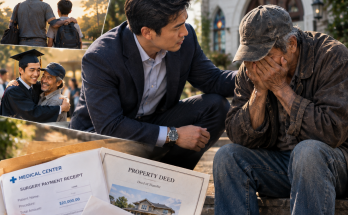
I had already paid for the surgery when my father came to my door asking me for money, and somehow that made what I did next even harder to forgive.
Arthur stood on my front step with his old baseball cap in both hands. He kept turning it over, thumb rubbing along the frayed seam above the brim. He had driven nearly an hour to get there, yet he looked as though he wanted to apologize for taking up the space outside my house.
I knew that cap. I had seen it through almost every important year of my childhood. It had been on his head beside a fishing pond when I caught my first bluegill. It had been soaked through when he waited outside my elementary school during a thunderstorm. It had rested on the passenger seat of his battered truck when he drove me to college with my belongings packed into cardboard boxes.
That afternoon, though, I saw only the man standing in front of me and the request I had spent weeks preparing to answer.
“Daniel,” he said, lowering his eyes. “I need to ask you something.”
I already knew.
The specialist had explained Arthur’s condition to me privately. His heart needed surgery. It was serious, expensive, and scheduled quickly because waiting carried its own risks. Arthur had insisted he could manage the cost somehow. I had told the hospital not to discuss the financial arrangements with him until I had handled them.
I had also decided to surprise him.
The envelope containing the payment confirmation and the deed to a small house sat inside my desk drawer upstairs. I had bought the property months earlier, intending to give it to him after the surgery. He had lived in the same cramped apartment for years, refusing every offer I made to improve his situation.
But standing there, I suddenly felt something ugly rise inside me.
“You need money for the operation?” I asked.
Arthur nodded once.
“I hate asking you.”
His voice was so quiet that I almost missed the words.
For a moment, I thought about the life I had built. The polished floors beneath my feet. The framed photographs on the walls. The expensive car in the driveway. The watch I had bought after my company finally crossed a revenue milestone I had once thought impossible.
Then I thought about being ten years old, sitting at a kitchen table while Arthur counted coins.
Something hardened inside me.
“You always told me you didn't want to owe anybody,” I said.
He looked up.
“That includes you?”
The question should have stopped me.
Instead, I heard another voice in my head, one I had been carrying for years.
Make him understand.
Make him feel what you felt.
I had spent too long believing that success had separated me from the frightened boy I used to be. I remembered empty cupboards. I remembered Arthur stretching meals. I remembered pretending not to notice when he skipped dinner.
Somewhere along the way, gratitude had become mixed with resentment.
I wanted him to know I had succeeded.
I wanted him to understand that I was no longer the child who needed rescuing.
So I told him I couldn't help.
Arthur stared at me for several seconds.
He didn't argue.
He didn't remind me of everything he had done.
He simply nodded.
“All right,” he whispered.
I expected anger.
Instead, he looked tired.
He thanked me for hearing him out, put his cap back on, and walked down the steps.
I watched through the window as he crossed the driveway.
The envelope in my desk seemed to become heavier.
I could have stopped him.
I didn't.
He reached his car, sat behind the wheel, and remained there without starting the engine.
That was when my wife, Emily, entered the room.
“What happened?”
I turned away from the window.
“Nothing.”
She looked at me for a moment.
“You don't look like nothing happened.”
I told her Arthur had asked for help and that I had refused.
Emily's face changed immediately.
“Daniel, you told me the surgery was already paid for.”
“I know.”
“So why did you let him leave thinking you wouldn't help him?”
I had no good answer.
I told myself I was angry because Arthur had always made sacrifices without asking for recognition. I told myself I was teaching him that he didn't have to carry everything alone.
But underneath those explanations was something much less noble.
I wanted him to feel powerless.
I wanted the man who had once protected me from every frightening thing in the world to experience the helplessness I remembered from childhood.
Emily crossed her arms.
“You're punishing him for being proud.”
I said nothing.
“And you're going to regret it.”
She walked away.
I remained at the window.
Arthur's car disappeared at the end of the street.
Ten minutes later, I was still standing there.
Then I saw the envelope on my desk.
I opened the drawer.
The hospital receipt was inside.
Paid in full.
Beside it was the deed.
The house was small but comfortable, with a backyard large enough for a garden. I had imagined Arthur opening the front door and pretending he didn't care, then walking through every room twice.
Now I looked at the deed and felt ashamed.
I grabbed my coat.
The sun was already sinking when I drove toward the chapel near Arthur's apartment. I didn't know why I went there. Perhaps I remembered that he sometimes sat on the chapel steps when he needed to think.
I found him exactly where I expected.
Arthur sat alone beneath a yellowing streetlamp.
His cap rested beside him.
His hands were clasped between his knees.
I parked across the street and stayed inside my car for several minutes.
He looked small.
That was what finally broke me.
Arthur had never looked small to me before.
He had always been the man who could carry furniture by himself, repair anything with a handful of tools, and stand between me and trouble without thinking twice.
Now his shoulders were rounded.
His head was lowered.
And I knew I had done that.
I stepped out.
The evening air had turned cold.
“Dad.”
His head lifted.
For a second, surprise crossed his face.
Then came something worse.
Fear.
Not fear that I had come to hurt him.
Fear that I had come to tell him he was no longer welcome in my life.
“Daniel?”
I sat beside him.
Neither of us spoke.
Arthur picked up his cap and held it against his knee.
Finally he said, “You don't have to come back because you feel guilty.”
I closed my eyes.
“That's not why I'm here.”
“You have a family.”
“I know.”
“You have responsibilities.”
“I know.”
He nodded.
“I shouldn't have asked.”
I looked at his hands.
“I should have told you.”
“Told me what?”
I pulled the hospital receipt from my coat.
Arthur stared at it.
“Your surgery is already paid for.”
He didn't move.
I handed him the house deed next.
“This is yours.”
His eyes moved from the papers to me.
Then he shook his head.
“No.”
“Dad.”
“I can't take this.”
“You can.”
“No.”
His voice remained gentle, but there was no uncertainty in it.
“I didn't raise you so you could buy me a house.”
“You sold your blood to buy my textbooks.”
Arthur looked down.
“You skipped meals.”
“That was a long time ago.”
“You wore the same pair of work shoes until the soles opened.”
He gave me a tired smile.
“They were good shoes.”
I almost laughed.
Instead, my throat tightened.
“You gave me everything.”
Arthur shook his head.
“I gave you what you needed.”
“And now I want to give you something.”
He pushed the deed toward me.
“I don't need repayment.”
I looked directly into his eyes.
“I'm not repaying you.”
“Then why?”
The answer came without hesitation.
“Because you're my father.”
Arthur stopped breathing for a moment.
His eyes filled.
He looked away, pressing his palm against his face.
I had seen Arthur cry only a handful of times in my life.
I had never seen him cry like that.
Not from pain.
Not from fear.
From being called what he had secretly been hoping I would call him for decades.
My father.
That night I drove him home.
The next morning I took him to the hospital myself.
I stayed through the tests, the consultations, the paperwork, and the long hours when the hallway lights seemed too bright for anyone who was supposed to be sleeping.
When the nurses finally took him toward surgery, Arthur reached for my hand.
“Don't worry,” he said.
I almost smiled.
He was the one going under the knife.
Yet he was comforting me.
“I'll be here when you wake up,” I told him.
He squeezed my fingers.
“I know.”
The operation lasted several hours.
When the surgeon finally came out, I stood so quickly that my chair struck the wall.
“He made it through,” the doctor said.
My knees nearly gave out.
I spent the night in a hospital chair beside Arthur's bed.
Near dawn, he opened his eyes.
He looked at me and smiled faintly.
“You stayed.”
I swallowed.
“Of course.”
His fingers moved weakly against the blanket.
“Good.”
He closed his eyes again.
I sat there listening to the machines.
For the first time in years, I understood something I had refused to admit.
I had spent my whole adult life trying to prove I no longer needed Arthur.
But the moment I thought I might lose him, all the money in the world felt useless.
Click here to continue reading: PART 2: After the Surgery, My Father Finally Told Me Why He Had Raised Me, and the Answer Made My Childhood Look Different
I Thought My Father Needed Money, Until I Saw the Look on His Face After I Told Him I Could Not Help
Part 1 of 20