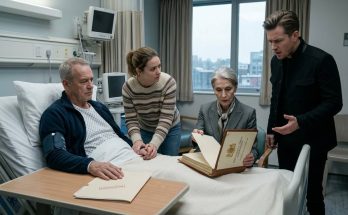
The closing took place on a cool Thursday morning. I arrived at Thomas's office shortly after nine, carrying my glasses and a folder of identification documents. Clara had offered to accompany me, but I told her she should go to school unless she genuinely wanted to take the day off.
“I do want to come,” she said.
“Then come. But don't feel that you have to.”
She arrived ten minutes before the appointment, still wearing the dark cardigan she used for parent meetings. Her hair was tied back, and she carried a small notebook in which she had written down the questions she thought I might forget to ask.
Thomas greeted us and reviewed the final documents. Horizon had satisfied the principal conditions, the title review had been completed, and the parties were ready to close the transaction. The final purchase price remained fifteen million dollars, with the contractual adjustments and costs to be handled according to the closing statement.
I read the statement carefully. Thomas explained each deduction and confirmed that the net proceeds would be transferred to the trust after the transaction was completed. The trust would retain the resources required for my living expenses, medical needs, and future care. The remaining funds would be administered under the terms I had signed.
I initialed the required pages, then signed the final documents.
There was no dramatic announcement. No one applauded. Thomas checked the signatures, exchanged a few calls with the other attorneys, and finally told me the closing had been completed.
The land I had held onto through years of disappointment was no longer mine to walk across whenever I wanted. In exchange, the trust had received the proceeds of the sale, creating a level of financial security I had never expected to possess again.
I felt relieved, but not triumphant. The property had been part of my life for so long that signing it away felt like closing a door on a difficult chapter.
Clara touched my arm.
“Are you all right?”
“Yes.”
“Are you sure?”
I smiled. “I'm allowed to have more than one feeling about it.”
She nodded. “That's probably true.”
Thomas gave us copies of the closing documents and explained the next administrative steps. He would continue overseeing the trust, making sure that expenses were paid and distributions followed the terms. He also reminded me that the money would need careful management, including appropriate tax planning and investment decisions.
I thanked him for his work. Before we left, I asked for a private moment with him.
“Can you arrange a meeting with Julian?” I said. “Now that the sale is complete, I want him to hear the facts directly.”
Thomas agreed to contact him.
The meeting took place three days later. Julian arrived at the office carrying the same leather folder he had brought to my house. Eleanor came with him, though she sat quietly near the window. Clara was there at my request, not because she had anything to prove but because I did not want her to remain the unspoken subject of every argument.
Thomas laid the closing statement on the table.
“The sale has been completed,” he said. “The net proceeds have been transferred to the trust, subject to the recorded terms and the applicable accounting requirements.”
Julian looked at the figures. His face changed as he read the final amount, then he leaned back and pressed his lips together.
“So it's done,” he said.
“Yes,” I replied.
“And the trust remains as written?”
“Yes.”
He looked at Thomas. “There is no provision for me?”
“The trust identifies Clara as the primary beneficiary after your father's lifetime needs and the other terms are satisfied,” Thomas said. “Any change would have to be made in accordance with the trust's legal requirements. Frank has not directed me to change it.”
Julian turned toward me.
“You really intend to leave everything to Clara?”
“I intend to provide for my own future first and leave the remaining assets according to the trust. Yes, Clara is the primary beneficiary.”
“Why?”
I had expected the question, but I still needed a moment before answering. I did not want to reduce our lives to a comparison of two bank accounts or turn the meeting into a contest in which Clara had to be declared the better child.
“Because I have considered what I want to do with what remains of my life and property. I want to make sure I can pay for my own care. I want the trust to be administered responsibly. And I want Clara to have the security she has spent her life trying to build for herself.”
Julian's eyes narrowed.
“So this is a reward for helping you with the surgery.”
“No.”
“You needed three thousand two hundred dollars, and she gave it to you. Now she receives the property proceeds.”
“She did not know about the trust when she helped me. She did not ask for anything. I made the decision after reviewing my circumstances, the property records, and the estate documents.”
“But you keep mentioning the surgery.”
“Because it revealed something I needed to acknowledge. When I asked you for help, you refused. Clara gave me what she could, even though she had very little. That does not mean I purchased her loyalty with an inheritance. It means I learned something about how each of you responds when another person needs help.”
Julian looked away.
“I had commitments.”
“I know.”
“I thought you could manage.”
“I did manage. But I had to accept that I could not depend on you in the way I had hoped.”
He rubbed his hands together, a gesture I remembered from his childhood whenever he was nervous and trying not to show it.
“I never thought a few thousand dollars would become the reason for all this.”
“It isn't the only reason,” I said. “The property, the agreement, and my plans for the future are all part of it. But the call mattered because it forced me to look at something I had avoided for a long time.”
Eleanor finally spoke.
“And what about me? I signed the agreement to protect our savings during the business troubles. I never expected the land to become valuable, but I didn't imagine it would leave me feeling so far removed from my own family.”
I turned toward her.
“I understand that the result is painful. I also remember why we signed the agreement. You wanted your savings protected, and I accepted that. The trust does not erase your rights under any other arrangements we have made, and I am not asking you to surrender anything that belongs to you.”
“But the property proceeds are no longer part of our household.”
“They belong to the trust under the documents we signed and recorded. I will continue to meet my responsibilities and pay my share of our living expenses. I have not abandoned those obligations.”
Thomas confirmed that the trust would cover the expenses assigned to it and that any questions about the household arrangement could be reviewed separately. He did not take sides, and I was grateful that he kept the discussion grounded in facts rather than allowing it to become an argument about blame.
Clara had remained quiet. Now she leaned forward.
“I don't want anyone to think I asked for this,” she said. “I didn't know about the land until after the decision was made. Dad needed help with surgery, and I had money saved. I gave it to him because I love him. That's all.”
Julian looked at her.
“You could have told me he was struggling.”
She held his gaze. “He called you himself.”
“I was busy.”
“I know. But he asked you for help, and you said no. I wasn't going to make him feel ashamed for needing it.”
Julian opened his mouth, then closed it again.
Clara continued, her voice steady.
“I don't want your money, Julian. I don't want to take anything from you. If Dad had recovered and never mentioned the land again, I would still have helped him. I would still have visited him in the hospital. That's not something I did to earn a place in a trust.”
No one answered immediately.
At last, Julian looked at me.
“I was wrong to assume you would find a way without help,” he said. “I was wrong to make the decision without asking more questions.”
It was not a dramatic apology. He did not suddenly become a different person, and the years of hurt between us did not disappear because he had finally acknowledged one mistake.
But it was a beginning.
“I appreciate you saying that,” I replied.
He glanced at the closing statement again.
“I'm still struggling to understand the inheritance decision.”
“You don't have to agree with it,” I said. “But you do have to accept that it is mine to make.”
He nodded slowly.
Eleanor remained quiet for the rest of the meeting. When we left Thomas's office, she walked beside me to the car and stopped before I opened the door.
“I need time,” she said.
“So do I.”
She looked at me for a long moment. “I don't know what this means for us.”
“Neither do I. But I don't want us to spend the rest of our lives arguing over a piece of land.”
She gave a small, tired nod and returned to Julian's car.
In the weeks that followed, life settled into a different rhythm. The trust began its administration, my medical recovery continued, and Thomas arranged for the proceeds to be managed according to the plan we had established. I had enough set aside for my own expenses, and I no longer woke in the middle of the night calculating whether I could afford another medical appointment.
Clara did not suddenly become extravagant. She continued teaching, kept her modest apartment, and eventually replaced her failing car when she could do so without exhausting her savings. When the trust made its first planned distribution available to her under its terms, she used part of it to establish an emergency fund and part to reduce the financial pressure she had carried for years.
She did not tell everyone about the money. She understood that a sudden change in circumstances could attract attention she neither wanted nor needed.
Julian and I began speaking more often, although our conversations were cautious at first. Sometimes he called to ask about my health. Sometimes he came by for coffee. He did not ask me to change the trust again, and I did not use the inheritance to remind him of the hospital call.
We had both learned that a relationship could not be repaired by pretending a painful event had never happened.
One afternoon, Julian visited while I was sitting on the porch. He brought a small box of pastries from a bakery near his office and set it on the table between us.
“I've been thinking about what happened,” he said.
“So have I.”
“I used to believe that being responsible meant making sure I never had to depend on anyone. I think I applied that idea to you, too. I assumed you would manage because you always had.”
I watched a pair of birds hop along the fence.
“I did manage,” I said. “But that doesn't mean I wasn't frightened.”
He nodded. “I should have listened.”
I did not tell him that everything was forgiven. Some things take longer than a conversation on a porch. Instead, I poured him coffee, opened the pastry box, and asked about his work.
It was an ordinary question, but it was the first time in months that I had asked it without wondering whether he would turn the conversation toward money.
As for Eleanor, we began discussing our household finances with more care. The old agreement remained in place, and the trust continued to operate according to its terms. We had difficult conversations about what we each expected from the years ahead, and there were days when we disagreed sharply. Yet we stopped treating every discussion as a test of loyalty.
I could not promise that our marriage would return to the way it had been before the business failed. Too much had changed. But I could be honest about what I owned, what I intended to provide, and what I could no longer accept simply to keep the peace.
Several months after the sale, Clara came to visit on a Saturday morning. She carried a small bag of groceries and a new notebook she had bought for her students. We sat at the kitchen table, and she told me about a child who had finally begun reading aloud in class after weeks of refusing to try.
She spoke with the quiet pride of someone who understood how much patience could accomplish when no one was demanding immediate results.
I listened, smiling, while sunlight moved across the table.
The envelope she had given me before the operation was long gone. The money had become part of the hospital payment, and the paper itself had been discarded. Yet I remembered the way she had pushed it toward me, refusing to let me turn her kindness into a debt.
That small act had not created the trust, and it had not determined the final sale price. It had reminded me of something I should have understood much earlier: money can measure what we possess, but it cannot tell us what we are willing to give when there is nothing to gain.
I had once believed that fairness meant dividing everything into equal portions and avoiding difficult questions. Now I understood that a thoughtful legacy required more than arithmetic. It required honesty about our needs, our choices, and the relationships we wanted to preserve.
My son had refused to help me when I was frightened and short of money. My daughter had given me almost everything she could spare. I could not change either event, and I did not want the inheritance to become a permanent punishment for one or a permanent obligation for the other.
What I could do was make sure my remaining years were secure, let the trust carry out its purpose, and leave room for my family to decide what kind of relationship they wanted with one another.
Clara reached for her coffee.
“Are you feeling better today?” she asked.
I looked around the kitchen, at the ordinary things I had once taken for granted: the table, the old chairs, the window above the sink, the notebook lying beside her hand.
“Yes,” I said. “I really am.”
And this time, I meant more than the operation.
The End
Read more original stories on Feel Every Story.
The Hospital Estimate Was Only a Few Thousand Dollars Short, Yet One Phone Call Exposed a Distance Years in the Making
Part 8 of 8