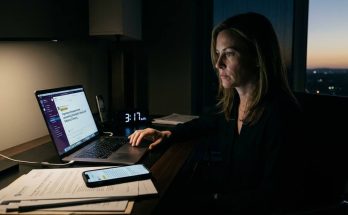
The message arrived at 6:17 on the evening of December 23, while I was sitting on the edge of my barracks bed, trying to decide whether my dress uniform needed another pass with the iron.
My father had written only three sentences.
Becca, I think it’s better if you don’t come home this year. Jason’s promotion is a big occasion, and we don’t want your Army accomplishments to overshadow his moment. I hope you understand.
I read it twice, then a third time, as if the words might rearrange themselves into something less insulting.
Outside my window, freezing rain ticked against the glass. A Christmas wreath hung crookedly on the door across the corridor, and somebody down the hall was playing an old holiday song through a tinny speaker. The smell of instant coffee and floor polish drifted beneath my door.
I had spent eleven months looking forward to those forty-eight hours at home. I had traded shifts, finished a stack of reports early, and bought my mother a silver pendant she had admired during our last phone call. My flight was scheduled for the following morning. The ticket had cost more than I wanted to admit, but I had been saving for it since October.
Now my father was telling me that my presence would spoil Christmas.
My name is Rebecca Hale, though everyone in the Army who knew me well called me Becca. At thirty-four, I had learned to recognize the difference between an order and a request, between criticism meant to improve me and criticism intended to put me in my place.
My father's message belonged to the second category.
I could have called him. I could have demanded an explanation, reminded him that I had never once asked anyone in the family to celebrate my accomplishments, or pointed out that Jason's promotion to regional operations manager had nothing to do with my service.
Instead, I put the phone facedown on the bed.
Jason had always been the family's golden boy. He was charming when he wanted to be, quick with a joke, and remarkably good at making other people feel that whatever he achieved was somehow their achievement, too. When he landed his first management job, my father bought him a watch. When he moved into a larger house, my father spent an entire weekend helping him renovate the kitchen.
When I received my first Army commendation, Dad sent a brief text three days later.
Good work. Stay safe.
I had kept the message anyway.
My mother, Claire, had always tried to bridge the distance between us. She called when she could, asked about my work, and listened carefully whenever I spoke about something difficult. Yet even her affection seemed constrained by invisible boundaries. She rarely contradicted my father in front of anyone, and whenever our conversations touched on family disagreements, she would lower her voice.
“Your father just wants things to be peaceful,” she often said.
Peaceful, in our house, meant nobody challenged him.
My stepmother, Linda, had perfected that arrangement. She married Dad when I was nineteen, and by the time I graduated from officer training, she had become the unofficial manager of every family occasion. She decided where we ate, who sat beside whom, what photographs were taken, and which subjects were better left alone.
She had never openly forbidden me from attending anything. She preferred making me feel that my attendance would create a problem for everyone else.
This time, Dad had done the work for her.
My phone vibrated again.
It was Jason.
Heard you might not make it tomorrow. That's probably for the best. The promotion dinner is kind of a big deal.
A second message followed.
Don't take it personally, okay? You know how Dad gets about these things.
I stared at the screen. Jason had known about my flight for weeks. He had even asked me to bring a bottle of bourbon from the base exchange because the brand he liked was difficult to find near our hometown.
Apparently, he had known about the invitation change before I did.
I typed a response, deleted it, and finally wrote, Congratulations on the promotion.
He reacted with a thumbs-up.
That little symbol hurt more than I expected.
I opened my airline reservation and canceled the trip. The confirmation appeared almost instantly, along with a notice that the ticket's value would be returned as credit. I watched the screen until it went dark.
Then I opened the duty roster.
A winter storm was expected to cross the region overnight, and the installation had been requesting volunteers for additional emergency-response coverage. I had planned to spend Christmas Eve eating my mother's roast chicken and listening to her complain about the neighbors' new dog.
Instead, I added my name to the overnight roster.
Captain Mercer, my commanding officer, called me less than ten minutes later.
“Hale, I see you've volunteered for the holiday shift.”
“Yes, sir.”
“You're certain? I know you had leave approved.”
“I've changed my plans.”
He paused. Mercer was a compact man with graying hair, an even voice, and a habit of noticing what people tried to conceal.
“Family trouble?”
“Nothing that affects my readiness, sir.”
“That wasn't my question.”
I looked at the canceled reservation on my laptop.
“My family has other priorities this year.”
He said nothing for a moment.
“Report at twenty hundred. Weather's deteriorating faster than forecast, and we're expecting traffic disruptions on the northern routes.”
“Understood.”
After the call, I packed my uniform, checked my emergency kit, and placed the silver pendant for my mother in the top drawer of my desk. I couldn't bring myself to return it to its box.
At eight that evening, I reported to the operations center. Snow had begun accumulating along the roads, and the wind pushed it across the floodlights in thin, ghostly sheets. The duty staff were busy checking communications equipment and coordinating weather advisories with local authorities.
For a while, the work helped. Maps, reports, vehicle movements, and radio checks were familiar things. They demanded attention without asking me to explain why my father preferred a Christmas without me.
At 10:43 p.m., an emergency notification appeared on the operations screen.
A multi-vehicle collision had been reported on a state highway north of the installation. The accident involved a commercial transport truck, two passenger vehicles, and a disabled emergency-response vehicle. The highway was partially blocked, and first responders were struggling with deteriorating visibility.
Mercer came out of his office, fastening the top button of his uniform jacket.
“Get me the latest road conditions. Find out whether military transport assets are available to support civilian emergency services. Nobody moves without authorization.”
I began coordinating the requests.
The initial reports described a white cargo truck that had jackknifed across two lanes. One passenger vehicle had struck its rear section. Another had gone off the road into a ditch. The emergency-response vehicle had been attempting to divert traffic when the collision occurred.
Then another message came in.
A civilian reporting from the scene had seen a man trapped inside the damaged truck's cab. The man was conscious but bleeding. He had repeatedly insisted that the responding personnel retrieve a small metal case from behind the driver's seat.
The dispatcher had recorded his words.
Don't let them take it. Don't let them take it to Fort Bragg.
I stopped moving my hands across the keyboard.
Fort Bragg.
The installation had been renamed several years earlier, and the phrase was ordinary enough to be dismissed as an old reference. But the man had repeated it three times, according to the dispatcher.
Mercer leaned over my shoulder.
“What have you got?”
I showed him the report.
He read it once, then again, his expression changing almost imperceptibly.
“Who made the call?”
“A civilian witness. The dispatcher hasn't obtained a full statement yet.”
“Get the original recording. Don't rely on a summary.”
I opened the communications channel and requested the audio. While we waited, another report arrived from the highway patrol. The truck's company information was unclear, and the license plate appeared to have been partially obscured by snow and damage.
The case behind the driver's seat was still inside the cab.
At 11:16 p.m., the recording came through.
The man sounded weak, with traffic roaring behind him and someone shouting for medical assistance.
“Tell them the Fort Bragg list is wrong,” he said. “Tell them the names don't match. They sent the wrong people.”
A voice asked him to clarify.
“No. Listen to me. It's not the road. They knew where we'd be.”
The recording ended with a burst of static.
Mercer straightened.
“Who else has heard this?”
“Dispatch, highway patrol, and our operations desk.”
“Keep the distribution limited. Find out what the man means by that list.”
I pulled up the accident report again, looking for the transport company's name. The information was incomplete, but one field had been entered before the connection dropped.
A cargo reference number.
I copied it into the search system. The first query returned nothing. The second produced an administrative record that should not have been connected to a civilian highway accident at all.
It referred to a military logistics movement scheduled months earlier.
The movement had been canceled.
Yet the reference number on the crashed truck was identical.
I checked the entry again, then compared it against the archived record. The number matched down to the final digit.
My mouth went dry.
“Sir,” I said, “I think this truck is carrying a shipment associated with a canceled military movement.”
Mercer studied the screen without touching the keyboard.
“Are you certain?”
“I'm checking the source now.”
“Check it twice.”
I did. Then I checked it a third time.
The reference was real. The shipment had been marked canceled, and the authorization trail contained a series of amendments that did not make sense. A route had been altered. A receiving unit had been removed. The original sign-off had been replaced with a digital authorization issued under credentials I recognized from a previous operations review.
I had seen that authorization pattern before.
Not recently. Not in a place where I expected it.
But I remembered the name associated with it.
Captain Mercer had not yet seen it.
I looked up at him, suddenly conscious of the quiet in the operations room. The radios continued chattering, printers continued feeding paper, and a weather alert flashed in the corner of the screen.
“Sir, I need to verify something before I report it.”
His eyes narrowed.
“What?”
“The authorization trail includes a name connected to a previous assignment of mine.”
He waited.
I turned the monitor slightly so he could read the record.
For the first time that night, Captain Mercer looked genuinely unsettled.
“Don't touch anything else,” he said. “Save a protected copy of the record. Then tell me exactly what you remember.”
I reached for the keyboard.
Before I could answer, the highway patrol sent another urgent update.
The truck's cargo had begun burning.
And the driver, who had been pulled from the wreckage only minutes earlier, had just told a paramedic that the people responsible for the shipment knew my name.
Click here to continue reading: PART 2: A Burning Truck, a Missing Military Shipment, and One Familiar Name Forced Me to Question Everything I Thought I Knew
My Father Uninvited Me From Christmas, but the Winter Road Ahead Would Expose a Secret My Family Had Kept Buried for Years
Part 1 of 8