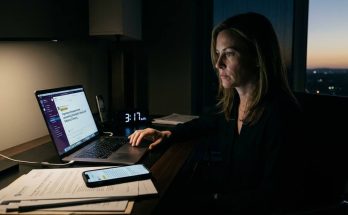
For several seconds, I couldn't make myself speak.
My mother had helped stop an operation. My father had approved its original plan. A missing analyst, a manipulated shipment, and a truck that had exploded on a snowy highway were now connected by a chain of allegations that reached back years.
I wanted Erica to be wrong.
I wanted her to be confused about the names, or mistaken about the report, or repeating a rumor that had grown more sinister with every retelling.
But she had known about the altered authorization before I told her what I had found. She knew that the shipment's route had been changed. She knew my name had been used.
Those details were not guesses.
“Erica,” I said, forcing my voice to remain level, “I need you to stop moving around and tell me how we can preserve the evidence you have.”
“I can't meet you.”
“I didn't ask you to meet me. I asked how we can preserve the evidence.”
“Someone has been watching my apartment.”
“Have you reported that?”
“To whom? The people who closed Daniel's disappearance?”
“Then we need to involve investigators who aren't connected to the original review.”
“I don't know whom to trust.”
“You called me.”
“Because you weren't supposed to be there tonight. When I heard the shipment had gone through, I thought the plan had changed again. Then I saw the news.”
“What plan?”
She went quiet.
“Erica?”
“I can't explain everything over the phone. But I can tell you this: the shipment wasn't carrying ordinary equipment. There were components inside that had been removed from a restricted inventory. Their serial numbers had been erased from the active system, but the original inventory still existed somewhere.”
“Who was buying them?”
“I don't know the final buyer. I know the transport company was connected to Northbridge Consulting. The company received contracts through a chain of subcontractors, which made it difficult to identify who controlled it.”
Walt wrote the name in his notebook.
“Did Northbridge have a direct connection to my father?” I asked.
“Your father introduced one of its executives to the procurement team. He said the company could provide transportation services at a lower cost. After that, the contract kept expanding.”
“What's the executive's name?”
“Elias Mercer.”
Walt's expression changed.
He looked at me, then at the name in his notebook.
“Erica,” I said carefully, “do you understand that this information could be important evidence in a criminal investigation?”
“Yes.”
“Then I need you to cooperate with the investigators. They can arrange a secure way for you to provide the original records.”
“And if they're working with Northbridge?”
“Then we'll establish that, too. But you cannot keep the evidence entirely to yourself and expect anyone to protect you.”
Her breathing became uneven.
“I don't want to disappear like Daniel.”
“Neither do I. That's why we need to do this properly.”
She asked for a few minutes to think.
I told her not to delete messages, alter files, or attempt to retrieve anything from a system she was no longer authorized to access. If she had copies of the records, she should preserve the original files and their metadata.
Then I gave the phone to Walt.
He identified himself, explained that an investigative team was being assembled, and arranged a follow-up through an approved channel. Erica did not sound reassured, but she agreed to speak again.
When the call ended, Walt remained beside my desk.
“Do you know Elias Mercer?”
“No. I've never worked with him.”
“Have you heard the name before?”
I considered it.
“No.”
Walt closed his notebook.
“I have.”
He explained that Elias Mercer was a civilian contractor who had appeared in several procurement reviews involving transportation and equipment storage. He had not been accused of a crime in those reviews, but his companies had been associated with irregular billing and unexplained changes to delivery schedules.
The name was also connected to Northbridge Consulting, a firm that had received multiple logistics contracts through subcontractors.
“Do you believe Erica is telling the truth?” I asked.
“I believe she has provided details we need to verify. That's not the same thing.”
He was right.
The temptation to believe her was strong because her account seemed to explain everything that had happened during the night. But a coherent story could still be wrong, and a person who possessed genuine documents could misunderstand what they meant.
I needed evidence.
Walt arranged for the original authorization trail to be examined by an independent digital forensics team. He also requested a review of the historical logistics records and instructed the investigative office to establish whether any connection existed between David Hale, Northbridge Consulting, and the canceled shipment.
I remained on duty, answering questions and documenting each development.
At 3:34 a.m., Jason called again.
I answered before the first ring had finished.
“Where are you?” I asked.
“Upstairs. My bedroom.”
“Are you alone?”
“Yes, but I don't think I have much time.”
“What happened?”
“Dad came into the garage after I spoke to you. He asked whether I'd been talking about the old photographs. I said no. He didn't believe me.”
“Did he threaten you?”
“Not directly. He said the family had made sacrifices to protect me, and that I shouldn't ruin everything because I was jealous of you.”
I almost laughed at the familiar accusation. Even in the middle of something potentially criminal, my father had found a way to turn the problem into a competition between his children.
“What did Linda say?”
“She told him I was confused. Then she asked whether I remembered Mom leaving for that long trip when I was little.”
My grip tightened around the phone.
“What did you say?”
“I told her I barely remembered it. She said that was good.”
“Good?”
“That's what she said. Then she looked at Dad, and he told her to stop.”
I asked Jason to describe the conversation as accurately as possible. He said Linda had seemed frightened, not angry. My father, by contrast, had been controlled and deliberate, asking questions in a way that made Jason feel as if he were being tested.
“Becca, I think they know you've found something.”
“Why do you think that?”
“Dad asked whether you were working tonight. He said he needed to know if the installation had contacted you about a shipment.”
I looked at Walt.
“Did you tell him anything about the investigation?” I asked Jason.
“No. I told him I didn't know what he was talking about.”
“Good. Don't try to investigate this yourself. Stay away from the study and keep your phone with you.”
“What about Mom?”
I swallowed.
“What about her?”
“Linda said Mom was supposed to come home for Christmas years ago, but she never did. I always thought she'd left because she couldn't stand living with Dad.”
I had heard that story before.
My mother had supposedly taken an extended trip when I was young. The explanation changed depending on who told it. Sometimes she had gone to help a relative. Sometimes she had needed time away. Sometimes the family simply said she had been gone for a while and refused to elaborate.
I had been told that she returned eventually, that everything was fine, and that children should not be troubled by adult problems.
But I remembered waiting by the front window on winter evenings, watching every passing car. I remembered my father telling me not to ask when she would come back.
And I remembered the day she finally appeared at the door, thinner than before, with a small suitcase and a smile that never quite reached her eyes.
“Jason,” I said, “do you remember where Mom went?”
“No. But I remember Dad saying she had been away for her own good.”
The phrase chilled me.
“Did he ever say why?”
“No. And every time I asked, he told me to be grateful she was home.”
I closed my eyes.
For years, I had believed my mother's silence was a form of acceptance. I had thought she stayed because she wanted the family to remain together, even if it meant avoiding difficult questions.
Now I wondered whether she had stayed because leaving was not an option.
“Becca?” Jason whispered.
“I'm here.”
“What if Dad did something to her?”
I wanted to tell him that our father would never hurt our mother. I wanted to give him the reassurance he needed.
Instead, I said, “We don't know what happened. But we're going to find out.”
When the call ended, Walt arranged for a welfare check on my family through the appropriate local authorities. He also requested a confidential review of any records relating to my mother's previous residence and the period when she had supposedly been away.
The investigators needed a starting point, and Jason's recollection of the photograph provided one.
I asked him to write down everything he remembered about the folder without attempting to retrieve it again. He agreed.
At 4:12 a.m., a message arrived from an unknown number.
There was no greeting.
Only a photograph.
It showed the front of my father's house, taken from across the street. The curtains in the living room were open, and the lights were on. A figure stood behind the glass, but the image was too grainy to identify the person.
Underneath it was a sentence.
You should have gone home for Christmas.
I stared at the screen until the words blurred.
The message was not proof that anyone had been watching my family. It could have been a threat designed to make me panic. But whoever sent it knew that I had changed my plans and was on duty at the installation.
I forwarded it to Walt and preserved the original message.
He examined the photograph without touching my phone.
“Don't respond,” he said.
“I wasn't going to.”
“Good. We'll have the communications team examine what they can from the message and determine whether the image contains useful metadata.”
He asked whether anyone outside the installation knew my duty assignment.
“My commanding officer, the duty scheduler, and the personnel who arranged the shift. My father knew I had changed my plans, but I don't know whether he knew I volunteered for overnight duty.”
“Could he have learned it from someone else?”
“Possibly.”
Walt nodded.
“We'll investigate that possibility.”
He returned to the operations center's secure telephone and spoke with the investigative team. While he was occupied, I examined the photograph again.
The image had been taken from a low angle, probably from a parked vehicle. The timestamp had been stripped, but the wet pavement reflected the same harsh white streetlights visible in the local weather footage.
Whoever took it had been near my father's house during the storm.
I wondered whether Jason was still inside.
I called him.
He answered in a whisper.
“Becca, Dad just left.”
“Where did he go?”
“He didn't say. Linda went with him. They told me to stay home.”
“Did they take their phones?”
“No. Why?”
“Because I received a photograph of the house from an unknown number. Someone may be watching you.”
Jason inhaled sharply.
“Are you serious?”
“Yes. Don't leave unless the authorities tell you to. Lock the doors, stay away from the windows, and contact emergency services if anyone tries to enter.”
“Who would do this?”
“I don't know.”
He was silent for a moment.
Then he said, “There's something else I haven't told you.”
“What?”
“Before Dad left, I heard him say he was going to meet someone named Mercer. He told Linda that if the first plan had failed, they would have to use the second.”
I looked toward Walt.
“Did he say where he was going?”
“No. But he said the meeting couldn't happen at the house anymore.”
My mind returned to the exploded truck, the false authorization, and the contractor whose name appeared in Erica's account.
“Jason, I need you to tell the investigators that exactly as you heard it. Don't interpret it. Don't add anything you aren't sure about.”
“I will.”
After the call, I gave Walt the new information.
He listened carefully, then asked the investigative team to check whether Elias Mercer or anyone connected to Northbridge Consulting had been scheduled to meet David Hale that night.
A few minutes later, the team reported that an unregistered vehicle had been seen leaving the vicinity of my father's house shortly after 3:30 a.m. The vehicle's description was incomplete, and its route was unknown.
It was not enough to identify anyone.
But it was another detail that fit the growing pattern.
At 5:06 a.m., Walt received a call from the local authorities conducting the welfare check.
He listened without speaking, his face growing harder with every passing second.
When he ended the call, he turned to me.
“Your stepbrother is safe for the moment,” he said. “But your father and Linda haven't been located.”
“What do you mean?”
“The house is empty. Both vehicles are gone. Your father's office appears to have been cleared of several files.”
I stood so quickly that my chair struck the desk behind me.
“What about the folder Jason saw?”
“We don't know whether it was removed. The local officers haven't located it.”
“And my mother?”
Walt hesitated.
“They found something else in the study.”
He placed a printed photograph on the desk.
It showed the same concrete building Jason had described. The sign above the entrance was now visible.
The words read:
OPERATIONS ANNEX — RESTRICTED ACCESS.
My mother stood near the wall, her face turned toward the camera. Beside her was a man I recognized from the old logistics records.
Daniel Reeves.
The analyst Erica had said disappeared.
On the back of the photograph, someone had written a date and a short note.
If anything happens to me, Becca must never be told what her mother witnessed.
I read the sentence again.
Then I looked up at Walt.
“Who wrote this?”
“We don't know yet.”
“Where was the photograph found?”
“Inside a locked compartment beneath your father's desk.”
I felt my hands begin to tremble.
The evidence had been hidden in my father's study, beside the documents bearing my name. My mother had stood beside a missing analyst at a restricted facility. Someone had taken pains to keep the photograph from being discovered.
And the note suggested that my father had known exactly what it meant.
Walt gathered the papers.
“We're going to need a formal statement from you, Major. We'll also need to speak with your mother as soon as we can locate her.”
I stared at Daniel Reeves's face.
“She's not going to be easy to find,” I said.
“Why?”
“Because if my father has spent years making sure nobody knows what she witnessed, he may have made sure nobody can find her, either.”
My phone vibrated once more.
This time, the message came from Jason.
Becca, I found a second folder. It was hidden behind the drawer in Dad's desk. There's a photograph of Mom, a list of names, and a note with your military identification number on it.
A second message appeared.
The last name on the list is yours.
Click here to continue reading: PART 5: The Last Name on My Father’s List Was Mine, and the Secret Behind It Reached Far Beyond the Burning Truck on the Highway
My Father Uninvited Me From Christmas, but the Winter Road Ahead Would Expose a Secret My Family Had Kept Buried for Years
Part 4 of 8