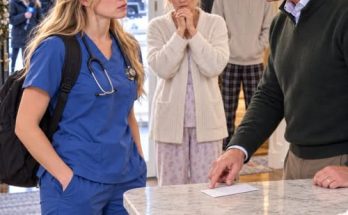
The DNA results arrived several days later.
Sheriff Shaw brought them to my hospital room in a sealed envelope.
Nathan was waiting outside with coffee, so I asked her to let him come in before I opened it.
I wanted him to hear the result at the same time I did.
My hands trembled as I unfolded the paper.
The test confirmed that Nathan Cole was my biological father.
For a moment, I couldn't look at him.
He sat very still, his eyes fixed on the page.
Then he let out a breath I hadn't realized he was holding.
"I always wondered," he said.
I put the paper on the table.
"I don't know what I'm supposed to say."
"You don't have to say anything."
I studied his face.
He wasn't asking me to celebrate.
He wasn't asking me to forgive my mother or pretend the years apart had been an unfortunate misunderstanding.
He simply looked relieved to know that the truth had finally been established.
I felt relief too.
But it came with grief.
I had spent my entire life believing my mother had told me what mattered about our family.
Now I knew there had been another person who could have answered questions she had left behind.
I wondered what my childhood might have been like if Nathan had been allowed to visit.
I wondered whether he would have taught me to recognize fire weather or how to read the mountains before a storm.
I wondered whether my mother had ever regretted her decision.
Those questions had no answers.
I folded the report and placed it in the drawer beside my bed.
"Thank you for coming back," I said.
Nathan's eyes filled.
"I should have found a way sooner."
"I don't know if you could have."
He looked down.
"Maybe not."
It was the first time he admitted that he might have made mistakes too.
I appreciated that more than I expected.
The next week brought a different kind of pressure.
Northstar's board wanted to know when I would be able to return.
The independent trustee had protected my voting rights, but the company still needed leadership. Pilots needed schedules, maintenance teams needed budgets, and medical facilities needed to know which flights would be available.
I couldn't ask everyone to wait until I felt ready to face the world.
So I asked the trustee to arrange a secure meeting with the board.
The meeting took place by video from my hospital room.
I wore a loose blouse that hid the bandage around my abdomen.
A stack of medical notes sat beside my laptop.
I looked exhausted.
I also looked alive.
The first person to speak was the board chair.
"Lena, we're relieved you're recovering."
"Thank you."
"We need to discuss the leadership arrangement."
"I know."
He explained that Grant had presented himself as the obvious temporary successor. Several board members had initially supported him because they believed I had died and wanted the company to remain stable.
The trust amendment had stopped that process.
Now the board had to decide how to proceed while the investigation continued.
I listened without interrupting.
Then I asked them to review the financial records that had been uncovered.
The questionable consulting payments.
The missing documentation.
The approvals Grant had made himself.
I wanted the board to understand that the criminal case was not separate from Northstar's future.
The same habits that had allowed Grant to hide money could undermine the company's safety if they went unchallenged.
I had spent years treating financial oversight as something I could delegate because I trusted my husband.
I would not make that mistake again.
"We need independent review of every major payment and every consulting agreement," I said. "No executive should be able to approve a transaction and review their own work."
The board chair nodded.
Several members took notes.
I asked for an outside financial review and a committee with authority to examine the transactions without interference from senior management.
I also requested that any executive connected to the questionable payments be removed from financial decision-making until the review was complete.
Nobody objected.
They had seen the same records I had.
By the end of the meeting, the board had agreed to the new oversight measures and confirmed that Grant would have no authority over company operations while the investigation continued.
It wasn't a victory I felt like celebrating.
It was a necessary repair.
When the call ended, I closed the laptop and leaned back against the pillows.
My abdomen hurt.
My head hurt.
I was exhausted from listening to people discuss my company as if it were a building damaged by a storm.
But Northstar was still operating.
Its aircraft were still transporting patients.
The people my mother had built the company to help were still getting where they needed to go.
That mattered more than Grant's title.
Later that afternoon, Nathan brought me a paper folder from the sheriff.
Inside were copies of the letters he had sent me.
The envelopes had been opened and resealed before Grant placed them in his safe.
I recognized his handwriting on the address labels.
I had seen it on company documents and holiday cards.
The letters were ordinary at first.
Nathan introduced himself.
He explained that he had known my mother when they were young.
He said he didn't expect me to accept his account without proof.
He included photographs, dates, and a copy of the letter my mother had written him years earlier.
He had tried to be careful.
He had given me room to refuse him.
Grant had taken that choice away.
I read the first letter twice.
Then I read the others.
The final one had been written only a few months before the fire.
Nathan had told me he would be in the region for emergency-response work and would be glad to meet if I wanted to talk.
He had not threatened to enter my life.
He had simply offered to be there.
I held that letter for a long time.
"He knew I could say no," I said.
Nathan nodded.
"I didn't want you to feel trapped."
I put the papers back in the folder.
"Grant never gave me that choice."
"No."
I looked at him.
"Did my mother ask you to forgive her?"
"Not directly."
"What did she say?"
Nathan stared out the window.
"She said she had spent too long telling herself that she was protecting everyone. By the time she understood what the silence had cost, she didn't know how to undo it."
I thought about the letter hidden in the metal box.
My mother had built Northstar around reaching people in emergencies.
She had created systems, trained crews, and paid for equipment that could bring help to isolated places.
But she had left her own family stranded in a silence that lasted decades.
I loved her.
I was angry with her.
Both things were true.
I didn't want to turn her into a villain just because she had made a decision that hurt us.
I also didn't want to pretend love made the decision harmless.
That evening, I visited Noah in the NICU.
He was still premature and needed support, but the nurses said he was making progress.
I sat beside the incubator and placed my finger against his palm.
He closed his tiny hand around it.
I thought about the trust amendment.
My mother had named him as my contingent heir.
At the time, it had seemed like another piece of legal protection.
Now it felt personal.
She had tried to protect the child she knew I was carrying, even though she had never met him.
She had anticipated the possibility that someone might use my death to seize control of what she had built.
She hadn't been able to save me from Grant.
But she had left behind something that could help protect Noah's future.
I spoke to him softly.
"You don't owe anyone anything just because they're family."
His eyes remained closed.
"You get to decide who stays."
I knew he couldn't understand me.
I needed to hear myself say it anyway.
The next morning, the hospital social worker asked whether I had a safe place to recover after discharge.
I told her I would stay somewhere private until the sheriff approved a longer-term arrangement.
Cedar Ridge was out of the question for now.
The cabin was a burned shell, and the investigation was still active.
My home in town was secure, but it held too many reminders of Grant.
I couldn't yet imagine sleeping in the same bedroom where he had once promised me a future.
Nathan offered to help find temporary accommodation.
I accepted the help but made it clear that I needed space to make my own decisions.
He understood.
We began with practical things.
A place to recover.
A way to visit Noah.
A schedule that allowed me to attend medical appointments without being surrounded by reporters.
No dramatic promises.
No demand that I trust him immediately.
Just one step at a time.
For the first time since the fire, I could think about the future without measuring every decision against Grant's expectations.
I wasn't ready to return to work full-time.
I wasn't ready to forgive anyone.
But I was ready to begin making choices that belonged to me.
Click here to continue reading: PART 7: Brooke Had Helped My Husband Leave Me in the Fire, Yet Her Evidence Forced Him to Face the Truth He Thought Money Could Hide
I Thought My Husband Would Come Back for Me Until I Saw Him Standing Beside the Burning Cabin With Her
Part 6 of 12