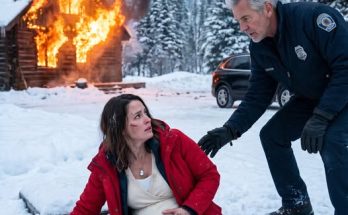
My discharge from the hospital did not feel like a victory.
I had imagined leaving with Noah in my arms, driving home, and beginning the ordinary work of raising a child.
Instead, I left with medical instructions, a list of follow-up appointments, and a son who still needed care in the NICU.
I couldn't take him home yet.
That was the hardest part.
I had survived the fire.
I had escaped the cabin.
I had stood beside my own empty casket and watched my husband get arrested.
But I still had to leave the hospital without my baby.
The nurse reminded me that Noah was making progress and that the team would tell me when he was ready.
I knew she was right.
I also knew that knowing something was right didn't make it hurt less.
Nathan helped me gather my belongings.
He carried the small bag containing my clothes and placed the silver locket around my neck after I checked that the clasp was secure.
I kept the key hidden inside.
I didn't want to lose it.
The first few nights away from the hospital were difficult.
I woke at the slightest sound.
If a car passed outside, I thought about Grant's SUV.
If I smelled smoke from a nearby fireplace, I remembered the kitchen ceiling turning orange.
I couldn't sleep with a door closed unless I knew where the lock was.
My doctor said the reactions were understandable after what I had experienced.
I didn't need a diagnosis to know that my body still believed the cabin was burning.
I took my medication as directed and followed the recovery plan.
I also made myself visit Noah every day.
Some days I stayed beside his incubator for hours.
Other days, I could manage only a short visit before exhaustion forced me to rest.
Nathan never complained.
He drove me when I needed help and waited outside when I wanted to be alone with my son.
He didn't try to become my father in a single week.
He was simply present.
That mattered.
The independent trustee arranged a meeting with Northstar's leadership team once my doctor approved it.
I attended from a private conference room at the hospital, wearing a loose blouse and carrying a folder of notes.
The people on the screen looked relieved to see me.
Some looked ashamed.
One senior manager apologized for supporting Grant's request for temporary control.
He said he had believed the company's stability required a familiar leader.
"I understand why you wanted continuity," I told him. "But continuity can't mean giving authority to someone just because he says he's entitled to it."
He nodded.
I didn't ask anyone to make a public apology.
I wanted the company to learn from what had happened.
We discussed the financial review, the consulting payments, and the new approval procedures.
I asked for an independent committee to examine every transaction that Grant had authorized during the previous two years.
I wanted the committee to report directly to the board rather than through the finance office.
I also wanted a clear process for raising concerns about executive conduct.
No one should have to choose between keeping a job and reporting a suspicious payment.
Northstar had spent years training its pilots to speak up when conditions became unsafe.
The company needed the same discipline in its offices.
A pilot who ignored a warning could put a patient and crew at risk.
An executive who ignored financial warnings could put the entire organization at risk.
I had treated those responsibilities as separate for too long.
That was going to change.
The board approved the new oversight structure.
They also agreed that I would retain my voting rights while I recovered and that the trustee would remain involved until the legal process allowed a return to normal governance.
I didn't ask to resume every duty immediately.
I needed time to heal.
I needed time with Noah.
I needed to learn how to live without measuring my decisions against Grant's reactions.
The company could wait for me to recover, provided it continued serving its patients safely.
The following week, the financial review uncovered more details about the consulting agreements.
The payments had been disguised as routine business expenses.
Some were connected to firms that had provided little evidence of meaningful work.
The reviewers were tracing the transactions and preserving the records for investigators.
I didn't ask them to rush.
I asked them to be thorough.
Grant had built his plan around the belief that nobody would look closely enough.
I wanted the review to make that assumption impossible in the future.
Meanwhile, the criminal case continued.
The prosecutor kept me informed about the evidence and the likely schedule for hearings.
Grant remained in custody.
His lawyers disputed parts of the investigation and challenged the conclusions drawn from the digital records.
That was their right.
I knew the case would not be settled simply because I had told the truth.
The legal process would require evidence, examination, and time.
I prepared myself for that.
I also prepared myself for the possibility that Grant would try to contact me.
He did.
A letter arrived through his attorney.
It was short and carefully written.
He said he regretted how things had unfolded.
He said he had been under pressure and had made decisions he could never take back.
He asked me to remember the good years of our marriage.
I read the letter once.
Then I placed it in the folder for the prosecutor.
There was no apology for chaining the doors.
No apology for leaving me inside.
No apology for the child he had nearly killed.
He regretted the consequences.
That was not the same as regretting what he had done.
I didn't reply.
A few days later, Nathan asked whether I wanted him to help me rebuild the cabin.
I had been thinking about Cedar Ridge since the fire.
The place had belonged to my mother before it belonged to me.
It held childhood memories, family arguments, summer afternoons, and the emergency passage that had saved my life.
It also held the memory of Grant walking away while the house burned.
I wasn't ready to rebuild it.
"Not yet," I told Nathan.
He nodded.
"We can leave it alone until you're ready."
I looked at him.
"I don't know if I'll ever want another cabin there."
"Then you don't have to build one."
His answer surprised me.
For years, I had believed that protecting a family legacy meant preserving every part of it.
My mother had taught me to care for the cabin.
She had also taught me that an emergency exit mattered more than a beautiful front door.
Perhaps preserving her legacy meant understanding why she had built the passage in the first place.
I didn't need to live inside the place where I had nearly died to prove that I loved her.
For now, Cedar Ridge would remain a burned structure under investigation.
When the legal restrictions were lifted, I would decide what to do with the land.
Until then, I had other work.
One morning, I arrived at the NICU to find Noah resting without the extra support he had needed earlier.
The nurse explained that he was breathing more steadily and gaining weight.
I sat beside him and slipped my finger into his hand.
He gripped it.
I laughed softly.
"You've been through a lot, little man."
He opened his eyes for a few seconds.
I wondered what kind of person he would become.
I hoped he would grow up knowing that strength didn't mean never being afraid.
I hoped he would understand that loving someone didn't require surrendering his judgment.
And I hoped he would never have to learn that lesson through betrayal.
Nathan came to visit later that afternoon.
He stood beside the incubator and watched Noah sleep.
"He looks stronger," he said.
"He is."
Nathan rested his hand on the edge of the incubator.
"I wish I'd known you when you were this small."
I looked at him.
"So do I."
The words came out before I could stop them.
He lowered his head, and I saw tears gather in his eyes.
I reached across the small space between us and touched his sleeve.
It wasn't forgiveness for every lost year.
It wasn't a promise that we would become close immediately.
It was simply an acknowledgment that we had both lost something we could never recover.
We could still choose what happened next.
That evening, I returned to the temporary apartment where I was recovering.
I placed the silver locket on the bedside table.
For the first time since the fire, I didn't feel compelled to check the door twice before lying down.
I still woke during the night.
I still remembered the chain.
But I was beginning to understand that the cabin was behind me, even if the fear had not fully caught up.
Grant had tried to take my life, my company, and my future.
He had failed to take all three.
My mother had left me a complicated inheritance.
Some of it was financial.
Some of it was painful.
Some of it was the knowledge that love without honesty could leave people stranded for decades.
I couldn't change what had happened.
I could decide what I did with what remained.
I would protect Northstar.
I would raise Noah to know the truth about his family.
I would allow Nathan to be part of our lives without pretending that the years apart hadn't mattered.
And I would never again confuse loyalty with silence.
For the first time in weeks, those decisions felt like mine.
Click here to continue reading: PART 9: The First Time I Returned to Northstar, I Found My Husband’s Decisions Still Hiding in the Company Records
I Thought My Husband Would Come Back for Me Until I Saw Him Standing Beside the Burning Cabin With Her
Part 8 of 12