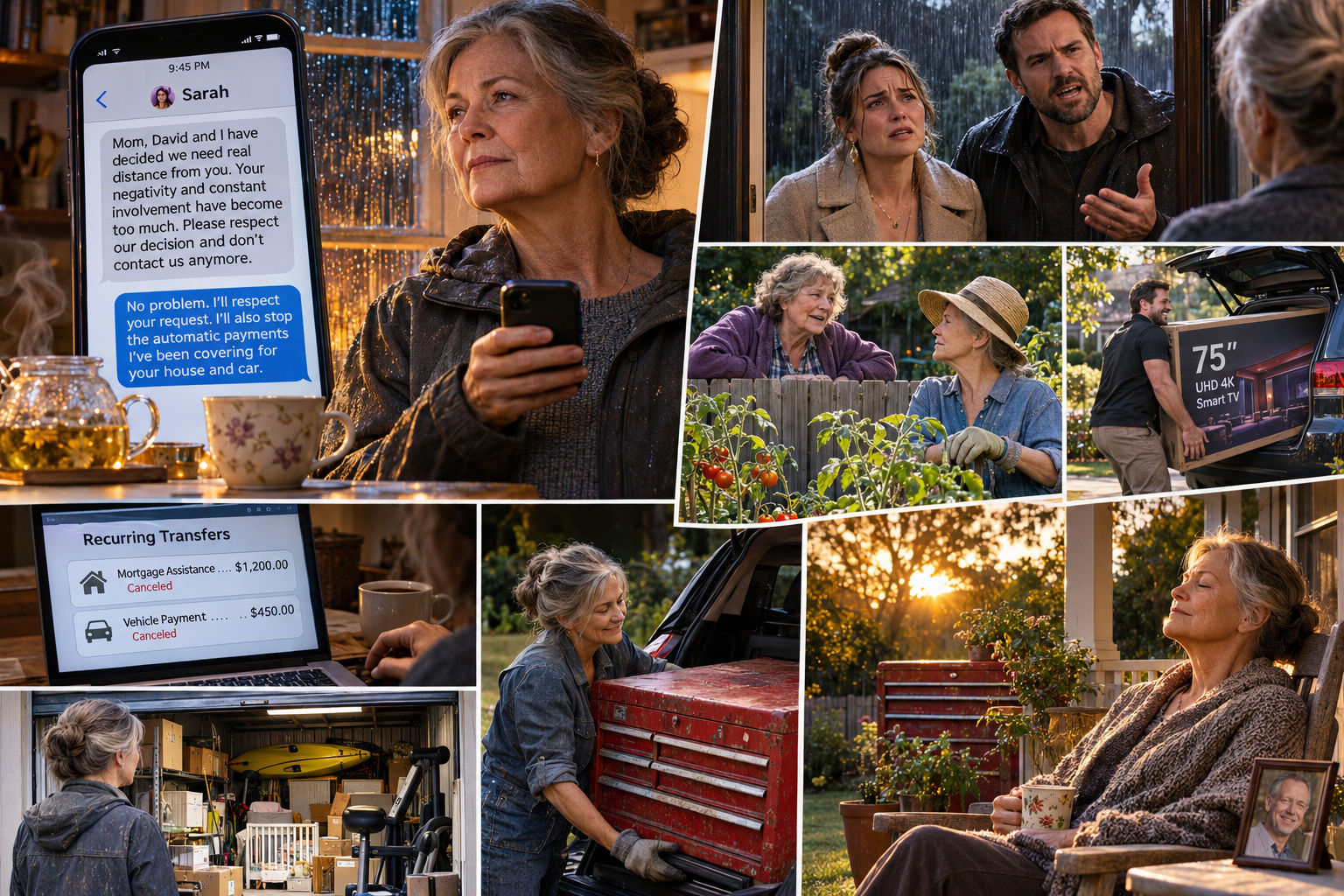
I placed it on my garage workbench and ran my fingers over the faded red paint.
For a long time, I didn’t move.
The chest still had the small dent near the bottom drawer where Michael had dropped a hammer twenty-three years earlier.
He had been fixing the back porch when it happened.
I remembered standing in the doorway, laughing as he complained that the hammer had a personal grudge against him.
He had looked up at me and smiled.
“At least the toolbox won’t complain when I get old.”
I hadn’t thought about those words in years.
Now, standing in my garage with his old tools in front of me, I felt something I hadn’t allowed myself to feel for a very long time.
I missed my husband.
Not just because he was gone.
I missed having someone who noticed when I was tired.
Someone who knew the difference between my smiling because I was happy and smiling because I didn’t want anyone to worry.
Someone who would have looked at my worn winter coat, the cracked window, and the stack of bills on my kitchen table and asked why I was giving away so much of myself.
Michael had been gone for six years.
And somewhere during those six years, I had slowly turned from a woman with a life of her own into a woman whose entire purpose seemed to be solving Sarah’s problems.
I opened the top drawer.
Inside were neatly arranged screwdrivers, measuring tapes, and a small metal box filled with assorted screws.
Everything was exactly where Michael had left it.
I picked up his measuring tape.
The yellow casing was scratched, and his initials were written on the back in black permanent marker.
M.M.
Michael Mitchell.
I pressed the button and let the tape retract with a sharp snap.
Then I laughed.
It was such a small sound, but it surprised me.
I hadn’t laughed alone in my garage for years.
On the side of the tool chest, tucked beneath a magnetic strip, was a folded piece of paper.
At first, I thought it was an old receipt.
I pulled it free.
It was a handwritten list.
Things to fix before winter.
Michael’s handwriting.
Guest-room window.
Bathroom faucet.
Garage light.
Back porch railing.
I stared at the list.
The first two things were still broken.
The garage light flickered whenever it rained.
And the porch railing had been loose long enough that I no longer leaned against it.
Michael had made that list shortly before he became ill.
He had intended to fix everything.
Then the hospital visits began.
The treatments.
The long nights.
The terrible final month when the house became so quiet that even the refrigerator seemed unbearably loud.
After he died, I told myself I would finish the repairs.
But Sarah needed help with her wedding debt.
Then David needed money to start his first business.
Then Leo was born.
Then they bought the larger house.
There was always something.
And somehow, Michael’s list had remained unfinished while my daughter’s list of needs never seemed to end.
I smoothed the paper against the workbench.
“Well, Michael,” I whispered, “I think we’re finally going to finish this.”
I folded the list carefully and placed it in my pocket.
Then I went inside and called a window repair company.
For the first time in four years, when the receptionist quoted the price, I didn’t immediately calculate how much of Sarah’s mortgage payment it would consume.
I simply scheduled the work.
The appointment was for Friday.
It felt like the beginning of something.
I didn’t know then how much more I was about to discover.
The first real sign that Sarah and David weren’t going to accept my decision came the following afternoon.
I had just returned from the grocery store.
There were two bags on my kitchen counter, a carton of eggs beside the refrigerator, and a small bouquet of yellow flowers I had bought for myself.
I rarely bought flowers anymore.
Sarah always called them a waste of money.
But they had been on sale, and I liked how bright they looked against the gray November sky.
My phone buzzed.
It was a message from David.
Amber, we need to discuss the financial situation like reasonable adults. You cannot create instability in a household with a child and then pretend you have no responsibility.
I read it once.
Then again.
There was something almost impressive about the confidence of a man who had spent four years accepting money from his mother-in-law and now considered the loss of that money an act of aggression.
I set the phone down.
A few minutes later, another message arrived.
Sarah is devastated. You’re putting Leo’s home at risk.
That one hurt.
Because he knew exactly which name to use.
Leo.
My seven-year-old grandson.
The little boy who loved dinosaurs and strawberry pancakes.
The child who used to crawl into my lap and ask me to tell him stories about his grandfather.
I hadn’t seen him in almost three weeks.
Sarah had canceled our last two visits.
The first time, she said Leo had a school project.
The second time, she said they needed family time.
Now David was using him as an argument for money.
I sat at the dining table.
I wanted to answer.
I wanted to tell David that if Leo’s home was truly at risk, perhaps the new television should have been the last thing they purchased.
But I stopped.
I had spent years explaining myself to people who only listened long enough to find a new way to make me feel guilty.
So instead, I opened my notebook.
On the first page, I wrote:
Money I have given Sarah and David.
Underneath, I began listing the recurring expenses.
Mortgage assistance.
$1,200 per month.
Vehicle assistance.
$450 per month.
Storage unit.
$150 per month.
Phone plan.
Subscriptions.
Repairs.
Emergency transfers.
The more I wrote, the more uncomfortable I became.
I had treated each payment as an isolated act of kindness.
A temporary favor.
A little help.
But when those favors were placed beside one another, the picture changed.
They weren’t occasional gifts.
They had become a second household budget.
One that I was funding.
I pulled out the folders where I kept my banking records.
Michael had always believed in paper copies.
“Computers forget things,” he used to say. “A good filing cabinet doesn’t.”
I had teased him about it.
Now I was grateful.
By the time the sun disappeared, I had four years of statements spread across the dining table.
I used a calculator.
Then I checked the numbers again.
The mortgage transfers alone came to $57,600.
The vehicle payments added another $21,600.
The storage unit had cost $7,200.
That was $86,400 before counting phones, subscriptions, emergency transfers, repairs, and the countless smaller things I had paid for without asking questions.
When I finished adding the rest, the number on my notepad was $112,780.
I stared at it.
One hundred twelve thousand, seven hundred eighty dollars.
I had given my daughter and son-in-law more than one hundred thousand dollars over four years.
Some of that money had come from my pension.
Some from the savings Michael and I had built together.
Money he had earned working long hours.
Money I had saved by taking extra shifts at the library before retirement.
Money we had intended to use for a peaceful old age.
I put the calculator down.
My hands were trembling.
Not because I suddenly hated Sarah.
I didn’t.
She was still my daughter.
I loved her.
But loving someone didn’t change what the numbers said.
I had been sacrificing my own security to protect two adults from the consequences of their spending.
And the moment I stopped, they acted as though I had stolen something from them.
I leaned back in my chair.
For the first time, I wondered whether my generosity had truly helped them.
Or whether it had allowed them to avoid growing up.
On Friday morning, the window repairman arrived at nine.
His name was Daniel.
He was a quiet man in his forties who wore a navy jacket and carried his tools in an organized black case.
He inspected the guest-room window and shook his head.
“This seal should’ve been replaced years ago.”
“I know.”
“You’re losing quite a bit of heat through here.”
“I know that too.”
He glanced at me.
“Anything stop you from getting it done?”
I almost gave my usual answer.
Money was tight.
Other things came up.
Life got busy.
Instead, I told him the truth.
“I kept paying other people’s bills before taking care of my own.”
Daniel nodded.
He didn’t ask questions.
He simply said, “Well, it’s getting fixed today.”
Those seven words made me unexpectedly emotional.
It’s getting fixed today.
Not eventually.
Not when Sarah and David were financially comfortable.
Not when every possible emergency had been solved.
Today.
While Daniel worked upstairs, I went through the kitchen cabinets.
I threw away expired spices.
Washed the curtains.
Cleaned the drawer filled with old batteries and rubber bands.
Then I found myself standing in front of the refrigerator, looking at a photograph of Leo.
He was five in the picture.
He had a missing front tooth and a crooked smile.
Michael had died before Leo was old enough to remember much about him.
But I had tried to keep his grandfather alive through stories.
I used to tell Leo about Michael’s terrible jokes.
About the time he accidentally planted zucchini where he meant to plant cucumbers.
About the little wooden birdhouse he built and painted blue because Sarah insisted birds preferred blue houses.
Leo loved those stories.
He would always ask for one more.
One afternoon, he had looked at me with complete seriousness.
“Grandma, was Grandpa your best friend?”
I had smiled.
“Yes, sweetheart. He really was.”
“Am I your best friend now?”
I had hugged him.
“You’re one of my favorite people in the whole world.”
Standing in my kitchen, I pressed the photograph against the refrigerator door.
I missed him terribly.
But I reminded myself that there was a difference between loving my grandson and allowing his parents to use him as leverage.
The distinction was painful.
It was also necessary.
At noon, Daniel finished the repair.
He showed me the new seal.
Then he checked the window from outside and assured me the draft was gone.
I paid him.
Without guilt.
Without transferring money from another account to replace what I had spent.
Without wondering whether Sarah would call with another emergency.
After he left, I stood beside the window.
The room was warmer.
And I realized that I had forgotten what it felt like to solve a problem in my own house.
That afternoon, Martha came over with a loaf of banana bread.
She took one look at my clean guest room and smiled.
“Someone’s been busy.”
“I had the window fixed.”
“About time.”
“I also ordered a new faucet.”
Martha placed the bread on the counter.
“Amber Mitchell, are you becoming irresponsible?”
I laughed.
“Apparently.”
She looked at me more seriously.
“How are things with Sarah?”
I sighed.
“Complicated.”
“That’s a polite word.”
I poured coffee for both of us.
We sat at the kitchen table.
Then I told her about the money.
Not every detail.
Just the total.
Martha stopped cutting her slice of bread.
“How much?”
“One hundred twelve thousand, seven hundred eighty dollars.”
She stared at me.
“Amber.”
“I know.”
“That’s not helping with groceries.”
“I know.”
“That’s a small fortune.”
I looked down at my hands.
“They always seemed to need it.”
Martha was quiet for a moment.
Then she asked a question that stayed with me.
“Did they ever ask what you needed?”
I thought about it.
Really thought.
I remembered birthdays when Sarah sent a quick text.
Mother’s Days when David said they were too busy to visit.
Christmas mornings when I arrived with gifts and spent half the day washing dishes.
I remembered the year my water heater broke.
Sarah had called while I was waiting for the plumber.
I told her what had happened.
She said, “Oh, that’s terrible, Mom. Anyway, David needs to talk to you about the car insurance.”
I had paid the insurance bill before the plumber even finished.
“No,” I finally said.
Martha didn’t look pleased to be right.
She just reached across the table and squeezed my hand.
“Then maybe it’s time somebody did.”
The next morning, Sarah called from a number I didn’t recognize.
I answered because I thought it might be the faucet installer confirming the appointment.
“Hello?”
“Mom?”
I closed my eyes.
“Sarah.”
“Please don’t hang up.”
“I wasn’t going to.”
She sounded tired.
Not angry this time.
“Can we talk?”
“You can talk.”
There was a pause.
Then she said, “I don’t understand why you’re doing this.”
I looked at the yellow flowers on my table.
“Which part?”
“Cutting us off.”
“You asked me not to contact you.”
“Mom, we’ve already explained that.”
“Then what exactly do you want me to understand?”
She exhaled sharply.
“We needed space from your comments.”
“What comments?”
“You know.”
“No, Sarah. I’d like you to tell me.”
There was a long silence.
Then she said, “You always make David feel judged.”
I nearly laughed.
“How?”
“You ask about his business.”
“Because he tells me the business needs money.”
“You ask whether we can afford things.”
“Because you tell me you can’t afford your mortgage.”
“You always make everything about money.”
I stared at the phone.
For years, I had carefully avoided asking questions about their finances because I didn’t want to embarrass them.
Now those few questions had somehow become my great offense.
“Sarah, you are the one calling me about money.”
“Because you suddenly stopped helping.”
“After you told me to stay away.”
She began crying.
And there it was.
That familiar sound that made my heart immediately reach for its old instructions.
Fix it.
Comfort her.
Take the blame.
Make the problem disappear.
I gripped the phone.
“Sweetheart,” I said, “are you and David in actual danger of losing the house?”
She sniffed.
“What do you mean?”
“Have you missed mortgage payments?”
“No.”
“Are you behind on the loan?”
“No, but—”
“Has the bank threatened foreclosure?”
“No.”
“Then please stop telling me Leo is about to lose his home.”
Silence.
I continued.
“Your next payment is coming due. You have time to make arrangements.”
“David’s income isn’t predictable.”
“Then perhaps you need to adjust your spending.”
“We have bills.”
“So do I.”
She sounded offended.
“Mom, you own your house.”
“Yes. Because your father and I spent thirty years paying for it.”
“That’s different.”
“How?”
“You didn’t have the kind of expenses we have.”
I looked toward the guest-room window.
I thought of the kitchen faucet.
The porch railing.
The retirement savings I had been quietly draining.
“Sarah, I have expenses you don’t even know about.”
“Then why didn’t you tell us?”
That question almost stopped me.
Because it was reasonable.
Why hadn’t I told them?
Why had I hidden the sacrifices?
Why had I made everything seem easy?
I took my time answering.
“Because I didn’t want you to feel guilty.”
She was quiet.
Then she said, “So now you’re trying to make me feel guilty?”
I felt the old exhaustion settle over me.
“No. I’m telling you the truth.”
“David says you’re doing this because you can’t stand not being involved.”
I closed my eyes again.
There was David.
Always standing between us.
Always explaining my motives to my daughter.
“Sarah, what do you think?”
“What?”
“What do you think, without David telling you?”
She didn’t answer.
I waited.
Finally, she whispered, “I think you’re being unfair.”
My chest tightened.
But I remained calm.
“Then I’m sorry you feel that way.”
“Will you restart the payments?”
“No.”
The word came out clearly.
Sarah inhaled.
“Not even for one month?”
“No.”
“Mom.”
“I love you, Sarah. But the answer is no.”
She began crying harder.
Then she said something I will never forget.
“You’re supposed to be my mother.”
I looked at Michael’s photograph on the mantel.
“Yes,” I said softly. “And I always will be.”
I paused.
“But you’re thirty-nine years old. Being your mother doesn’t mean being responsible for your mortgage forever.”
She hung up.
I stood in the kitchen for several minutes.
My hands were shaking.
I had said no to my daughter.
And the world had not ended.
The following Monday, I called the financial adviser Michael and I had used for years.
His name was Robert Hayes.
He had helped us prepare for retirement.
After Michael died, Robert occasionally sent me reminders to review my accounts.
I usually postponed the appointments.
There was always something more urgent.
This time, I booked one.
I carried my folder of bank statements into his office.
Robert greeted me warmly.
Then he opened the folder.
At first, he said very little.
He read the transfers.
Checked the dates.
Reviewed the withdrawals from my savings.
Finally, he removed his glasses.
“Amber, may I ask you something?”
“Of course.”
“Did you realize how much money you were giving away?”
I looked down.
“Not until recently.”
He nodded.
“That happens when payments become routine.”
He turned the statements toward me.
“Your pension covers your basic expenses, but these additional payments have been eating into your reserves.”
“I know.”
“Your savings are still meaningful. You’re not in immediate financial trouble.”
I felt some relief.
Then he continued.
“But the pace of these withdrawals was not sustainable indefinitely.”
There it was.
The truth I had been avoiding.
He showed me what my retirement savings might look like if I continued the payments.
Then he showed me what they might look like if I stopped.
The difference was enormous.
Money I could use for repairs.
Medical expenses.
Unexpected emergencies.
Travel.
Or simply the comfort of knowing I wouldn’t have to worry every time the furnace made a strange noise.
Robert leaned back.
“Your husband worked hard to help provide you with a secure retirement.”
My throat tightened.
“He did.”
“There’s nothing wrong with helping family.”
“I know.”
“But help needs limits, especially when it threatens the giver’s own stability.”
I nodded.
He glanced at the vehicle loan paperwork.
“We should also deal with this.”
That was the part I dreaded.
When Sarah and David bought their SUV, the dealership had offered unfavorable financing.
David’s credit history was uneven because of his business.
Sarah had called me in tears.
They needed a reliable vehicle for Leo.
Could I please cosign?
Just temporarily.
They promised to refinance after a year.
That was almost three years ago.
And my name was still on the loan.
Robert examined the paperwork.
“You’re not simply contributing toward the payment,” he said. “You’re legally responsible for this debt as a cosigner.”
“I thought so.”
“Stopping your separate transfer doesn’t remove that responsibility.”
I sighed.
“What’s the safest way out?”
“We need to determine whether they can refinance into their own names, pay off the loan, or sell the vehicle. And until that happens, you need to monitor the account carefully.”
He gave me the number of an attorney who handled consumer finance issues.
Then he asked if I had guaranteed any other debts.
I thought about it.
“Not that I know of.”
He looked at me carefully.
“Let’s make sure.”
We reviewed my credit report.
Thankfully, there were no hidden loans.
But seeing that SUV listed as my responsibility was unsettling.
I had been thinking of the $450 as a gift I could simply stop giving.
Legally, it was more complicated.
That was a mistake I had made.
And I intended to correct it properly.
Before I left, Robert gave me a printed retirement budget.
He had included an amount for home maintenance.
An amount for personal spending.
An amount for emergencies.
And, at my request, a small amount for gifts.
When I looked at the line labeled Personal enjoyment, I smiled.
“Michael would laugh at this.”
“Why?”
“He used to say I could save money faster than anyone he knew, but I had no idea how to enjoy spending it.”
Robert smiled.
“Perhaps it’s time you learned.”
The conflict with David reached a new level on Wednesday.
He appeared at my house just before lunch.
Alone.
I was in the garage sorting Michael’s tools when I heard a car door slam.
Then footsteps.
Then three loud knocks on the front door.
I wiped my hands and went inside.
David stood on the porch wearing an expensive jacket and an expression that told me he had not come to apologize.
“We need to talk.”
“Good afternoon to you too.”
He ignored that.
“Are you seriously making Sarah refinance the car?”
“I’m asking you to remove me from a loan that should never have remained in my name this long.”
He shook his head.
“That’s not possible right now.”
“Then we need another solution.”
“You’re making things difficult for no reason.”
I folded my arms.
“David, I have plenty of reasons.”
He looked past me into the house.
“Can I come in?”
“No.”
His eyebrows rose.
“Seriously?”
“We can talk here.”
He let out a frustrated breath.
“Look, Amber. I’m trying to keep this family together.”
I waited.
“Sarah has been crying all week. Leo knows something is wrong. And now we’re supposed to sell our car?”
“That is one option.”
“It’s ridiculous.”
“Then refinance.”
He looked away.
I noticed it.
It was a small movement.
But after years of watching David avoid uncomfortable questions, I recognized it immediately.
“Can you refinance?” I asked.
He didn’t answer.
“David?”
“The business has had some cash-flow issues.”
“How serious?”
“That’s none of your concern.”
“You’re asking me to remain responsible for your vehicle loan. It is absolutely my concern.”
His jaw tightened.
Then he said, “We’ve invested heavily in the business.”
I thought about the television.
The home theater.
The nearly new SUV.
“How heavily?”
He laughed without humor.
“You’re doing it again.”
“Doing what?”
“Interrogating us.”
“No. I’m asking a question because my name is attached to your debt.”
He stepped back.
“Sarah was right. You have to control everything.”
For a moment, I felt the sting.
Then I remembered something Robert had said.
A boundary is not a punishment simply because someone dislikes it.
I looked at David.
“I don’t want to control your business, your house, or your marriage.”
“Then stop interfering.”
“I would be delighted to.”
He stared at me.
“But I will not continue financing them.”
He shook his head.
“You have no idea how much pressure I’m under.”
“Then perhaps you should stop placing that pressure on other people.”
His face reddened.
“You’re unbelievable.”
“Maybe.”
I reached for the door.
“But this conversation is finished.”
He placed his hand against the doorframe.
“Sarah is your daughter.”
“I know exactly who Sarah is.”
“And Leo is your grandson.”
I felt my voice become very still.
“Don’t use Leo to negotiate money with me.”
He opened his mouth.
Then closed it.
I continued.
“Whatever happens between the adults, I love that boy. But my love for him is not a blank check.”
David finally stepped away.
“You’ll regret this.”
I looked at him.
“Perhaps. But I already regret how long I waited.”
Then I closed the door.
My heart was pounding.
I leaned against the wall for several seconds.
I wasn’t fearless.
I wasn’t suddenly a different person.
I was a sixty-seven-year-old widow who still hated confrontation.
But I had finally learned that being uncomfortable for a few minutes was better than being quietly miserable for years.
That evening, I found an envelope in my mailbox.
There was no stamp.
Sarah had dropped it off.
Inside was a handwritten letter.
I recognized the handwriting immediately.
She had always formed her capital S with an exaggerated curve.
She used to practice it on school notebooks when she was little.
I sat down before opening the pages.
Mom,
I don’t know how we got here.
I feel like everything I say makes you angry now.
David thinks we need to stand firm, but I don’t want to fight with you forever.
I know you’ve helped us. I know you’ve done a lot.
But sometimes I feel like your help comes with expectations.
You want to know everything about our lives.
You want us to visit.
You get upset when we’re busy.
And when we say we need space, you take away the things we’ve depended on.
I don’t know how to fix this.
I just want my mother back.
Love, Sarah.
I read it three times.
There was hurt in it.
Real hurt.
And underneath that hurt, there was confusion.
She had mistaken my availability for something she was entitled to.
But I also had to face something about myself.
I had spent years offering help without clearly discussing expectations.
Sometimes I had hoped they would visit more often.
Sometimes I had hoped they would invite me to dinner.
Sometimes I had hoped they would remember my birthday without needing a reminder.
I hadn’t said those things aloud.
Instead, I had given money and waited for affection to appear naturally.
That wasn’t fair to any of us.
Love should not be purchased.
And financial help should not be an unspoken agreement to provide companionship.
I had confused generosity with closeness.
Perhaps Sarah had confused dependence with security.
Both of us had things to learn.
I took out a sheet of stationery.
I wrote slowly.
Sarah,
I love you. That has not changed.
You are right that I sometimes wanted more time with you and Leo than you were able to give. I should have spoken about feeling lonely instead of pretending I was always fine.
But the financial help was never meant to become permanent.
I am sixty-seven years old.
I need to protect my retirement, maintain my home, and take responsibility for my own future.
You and David have your own household. You need to make decisions based on the income you actually have.
I will always be your mother.
I will always love you.
But I cannot be your financial safety net while being told my presence is unwanted.
I am willing to rebuild our relationship without money being part of it.
If you want that too, I hope we can begin with an honest conversation.
Love, Mom.
I placed the letter in an envelope.
Then I walked to the mailbox.
I didn’t know if Sarah would understand.
But for once, I had said exactly what I meant.
The storage unit became the next problem.
Three days before the rental period ended, the manager called.
“Mrs. Mitchell, your daughter contacted us.”
“Good.”
“She said she wasn’t aware the lease was ending.”
I closed my eyes.
“I sent her the notice.”
“She also said you were supposed to continue paying.”
“That’s incorrect.”
The manager hesitated.
“Would you like to extend for another month?”
“No, thank you.”
“All right. We’ll follow the terms of the rental agreement.”
I thanked him and ended the call.
Within an hour, Sarah texted.
Mom, we can’t move everything that quickly.
I wrote back.
The manager has your contact information. Please arrange directly with him before the deadline.
Her next message came immediately.
Where are we supposed to put everything?
I thought about the enormous basement in their house.
The one David was turning into a home theater.
I didn’t mention it.
Instead, I wrote:
That’s something you and David will need to decide.
Then I set down the phone.
The next morning, Martha and I went to a garden supply store.
I bought two large planters, fresh soil, and a little wooden bench for the back garden.
It wasn’t an expensive outing.
But it felt luxurious.
Not because of the money.
Because I had made a decision based entirely on what I wanted.
On the way home, Martha said, “You look different.”
“Do I?”
“Yes.”
“How?”
She thought for a moment.
“Like you’re not waiting for someone to give you permission to enjoy your life.”
I looked out at the passing houses.
“That’s exactly how I feel.”
We stopped for lunch at a small café.
I ordered tomato soup and a grilled cheese sandwich.
Martha ordered chicken salad.
We talked about gardening.
About a neighbor’s new puppy.
About a book we were both reading.
Not once did we discuss Sarah and David.
I hadn’t realized how much space their problems had been taking up in my conversations.
By the time I got home, I felt lighter.
Then I pulled into my driveway and saw Sarah sitting on my front steps.
Alone.
She stood when I got out of the car.
She looked exhausted.
Her hair was tied back.
There was no designer handbag.
No dramatic makeup.
Just my daughter in jeans and an old gray sweater I recognized from her college years.
“Mom?”
I closed the car door.
“Hello, Sarah.”
“Can we talk?”
I looked at her.
“Is this about money?”
Her eyes filled.
“Not exactly.”
I nodded toward the house.
“Come inside.”
We sat at the kitchen table.
For a moment, neither of us spoke.
Then Sarah looked around.
“The place looks different.”
“I’ve been fixing things.”
“I noticed the new window seal.”
“And the faucet.”
She smiled faintly.
“Dad would be happy.”
The mention of Michael made my throat tighten.
“Yes,” I said. “I think he would.”
Sarah looked down at her hands.
Then she said, “I found your letter.”
“I hoped you would.”
“I read it.”
I waited.
She took a deep breath.
“David says you’re trying to manipulate me.”
I felt my heart sink.
“But I don’t think that’s entirely true.”
I remained quiet.
She continued.
“I’ve been thinking about everything.”
Her voice trembled.
“How often I call you.”
“All right.”
“Why I call you.”
I watched her struggle with the words.
Finally, she whispered, “I don’t think I’ve called just to ask how you were doing in months.”
I didn’t answer.
I couldn’t.
She wiped her cheek.
“I kept telling myself I was busy.”
“You have a busy life.”
“Yes, but that’s not the whole reason.”
She looked at me.
“Sometimes I didn’t call because I knew you’d ask to see Leo, and I didn’t want another argument with David.”
That surprised me.
“What argument?”
She hesitated.
“David thinks you spoil him.”
I almost smiled.
“I make him pancakes.”
“He says you let him have too much attention.”
“He’s seven.”
“I know.”
She looked miserable.
“David says we need to be independent. That we need to make our own decisions.”
I raised my eyebrows.
“While accepting my money?”
Sarah winced.
“I know how that sounds.”
I took a breath.
“Sweetheart, I don’t want to interfere in your marriage.”
“I know.”
“But I need to ask something.”
She nodded.
“Do you agree with everything David says?”
Her face changed.
I saw uncertainty.
Then fear.
Then something that looked like shame.
“No,” she whispered.
It was such a small word.
But I understood what it had cost her to say it.
I waited.
Sarah twisted her fingers together.
“Sometimes it’s easier to agree.”
I felt a chill.
“Why?”
“Because otherwise he keeps arguing until I give up.”
I looked at my daughter.
For years, I had thought David was simply arrogant.
Self-centered.
Too comfortable spending other people’s money.
But now I wondered how much Sarah had been swallowing to keep peace in her own home.
“Does he frighten you?” I asked.
She looked up quickly.
“No. He doesn’t hit me or anything like that.”
“That wasn’t my question.”
Her eyes filled again.
She stared at the table.
“Sometimes,” she admitted.
My heart hurt.
I wanted to reach across the table and tell her to pack her bags.
To come home.
To leave David immediately.
But I knew that would only make her retreat.
So I asked another question.
“What do you need from me right now?”
Sarah looked startled.
“I don’t know.”
“Then we don’t have to solve everything today.”
She wiped her eyes.
After a moment, she said, “I miss you.”
I felt tears rise.
“I miss you too.”
She looked toward the refrigerator.
At Leo’s photograph.
“He’s been asking about you.”
My throat tightened.
“I’ve been thinking about him every day.”
“He asked why Grandma doesn’t come over anymore.”
I closed my eyes briefly.
“What did you tell him?”
“That the grown-ups were sorting something out.”
“That’s enough for now.”
Sarah nodded.
Then she whispered, “Would you still want to see him?”
I looked at her.
“Of course.”
She began crying.
I reached across the table and took her hand.
But I did not offer to restart the payments.
And she did not ask.
For the first time in a long time, we were sitting together as mother and daughter.
Not as a financial problem and its solution.
Just two people who had hurt each other and were trying to find a way forward.
The following Sunday, Leo came over for lunch.
Sarah brought him at eleven.
David didn’t come.
I didn’t ask why.
Leo ran up the front path before Sarah had even turned off the engine.
“Grandma!”
I opened my arms.
He crashed into me with enough force to make me take a step backward.
“Whoa, careful!”
He squeezed me tightly.
“I missed you!”
“I missed you too, sweetheart.”
He pulled back.
“Mom says we’re having pancakes.”
“Strawberry pancakes.”
His eyes widened.
“With whipped cream?”
“Just a little.”
“A big little?”
I laughed.
“We’ll negotiate.”
He raced inside.
Sarah stood near the car watching us.
Her expression was difficult to read.
Relief, perhaps.
And sadness.
Maybe she was remembering when things had been easier between us.
I walked back to her.
“Would you like to stay?”
She hesitated.
Then nodded.
“Yes.”
We spent the afternoon together.
Leo helped me mix batter.
He spilled flour on the counter and insisted the white mark on his nose was a chef’s badge.
After lunch, we went into the garage.
I showed him Michael’s old tool chest.
“Was this Grandpa’s?”
“Yes.”
Leo ran his fingers over the faded red paint.
“Did he make things?”
“All the time.”
“Can we make something?”
I looked at the tools.
Then at the small pile of wood scraps Michael had saved.
“Actually, I think we can.”
We built a birdhouse.
It was crooked.
The roof wasn’t perfectly even.
Leo insisted on painting it bright blue.
Just like the one Michael had made for Sarah decades earlier.
When Sarah came into the garage, she stopped in the doorway.
For a moment, she simply stared.
Then she covered her mouth.
“Mom.”
I looked up.
“What?”
“That looks like Dad’s birdhouse.”
I smiled.
“Leo picked the color.”
She walked over and touched the little wooden roof.
“I remember when he made mine.”
“So do I.”
Her eyes filled.
Leo looked between us.
“Why are you crying, Mom?”
Sarah laughed through her tears.
“Because Grandpa used to make birdhouses too.”
Leo thought about that.
Then he said, “Maybe he taught Grandma how.”
I looked at the little blue house in my hands.
“Yes, sweetheart,” I whispered. “He did.”
We hung it near the back fence.
Martha leaned over to admire it.
Leo proudly announced that the first bird to move in would be named Captain Feathers.
For two hours, our family felt almost normal.
But normal wasn’t the same as healed.
And I knew there were still difficult conversations ahead.
The next one arrived sooner than expected.
On Tuesday evening, Sarah called.
This time, her voice was tight with worry.
“Mom, can I ask you something?”
“Of course.”
“Did you know David bought the television?”
I paused.
“Yes.”
She went quiet.
“How?”
“Martha saw him loading it into the SUV.”
Sarah exhaled.
“I didn’t know he was buying it.”
That surprised me.
“I thought you were renovating the basement together.”
“That was the plan. Eventually.”
I waited.
She continued.
“He told me the television was part of a promotional arrangement through his business.”
“Was it?”
“No.”
She sounded embarrassed.
“I found the receipt.”
“How much?”
“Almost four thousand dollars.”
I closed my eyes.
Four thousand dollars.
When they supposedly couldn’t afford the mortgage without my assistance.
“Sarah.”
“I know.”
“Have you asked him about it?”
“Yes.”
“What did he say?”
“He said he deserved something after working so hard.”
I rubbed my forehead.
“And what do you think?”
She was silent.
Then she said, “I think I’m starting to understand why we never have enough money.”
Those words were the beginning of a much larger conversation.
Over the next hour, Sarah told me things I hadn’t known.
David’s business had made money during some months.
Quite a bit, actually.
But instead of building an emergency fund or reducing debt, he had used the extra income on expensive purchases.
A new computer.
Sports equipment.
Weekend trips with friends.
Restaurant bills.
The television.
He justified each purchase as a reward for his hard work.
Meanwhile, Sarah used her part-time income to cover groceries, school supplies, and Leo’s everyday expenses.
My payments covered the mortgage and car.
For years, the arrangement had allowed David to live as though their household had more money than it actually did.
And because I never questioned the arrangement, it continued.
“Mom,” Sarah whispered, “I think I’ve been making excuses for him.”
I didn’t say I told you so.
I didn’t need to.
Instead, I asked, “What are you going to do?”
“I don’t know yet.”
“Then start with the numbers.”
She was quiet.
“Your actual income. Your actual expenses. Every loan. Every credit card.”
“David hates talking about money.”
“That doesn’t make the numbers disappear.”
She sighed.
“I know.”
Then she said something that made me sit very still.
“Mom, do you think I’ve been using you?”
I looked toward Michael’s photograph.
I wanted to protect her from the answer.
But I had promised myself I would stop hiding difficult truths.
“Yes, sweetheart,” I said gently. “I think you have.”
She began crying.
I continued.
“I don’t believe you woke up each morning planning to hurt me. But you got used to my help. And after a while, you stopped seeing what it cost.”
“I’m sorry.”
I closed my eyes.
The words were quiet.
But they were real.
“I know.”
“I really am.”
“I believe you.”
She sniffed.
“Will you ever forgive me?”
“I already want to.”
“Then why does everything still feel so bad?”
“Because forgiveness and trust aren’t the same thing.”
She was quiet.
Then I added, “Trust takes time.”
Two weeks later, Sarah asked if she could come over without Leo.
I said yes.
When she arrived, she carried a folder.
She sat at the kitchen table and placed it between us.
“I made a budget.”
I looked at her.
“Good.”
She opened the folder.
For the first time in four years, my daughter showed me the actual numbers.
Her income.
David’s average business income.
Their mortgage.
Insurance.
Utilities.
Groceries.
Car payments.
Credit cards.
Business expenses.
Subscriptions.
And a frightening amount of money disappearing into purchases that neither of them had been tracking.
She had highlighted several items in yellow.
“We can make the mortgage payment,” she said quietly.
I waited.
“Not easily. But we can.”
I nodded.
She swallowed.
“We would have to stop doing a lot of things.”
“Like what?”
“Restaurants. Some subscriptions. The gym membership David never uses.”
I said nothing.
“Probably sell the television.”
I raised my eyebrows.
She gave me a sad smile.
“I know.”
Then she turned another page.
“And we may have to sell the SUV.”
I looked at her carefully.
“Have you talked to David?”
“Yes.”
“How did he react?”
She laughed bitterly.
“Not well.”
I nodded.
“He says we’re making our lives smaller just because you decided to be difficult.”
I folded my hands.
“And what do you think?”
Sarah looked at the folder.
“I think we’ve been living larger than we could afford.”
For the first time, I felt genuine hope.
Not because Sarah had agreed with me.
But because she had looked at her life honestly.
She turned another page.
“This is what I wanted to show you.”
It was a plan to increase her work hours.
She had spoken to her manager about moving from part-time to a fuller schedule.
There might be an opening after the holidays.
She also wanted to start saving a small emergency fund.
“Even if it’s only fifty dollars a month,” she said.
“That’s how your father and I started.”
She smiled faintly.
“I remember him keeping coins in a coffee tin.”
“He did.”
“He used to say every dollar needed a job.”
I laughed softly.
“Your father had a saying for everything.”
Sarah looked at me.
“I wish he were here.”
My eyes filled.
“So do I.”
She took a deep breath.
“Mom, I don’t want to ask you for money.”
I felt my shoulders relax.
“But I do want to ask for advice.”
I smiled.
“That I can give you.”
For the next hour, we talked about budgeting.
Not as a lecture.
Not as a fight.
But as a mother sharing what she knew with her grown daughter.
When she left, she hugged me.
It was a longer hug than usual.
And for the first time in months, I didn’t wonder whether a request for money was coming next.
David did not respond to Sarah’s new approach kindly.
A few days later, he sent me a message.
I hear you’ve convinced Sarah we need to sell our car and our television. Congratulations. I hope you’re happy destroying the life we’ve worked for.
I read it and placed the phone down.
Then I picked it up again.
This time, I answered.
David, your financial decisions belong to you and Sarah. I have not instructed either of you to sell anything. My only request is that my name be removed from the vehicle loan through a lawful arrangement. Please communicate with me about that issue only.
He replied immediately.
Unbelievable.
I did not respond.
The following week, my attorney sent a formal letter outlining possible ways to resolve the loan.
It wasn’t a threat.
It wasn’t a demand for money beyond the existing agreement.
It simply explained that I would not continue voluntarily funding the payments, that I remained legally responsible while the loan was outstanding, and that the parties needed to pursue refinancing, sale, or payoff.
For the first time, David could not turn the discussion into a debate about my personality.
There were documents.
Dates.
Amounts.
Actual obligations.
And none of them cared whether he thought I was too involved.
Meanwhile, I continued working on my house.
The new faucet was installed.
The garage light was replaced.
A carpenter repaired the porch railing.
I planted winter flowers in the planters Martha had helped me choose.
Every completed repair felt like reclaiming another small corner of my life.
I also joined a weekly book club at the public library.
I had worked there for eighteen years before retiring.
Walking through those doors again felt like visiting an old friend.
The smell of paper.
The quiet sound of pages turning.
The familiar rows of shelves.
I had missed it.
At the first meeting, I sat beside a woman named Eleanor, who was seventy-one and had recently returned from a trip to Vermont.
She told me about the mountains.
The little cafés.
The autumn colors.
Then she asked, “Do you travel much?”
I smiled.
“Not lately.”
“Why not?”
I almost said, “My daughter needs help.”
But I stopped.
The reason wasn’t true anymore.
“I suppose I forgot I could.”
Eleanor laughed.
“Well, remember quickly. Life doesn’t hand out extensions.”
That evening, I went home and opened my laptop.
I searched for short trips.
Nothing extravagant.
A few days away.
A comfortable hotel.
A place with pretty scenery and a bookstore.
I chose a three-night trip to a lakeside town about two hours away.
I booked a room.
Then I sat back and stared at the confirmation email.
For years, I had paid $1,200 every month toward a house I didn’t live in.
Yet I had hesitated to spend a fraction of that on a trip for myself.
The realization made me both sad and strangely excited.
I called Martha.
“I booked a vacation.”
There was silence.
Then she shouted, “Amber Mitchell!”
I laughed.
“Three nights.”
“Where?”
I told her.
“You’re going alone?”
“Unless you want to come.”
She didn’t hesitate.
“Of course I want to come.”
And just like that, I had something to look forward to.
Something that wasn’t a bill.
Or a crisis.
Or someone else’s emergency.
Something that belonged to me.
The trouble in Sarah’s marriage became impossible to ignore shortly before Christmas.
She called me on a Thursday afternoon.
I was wrapping a birthday gift for Martha when the phone rang.
“Mom?”
Her voice was thin.
“Sarah, what’s wrong?”
There was a long pause.
Then she said, “David moved out.”
I sat down.
“When?”
“Last night.”
“Where did he go?”
“His brother’s place.”
I waited.
She began crying.
“We had a terrible argument.”
“About the money?”
“About everything.”
She told me that David had refused to sell the television.
He had also resisted discussing the credit cards.
When Sarah pressed him about the business accounts, he accused her of taking my side.
Then he told her that if she was going to become just like her mother, perhaps he needed time away.
“He said I was ruining the family,” she whispered.
I felt anger rise.
Not because he had criticized me.
I had grown used to that.
But because he was making my daughter responsible for the consequences of choices he had helped make.
“Sarah, are you safe?”
“Yes.”
“And Leo?”
“He’s at school. He doesn’t know much.”
“All right.”
She took a shaky breath.
“Mom, I don’t know what to do.”
I thought carefully.
Then I said, “First, you don’t have to make every decision today.”
She cried quietly.
“Second, you need to understand your finances. Make sure you can access your own accounts and important documents.”
“Okay.”
“Third, if you and David want to work on your marriage, you both need to be willing. You cannot do it alone.”
She was silent.
Then she whispered, “I’m scared.”
My heart broke.
I wanted to drive over immediately.
I wanted to hold her.
I wanted to fix everything.
Instead, I asked, “Would you like me to come sit with you?”
“Yes.”
“Then I’ll be there.”
I took my coat from the closet.
The same old coat with the repaired lining.
For a moment, I looked at it.
I had recently ordered a new one.
A warm navy wool coat that was due to arrive the following week.
I smiled sadly.
Then I put on the old one and drove to my daughter.
Their house looked beautiful from the outside.
Large windows.
Fresh landscaping.
A wreath on the front door.
The SUV parked in the driveway.
Everything suggested comfort.
But inside, Sarah sat at the kitchen island surrounded by bills.
The enormous television was mounted on the basement wall.
I saw it when I passed the stairs.
It was almost absurd.
Four thousand dollars hanging on a wall while my daughter worried about whether she could keep the lights on.
Sarah stood when she saw me.
Then she walked straight into my arms.
I held her.
Not as a lender.
Not as a problem solver.
As her mother.
She cried for several minutes.
I didn’t rush her.
When she finally stepped back, I wiped her cheeks with a tissue.
“Have you eaten?”
She shook her head.
“Then we’re going to make something.”
“Mom, I can’t eat.”
“You can have soup.”
She gave a small, tired laugh.
“You always say that.”
“Because soup is reliable.”
We made tomato soup and grilled cheese sandwiches.
Then we sat together.
I didn’t criticize David.
I didn’t tell Sarah to leave him.
I didn’t offer to pay the mortgage.
I simply listened.
She told me about years of small arguments.
About being told she worried too much.
About feeling guilty whenever she questioned spending.
About the way David would become affectionate after a fight and then angry again when she returned to the original issue.
She wasn’t certain what she wanted.
Part of her still loved him.
Part of her was exhausted.
“I don’t know if my marriage is over,” she said.
“You don’t have to know today.”
“But what if I can’t manage everything alone?”
I looked at her.
“You are more capable than you think.”
She shook her head.
“I don’t feel capable.”
“Neither did I after your father died.”
Her eyes filled.
I continued.
“I was terrified. I had bills, paperwork, a house full of memories, and no idea how I was supposed to get through the next week.”
“But you did.”
“One day at a time.”
She reached for my hand.
“Was it awful?”
“Some days.”
“How did you get through it?”
I thought about that.
Then I said, “I stopped asking myself how I was going to survive the rest of my life.”
She looked at me.
“I asked what I needed to do before bedtime.”
Sarah was quiet.
“Sometimes that was enough.”
We sat together until it was time to pick up Leo.
Then I went with her to the school.
When Leo saw me, he ran toward us.
“Grandma! Are you having dinner with us?”
I looked at Sarah.
She nodded.
“If Grandma wants to.”
“I’d love to.”
That evening, we ate spaghetti at their kitchen table.
Leo told me about a science project.
Sarah laughed at one of his jokes.
For a few hours, the house felt warm again.
But I understood something important.
I could support my daughter without taking over her life.
I could sit beside her while she faced difficult decisions.
I did not have to make those decisions for her.
And I did not have to pay for them.
Christmas was different that year.
For the first time in decades, I didn’t exhaust myself trying to create a perfect holiday for everyone else.
I bought a small tree.
Decorated it with the old ornaments Michael and I had collected.
Baked ginger cookies.
And invited Martha and Eleanor over for Christmas Eve dinner.
We ate roast chicken.
Potatoes.
Green beans.
And Martha’s famous apple pie.
We laughed until my cheeks hurt.
At one point, Eleanor lifted her glass.
“To women who finally remember they’re allowed to have fun.”
We toasted.
Later that evening, after my guests had gone home, I sat beside the Christmas tree.
The lights reflected softly in the window.
Michael’s photograph stood on the mantel.
I looked at it.
“Merry Christmas, sweetheart,” I whispered.
I still missed him.
I always would.
But the loneliness felt different.
It wasn’t quite as sharp.
There were people in my life who wanted to spend time with me.
Not because I paid their bills.
Not because they needed me to solve a problem.
Simply because they enjoyed my company.
At ten o’clock, my phone buzzed.
Sarah.
Merry Christmas, Mom. Leo wants to know if we can come for breakfast tomorrow.
I smiled.
Of course. Pancakes at nine?
Her response came immediately.
He says nine is too late. He votes for eight.
I laughed.
Tell him Grandma is retired and the restaurant opens at nine.
A moment later, Sarah sent a photograph.
Leo was wearing dinosaur pajamas.
He was grinning beside their Christmas tree.
Underneath, Sarah wrote:
He says he’ll accept nine if there’s whipped cream.
I replied:
Deal.
Then I placed the phone beside me and watched the lights.
There was no request for money.
No emergency.
No argument.
Just a daughter sharing a moment with her mother.
It felt like the best Christmas present I could have received.
The following morning, Sarah and Leo arrived at nine sharp.
Leo carried a wrapped package.
“Grandma, I made this!”
I opened it carefully.
Inside was a small wooden frame.
Sarah explained that Leo had painted it at school.
The frame held a photograph of our blue birdhouse.
Underneath, in uneven letters, Leo had written:
GRANDPA’S BIRDS LIVE HERE.
I stared at it.
Then I pulled him into my arms.
“Oh, sweetheart.”
“Do you like it?”
“I love it.”
“Mom said Grandpa made birdhouses.”
“He did.”
“And now we make them too!”
“Yes, we do.”
Sarah watched us from the doorway.
Her eyes were wet.
Later, while Leo played with a puzzle in the living room, Sarah helped me clean the kitchen.
It was such a simple thing.
She picked up a dish towel.
I washed.
She dried.
For years, I had been the one cleaning her kitchen after holiday meals.
Now she stood beside me, working without being asked.
“Mom?”
“Yes?”
“I have some news.”
I turned off the faucet.
“What is it?”
“I got the full-time position.”
I stared at her.
“Sarah!”
She smiled.
“I start in January.”
I hugged her.
“I’m so proud of you.”
She laughed nervously.
“I’m scared.”
“Of course you are.”
“I haven’t worked full-time since before Leo started school.”
“You’ll adjust.”
She nodded.
“The benefits are better too.”
“That’s wonderful.”
She folded the towel.
“And I’ve opened a separate savings account.”
I smiled.
“Good.”
“Only two hundred dollars in it so far.”
“That’s two hundred more than you had before.”
She laughed.
“Dad used to say that.”
“He did.”
She looked down.
Then she said, “I wish I had listened to him more.”
I touched her arm.
“He loved you very much.”
“I know.”
“And he would be proud that you’re trying.”
Her eyes filled.
“Do you think so?”
“I know so.”
We finished the dishes.
Then Sarah turned toward me.
“Mom, I also need to tell you something.”
I waited.
“David wants to come home.”
I felt my expression become still.
“How do you feel about that?”
She took a breath.
“I told him we need counseling first.”
I nodded.
“He wasn’t happy.”
“I imagine not.”
“But I can’t go back to the way things were.”
I looked at my daughter.
There was a steadiness in her voice I hadn’t heard in years.
“I’m glad you’re thinking about what you need.”
She smiled faintly.
“I learned that from someone.”
I raised an eyebrow.
“Someone very wise, I hope.”
She laughed.
“Someone stubborn.”
“That sounds more accurate.”
Then she hugged me again.
January brought snow.
It also brought changes.
Sarah began working full-time.
She arranged after-school care for Leo three days a week.
I offered to spend one afternoon with him.
Not because she demanded it.
Not because I owed her childcare.
Because I wanted to.
We agreed on Wednesdays.
Every Wednesday, I picked Leo up from school.
We baked.
Read books.
Worked on small projects.
Sometimes we went to the park when the weather was clear.
Sometimes we stayed inside and played board games.
I loved those afternoons.
But I also enjoyed the other days.
My book club.
Coffee with Martha.
Gardening plans.
And the little lakeside trip that Martha and I had postponed until spring because of the weather.
I was building a life that included my family without revolving entirely around them.
Sarah and I were rebuilding too.
Slowly.
There were awkward moments.
Sometimes she called and I immediately felt my stomach tighten, expecting another emergency.
Sometimes she sounded defensive when I asked an ordinary question.
We were both learning new habits.
But we kept trying.
One evening, she called simply to tell me about something funny Leo had said at school.
After we laughed together, I realized she hadn’t asked for anything.
And I hadn’t felt the need to offer anything.
It was a small victory.
But it mattered.
Meanwhile, the vehicle loan remained unresolved.
David had resisted refinancing.
But the lender had made it clear that my obligation would continue until the loan was paid or refinanced.
My attorney advised me to keep monitoring the account and communicating in writing.
I did.
I wasn’t going to pretend the legal responsibility had disappeared simply because I wished it would.
Then, in late January, Sarah called with news.
“We’re selling the SUV.”
I sat down.
“Are you sure?”
“Yes.”
“What changed?”
She took a breath.
“David finally looked at the numbers.”
I waited.
“He wasn’t happy. But he couldn’t argue with them.”
“That’s a start.”
“The dealer says we may have to cover a small difference between the sale price and the remaining loan.”
I felt the familiar urge to offer help.
Just a little.
Just this once.
Then I stopped.
“Do you have a plan?”
“Yes.”
She explained that they had some savings and planned to sell the television and other unused items.
They were also looking at a modest used car they could afford with a much smaller payment.
I listened.
Then I said, “That sounds sensible.”
Sarah laughed.
“Mom, you have no idea how hard it was to get David to agree.”
“I can imagine.”
“We’re figuring it out.”
I smiled.
“Yes, you are.”
By early February, the SUV had been sold.
The outstanding loan was paid off using the sale proceeds and money Sarah and David arranged themselves.
I received written confirmation from the lender.
My obligation was finally over.
I held the letter in my hands for a long time.
Then I placed it in my filing cabinet.
The same cabinet Michael had always insisted we keep.
I felt an enormous sense of relief.
Not because the vehicle was gone.
Because another financial tie had been untangled.
Sarah and David bought an older, smaller car.
It wasn’t impressive.
It didn’t have leather seats.
Or a panoramic roof.
Or an expensive sound system.
But it worked.
It was safe.
And, most importantly, they could afford it.
Sarah sent me a photograph.
Leo was standing beside the car, giving a thumbs-up.
She wrote:
Leo says it looks like a secret agent car.
I laughed.
I replied:
Then every secret agent needs a good driver.
A minute later, she wrote:
Thanks for letting us figure this out ourselves.
I stared at the message.
Those words meant more to me than she probably realized.
Because she was beginning to understand.
My refusal had not been abandonment.
It had been a boundary.
And that boundary had forced all of us to confront the truth.
David remained distant.
He and Sarah were attending counseling, but they were still living separately while they decided what they wanted.
I did not ask for details.
Sarah shared what she felt comfortable sharing.
Some weeks sounded hopeful.
Others sounded difficult.
I reminded myself that her marriage belonged to her.
Not me.
I could offer support.
I could listen.
But I could not build a healthy relationship on her behalf.
And I could not force David to become someone he wasn’t.
One afternoon, Sarah called and said, “Mom, David wants to apologize.”
I was quiet.
“To me?”
“Yes.”
I thought about it.
Part of me wanted to refuse.
I remembered his threats.
His accusations.
The way he had stood on my porch and treated my generosity as a contractual obligation.
But another part of me wondered whether hearing him might help us all move forward.
“All right,” I said. “He can call.”
David called the following evening.
His voice sounded unfamiliar.
Less confident.
More cautious.
“Amber.”
“David.”
There was a long silence.
Then he said, “Sarah thinks I owe you an apology.”
I waited.
He cleared his throat.
“And I guess she’s right.”
I said nothing.
“I shouldn’t have spoken to you the way I did.”
“That’s true.”
He sounded surprised.
Then he continued.
“I was under pressure.”
“I understand pressure, David.”
“I thought you were trying to interfere in our marriage.”
“I was trying to stop paying bills I could no longer justify.”
He sighed.
“I know.”
There was another silence.
Then he said, “I got used to the help.”
I looked out the window.
Snow covered the garden beds.
“Yes,” I said.
“And I didn’t really think about what it meant for you.”
I felt my throat tighten.
It wasn’t a perfect apology.
But it was the first time he had acknowledged my sacrifices without turning the conversation into an accusation.
“I appreciate you saying that.”
He took a breath.
“I’m sorry.”
“Thank you.”
Then he asked, “Do you think we can move past this?”
I considered my answer carefully.
“I think we can be civil. I think we can work toward a better relationship.”
“Okay.”
“But I need you to understand something.”
“What’s that?”
“I will not return to the old financial arrangement.”
He answered immediately.
“I know.”
“And I won’t be pressured about money again.”
There was a pause.
Then he said, “Understood.”
I wasn’t sure whether he truly meant it.
Time would tell.
But I had said what I needed to say.
And that was enough for the moment.
Spring arrived slowly.
The snow melted.
The garden beds softened.
Tiny green shoots appeared beside the fence.
Martha and I took our trip to the lake.
We stayed in a charming inn with white shutters and a porch overlooking the water.
Every morning, we drank coffee while watching the mist rise from the lake.
We visited bookstores.
Walked through small shops.
Ate too much pie.
And laughed at how long it had taken us to do something so simple.
On our second evening, we sat outside wrapped in blankets.
The sun was setting.
The sky had turned pink and gold.
Martha looked at me.
“Do you regret it?”
I knew what she meant.
Stopping the payments.
The confrontation.
The painful months that followed.
I thought about Sarah crying at my kitchen table.
David’s angry visits.
The fear in my chest every time the phone rang.
I thought about the $112,780.
The years I had spent postponing repairs.
The loneliness I had disguised as generosity.
Then I thought about the present.
The warm guest room.
The repaired porch.
The money staying in my retirement account.
The Wednesdays with Leo.
The honest conversations with Sarah.
The way she had begun making decisions for herself.
“No,” I said.
Martha nodded.
“Not even a little?”
I smiled sadly.
“I regret that it had to become so painful.”
“That’s fair.”
“But I don’t regret stopping.”
We watched the lake for a while.
Then I added, “I think I was afraid that if I stopped giving them money, they wouldn’t need me anymore.”
Martha turned toward me.
“And now?”
I looked at the water.
“Now I understand that being needed isn’t the same as being loved.”
She smiled.
“That’s an important distinction.”
I nodded.
“And being loved shouldn’t require making yourself smaller.”
Martha reached over and squeezed my hand.
“Michael would be proud of you.”
I looked toward the sunset.
“I hope so.”
When I returned home, there was a letter waiting for me.
Not a bill.
Not a demand.
Not an attorney’s notice.
A real letter.
From Sarah.
I carried it inside.
Made a cup of tea.
Then sat at my kitchen table.
The letter was three pages long.
She wrote about her childhood.
About the summers Michael spent teaching her to ride a bicycle.
About how I used to stay awake when she was sick.
About the cookies we baked on rainy afternoons.
She wrote about the years after Michael died.
How frightened she had been of losing me too.
How she had gradually stopped thinking of my help as a gift.
How every time I solved a problem, she felt relieved.
And how, eventually, she stopped asking whether solving that problem had created one for me.
Then she wrote:
Mom, I think I became so used to you being strong that I forgot you were allowed to be tired.
I stopped reading.
Tears blurred the page.
I wiped my eyes and continued.
She apologized for the original text.
She admitted that David had suggested some of the wording.
But she also took responsibility for sending it.
She wrote that she had been frustrated by conversations about money and visits.
She wanted distance from the discomfort.
But she never really considered what her request meant.
Then came the sentence that made me cry hardest.
I wanted you to stop asking questions, but I still expected you to keep answering every time I needed help.
I held the letter against my chest.
Because that was exactly what had happened.
Not just with Sarah.
With me too.
I had trained myself to answer every call.
Every emergency.
Every request.
I had made my support so automatic that no one noticed what it cost.
At the end of the letter, she wrote:
I don’t expect you to pay our bills again.
I don’t want that anymore.
I want to visit because I miss you.
I want Leo to know his grandmother because she’s wonderful, not because she’s helping us financially.
And I want to learn how to be a better daughter.
I love you, Mom.
I’m sorry it took me so long to show it.
Love, Sarah.
I sat there until my tea went cold.
Then I took out my own stationery.
I wrote only a few lines.
Sarah,
Thank you for your letter.
I love you, and I am proud of the work you’re doing to build a healthier life.
We cannot change the past.
But we can choose what happens next.
Come for Sunday dinner.
Bring Leo.
We’ll make your father’s favorite chicken recipe.
Love, Mom.
I placed the letter in the mailbox that afternoon.
And for the first time in a long time, I felt hopeful without feeling responsible for everyone else’s happiness.
Sunday dinner became a new tradition.
Not every Sunday.
That was important.
I had my own plans now.
My book club.
My garden.
My friends.
My occasional trips.
But once or twice a month, Sarah and Leo came over.
Sometimes David joined them.
He was quieter now.
More respectful.
He and Sarah were still working through their marriage.
There were no guarantees.
But I had stopped measuring the success of my life by whether their relationship survived.
That was theirs to decide.
Mine was to live.
One Sunday afternoon, Leo came into the garage while I was repairing a small wooden stool.
“Grandma?”
“Yes, sweetheart?”
“Are you rich?”
I nearly dropped the screwdriver.
“Why do you ask?”
He shrugged.
“Dad said you have lots of money.”
I looked at him.
“Did he?”
“Yeah.”
I considered how to answer.
Then I set down the screwdriver.
“Well, Leo, I have enough money to take care of myself if I’m careful.”
He nodded seriously.
“Is that rich?”
I smiled.
“Some people might think so.”
He thought about that.
Then asked, “Can money make you happy?”
I looked around the garage.
At Michael’s red tool chest.
At the little birdhouse Leo and I had built.
At the sunlight falling across the workbench.
“Money can make life easier,” I said.
“Like buying ice cream?”
“Exactly.”
He grinned.
“Then I like money.”
I laughed.
“Most people do.”
Then I added, “But some of the best things don’t cost very much.”
“Like what?”
“Like spending an afternoon making something with someone you love.”
Leo looked at the stool.
“Even if it’s crooked?”
“Especially if it’s crooked.”
He laughed.
Then he leaned against my side.
“Grandma, can I ask you something else?”
“Of course.”
“Are you happy?”
The question was so simple.
And it caught me completely off guard.
I thought about the woman I had been six months earlier.
Standing at the kitchen counter with a cup of chamomile tea.
Reading a message that told her she was no longer wanted.
I thought about the fear.
The hurt.
The loneliness.
And the decision that followed.
I looked down at my grandson.
“Yes, Leo,” I said. “I think I really am.”
He smiled.
“Good.”
Then he picked up a screwdriver.
“Because happy grandmas make better birdhouses.”
I burst out laughing.
And somewhere in that laughter, I felt another piece of my heart heal.
By summer, my finances looked very different.
My retirement savings were no longer shrinking at the same pace.
I had an emergency fund.
The house repairs were finished.
The garage was organized.
And I had finally canceled the last subscription that had remained connected to Sarah and David’s household.
I kept a simple notebook of monthly expenses.
It was the same notebook I had used when I first calculated what I had given away.
But now the pages looked different.
There were entries for books.
Garden supplies.
Travel.
Lunch with friends.
A new winter coat.
Birthday gifts.
And a small donation to the library where I had once worked.
At first, spending money on myself felt uncomfortable.
I would stand in a store holding something I wanted and hear an old voice in my head.
You don’t need that.
Sarah might need help.
Something could happen.
Then I would remind myself that I had spent decades being responsible.
I was allowed to enjoy the life Michael and I had worked to build.
I didn’t become reckless.
I didn’t buy expensive things just because I could.
I simply stopped treating every personal pleasure as an indulgence I needed to justify.
One afternoon, I bought a beautiful blue ceramic planter.
It cost forty-eight dollars.
I carried it home.
Placed it beside the front steps.
Filled it with flowers.
Then stood back and admired it.
Forty-eight dollars.
Four years earlier, I would have worried about spending that money.
Now I smiled.
Because the flowers were beautiful.
And because I had chosen them.
The anniversary of Michael’s death arrived in August.
I had always dreaded that day.
Usually, I spent it alone.
Sometimes Sarah called.
Sometimes she forgot.
I never reminded her.
That morning, I woke early.
Made coffee.
Then opened the garage.
The red tool chest stood neatly against the wall.
Beside it hung a framed copy of Michael’s old repair list.
Every item was checked off.
Guest-room window.
Bathroom faucet.
Garage light.
Back porch railing.
I had kept the original paper.
The faded handwriting.
The little smudge beside the word railing.
It reminded me of the life we had shared.
And the promise I had finally kept.
At ten o’clock, Sarah arrived.
She was carrying flowers.
Not an envelope.
Not a bill.
Not a crisis.
Flowers.
“Mom,” she said softly, “I thought we could visit Dad today.”
I looked at her.
For a moment, I couldn’t speak.
Then I nodded.
“I’d like that.”
We drove to the cemetery together.
Leo came too.
He carried a little blue wooden bird.
He had made it at school.
We placed it beside Michael’s headstone.
Sarah knelt and brushed a few leaves away.
Leo asked questions about his grandfather.
What had he liked to eat?
Was he funny?
Did he like dogs?
Had he ever been afraid?
Sarah and I answered together.
We told stories.
We laughed.
We cried.
At one point, Sarah looked at the headstone and whispered, “I’m sorry I wasn’t there for Mom the way I should have been.”
I reached for her hand.
“Sarah.”
She looked at me.
“We’re here now.”
Tears ran down her cheeks.
I squeezed her hand.
“That’s what matters.”
We stayed for nearly an hour.
Then we drove home and made Michael’s favorite lunch.
Grilled cheese sandwiches with tomato soup.
Because my husband had been a simple man.
He didn’t care about expensive restaurants.
He cared about good food, a warm house, and people who enjoyed being together.
As we sat at the kitchen table, Leo looked around.
“Grandpa would’ve liked today.”
I smiled.
“Yes, sweetheart.”
I looked at Sarah.
“He really would have.”
A few weeks later, David came to see me.
He called first.
That alone was an improvement.
He asked if I had time for a conversation.
I said yes.
When he arrived, he looked different.
Not physically.
He still dressed neatly.
Still carried himself with confidence.
But the sharpness in his manner had softened.
We sat on the porch.
He looked out at the garden.
“You’ve done a lot with the place.”
“Thank you.”
“The flowers look good.”
“I’ve been enjoying them.”
He nodded.
Then he cleared his throat.
“Amber, I wanted to talk about the money.”
I felt my shoulders tighten.
He noticed.
“Not to ask for any.”
I relaxed slightly.
He looked embarrassed.
“Sarah and I have been going through our finances.”
“That’s good.”
“We finally calculated how much you helped us.”
I looked at him.
He continued.
“I didn’t realize it was that much.”
I remained quiet.
“Over a hundred thousand dollars.”
“Yes.”
He rubbed his hands together.
“I don’t know what to say.”
For a moment, I saw something I hadn’t expected.
Shame.
Not theatrical shame.
Not the kind meant to inspire sympathy.
Just a man finally confronting a number he had spent years refusing to calculate.
“I treated it like it was normal,” he admitted.
“It became normal.”
“And I was angry when it stopped.”
“Yes.”
He looked at me.
“I thought you were trying to hurt us.”
I waited.
“But you weren’t.”
“No, David. I wasn’t.”
He stared at the garden.
“Sarah says you spent years putting off repairs because you were helping us.”
“That’s true.”
He swallowed.
“I didn’t know.”
I looked at him.
“You didn’t ask.”
He nodded slowly.
“You’re right.”
There was a long silence.
Then he said, “I owe you a real apology.”
I waited.
“I’m sorry for treating your help like something we deserved. I’m sorry for how I spoke to you. And I’m sorry for using Leo to make you feel guilty.”
I felt my throat tighten.
He looked directly at me.
“You didn’t deserve that.”
I took a breath.
“Thank you, David.”
He nodded.
Then he said, “Sarah and I want to start paying you back.”
I stared at him.
“What?”
“We know we can’t repay everything quickly.”
I waited.
“But we thought we could make monthly payments. Even small ones.”
I looked out at the garden.
The flowers moved gently in the breeze.
For years, I had wanted someone to acknowledge what I had given.
Now that the acknowledgment had come, I realized I didn’t want another arrangement that would keep us tied together through money.
I thought carefully.
Then I said, “David, I appreciate the offer.”
He nodded.
“But most of what I gave was intended as help, not a loan.”
“I know.”
“I’m not going to turn those gifts into a debt now.”
He looked relieved and confused at the same time.
“Are you sure?”
“Yes.”
Then I added, “But I do want something from you.”
He straightened.
“What?”
“I want you and Sarah to build an emergency fund.”
He blinked.
“That’s it?”
“I want you to stop treating financial problems as things someone else will automatically solve.”
He looked down.
“And I want Leo to grow up seeing adults handle money responsibly.”
David nodded slowly.
“That sounds fair.”
I smiled faintly.
“Good.”
Then I said, “And one more thing.”
He looked at me.
“If you ever need advice, you may ask.”
He smiled.
“All right.”
“But don’t confuse advice with a check.”
For the first time since I had known him, David laughed without defensiveness.
“Understood.”
I didn’t suddenly forget the past.
I didn’t pretend everything was fixed.
But I saw an opportunity for something better.
And I decided to leave the door open.
Not the bank account.
The door.
By autumn, Sarah and David had made some progress.
They had moved back in together after months of counseling and difficult conversations.
Their marriage wasn’t perfect.
No marriage was.
They still disagreed.
They still struggled with money sometimes.
But they had begun using a shared household budget.
Sarah kept her full-time job.
David separated his business finances from their personal accounts.
They had built a modest emergency fund.
And the television was gone.
Sarah told me they sold it to a young couple who were thrilled to get a bargain.
I laughed.
“What did you put in the basement instead?”
She smiled.
“A secondhand couch, a bookshelf, and Leo’s toys.”
“That sounds nice.”
“It is.”
Then she added, “We actually use the room now.”
I smiled.
Funny how a space designed to impress people had become more valuable once it was made for the family who lived there.
One Saturday, they invited me to dinner.
I arrived at six.
Sarah had cooked roast chicken.
David had made potatoes.
Leo had decorated the table with paper stars.
There were no expensive centerpieces.
No elaborate decorations.
No attempt to make everything look perfect.
But the house felt comfortable.
Warm.
Lived in.
After dinner, Sarah and David cleared the table together.
I started to stand.
Sarah shook her head.
“Mom, sit down.”
“I can help.”
“I know you can.”
She smiled.
“But you’re our guest.”
I sat back down.
It was such a small moment.
Yet I nearly cried.
For years, I had been the one cooking, cleaning, paying, organizing, and fixing.
Now my daughter was telling me to rest.
Leo climbed into the chair beside me.
“Grandma, want to see my new drawing?”
“Of course.”
He showed me a picture of a blue birdhouse.
Beside it stood three people.
A little boy.
A woman with long hair.
And an older woman with gray hair.
I pointed to the figures.
“Who’s this?”
“Me.”
“And this?”
“Mom.”
“And this?”
He grinned.
“You.”
I looked more closely.
The older woman was smiling.
Very widely.
“Why am I so happy?” I asked.
Leo shrugged.
“Because we’re together.”
I felt tears rise.
And I thought about how much money I had spent trying to keep my family close.
All those transfers.
All those sacrifices.
All those months of convincing myself that if I just helped enough, eventually everything would feel right.
Yet here we were.
Sitting around an ordinary dinner table.
Eating ordinary food.
Enjoying an ordinary evening.
And no money had changed hands.
A year after Sarah sent that original message, I found myself standing in almost the same place.
My kitchen counter.
A cup of chamomile tea.
Rain tapping softly against the window.
The clock read 9:45.
I noticed the time and smiled.
Exactly one year.
I still remembered the words.
We’ve decided to distance ourselves from you.
Please don’t contact us anymore.
I remembered how my chest had tightened.
How I had read the message twice.
How I had opened the banking app.
And how I had canceled those automatic transfers with trembling fingers.
At the time, I had thought I was losing my family.
I didn’t understand that I was finally refusing to lose myself.
My phone buzzed.
Sarah.
For a moment, the memory felt almost too perfect.
I picked it up.
The message contained a photograph.
Leo was sitting at the kitchen table in their house, holding a paper covered in colorful writing.
Above it, Sarah had written:
Leo has a school assignment about someone he admires. Guess who he picked?
I enlarged the photograph.
The paper said:
MY GRANDMA AMBER
Underneath, in his uneven handwriting, Leo had written:
My grandma is good at fixing things.
She makes birdhouses.
She tells stories about Grandpa.
She makes the best pancakes.
She is brave.
She says people should be kind to each other.
And she is always happy when I come to visit.
I stared at the words.
She is brave.
A tear rolled down my cheek.
I had never thought of myself as brave.
I had spent much of my life avoiding conflict.
Swallowing hurt.
Making excuses.
Choosing silence because it seemed easier.
But perhaps bravery wasn’t always loud.
Perhaps sometimes it looked like an old woman sitting at her kitchen table and deciding that love did not require her to sacrifice her dignity.
Perhaps it looked like telling her daughter no.
Perhaps it looked like opening a bank statement.
Or repairing a window.
Or taking back a spare key.
Or allowing other adults to solve their own problems.
I wiped my eyes.
Then I replied to Sarah.
Tell Leo his grandma loves him very much. And tell him I’m proud of his writing.
A moment later, Sarah answered.
He says he loves you too. Also, he wants pancakes on Sunday.
I laughed.
Of course he did.
I typed:
Sunday at nine. The restaurant still opens at nine.
Sarah sent a laughing face.
Then another message followed.
Mom, can I tell you something?
I answered:
Always.
She wrote:
I’m really glad you didn’t let us keep treating you the way we did.
I put the phone down for a moment.
I looked around the kitchen.
At the yellow flowers in the blue vase.
At the warm light.
At the repaired window.
At Michael’s photograph.
And at the little framed picture of the birdhouse Leo had made.
Then I picked up the phone and replied.
So am I, sweetheart.
That night, before going to bed, I walked into the garage.
The red tool chest was still on the workbench.
The drawers were closed.
Michael’s old measuring tape lay beside a half-finished wooden birdhouse.
Leo and I had started it the previous Wednesday.
He wanted to paint this one green.
“Birds need choices,” he had explained.
I smiled at the memory.
Then I looked at the framed list hanging above the bench.
Things to fix before winter.
Every item checked.
I reached up and touched the frame.
For years, I had believed that being a good mother meant making sure my daughter never struggled.
I had mistaken rescuing her for protecting her.
I had thought that if I gave enough, sacrificed enough, and stayed available enough, I would never have to face the possibility that my love might not be returned in the way I needed.
But love doesn’t work that way.
It isn’t a subscription.
It isn’t a monthly transfer.
It isn’t something you keep active by making payments.
And a family should never require one person to become financially or emotionally exhausted so everyone else can remain comfortable.
I had spent four years sending money into my daughter’s household.
More than one hundred twelve thousand dollars.
Money I would never get back.
And I was at peace with that.
Because I had stopped waiting for repayment.
The money had been given.
The lesson had been expensive.
But the lesson was finally learned.
I had something more valuable now.
A daughter learning to take responsibility for her own life.
A grandson who knew I loved him.
Friends who enjoyed my company.
A home that was warm and cared for.
Savings that gave me security.
And a quiet confidence I hadn’t felt since Michael was alive.
I picked up his measuring tape.
Pressed the button.
And listened to the familiar snap.
Then I whispered, “We did it, Michael.”
The garage was quiet.
But in my memory, I could almost hear him laughing.
I switched off the light.
Closed the door.
And went back inside.
There was one last thing I wanted to do before bed.
I opened my phone and found the message Sarah had sent a year earlier.
The one that had hurt so much.
The one I had read over and over.
I looked at it for a moment.
Then I scrolled to our latest conversation.
Photographs of Leo.
Plans for Sunday breakfast.
Little jokes.
Ordinary messages between a mother and daughter who were finally learning how to love each other without confusing love with obligation.
I didn’t delete the old message.
It was part of our history.
But I no longer needed to keep rereading it.
I closed the conversation.
Set my phone beside the bed.
And turned out the light.
The next morning, I woke to sunshine.
I made coffee.
Opened the curtains.
And sat on my back porch.
The repaired railing was solid beneath my hand.
The garden looked beautiful.
A small bird landed on the blue birdhouse near the fence.
I watched it hop along the roof before disappearing through the opening.
Then I laughed softly.
“Captain Feathers,” I whispered.
Leo would be delighted.
I reached for my coffee.
And for the first time in a very long time, I wasn’t waiting for the phone to ring.
I wasn’t wondering who needed money.
I wasn’t rehearsing explanations.
I wasn’t preparing to apologize for a boundary.
I simply sat there.
Enjoying the morning.
Enjoying my home.
Enjoying the life I still had ahead of me.
At sixty-seven, I had believed most of my important choices were behind me.
I had been wrong.
Sometimes the decision that changes your life isn’t a dramatic one.
It doesn’t involve moving to another country.
Starting a new career.
Or winning some extraordinary amount of money.
Sometimes it happens on a rainy Tuesday evening, when someone you love sends you a message asking you to disappear from their life.
And instead of begging to stay, you finally recognize that your love, your time, and your security have value too.
I didn’t stop loving my daughter that night.
I stopped paying for the privilege of being tolerated.
And in the months that followed, something remarkable happened.
Without the payments, Sarah had to learn to stand on her own.
Without the constant emergencies, I had room to build a life again.
Without money standing between us, we had to discover whether our relationship could survive on something real.
It could.
Not immediately.
Not perfectly.
But it could.
I learned that saying no does not mean your heart has become hard.
It can mean you are finally taking care of the heart you’ve spent a lifetime giving away.
I learned that being a mother does not end when your child grows up.
But the job changes.
At some point, you have to stop carrying them and trust them to walk.
And most importantly, I learned that respect is not something you should have to purchase with your retirement savings.
My daughter once asked me not to contact her anymore.
I respected her words.
I also stopped the payments.
For a little while, she thought that meant I had abandoned her.
But eventually, she understood.
I had not abandoned my daughter.
I had finally stopped abandoning myself.
And that, at sixty-seven years old, was the beginning of the happiest chapter of my life.
THE END