My husband abandoned us for another woman. His mother learned nothing until she came to visit her grandchildren and noticed what was missing from our home…
The Empty Hook
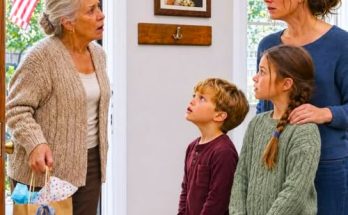
My mother-in-law arrived bearing gifts for the children, then immediately noticed the vacant spot where her son once hung his coat.
“Where’s Trevor?” she asked.
“He’s at work.”
“On a Saturday?”
I might have reached out and taken the bag from her. It would have given me something to do with my hands. Instead I left her holding it while I told her how busy he’d been lately. I’d been saying some version of that for six months. Until that morning I’d mostly said it over the phone, where Dorothy couldn’t glance down and see that there were only three pairs of shoes by the door.
She rang while I prepared breakfast and asked after the children before greeting me. I directed her toward the living room, expecting her to hand over the bag and hurry inside. Instead, she halted at the shoe rack, brushing the colorful tissue paper against her sleeve.
Piper recognized her voice immediately. “Grandma!” she yelled, and came running down the hall with Gavin behind her. Piper was eight and already tall enough to put her arms around Dorothy’s waist without reaching. Gavin was five. He went for her knees and held on even while she tried to set the bag down.
“Let me get a good look at you,” Dorothy said. She gathered both children close. Dorothy wiped a crumb from Gavin’s cheek; he leaned back, anticipating the kiss she promptly gave him.
As they chatted, I escaped to the kitchen with the gifts, relieved to have breakfast to finish. Avoiding difficult questions had become second nature. I poured Dorothy’s coffee with a little milk, then moved it away from Trevor’s vacant chair.
Dorothy followed us to the table. Piper had brought her plate in from the living room, and Gavin was trying to decide where to sit so he could stay close to both his sister and his grandmother. Dorothy listened to them long enough to learn why this was a problem. She moved her chair a few inches and let Gavin squeeze into the space she’d made.
When he looked down at his breakfast again, I caught her looking at Trevor’s chair. Then she looked at the calendar on the refrigerator. I’d written school reminders and bill due dates in my own narrow handwriting. Between the kitchen and the hall were the same family pictures she’d seen for years. In one of them, Trevor was holding Gavin at an age when the whole of him could still lie across his father’s forearms. I was used to passing that picture with a laundry basket in my hands. It had been a while since I’d looked all the way up at it.
“Do you want more coffee?” I asked Dorothy.
Dorothy nudged her cup toward me. My trembling hand spilled coffee; I scrambled with a napkin before it reached Gavin’s plate. Piper lifted her fork, and Dorothy held her cup while I cleaned up.
“Joanna,” she said, “how long has it been since Trevor came home?”
I pressed the wet napkin flat with my fingers. “I told you he’s working out of town.”
“I asked how long.”
I’d had answers ready for every question I believed she’d ask. I could tell her how busy he was, why a trip had gone on longer than expected, and why there was little point in trying him at a particular hour. I’d never had to put the empty chair beside any of those answers before. Piper set her fork back on her plate.
“Grandma, Daddy doesn’t sleep here anymore.”
Dorothy turned to her. “What do you mean, sweetheart?”
Piper looked down. “Mommy says he’s busy. I think he doesn’t want to live with us anymore.”
My daughter had finally expressed her own conclusion. For six months she had seen what I saw, even while I offered excuses and reasons to wait.
Gavin glanced among us and slid his plate toward Dorothy. I gripped the soaked napkin, wishing I could ask Piper for a moment as I did when sorting bills. Tears threatened, and she noticed.
“You’re okay, honey,” I said to her. “Finish eating if you want.”
Dorothy watched me for a moment. Then she put her cup down and asked Gavin whether he thought he could manage one more piece of toast. He held up the piece he already had so she could see he was working on it. She let the matter of Trevor rest while the children finished their breakfast.
Six months before, Trevor had set his keys on that table without removing his coat. I gathered clutter into my arms, waiting to hear why he looked so troubled.
“Did something happen at work?” I asked.
He nudged his keys toward the table’s center. “I’m tired of this life, Joanna.”
I kept waiting for something specific I could help with. Eleven years of marriage had given me a good idea of which pressures he meant when he came in looking like that. If there was a bill, we could sit down and look at it. If it was work, I could give him a minute to get his coat off and he’d tell me about it when he was ready. I asked if he wanted to talk after the kids were in bed. I still thought, when I went to bed myself, that we’d have the conversation when he could find his way into it.
With both children at school the next morning, I heard luggage zipping upstairs. Trevor was closing a suitcase on our bed and finished before meeting my eyes.
“Where are you going?” I asked.
“There’s someone else,” he said.
He waited for me to ask who. At first I couldn’t think beyond the suitcase. He’d had time to decide which clothes he needed and put them in it. I was standing on the other side of the bed trying to find one question that would give me any idea what I’d be doing when the children came home.
Her name was Tiffany. She worked with him. He said they’d been in love for months, in a voice that made it sound as if he’d been trying those words out until he could say them straight through. I’d spent most of those months going to work, getting home in time to feed our children, and thinking he might have more to tell me about his day if we could ever get through dinner without somebody needing something.
“What do we tell Piper and Gavin?” I asked.
He put his hand on the suitcase handle. “I’ll still see them.”
“They’ll want to know when.”
“I’ll work it out.”
He briefly lifted and lowered the suitcase, apparently expecting questions about Tiffany. I had plenty, including how she knew parts of his life he no longer shared with me. Yet all I could think of was Gavin asking at bedtime and Piper asking after school.
“I’ll talk to them,” he said.
“Today?”
He looked at his hand on the handle. “I’ll see when I can.”
He waited for me to move. I recalled laughing when we once squeezed through that doorway together, exchanging exaggerated apologies. This time I stepped aside, and he carried his suitcase past.
I stood in the bedroom for a while after I heard the front door close. There was a crease across the bedspread where the bag had been. I straightened it with the side of my hand, then stood there with my palm on the bed, thinking how soon I had to go get the kids.
For a few weeks he answered some of my texts. I kept the messages short. If I asked him to tell me whether he’d be there Saturday, I believed it would be easier for him to answer than if I asked him how he intended to be their father from now on. Some of the promises he made were specific enough that I could give the children a day to look forward to. I stopped doing that after I had to explain too many times that there’d been a change.
Gavin often asked about his father’s bedtime calls just as I reached for the light switch. I could only say I didn’t know, and he would ask for the door to remain wider open. Piper began noticing how other busy adults still found time to call.
I went to work. I paid bills at the kitchen table after they fell asleep and put the things they needed for school where I could reach them in the morning. Some days I had enough time to think about what had happened. On others I was doing well to remember whose shoes pinched and which day I had to get two children and a set of soccer cleats out the door. As Trevor’s replies grew farther apart, I learned that I could make it through a great many ordinary days without settling a single question about what he’d done.
Dorothy was the person I could least imagine telling. Frank had died, and Trevor was her only son. She was proud of him in the particular way a mother can be proud of a grown child, still able to tell you how hard he’d worked at something he probably couldn’t remember doing. She expected him to come through when she needed him. After he left, the thought of explaining he hadn’t come through for us felt like asking her to lose somebody else.
I first invented a business trip to get through one difficult week. Later came meetings and another out-of-town assignment. Each excuse generated more questions, until I routinely said we didn’t know whether he would be home that weekend. At least that part was true.
Meanwhile the children kept growing. Gavin’s shoes by the door changed size, and Piper began to ask if she could see the family calendar when she wanted to know something about the weekend. I’d thought the explanation would wear out faster on Dorothy than it did on them. At breakfast that Saturday, Piper had been the one to put an end to it.
Once I’d cleaned the table, Dorothy brought in the gift bag. She gave the children room to tell her things in the order they remembered them. Gavin wanted to tell his first story again because something had happened in the part he’d gone too fast through. She let him start over. Piper was quieter. A couple of times I caught her looking at me, checking whether the morning could go on. I hoped it to. I cleared the plates and stayed close enough to hear what she was saying, even when the conversation had moved on to school.
Piper followed me into the kitchen, twisting her napkin while I rinsed dishes. Softly, she asked whether I wished she’d kept quiet about Dad.
“I wish I’d made it easier for you to say what you were thinking,” I told her. “You can tell me things like that. You can tell Grandma, too.”
“She got quiet.”
“She had a lot to think about. I’m going to talk to her later.”
Piper noticed her twisted napkin and carefully flattened it on the counter. “Can I go back in there?”
“Of course.”
She hurried back to Dorothy with something from school, and I heard Grandma ask to see it.
When the children went upstairs after lunch, Dorothy asked me to sit in the kitchen. She rotated her nearly empty cup until her fingers rested around its handle.
“I want you to tell me what happened,” she said.