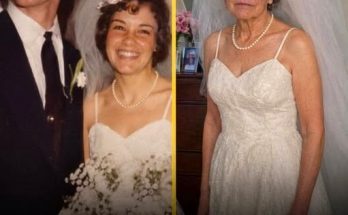
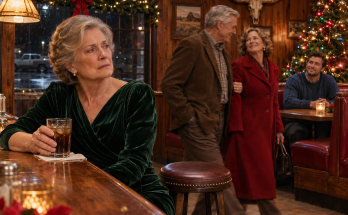
**I Married a Wonderful Man and Raised Three Children After My First Fiancé Abandoned Me at the Altar. Fifty Years Later, His Attorney Arrived With a Box That Finally Revealed Why He Left.**
The first time Henry shattered my heart, he stood only a few feet away from me inside a church.
The second time, he wasn’t even present.
I was twenty-two when he shouted “I don’t!” before eighty wedding guests and fled the ceremony.
Fifty years passed before a young lawyer appeared at my doorstep carrying a box containing the explanation I’d spent decades wondering about.
Initially, I refused to invite him inside.
“My name is Daniel,” he said. “I represent Henry. He’s very ill, and he asked me to deliver this personally.”
“Then tell him I have nothing to say.”
“I understand. But there’s something in this box you deserve to see.”
I stood holding a dish towel. I’d been preparing cookies for my grandchildren, and the kitchen timer continued ticking behind me.
“Why now?”
Daniel glanced at the package.
“Because he’s afraid he’ll die before you know what happened.”
My first instinct was to shut the door.
Instead, I stepped aside and allowed him into my kitchen.
We settled at the table, where he placed the box between us without attempting to open it.
“Henry told me you might ask me to leave. If you do, I will.”
“Are you related to him?”
“I’m his nephew. I’m also the attorney helping him settle his affairs.”
His connection explained the emotion beneath his professional manner, although I still couldn’t understand why a humiliation from fifty years earlier had suddenly returned to my kitchen.
I carefully lifted the lid.
Inside were an aged wedding invitation, several photographs, and a narrow envelope bearing my name.
The handwriting seemed disturbingly familiar.
It resembled the neat lettering I’d used as a young woman, when lengthy handwritten correspondence was more common than telephone conversations.
I unfolded the enclosed letter.
“Henry, I need to be honest before we make a mistake.”
“I don’t love you the way you love me.”
“I’m marrying you because I need security, and because your family can give me the kind of life mine never could.”
My throat tightened.
The letter continued.
“Please don’t expect me to become some devoted wife after the ceremony.”
“I’m grateful for what you can provide, but this marriage is about necessity, not love.”
“I hope you’ll be sensible enough to accept that.”
At the bottom appeared my signature.
“Margaret.”
I stared at Daniel.
“Where did you get this?”
“Henry kept it.”
“I never wrote it.”
Daniel nodded. “He knows.”
I examined the handwriting again.
Its rounded letters and carefully crossed t’s were remarkably similar to mine.
But those cruel statements had never come from me.
I’d loved Henry since adolescence.
I loved him when his battered truck had a broken heater, when he worked exhausting shifts at his father’s store, and when he saved for months to purchase my engagement ring.
His family was wealthy. Mine struggled financially.
People noticed the difference, but Henry had never made me feel inferior.
At least, that was what I’d believed.
My fingers trembled as I folded the paper.
I’d met Henry when I was sixteen.
He regularly waited outside the school library because he knew I’d remain there until closing. During winter, he walked me home despite the additional two miles it added to his journey.
His mother, Evelyn, disliked our relationship from the beginning.
She invited me to dinner only twice.
Both evenings, she questioned my father’s employment and whether my mother intended to resume cleaning other people’s houses.
Once, while I helped clear the table, she remarked, “Henry has always had expensive tastes. I wonder when he lost it.”
I smiled awkwardly, uncertain how to respond.
Henry apologized afterward.
“She thinks she gets a vote in everything. She doesn’t.”
When he proposed, Evelyn insisted we were too young. She suggested postponing the wedding until Henry assumed control of his father’s business.
He refused.
We scheduled a spring ceremony.
My mother helped sew my wedding dress, staying awake late to adjust the hem while I practiced walking across our modest living room.
On the wedding morning, excitement made eating nearly impossible.
Outside the church, Dad straightened my veil.
“Ready?” he asked.
“I’ve been ready for years.”
Henry waited near the altar wearing a dark suit.
When our eyes met, his filled with tears.
That memory haunted me afterward.
He genuinely looked like a man eager to marry the woman approaching him.
Then the minister asked whether he accepted me as his wife.
Henry stared directly at me.
His expression suddenly hardened.
“I don’t!” he said.
His refusal echoed through the church.
“Henry?”
He stepped backward, turned around, and hurried down the aisle.
Guests gasped. My mother shouted his name. Somewhere behind me, a chair scraped against the floor.
I remained frozen, clutching my bouquet while eighty people watched.
At first, I expected him to return.
Perhaps he’d become frightened or suddenly ill.
Surely there was an explanation.
I waited until every guest departed.
Eventually, I sat outside on the church steps, my wedding gown spread across the cold stone.
By sunset, Dad had to carry me into his car because I couldn’t stop sobbing.
For weeks afterward, people questioned what I’d done to drive Henry away.
One woman suggested he’d discovered I was pregnant with another man’s child.
My aunt Ruth offered her own judgment.
“Men don’t run from a happy wedding for no reason, Margaret.”
I desperately wanted to explain that I was just as confused as everyone else.
Neither Henry nor Evelyn contacted me afterward.
Six months later, I left for Chicago with two suitcases and twenty-seven dollars I’d saved from part-time employment.
I became a waitress at a diner and rented a small room above a grocery store.
Some nights, I buried my face in my pillow to keep my landlady from hearing me cry.
Eventually, Robert entered my life.
Every Thursday, he visited the diner for coffee and pie.
When I finally accepted his dinner invitation, he seemed far more interested in discussing books than investigating my past.
Several months into our relationship, I told him about my abandoned wedding.
He listened patiently without interrupting.
“Do you still love him?”
“I don’t know. I don’t think I even know who he was.”
Robert nodded. “Then we can take our time.”
And we did.
He never demanded immediate trust or pressured me to move faster than I felt comfortable.
We eventually married in an intimate ceremony attended by twenty guests.
Together, we raised three children.
Our marriage included disagreements about finances, graduation celebrations, responsibilities toward aging parents, and countless opportunities to forgive everyday mistakes.
Robert died four years ago.
Occasionally, I still placed two cups on the kitchen counter before remembering he was gone.
Daniel remained quiet while I studied the mysterious letter.
“Henry’s mother gave it to him on the morning of the wedding,” he said.
“She said I’d written it?”
“Yes. She claimed you’d left it at their house the night before.”
I remembered Evelyn’s immaculate appearance, pearl earrings, and commanding manner.
“Why would he believe her?”
“She showed him the envelope. She said she’d found it tucked inside a book you’d borrowed.”
“That’s ridiculous. I was at home all evening, finishing my dress.”
“Henry knows that now.”
Daniel reached into the box and removed another folder.
“Evelyn died 12 years ago. While Henry was sorting her belongings, he found these in the bottom of a locked desk.”
Inside were three sheets of lined paper.
Each contained attempts to reproduce my handwriting.
One repeatedly copied the words, “I love you, Henry,”
Another listed distinctive characteristics of my writing:
“Margaret rounds her capital M. She uses a long tail on the y. She leaves little space after commas.”
The final sheet contained an earlier version of the letter.
It began, “Henry, I have been deceiving you.”
Several sentences had been crossed out and replaced with colder, more calculated wording.
Nausea swept through me.
“She practiced?”
“For some time, apparently.”
“She sat at a desk and practiced writing like me so she could destroy our relationship?”