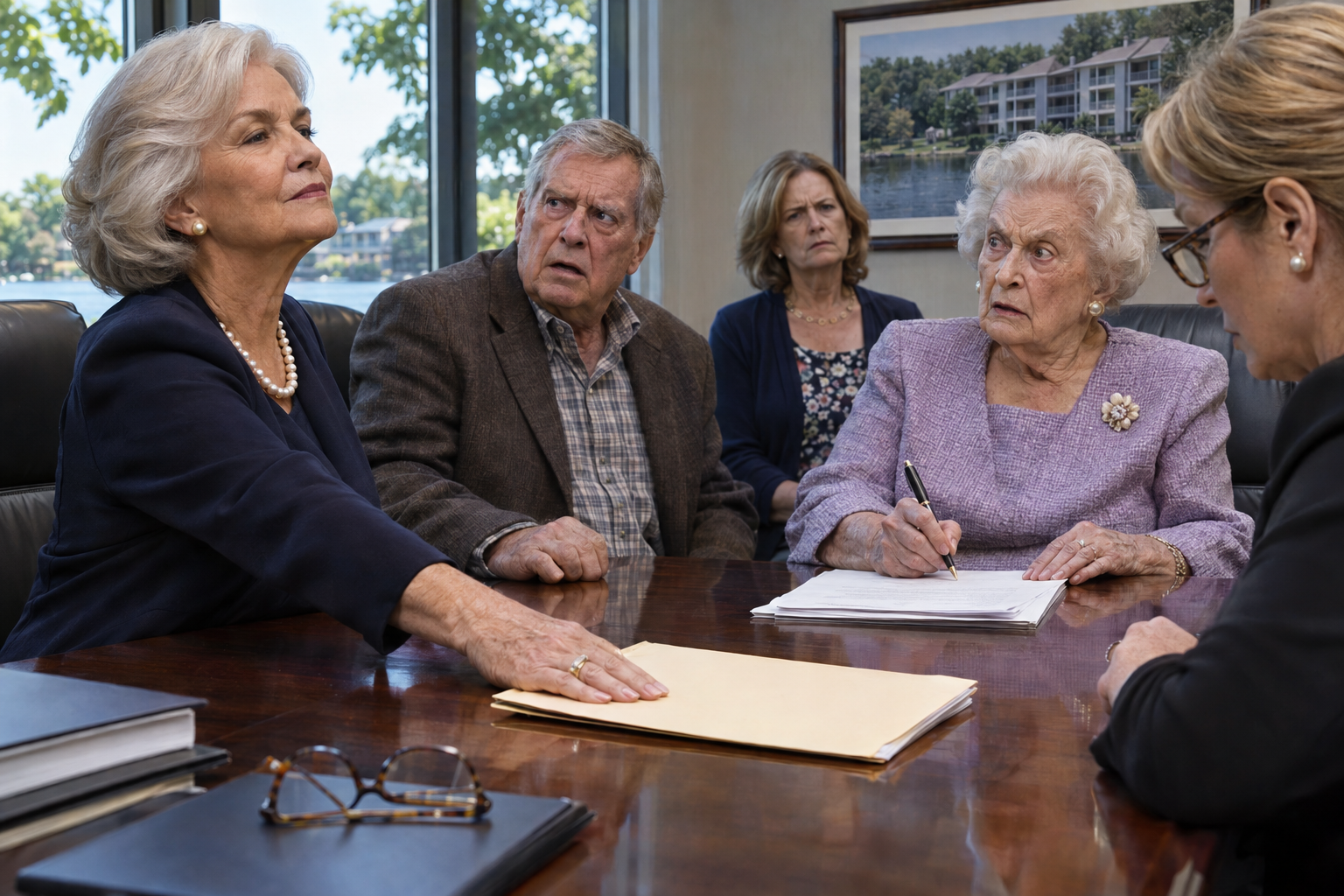
“Before you sign, Mrs. Whitley,” I said, “there’s one more paper.”
Dorcas kept the pen raised.
Harvey reached for my folder before I had finished sliding it across the table.
I laid my hand flat on the cover.
“That’s for the woman handling the closing.”
The room went so quiet I could hear the air coming through the ceiling vent.
The closing lady looked from my hand to Harvey’s. Her nameplate said ELAINE PORTER. Until that morning, I had thought of her as another nice person who would tell us where to sign.
Now I was grateful for how carefully she watched us.
“Would you like to speak privately, Mrs. Whitley?” she asked.
“No, thank you. Everybody who needs to hear this is sitting right here.”
I opened the folder and turned the first sheet toward her.
It was a letter from my bank confirming that no wire would be sent without further instructions from me. Beneath it was a copy of the written notice my lawyer had sent that morning to the closing office and our real estate agent.
I would not authorize my money to be used for this purchase under the ownership arrangement presented to me.
Elaine read both pages. Then she put down her reading glasses.
“We need to stop,” she said.
Harvey gave a short laugh.
“There’s no need for that. Lorene’s just confused about Mama’s name being on there.”
“I’m not confused.”
He looked at me the way people look at a clock that has begun running backward.
“Honey, let me explain.”
“You had Tuesday evening. You had all day Wednesday and Thursday. You had the whole drive over here.”
His sister shifted in her chair.
“This is a family matter,” she said.
I looked at her.
“Then you should have included the woman paying for most of it.”
Dorcas lowered her pen onto the table, slowly, as though she might still get another chance to use it.
“Harvey said everything was arranged.”
“Harvey arranged it with you,” I said. “He didn’t arrange it with me.”
Elaine moved the deed away from Dorcas’s hand.
That small motion did more to settle me than anything I had rehearsed in the mirror.
For two nights I had imagined having to snatch papers away, or raise my voice, or convince a roomful of people that my money belonged to me.
Instead, a woman in reading glasses simply moved the papers out of reach.
“Nothing will be signed while there’s a dispute about the transaction,” she said.
Harvey leaned forward.
“There isn’t a dispute. My wife and I just need five minutes.”
“There is a dispute,” I said. “Please write that down.”
Elaine picked up her pen.
I watched her make the note.
Harvey’s face had gone red above his shirt collar.
“Do you realize how embarrassing this is?”
“Yes.”
He waited.
I let him.
His sister finally pushed back from the table.
“Mama’s ninety-one, Lorene. Nobody’s trying to take anything from you.”
“Then why does she need an ownership interest in a condo she isn’t buying?”
“For security.”
“Whose?”
She looked at Harvey.
That was answer enough, but I wanted the words out where all of us could hear them.
“Your mother already lives with you. Harvey told me this would be our home. He told you it would stay in your family. Those are two different promises.”
“You were listening to my private conversation?” Harvey asked.
“I was washing the dishes in my kitchen. You were standing outside my open window.”
He rubbed his mouth.
I could see him searching for a smaller wrong to put in place of the large one.
“You should have asked me about it.”
For the first time that morning, my hands wanted to shake.
I folded them in my lap, beneath the table.
“You should have told me.”
Elaine asked whether I had an attorney representing me.
I took a business card from the folder and passed it to her.
“Ruth Mercer. She’s expecting your call.”
Harvey stared at the card.
“You hired a lawyer?”
“I paid for a consultation. Then I paid for another hour.”
“Without telling me?”
I looked at him until he dropped his eyes.
The ridiculousness of his question seemed to arrive in the room a moment after he said it.
Dorcas straightened the cuff of her lavender sleeve.
“A good wife doesn’t bring lawyers into her marriage.”
I had spent three years swallowing little remarks from that woman. Remarks about my cooking, my children, my church shoes, the way I put towels away.
Most of the time I told myself she was old. Sometimes I told myself she was frightened of losing her son.
That morning I was too tired to make another excuse for her.
“A good husband doesn’t make one necessary.”
Harvey’s sister made a small, offended sound.
Elaine stood.
“I’m going to contact Mrs. Mercer and notify the agents that we’re paused. Please leave the documents on the table.”
“How long is paused?” Harvey asked.
“Until we understand whether there’s a transaction everyone actually agrees to.”
She stepped into the hall with my papers.
The door clicked shut behind her.
Harvey immediately turned his chair toward mine.
“We can take Mama off.”
I had expected him to say that. I had even hoped, sometime around three in the morning, that hearing it might make everything simple again.
But the words did not reach the place he wanted them to reach.
“Can we?” I asked.
“Of course. If you’re going to make this big a fuss.”
There it was.
He wasn’t sorry he had done it. He was sorry I had stopped it.
“I haven’t raised my voice once, Harvey.”
“You know what I mean.”
“I know exactly what you mean.”
He lowered his voice.
“I was trying to make sure Mama was protected if something happened to me.”
“With my money.”
“With our money.”
I opened the folder again, although Elaine had taken the first two sheets. The rest were still neatly clipped inside.
There was the settlement statement from the sale of my house. The deposit record. The page on which I had written our proposed contributions in my own handwriting when we first made the offer.
One hundred eighty thousand dollars from me. Sixty thousand from him. We would each pay our agreed share of the closing expenses separately.
“You knew where that money came from,” I said.
“I never said I didn’t.”
“You knew Leroy and I paid that house off a little at a time. You knew I kept it after he died because I wasn’t ready to leave.”
His jaw moved.
“Here we go. Leroy again.”
That hurt. Even then, after everything else, he found a fresh place.
“Yes,” I said. “Leroy again. The man whose name you were happy to forget when you were spending what he helped build.”
Dorcas lifted her chin.
“My son contributed too.”
“Then he should keep his contribution.”
Harvey looked up sharply.
I turned another page toward him. It was a brief letter confirming the instructions about the earnest money I had supplied, subject to the purchase contract and whatever the seller was entitled to claim.
“My lawyer is handling the cancellation,” I said. “She explained I may lose money. I understand that.”
“You’re throwing away the condo?”
“I’m withdrawing my money from a purchase I no longer agree to make.”
“We already gave notice on everything.”
“The storage company can change a date. So can the movers.”
He looked at the folder as though it had begun producing snakes.
“What else is in there?”
I hesitated before taking out the last page.
It wasn’t a deed. It wasn’t a magic document that made a new home mine in two days.
It was an offer on the one-bedroom next door, prepared by the agent my banker had called while I sat in his office. The seller had accepted it Thursday afternoon, subject to the inspections and other terms my lawyer insisted on.
“I’m trying to buy the smaller place,” I said.
Harvey stared.
“By yourself?”
“Yes.”
“Where am I supposed to live?”
His sister looked toward the ceiling. Dorcas reached for her purse.
“That,” I said, “is something you should have thought about before you made plans for my home without me.”
For a moment none of us moved.
Outside the window, somebody’s car alarm chirped twice. A woman laughed in the hall. Somewhere else in that building, ordinary business was going on.
I had imagined the world would feel different when my marriage broke.
But there was still a paper cup beside Harvey’s elbow. Still a loose thread at the cuff of my suit. Still the faint smell of coffee burned on a warming plate.
Elaine came back before he could answer.
“Mrs. Mercer is on her way,” she said. “She asked that no one pressure her client to sign anything.”
“Her client is my wife,” Harvey said.
“I understand.”
Elaine’s voice stayed pleasant.
It did not move an inch.
She explained what would happen next. The agents would communicate with the seller. The deposit would remain where it was until the contract issues were resolved. No one was promising me every penny back.
I nodded at each point.
“You hear that?” Harvey said. “This is going to cost us.”
“I heard her.”
“All because of a name on a piece of paper.”
“If it was only a name, you wouldn’t have hidden it.”
He looked away.
That was the last thing I said to him in that room.
Ruth Mercer arrived carrying a brown leather bag with a scuffed corner. She was perhaps sixty, with short gray hair and sensible shoes.
She shook my hand first.
Then she asked whether I wanted to leave.
I had been so busy preparing to stand my ground that I had forgotten I could simply stand up.
“Yes,” I said. “I do.”
Harvey rose with me.
“We came together.”
“I’ll take her,” Ruth said.
His sister began gathering Dorcas’s things, briskly, angrily. The pen lay beside the unsigned deed.
I glanced at it once more before I left.
Such a little thing. Black plastic, silver clip. The sort you get free from an insurance office.
I had nearly handed away the safety of my remaining years with something just like it.
In the parking lot, the cold reached through my suit jacket.
Ruth unlocked her car.
“Have you eaten?” she asked.
“Half a piece of toast.”
“Let’s fix that before we make any more decisions.”
At the diner down the street, I ordered scrambled eggs and could not get the first bite past my throat.
Ruth ordered tea for both of us.
“You did well,” she said.
I watched steam rise from the cup.
“I feel like I’ve done something terrible.”
“What do you think you’ve done?”
“Humiliated him. In front of his mother.”
She gave me a moment to hear myself.
Then she asked, “Did he consult you before putting you in that position?”
I shook my head.
“You were allowed to refuse, Lorene.”
I pressed my napkin between my palms.
“I know that in my head.”
“Sometimes the rest of you needs longer.”
She didn’t tell me to divorce him over breakfast. She didn’t promise I would get everything I wanted. She asked where I was staying and whether I felt comfortable going there.
The buyers of my old house were allowing me to remain until the end of the month under a written arrangement. We had planned to move into the condo well before then.
Now I had thirteen days.
“My daughter lives twenty minutes away,” I said. “I could go there.”
“Would you like to call her?”
I looked down at my phone.
Harvey had called six times since we left the title office.
I called my daughter instead.
“Mama?” she said. “Are you in your new place?”
I opened my mouth and began to cry.
Not neatly, either. My breath caught hard enough that the waitress looked over from the counter.
“Mama, where are you?”
I told her the name of the diner.
“Stay there. I’m coming.”
My daughter’s name is Beth. She is forty-six and teaches third grade. She can settle a room full of children with one raised eyebrow, but when she saw me in that booth, her face changed into the little girl who used to climb into my bed after thunderstorms.
“What happened?”
I told her.
She listened without interrupting. When I got to what Harvey had said outside the kitchen window, she put one hand over her mouth.
“He said that about you?”
“He did.”
“And you sat next to him in the car this morning?”
“I needed to get there.”
Beth looked at Ruth.
Ruth introduced herself and explained only what I gave her permission to explain.
That mattered to me. I was tired of people deciding what I needed without asking.
Beth pushed my plate a little closer.
“Eat two bites, Mama. Then we’ll get your things.”
I managed three.
On the way back to the house, I asked her not to call her brother yet.
“Daniel will drive over and get angry.”
“Probably,” she said.
“I don’t need angry right now.”
“Then I’ll tell him what you do need.”
She said it so simply that I began crying again.
Harvey’s truck was in the driveway when we arrived.
He stood up from the kitchen table as soon as I came through the door. The pound cake was still beneath its glass dome on the counter.
He had cut himself a generous slice.
I don’t know why that made my chest ache so badly. Perhaps because I had put real butter in it. Perhaps because even after hearing him laugh at me, I had taken care to scrape the lemon zest finely, the way he liked.
“Beth,” he said, with a strained smile. “Your mama’s got everybody stirred up.”
“I’m here to help her pack.”
His smile disappeared.
“Lorene, can we talk without an audience?”
I looked at my daughter.
“Give us ten minutes. Leave the bedroom door open.”
She nodded and carried my overnight bag down the hall.
Harvey stood beside the table, one hand on the back of a chair.
“You made your point,” he said. “We’ll change the deed. We can still get the bigger condo.”
“I’m not buying a home with you now.”
“Now meaning this week?”
“Now meaning I no longer trust you with my home.”
He lowered himself into the chair.
The bad knee always troubled him after sitting too long. I noticed him favor it, and my first impulse was to bring him the cushion from the other room.
I stayed where I was.
“Mama worries,” he said.
“About what?”
“About me having somewhere if you go first.”
I nodded toward the drawer where we kept the original condo figures.
“Then you should have talked to me. We could have paid someone to help us plan it fairly.”
“You get touchy when it’s about your kids.”
“You mean I care whether my children are treated decently.”
He began rubbing the sore knee.
“You always say my money and my house.”
“Because you were planning to give part of them to someone else.”
“Mama wouldn’t have thrown you out.”
I pulled out the chair across from him but did not sit.
“Listen to what you just said.”
His eyes lifted to mine.
“You think it should comfort me that your mother might let me stay in the home I paid for.”
“That’s not how I meant it.”
“It is how you’ve been thinking about it.”
He picked at a crumb beside his plate.
For a few seconds he looked old in a way I had never seen before. Not harmless. Just old, and cornered by the thing he had chosen.
“I didn’t think you’d care this much.”
“You thought I wouldn’t find out.”
He did not answer.
I sat down then, because my legs were beginning to hurt.
“Did you tell them I was a retirement plan?”
His head came up.
“What?”
“Your mother said it at our wedding. Did you ever tell her she was wrong?”
“You know how Mama talks.”
“I’m asking how you talk when I’m not there.”
He looked toward the hall.
Beth was putting folded clothes into my bag. A dresser drawer closed softly.
“I never meant to hurt you,” he said.
I had wanted him to say those words for three days. When they finally came, they seemed to stop short of everything that mattered.
“What did you mean to do?”
He spread his hands.
“Keep things simple.”
I let out one tired breath.
“For you.”
Beth appeared in the doorway with my bag.
“I’ve got your medication and the blue sweater. Anything else?”
“The photograph on my side of the bed.”
Harvey knew which one.
It was Leroy holding our first grandchild, both of them asleep in the recliner. I had moved it from the living room after Harvey said there were too many reminders of another man in the house.
That day I wondered how many small things I had moved to make him comfortable.
Beth went back for it.
Harvey’s voice hardened.
“So that’s it? Three years, and you walk away over paperwork?”
“You were counting on me not reading it.”
“People say things.”
“And people hear them.”
I stood.
He looked at the cake.
“Why’d you bake that yesterday if you were planning all this?”
I thought about Thursday afternoon. The cooling rack. The butter wrapper. My hands going through a recipe I had made a hundred times while my mind tried to catch up with my life.
“Because I knew how to bake a cake,” I said. “I didn’t yet know how to stop being your wife.”
He looked down.
For a moment, I thought he might say something honest enough to make me stay another ten minutes.
Instead he asked whether I had told Daniel.
“Not yet.”
“He’s never liked me.”
“He wanted me to be happy.”
Beth came back with the photograph wrapped in my sweater.
I picked up my purse.
At the door, I told Harvey I would return with help to sort the rest of my things. I asked him to leave the financial papers alone and communicate through Ruth about the purchase.
He said I was making it sound like a business arrangement.
I looked at him one last time.
“I thought we were making a home. You’re the one who had a different arrangement.”
Then I went outside.
Beth did not turn the radio on.
We drove past the pharmacy, the little church where Harvey and I had been married, and the hardware store with the pumpkins stacked outside.
At a red light, she reached over and took my hand.
“You can stay as long as you need.”
“I don’t want to disrupt your family.”
“You are my family.”
I turned my face toward the window so she wouldn’t see me start again.
That first night, I slept in the room my granddaughter had used before leaving for college. There were pale squares on the walls where her posters had been.
I set Leroy’s photograph on the dresser, beside a jar full of hair ties.
My phone lit up until I finally turned it facedown.
Harvey wanted to explain. His sister wanted me to apologize to Dorcas. Dorcas left one message herself, saying she had never been so insulted in her life.
I did not listen to it twice.
At supper, Beth’s husband asked whether I wanted chicken or soup. He didn’t ask for the story before handing me a plate.
Afterward, Daniel called.
“Do you need me there?”
“Not tonight, honey.”
“Beth told me not to go talk to him.”
“Beth was right.”
He was quiet for a while.
“I’m sorry, Mama.”
“You didn’t do it.”
“I know. I’m sorry it happened.”
I sat on the edge of the narrow bed and looked at my shoes.
“I feel foolish.”
“You trusted your husband.”
“I’m old enough to know better.”
“Old enough for what? To never trust anybody again?”
I had no answer for that.
He told me he would come Sunday to help with the furniture. Then he asked whether I had enough clean socks.
That was my boy. Furious on my behalf, asking about socks because it was something he could fix.
Before I went to sleep, I took the folder out of my purse.
It had a bent corner now. A faint ring from the diner table marked the back.
I placed it on the dresser beside Leroy’s picture.
Then I turned the bedside lamp off myself.
On Monday morning, Ruth met me at her office with a yellow pad and a list of questions I wished someone had asked before I married Harvey.
Which accounts were joint? Which bills came out automatically? Had I guaranteed anything for him? Where were the proceeds from my house, and could I trace every transfer?
I had brought a grocery sack full of records.
She found an empty box and helped me sort them.
“I thought putting his mother on there meant my children would automatically lose everything,” I admitted.
Ruth turned a page toward me.
“There are different ways to hold property. The wording matters, and so do the surrounding facts. What matters today is that you didn’t agree to this proposed arrangement. You caught it before completion.”
“So I might have misunderstood some of it.”
“You understood that your husband was concealing something important.”
She let me read the page before continuing.
“You don’t have to prove the worst possible outcome to have a reason to say no.”
I sat back in the chair.
For three days, I had been afraid someone would discover one detail I had misunderstood and use it to make everything Harvey did acceptable.
Ruth asked what I wanted to do about the marriage.
I looked at the wedding band on my hand.
“I want a little time.”
“Then we’ll make sure you have it.”
She also explained that putting only my name on a future purchase was not, by itself, a complete answer to every financial question a marriage could create.
We would document the source of the funds. We would deal properly with any claims. We would not rush another closing because I was frightened or angry.
That disappointed me for about a minute.
I wanted the smaller condo to be waiting like a reward for being brave.
Instead there were inspections to schedule, records to gather, and an old marriage to untangle from a new address.
Ruth asked whether I still wanted the place if it took longer.
“Yes,” I said. “I liked it before any of this happened.”
That was true.
The first time we toured the building, I had lingered at the one-bedroom’s open door. The seller was moving closer to her son, and her agent had let us look inside.
It had a screened porch facing a stand of trees, with the lake showing between them. The kitchen was small enough to clean without sitting down halfway through. There was a deep closet beside the bathroom for towels.
Harvey had said it was too small for us.
It was just right for me.
On Tuesday, I went back with my agent and the inspector.
There was a worn patch in the carpet near the sliding door. The kitchen faucet dripped. One screen had a tear in the corner, and an outlet needed attention.
I liked knowing those things.
They were ordinary problems with ordinary remedies. Nobody told me I was making a fuss by asking about them.
I opened the kitchen drawers and checked the windows. I read the association documents with a ruler beneath each line because the print was small.
My agent waited.
When I apologized for taking so long, she said, “It’s a home, Lorene. Take your time.”
I stopped apologizing after that.
The seller agreed to an extension while my lawyer worked through the financial arrangements. I paid for the extra inspection I wanted and asked for the repair receipts.
At Beth’s that evening, I spread the papers across the dining table.
She brought me a lamp.
“Too much glare from the ceiling,” she said.
We sat together until almost ten. She read some sections aloud while I made notes, but she never took the pen from my hand.
Wednesday brought the first real bill for stopping the other purchase.
The seller wanted compensation. The agents had expenses and explanations. Ruth negotiated, called me, and explained the choices in plain words.
I asked her to repeat one part.
She did.
In the end, I accepted a loss of several thousand dollars under a written settlement that released the disputed purchase. I hated paying it. I could think of forty useful things that money might have bought.
But I signed only after Ruth explained each page and I had read it myself.
Harvey called when he learned the amount.
“You see what being stubborn costs?”
I was sitting on Beth’s back steps with a cup of tea.
“I see what keeping a secret costs.”
“We could still fix it.”
“The purchase is canceled.”
“I mean us.”
I listened to the wind moving the dry leaves against the fence.
“Then tell me what happened, Harvey. Start at the beginning. Leave out the part where I caused it by finding out.”
He was silent long enough that I thought the call had dropped.
Then he said his sister had raised the idea after we made our offer. Dorcas worried that my children would leave him with nothing if I died. He had told them our money was already being combined for the purchase.
“She said we ought to protect our side.”
“Our side,” I repeated.
“That’s just how she put it.”
“And where was I?”
He let out a breath.
“I didn’t think of it like sides.”
“You repeated it.”
He admitted he had requested the change. He said he had planned to explain it after the closing, once I saw it was nothing to worry about.
I closed my eyes.
“You planned to tell me when I couldn’t easily refuse.”
“I thought you’d get used to it.”
That was the first answer he gave me that sounded entirely true.
I thanked him for finally telling me.
He seemed encouraged.
“So can I come get you?”
“No.”
“But I told you.”
“Yes. And now I understand more than I did before.”
We ended the call without shouting.
I stayed on the steps until Beth came outside and put a sweater around my shoulders.
On Sunday, Daniel and Beth helped me finish sorting the house.
Harvey had agreed to be elsewhere. His sister collected him that morning, and I was grateful we did not have to carry chairs around another argument.
The rooms looked strange with the pictures down.
There were little clean rectangles on the walls and a darker square where the rug had protected the floor. My kitchen sounded hollow when Daniel opened the empty cupboards.
I had known leaving that house would hurt.
I had not expected to do it without the person who had promised to help me begin again.
Beth found me standing in the doorway of the sewing room.
“Do you want a minute?”
“I want about ten years,” I said.
She smiled sadly.
“I can give you twenty minutes.”
She closed the door halfway and left me there.
I touched the windowsill Leroy had sanded one summer when the old paint began to peel. I looked at the faint mark where Daniel’s school desk had scraped the wall before this became my sewing room.
Then I cried for the house instead of Harvey.
That helped me understand something I had been mixing together.
I could mourn the home I was leaving without returning to the man I was leaving it for.
When I came out, Daniel was studying two boxes marked HARVEY.
“These go to storage too?”
“Separate corner, please. He’ll arrange to collect them.”
He nodded.
No speech. No threat. Just tape drawn across cardboard, firmly enough to hold.
We kept an inventory and took photographs so nobody would have to argue later about who took a lamp or a toolbox. Ruth had suggested that, and at first I thought it sounded cold.
By afternoon, I was glad for it.
It let us get through the day without asking every object to testify about our marriage.
The small kitchen table was mine. The recliner with the lift mechanism was Harvey’s. The chipped blue bowl had belonged to my mother. The lawn tools went with him except for Leroy’s old hand trowel.
I kept that.
It fit in a shoebox with my gardening gloves.
The pound cake was gone from the counter. The glass dome had been washed and set upside down on a towel.
I put it in a box marked KITCHEN.
By the end of the day, I was so tired I could hardly hold my cup.
But when Daniel asked whether I regretted stopping the closing, I answered before he finished the question.
“No.”
That certainty was small, but it stayed with me.
Harvey wanted to meet the following week.
I agreed to the public café beside the library, in the afternoon. I drove myself in the little sedan I had owned since before we married.
He was waiting with two coffees.
Mine had cream and no sugar, the way I liked it.
For some reason, that almost undid me.
He knew things about me. We had shared ordinary mornings, bad colds, grocery lists, and jokes nobody else would have found funny.
It would have been easier if every kind thing had turned false all at once.
“You look tired,” he said.
“I am.”
He nodded toward the empty chair.
I sat.
For a while we discussed the movers, the mail, and a prescription that had been delivered to the old house by mistake.
Then he took a folded sheet from his jacket.
It was a handwritten apology.
He asked if he could read it.
I said yes.
He had written that he was sorry for upsetting me, sorry for the misunderstanding, sorry that things had gotten out of hand.
I waited until he finished.
“Could you tell me what you did?” I asked.
He looked down at the paper.
“I just did.”
“You told me how I felt.”
His mouth tightened, but I kept my voice quiet.
“Harvey, I need to know whether you understand why I left.”
He folded the sheet along the same crease.
“I should have told you about Mama.”
“And?”
“I shouldn’t have said that thing to my sister.”
“What thing?”
He glanced toward the counter.
“That you wouldn’t read it.”
“Why did you say it?”
He took a long drink of coffee.
“Because you trust people,” he said finally.
I looked at the cream turning slowly in my cup.
“I trusted you.”
His eyes watered. I knew he hated that, especially in public.
“I got scared, Lorene.”
“I believe you.”
He looked relieved.
I put both hands around my cup.
“I was scared too. After Leroy died, I used to leave the television on so the house wouldn’t be quiet. Sometimes I bought too many oranges because I forgot there was only one of me.”
He watched me.
“When you asked me to dance, I thought I’d been given something back.”
He reached across the table.
I moved my hand before his covered it.
“Being scared didn’t give you permission to use that against me.”
He sat back.
“Would counseling help?”
I had expected to feel grateful if he offered.
Instead I felt tired all the way through.
“I’m going to speak to someone for myself,” I said. “But I’m not promising to rebuild this marriage.”
“So you won’t even try.”
I looked at him carefully.
“I tried while you were planning it. I tried when your mother insulted me and you said she didn’t mean it. I tried when you asked me to put away Leroy’s photograph. You just didn’t notice because trying looked like me making things pleasant.”
He stared at his folded apology.
I gave him time.
Then he said, very softly, “I liked being the one who knew how things worked.”
I thought of him explaining the television remote after I already knew how to use it. Taking paperwork from my hand. Calling me his sweet little worrywart whenever I asked about a bill.
Some of it had felt like care at the time.
“I liked having somebody beside me,” I said. “Those things ought to have fit together.”
He nodded without looking up.
When we left, he asked whether I would let him know when the smaller condo closed.
“Through Ruth,” I said.
He flinched, but he nodded again.
I drove back to Beth’s and sat in the driveway until I could stop shaking.
I still loved parts of him. That was the hardest thing to explain, even to myself.
But I no longer wanted to put my future in his hands.
The weeks that followed were full of unremarkable work.
I met with a counselor twice. I made copies of account statements. I canceled one automatic payment and set up another. I learned which forms needed original signatures and which could be sent by email.
Sometimes I got impatient.
Sometimes I asked Beth to sit beside me while I made a call.
Harvey and I eventually signed a written financial agreement after each of us had separate legal advice. My house proceeds were documented. His savings stayed his. The joint bills and the costs of ending the purchase were accounted for instead of left to memory.
There were things we disputed.
I gave way on some small ones and stood firm on the ones that would affect my ability to live. Ruth explained every compromise before I agreed.
Nothing was settled by a grand speech.
It was settled by answering questions, checking figures, and refusing to sign until I understood.
Once the property arrangements were resolved to Ruth’s satisfaction, I could move forward with the one-bedroom purchase.
The seller had been more patient than she needed to be. Her own move had been delayed, which gave us both room to finish properly.
On the morning of my second closing, Beth offered to come.
“I’d like that,” I said. “But I want to do the talking.”
She kissed my cheek.
“I know.”
I wore the same navy suit.
I almost chose another one because I didn’t want it attached forever to that first morning.
Then I remembered I had liked that suit long before Dorcas saw it.
The pearls too.
Elaine was waiting at the title office. She had offered to handle the new closing if I was comfortable with her, and I was.
There were only four of us at the table that time: Elaine, my agent, Beth, and me.
My folder was beside my purse.
Elaine slid the first document toward me.
“Take your time.”
I read it.
Then I asked a question.
She answered it, and I read the next page.
Beth sat quietly with her hands folded. Once, she caught my eye and smiled, but she did not point to any of the little flags.
When I signed the final page, Elaine checked the file and handed me a small envelope with the keys.
“Congratulations, Mrs. Whitley.”
I closed my fingers around them.
They were ordinary keys on a cheap metal ring, but I could feel their edges through my palm all the way to the car.
At the condo, Beth unlocked the door and stepped aside for me.
The air smelled faintly of fresh paint and the soap the seller had used on the counters.
The repaired screen moved gently in the breeze.
I walked through every room before speaking.
Kitchen. Bedroom. Bathroom. Living room. Porch.
Mine to arrange. Mine to clean badly if I felt like it. Mine to fill with people because I wanted them there.
Beth stood beside the sliding door.
“Well?”
I put my purse on the counter.
“I think the blue chair goes right here.”
Then we both started laughing.
The movers arrived after lunch. Daniel came with sandwiches and a little bag of tools. By supper, the bed was made and my mother’s bowl was in the kitchen cupboard.
Leroy’s photograph went on a bookshelf in the living room.
Beside it I put a picture of all the grandchildren, including the one born after he died.
I didn’t hide either part of my life.
The blue chair fit beside the porch door, just as I thought it would.
Daniel tightened a loose leg on the kitchen table and checked the smoke alarms. Beth lined a drawer with paper, then asked where I wanted the dish towels.
“Here,” I said.
She put them there.
It is a small thing, being asked where your own towels belong.
That evening it nearly made me cry.
After the children left, I washed two cups and stood them on the draining board.
I checked the lock once.
Then I walked out onto the screened porch with a blanket around my shoulders.
Across the water, somebody had turned on a porch light. A dog barked twice and stopped. Through the trees, the lake held the last pale color of the sky.
I was alone.
I had dreaded that word for weeks.
But nobody was waiting in the next room for me to pretend I hadn’t heard something cruel. Nobody was telling me my worry was an insult to his family.
I sat until my feet got cold.
The first person to knock the next morning was my neighbor, a woman with a cane and a loaf of bread wrapped in a clean towel.
“I’m June,” she said. “They told me you’d moved in.”
I invited her inside.
She admired the blue chair, complained about the laundry-room dryer, and told me which path to avoid when the leaves were wet.
She didn’t ask whether I had a husband.
I liked her at once.
We ate toast at my little table, and she left before either of us felt obliged to fill a silence.
Later that week, Harvey’s sister called.
I nearly let it ring, but I was waiting for a delivery and picked up without checking carefully.
“Mama wants her earrings back,” she said.
I blinked.
“I don’t have her earrings.”
“She says you picked them out.”
“I did. Harvey gave them to her. She wore them to the closing.”
There was a pause.
“Well, she’s upset.”
I looked at my unopened moving boxes.
“I’m sure she is.”
“Harvey’s staying in my spare room. He can’t stay forever.”
I knew what was supposed to happen next. I was supposed to offer a solution. Make space. Smooth the conversation until everybody could believe they hadn’t asked too much.
I shifted the phone to my other ear.
“He has his savings and his retirement income. He can make a plan.”
“You sound very cold.”
“I’m not discussing his housing with you.”
She waited for me to soften it.
I didn’t.
Before hanging up, I asked her to keep any remaining property questions in writing through the lawyers.
Then I finished unpacking my dishes.
I put the cake dome on the top shelf.
The divorce took months.
There were dates on calendars, envelopes in the mail, and a morning when I had to sit in a hallway beneath a clock that seemed determined not to move.
Harvey looked smaller in his good jacket.
I didn’t take pleasure in that.
We had made each other laugh once. I could still remember the warmth of his hand at my back in line-dancing class, the careful way he counted the steps because he was afraid of getting them wrong.
I wished he had been that careful with me afterward.
When the last papers were finished, we stood outside with a stretch of pavement between us.
“I found an apartment,” he said.
“I’m glad.”
“One bedroom. Near the grocery store.”
I nodded.
He turned his keys over in his hand.
“Mama didn’t need to be on the deed.”
“I know.”
“I knew too.”
That made me look at him.
He kept his eyes on the keys.
“I’ve been saying she wanted it, and my sister talked me into it. But I made the call.”
I waited.
“And I thought you’d sign because you loved me.”
A bus sighed to a stop at the corner. He watched it out of habit, the mechanic in him noticing the engine before anything else.
Then he looked back.
“I’m sorry, Lorene. For doing it. For what I said. All of it.”
There was no request attached this time.
No mention of coming home, no complaint about how much it had cost, no reminder that his mother was old.
“Thank you,” I said.
He nodded.
“You take care of that knee,” I told him.
“I will.”
We went to separate cars.
I cried on the drive home. At the next light, I pulled into a parking lot and waited until I could see clearly.
Accepting his apology did not make me want my marriage back.
It simply let me stop waiting for him to say it.
By spring, I had learned the sounds of my condo.
The refrigerator clicked before the motor started. The porch door needed a firm pull when the weather was damp. The upstairs neighbor watered her plants every Saturday, and sometimes a little water reached my railing.
I bought a pot of geraniums and used Leroy’s hand trowel to settle them into fresh soil.
I went back to line dancing too.
The first evening, I sat in the parking lot with my hand on the ignition. I was afraid people would ask questions, or pity me, or stop talking when I came in.
June was waiting by the entrance.
She tapped my window with one knuckle.
“You coming? They’ve already started.”
So I went.
A woman moved over to give me room. Somebody called out the count. I missed the first turn and laughed, and by the second song I was warm enough to take my sweater off.
Nobody asked me to explain my whole life before letting me dance.
On the way home, June asked if I regretted marrying again.
I thought about it.
“I regret some things I put up with,” I said. “I don’t regret wanting company.”
“Good,” she said. “That would make bridge club difficult.”
I laughed so hard I had to wait before turning out of the parking lot.
A few days later, I went to the bank to review my monthly budget.
The same banker brought out the figures we had prepared before the move. We checked the association fee, insurance, groceries, utilities, and the little amount I wanted to set aside for repairs.
There was enough.
I asked him to check it again anyway.
He did, without smiling at me as if I were a nervous child.
“You have room to live, Lorene,” he said.
I looked at the line marked personal spending.
“Could that include a sewing machine?”
“It could.”
My old one had been giving me trouble for years. Harvey always said repairing it would be cheaper, although the repairs had begun to cost more than the machine was worth.
I had kept putting it off.
On the way home, I stopped at the sewing shop. The woman there showed me three models and let me try each one on scraps of cotton.
I chose the middle one.
It had a clear instruction book, a good light, and a buttonhole attachment I understood after she showed me twice.
That afternoon, I set it up by the window and hemmed the porch curtains I had bought on sale.
The seam wandered a little near the end.
I unpicked it and started that section again.
When I hung them, the curtains moved in the breeze without catching beneath the door.
I called Beth to tell her.
She asked me to send a picture.
I sent three, because the first two had my thumb over the lens.
She wrote back that the curtains looked beautiful.
I stood there grinning at the phone, pleased about something small I had chosen, paid for, and finished with my own hands.
For once, I didn’t wonder whether someone else would approve before deciding that I liked it. I stayed there until the afternoon light began fading.
My children came for Sunday dinner the following month.
There wasn’t enough room for everybody to sit at the little table, so Daniel brought folding chairs and Beth carried plates out to the porch.
The grandchildren complained cheerfully about being assigned the card table. The youngest put a thumbprint on the glass door within five minutes.
I left it there until Monday.
For dessert, I made lemon pound cake.
Beth saw it cooling and went quiet.
“You sure about that one, Mama?”
I grated the last bit of lemon over a bowl.
“Your daddy liked it too. And so do I.”
She looked at me for a moment, then took the plates out of the cupboard.
We ate it with strawberries because they had looked good at the market. There was no ceremony about it. No speech. Just cake, coffee, and Daniel trying to convince his niece that the fish he’d caught last summer was longer than her arm.
Afterward, Beth stayed to dry dishes.
“I was worried about you,” she said.
“I know.”
“Not just about the money.”
I rinsed the blue bowl and handed it to her.
“I was worried about me too.”
She set the bowl on the counter.
“You seem more like yourself.”
I thought about the first night in her spare room, crying beside a jar of hair ties. The diner eggs. The folder with its coffee ring. All those moments when I had felt foolish and somebody had stayed close without taking over.
“You helped,” I said.
She leaned her head against my shoulder for a second, the way she used to while I brushed her hair.
Then we finished the dishes.
That evening, after everybody left, I took my papers out of the cabinet.
Ruth had helped me update my plans so my wishes were written clearly. My children knew where the documents were. They also knew the money was mine to live on, to spend when I needed, and to enjoy while I was here.
I checked the list once, then put it away.
The old folder was underneath.
Its bent corner had softened from being opened and closed. I could still see the faint circle left by the cup at the diner.
I thought about throwing it out.
Instead I emptied it, put the important papers where they belonged, and used it for the appliance manuals.
I didn’t need to keep living at that closing table.
There were ordinary things to learn in this home. How to change the stove clock. Which filter the furnace needed. Why the dishwasher made a clunk halfway through its cycle.
I wanted my attention for those things too.
Outside, the porch light had come on automatically. I carried out a cup of tea and the last small slice of cake.
There was a little plate waiting on June’s side of the railing. She had returned the one I’d sent home with her, along with two peppermint candies.
I smiled and brought it inside.
Before bed, I checked the front door, turned out the kitchen light, and stood a moment in the quiet living room.
My blue chair. My family’s photographs. My mother’s bowl drying beside the sink.
I had nearly let somebody persuade me that keeping all this peace was selfish.
Then I looked toward the porch, where the lake was just visible beyond the trees, and felt ready for morning.
I left the cake dome on the counter.
There would be company again on Tuesday.